Under about 50 parcels a day, a booking sheet, a numbered AWB label book, WhatsApp and a rider app from the network you work with are enough. Between roughly 50 and 500 parcels a day, move to a delivery management or courier booking tool with scanning, proof of delivery and a COD ledger. Custom software pays only when your routes, contracts or sender integrations do things packaged tools cannot.
I have not verified the current features or pricing of any named tool category; costs are rough estimates for budgeting.
What a parcel business has to track
The unit of work is the consignment, identified by an AWB (air waybill) number, and each one passes through states: booked, picked up, inscanned at the hub, out for delivery, delivered, failed, returned to origin. Software mostly exists to record that chain and tie money to it.
| Record | What it must capture | What breaks if it is missing |
|---|---|---|
| Booking and AWB | Sender, receiver, pin code, declared weight, dimensions, COD amount, charges | Rate disputes and a wrong COD figure printed on the label |
| Pickup manifest | Count of parcels collected from each seller with their signature or photo | A seller claiming ten parcels were handed over when you counted eight |
| Hub inscan and outscan | Time, user, bin, rider bundle | A parcel last seen in the hub, with no one responsible |
| Delivery proof | OTP, signature, photo, geo-stamp, receiver name | A 'not received' claim you cannot rebut |
| NDR record | Reason, call time, reattempt date, instruction | Parcels that circle for a week and come back |
| COD ledger | AWB, amount collected, rider, deposit date, sender remittance date | Cash that nobody can account for |
| Weight and claims | Scale weight at pickup, billed weight, dispute status, claim file | Silent margin loss |
Under 50 parcels a day: sheet, label book and WhatsApp
At this size the owner knows every parcel. The goal is a clean paper trail and a habit of scanning, not a system.
- Booking sheet in Google Sheets: one row per parcel with a generated serial AWB, date, sender, receiver, pin code, weight, charge, COD amount, rider, status and POD note. Use data validation for status values and a protected header.
- Printed or pre-numbered AWB slips with a carbon copy for the sender, or a basic label from a thermal printer driven by a mail merge.
- Rider list on WhatsApp: each rider receives their route list at 9 am with address, phone and COD amount, and sends back a photo of the OTP screen or signed slip.
- A COD tab: amount collected, amount deposited, and a daily difference column that must be zero.
- Network or aggregator panel: if you work under a franchise or aggregator, use their booking panel for network parcels. Do not duplicate it; reconcile against their statement.
- GST invoicing: a GST billing tool for monthly seller invoices; see our GST billing software guide.
GST on courier services and treatment of third-party charges are matters for your CA. This is not tax advice.
50 to 500 parcels a day: a delivery management tool
The sheet fails when two people edit it, when a rider asks the office for an address ten times a day, and when a COD amount is wrong. At this stage, packaged tools do most of the work.
| Need | Packaged tool type | Check before buying |
|---|---|---|
| Booking, AWB labels, rate cards, GST invoice | Courier or franchise booking software sold to Indian courier agencies | Label format, weight-slab and zone rate cards, bulk upload from CSV, invoice export |
| Hub scanning and manifests | Hub management modules with scanner support | Does it work with cheap Bluetooth scanners, offline scanning and bag or manifest creation? |
| Rider app with route list, OTP and photo POD | Last-mile delivery management tools (DMS) with a driver app | Low-end Android support, regional languages, battery use, offline mode |
| Route planning | Route optimisation inside a DMS, or a routing add-on | Pin-code or zone clustering and the cost per rider |
| Tracking page and WhatsApp updates | Branded tracking link and WhatsApp notifications | WhatsApp Business API charges and template approval time; see our WhatsApp guide |
| COD reconciliation and remittance | COD ledger inside the DMS or an accounting tool | Matching by AWB, rider-wise cash and exportable seller statements |
| Seller integrations | Plugins or APIs for common online storefronts and marketplaces | Whether you need them yet; many small sellers still book by sheet |
Keep the weight dispute flow in mind: a tool that stores scale weight and a pickup photo for each AWB will pay for itself the first time a network raises a discrepancy. If you take COD, never let the rider's cash sit as a single running balance; the ledger must be per AWB.
What breaks as volume grows
- Duplicate AWBs and mis-scans: two riders scanning the same parcel; fix with a rule that an outscan to rider B is blocked until the parcel is inscanned back from rider A.
- Address and pin-code errors: a wrong pin code sends a parcel to the wrong rider's bin. Validate pin codes at booking against your serviceable list.
- NDR backlog: hundreds of failed parcels with no one calling. Use a daily queue sorted by age, with a status for each call.
- Cash timing: rider deposits arrive a day late and sender remittance is due. Track rider-wise cash ageing.
- Multi-hub transfers: a bag sealed at hub A and opened at hub B needs a manifest with a count, not a verbal handover.
- Data privacy: sender and receiver names, phones and addresses are personal data; see our DPDP checklist.
When custom software is worth it
Build only when three conditions hold: you have a steady volume, a specific workflow packaged tools cannot do, and a person who will own the product afterwards. A custom build does not repair weak routes or unreliable riders.
| Situation | Custom helps when | What it would cover |
|---|---|---|
| Own same-day intracity service with vans, three-wheelers and bikes | You book by vehicle type and want live tracking and driver assignment, not parcel scanning | Customer app, driver app, dispatcher dashboard on a map, fare rules |
| Multi-seller aggregation under your own brand | You manage seller wallets, rate cards by seller and automated COD statements | Seller portal, wallet, rate engine, remittance reports |
| Contracts with unusual rules | A large seller wants custom pickup windows, SLAs and API feeds | Integrations, SLA dashboard, exception alerts |
| Hub-to-hub line-haul | You run trucks and bags between hubs | Manifests, seal numbers, trip tracking |
See the cost ranges in our logistics app guide and the hyperlocal delivery guide, and the general question of UPI payments inside an app if you plan to collect COD digitally.
A concept build and The Saral, in short
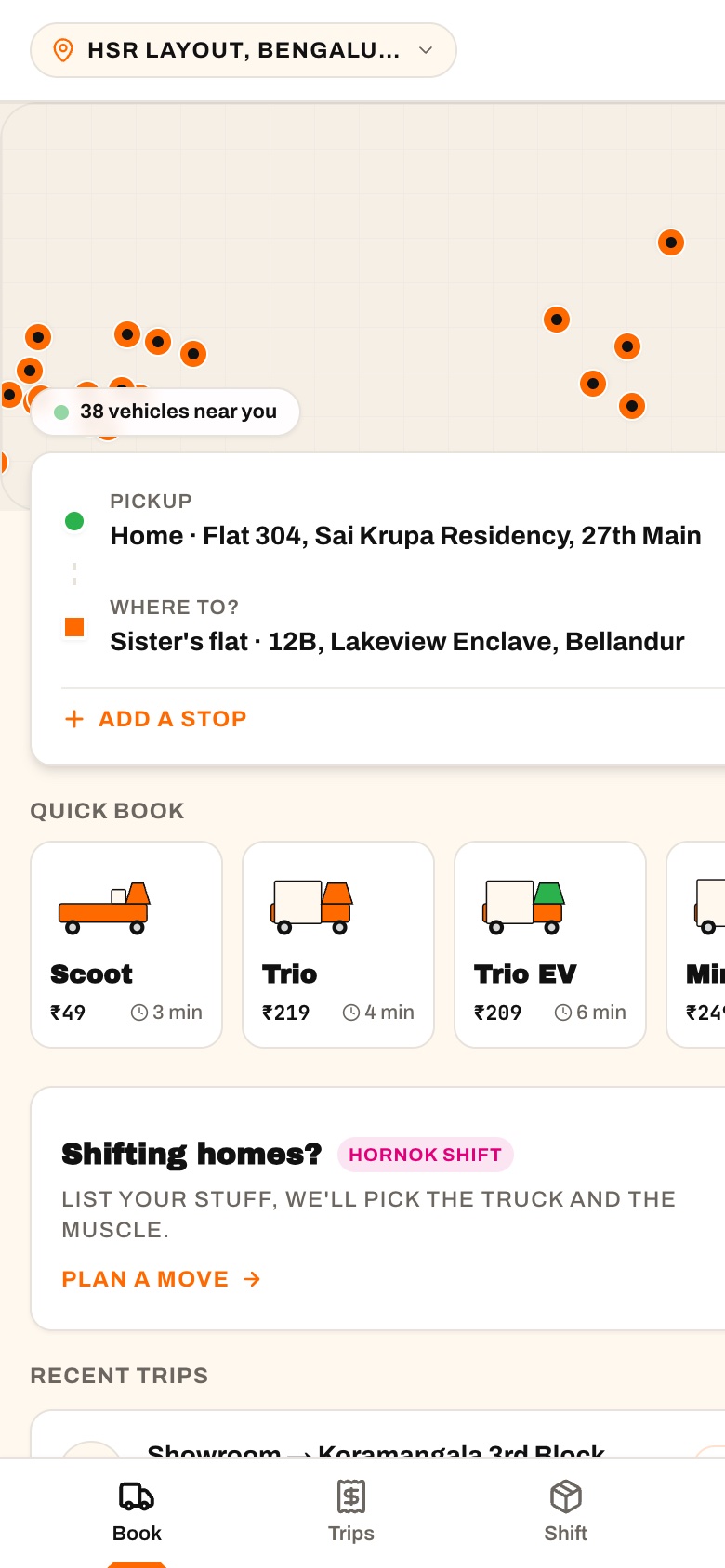
Our concept build HornOK is intracity logistics for mini-trucks, three-wheelers and bikes: a customer app to book by vehicle type, a driver app and a dispatch dashboard on maps with live tracking. That matches a same-day city service. It does not include hub scanning, AWB labels, pin-code serviceability checks, COD ledgers or weight-dispute records; those would be added for a parcel network.
The Saral builds apps and websites for Indian businesses on fixed quotes. If your workflow needs one of the custom cases above, see what a logistics app involves or send a brief. If a packaged tool covers you, use it.
More on starting a courier business
- Start hereThe full playbook →Models, licences, startup costs and the steps to your first customer.
- Go deeperWhat to buy →Hub kit, vehicles, rider gear and scan hardware for a parcel business, with what to defer.
- Go deeperWho to hire →Riders, sorters, a supervisor and a cash desk: pay, vetting and how to keep riders.
- Go deeperGetting customers →Sellers, aggregator tie-ups and pin-code density: where parcels come from and how to price them.
Questions people ask
What software does a small courier business need?
For a small courier, you need booking with AWB labels, hub scanning, rider proof of delivery, tracking updates, a COD ledger and GST invoicing. Under about 50 parcels a day, a spreadsheet, label book and WhatsApp can do it. Above that, a delivery management tool with scanner and rider-app support usually costs less than the errors it prevents.
How do I reconcile COD collections from riders?
Reconcile per AWB, not as a running balance. Record the amount expected, the amount the rider collected and the deposit date, then check the daily total against the cash and UPI received. Keep a rider-wise ageing report, and remit senders on your promised cycle. A non-zero daily difference should be investigated the same day.
Should I build my own courier tracking app?
Usually not at first. If you work under a network or aggregator, use their panel and a rider app, and use a packaged delivery management tool for your own bookings. A custom build makes sense with steady volume, a workflow packaged tools cannot cover, and someone to own the product. Get quotes and compare against a year of tool subscriptions.
How do I prevent weight discrepancy losses with software?
Record the scale weight and dimensions for each AWB at pickup, with a photo, and let the system compute volumetric weight and bill the higher figure. Store that evidence against the AWB so you can contest a network's revised weight. Educating sellers on packaging size lowers disputes more than any tool.
Can WhatsApp replace a courier tracking system?
WhatsApp is fine for rider route lists and proof photos at a small scale, but it cannot give you scan history, a COD ledger or searchable status per AWB. Use it as the messaging layer on top of a sheet or delivery management tool, and move to a proper system as parcels grow.