A small dairy farm earns most when it splits its milk: base volume to a collection centre or dairy for steady cash, and a growing share direct to households, shops and caterers at a higher price. Start with the buyers who are closest, ask them to taste, and let the farm itself be the proof.
Selling at the farm gate, as a farm, is different from running a delivery round. This page covers what a farm has that a distributor does not: animals people can see, a choice of milk types and by-products. Door-to-door route building and society access are covered in our milk delivery customer page.
Three buyer routes and what each pays you for
A collection centre or cooperative society usually pays by the fat and SNF content of the milk, measured at the counter at each pour. A direct customer pays for taste, trust and reliability. A shop or caterer pays for steady volume and a price slightly under retail. The same litre can earn very different amounts depending on where it goes.
| Route | Typical ₹ per litre to you (estimate) | What you give up |
|---|---|---|
| Cooperative or dairy collection centre | Roughly ₹35–55 for cow milk and more for high-fat buffalo milk, set by fat and SNF; rates vary by state and season | Price control; wait for payment cycle, often 10–15 days |
| Local sweet shops, tea stalls, hotels and caterers | Often a little above the collection rate, higher for rich buffalo milk | Chasing payments; needing fixed daily quantity |
| Direct to households | Roughly ₹60–100 or more in a city catchment, depending on milk type and local pricing | Chilling, delivery, billing and customer service |
| Ghee, paneer, curd and buttermilk | Margin depends on yield and local prices; ghee from cow milk typically needs a large volume of milk per kilogram | Processing time, hygiene standards, shelf life |
Pricing varies sharply by state and season. I did not verify current cooperative rates, so ask your nearest collection centre for today's fat-and-SNF rate card.
Using the collection centre well while you build direct sales
The centre is not a failure route. It keeps cash flowing while you learn. Ask for the rate card, learn what fat and SNF mean for your price, and note which animals give the richest milk. If your cow milk tests 4.2% fat and 8.5% SNF, you know what you are selling when a customer asks.
- Keep your own meter. A small milk analyser or lactometer helps you check the figures the centre quotes and the milk you deliver yourself.
- Track each animal's milk and fat. Higher-fat animals can feed your direct customers while the rest go to the centre.
- Hold back a share only once you have buyers. Move 10 to 20 litres a day to direct customers first, not half the herd.
- Watch the payment cycle. Keep one cycle of feed and labour cost in cash so a late cheque does not stop the shed.
The farm visit is your best marketing, so plan it
People pay more for milk when they can see where it comes from. A dairy farm is the one business where a customer can stand next to the product being made. Organise it so it is safe, clean and honest.
- Open one or two fixed slots a week, such as Sunday at the morning milking, so visits do not disrupt the shed all week.
- Walk visitors through the full route: feed, milking, cooling and bottling, so they see the hygiene steps. Do not hide the dung drain; show how it is managed.
- Set rules for visitors. Wash hands, no feeding unknown items to animals, children supervised, and no visits if anyone is unwell or if the herd is under treatment.
- Offer a warm sample. A cup of fresh boiled milk or lassi on the spot convinces more people than a brochure.
- Take contact details with consent, ideally a WhatsApp number, and follow up with a trial the next day.
Some visitors will also ask about A2 milk and health benefits. Keep your claims factual. Say which breed your cows are and let customers decide. Food regulators in India have taken a cautious line on health claims in dairy marketing, and the rules are subject to change, so avoid claims such as cures or immunity and confirm labelling rules with FSSAI or a consultant.
The first 10 customers: nearby homes, a trial week and a clear offer
Your first buyers are the people who already know someone at the farm or who live within 10 to 15 minutes. Ten households taking a litre a day is 10 litres, enough to test your chilling, bottling and billing without big risk.
- Start with family friends, staff and nearby villagers' relatives in town. Ask each for one introduction.
- Give a five-day trial of a half-litre bottle at a fixed rate, delivered at the same time, with a written note about the milk type and the milking time.
- Ask for two things after day five: would they keep it, and what would stop them? Fix the answer before the next customer.
- Quote a monthly price and a delivery window. A simple message with litres, rate and billing date does more than a poster.
- Collect payment in advance for the month. It reduces chasing and gives you working capital.
Selling more than milk: ghee, paneer, curd and the rest of the farm
A dairy has more to sell than liquid milk. Value-added products turn surplus winter milk into longer-lasting stock and lift your average earning per litre, but each one brings its own hygiene, shelf-life and licensing questions.
| Product | What it needs | Watch out for |
|---|---|---|
| Curd and buttermilk | Clean vessels, a starter culture, a cool set-up | Short shelf life; summer spoilage; consistent taste is what makes people reorder |
| Paneer | Boiling, curdling with a food-grade acid, pressing; roughly several litres of milk per kilo (yield depends on fat) | Fast-moving, low shelf life; weigh yield against selling the milk directly |
| Ghee (including bilona or desi methods) | Cream or curd, churning and heating; larger volumes of milk per kilo for cow milk than buffalo | Authenticity questions; label honestly; slow to produce but keeps well |
| Dung, vermicompost and biogas slurry | A drying area and bagging | Sell to nurseries, farmers and kitchen-garden buyers; modest income but steady |
| Surplus calves and heifers | Records and a buyer network | Sold to other farmers; calves of females are more saleable than bulls in many areas |
FSSAI registration or a licence is generally needed for processing and selling dairy products, and the category depends on volume. Confirm which applies on the FSSAI FoSCoS portal or with a consultant before you sell packed products.
Institutional and trade buyers
Sweet makers, tea stalls and small restaurants want a fixed quantity every morning at a steady fat level, and they need to trust you will not skip a day. Hostels, caterers, small cafés and sweet shops near festival peaks are especially useful, because they absorb surplus when household demand dips.
- Buffalo milk for tea shops and sweet makers. Higher fat gives better body; tell buyers the fat range.
- Written weekly rate and quantity. Agree on a price rule if fat falls, and who wins when it rises.
- Payment weekly or fortnightly, not monthly, unless the buyer is very reliable.
- Keep a daily delivery note signed by the buyer, so quantity disputes have a record.
- Festival season plan. Diwali, weddings and Navratri-linked demand can lift ghee, paneer and khoa demand; plan ahead rather than discovering the shortage in the week.
Pricing and keeping customers through summer, a sick herd and price changes
Price per litre follows your cost: feed, labour, vet, delivery. Track your cost per litre each month, and raise prices before you lose money, with notice of one to two weeks. Customers accept increases that are explained, such as a feed price rise, more than surprises.
- Be honest about summer. Yield dips in heat. Tell customers in April that supply may reduce and offer a priority list.
- Tell customers early if an animal is under treatment. Treated animal milk is withheld for the period the vet advises. A short message builds more trust than silence.
- Share a milk test result now and then, such as fat and SNF, and show the date.
- Let customers pause for travel with a day's notice. Our subscription app guide explains how apps handle pauses and top-ups.
- Publish your farm on Google. A Google Business Profile with real photos helps nearby searches; see our local SEO guide.
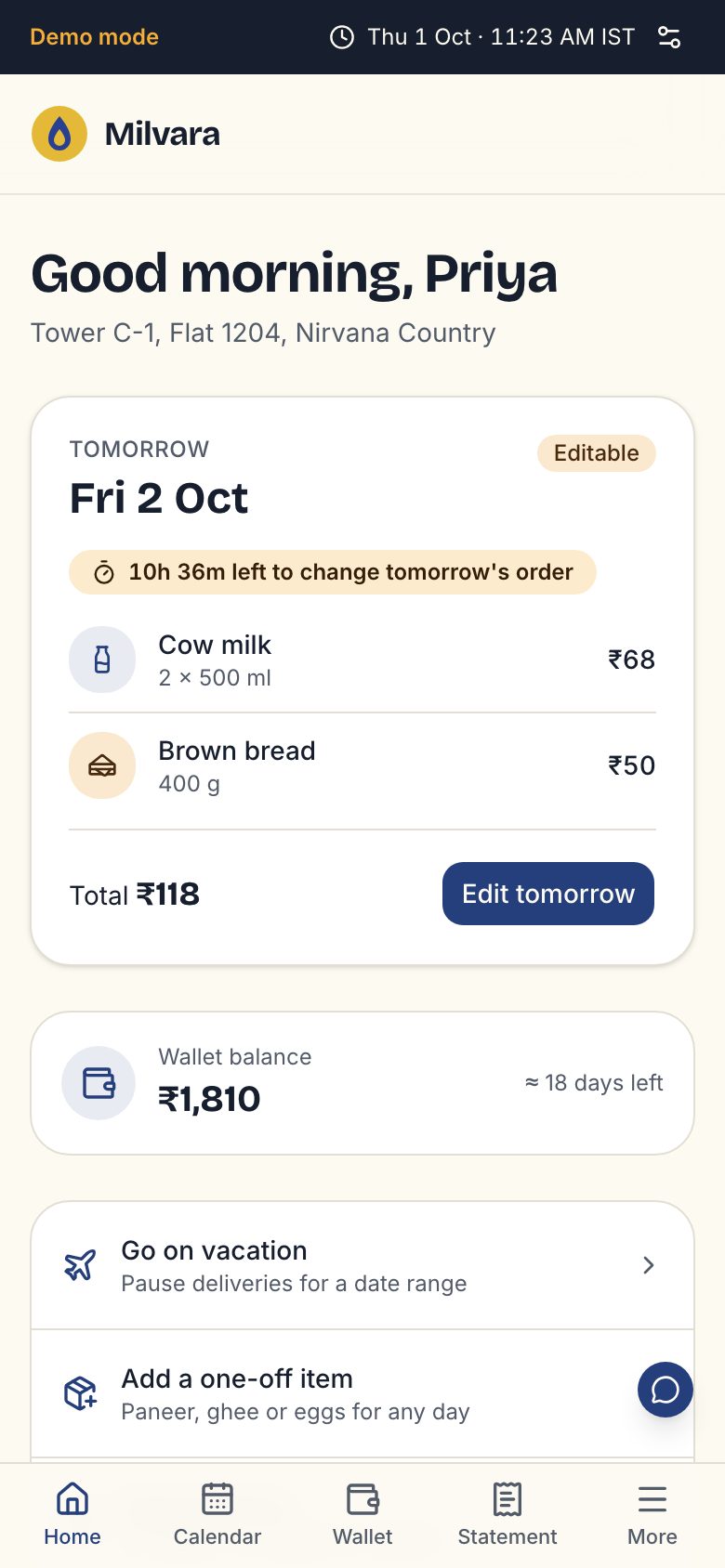
When your direct list reaches a few hundred homes, tracking pauses, deliveries and payments by memory breaks down. That is the point at which a subscription delivery app is worth looking at. Our concept build, Milvara, shows how a farm dairy might run that side.
More on starting a dairy farm
- Start hereThe full playbook →Models, licences, startup costs and the steps to your first customer.
- Go deeperWhat to buy →Animals, shed, milking and fodder kit costed, with what to skip until the herd earns.
- Go deeperFinding suppliers →Animals, fodder, feed, semen and vets: where to find them, how to vet them, and the red flags.
Questions people ask
Is it better to sell milk to a dairy or directly to customers?
Direct sales usually pay more per litre, but you take on chilling, delivery, collection and complaints. Selling to a collection centre is simpler and steadier. Most small farms start with the centre for base volume and move 10 to 20 litres a day to direct customers, scaling only as the deliveries become routine.
How many litres should I try to sell directly at first?
Start with 10 to 20 litres a day, which is roughly 10 to 20 households taking a litre each. That is enough to test your chilling, delivery and billing without risking the base income from the collection centre. Grow only when deliveries are on time and customers are staying after the first month.
Can I call my milk A2 or organic?
Be careful. Health and organic claims on food are regulated in India, and the rules are updated from time to time. Safer is to state facts you can show: the breed of your cows, how they are fed and when the milk was drawn. Check current FSSAI labelling and claim rules before printing anything.
Is ghee or paneer worth making from farm milk?
It can be, if you have surplus milk, a clean processing area and a buyer. Yield depends on fat and method, so test small batches and work out how much milk each kilo uses before pricing. You will need food licensing for packed products, so confirm that before selling.
How do I get customers to trust farm milk?
Let them see it. Offer weekly farm visits, share your milk test numbers, give a short trial and be open about how the animals are fed and treated. Trust grows with steady quality and honest communication, especially when supply drops in summer or an animal is under treatment.