A lab needs software that does one job well: tie a patient to a barcode, the barcode to an analyser result, and the result to a signed report. Start with a registration sheet and a billing app if you must, but move to an off-the-shelf laboratory information system (LIS) with analyser interfaces as soon as you run more than about 30–40 patients a day.
Health data is sensitive. Whatever you choose, ask about access control, audit trails, backups and where data is stored, and read our DPDP checklist. Prices below are estimates and we have not verified any vendor's current pricing.
What the software must do, in lab terms
Think of a sample's life: booked, collected, labelled, transported, received, processed on an analyser, reviewed, signed, delivered and billed. Each hand-off is a place where a spreadsheet loses track.
| Stage | What the software must record | What goes wrong without it |
|---|---|---|
| Booking and registration | Patient identity, age, sex, doctor, tests, preparation, address and slot | Duplicate patients, wrong age for reference ranges |
| Collection and labelling | Barcode printed at registration, collector, time collected, tube types | Mislabelled or untraceable tubes |
| Transport and receipt | Batch of samples, temperature note, time received, rejection reason | Spoiled samples reported anyway |
| Analysis and results | Instrument interface, auto-flagging against reference ranges, manual entry for others | Transcription errors from copying numbers by hand |
| Validation and signing | Review queue, pathologist sign-off, amended report trail | Unsigned or edited reports with no history |
| Delivery and billing | PDF with correct letterhead, WhatsApp or email dispatch, invoice, UPI, credit accounts | Patients chasing reports; reconciliation headaches |
Day one with almost no budget: sheets and a billing app
For the first few weeks, or for a collection centre that sends samples to a main lab, a disciplined spreadsheet can work. It will not scale, but it teaches you what you need.
- A registration sheet with a running barcode number, patient name, age, sex, doctor, tests and collection time. Lock the columns that must not be edited.
- A thermal barcode label printer and pre-numbered labels so that every tube has an ID, even before software exists.
- A GST billing app for invoices and UPI collections; see our GST billing software guide. Check with a CA on how diagnostic services are treated for GST.
- Report templates in a word processor with the pathologist's name and registration, kept in a controlled folder.
- A WhatsApp Business number with quick replies and a shared inbox for report delivery.
Stop using sheets for results once you report more than a few dozen patients a day. Manual copying from analyser to sheet to report is where reporting errors come from.
Off-the-shelf LIS: the sensible default for most labs
Several Indian and international vendors sell LIS products to small and mid-sized labs, usually as a cloud subscription or a locally installed licence. Evaluate them on what actually happens in your lab.
| Feature to test | Why it matters | How to check in a demo |
|---|---|---|
| Analyser interface (ASTM or HL7, bidirectional) | Results flow in without typing; the analyser can query the test orders by barcode | Ask for a live demo with your analyser model, or a list of labs using it |
| Reference ranges by age and sex | Correct flags for children, women and older adults | Register a test child and an older adult and see flags change |
| Delta checks and critical-value alerts | Catches sudden unexplained changes and dangerous values before reports go out | Enter a very high potassium and see what the system does |
| Quality control module | Levey-Jennings charts, Westgard rules, daily QC records | Ask to see a month of QC data and how a violation is flagged |
| Multi-centre support | Lets collection centres register and the main lab process | Create a booking at a branch and track it at the hub |
| Report format and dispatch | Letterhead, pathologist signature, QR code, WhatsApp, email, portal | Send a sample report to your own phone |
| Audit trail and access control | Who changed what and when; role-based permissions | Edit a signed report and inspect the history |
| Data export and backup | You can leave the vendor with your records | Ask for a full export in a standard format |
Add a mobile or web booking tool for home collection, a rider app that shows each visit and a way to capture the collection time and tube details at the doorstep. Many LIS products include these as add-ons; if not, you can run a standard booking form feeding the LIS.
Tools that sit around the LIS
- Appointment and slot booking for collection centres and home visits, with a calendar by locality; see our doctor appointment solutions.
- Route and visit tracking for phlebotomists, with timestamps and status, similar to a logistics app.
- Billing and accounts: credit customers such as corporates and referring centres need statements; a billing app or accounting software handles that.
- Inventory: reagent lots, expiry, tube stock and reorder points; a sheet works until you have two or more analysers.
- Patient and doctor portal: secure report access and history, so patients do not depend on WhatsApp alone.
- CRM and messaging: consented reminders and complaint tracking; see business inbox and CRM.
Make sure every tool exports data you can import into the next one, and keep a single patient ID across them. A phone number is not a patient ID, because families share numbers.
When custom software is worth it
Custom pays when your workflow is the product: a multi-city network, a branded app with family profiles and reminders, tight B2B integrations with hospitals or insurers, or a rider app tied to your own cold-chain rules. It rarely pays for a single-site lab; a good LIS plus a booking form covers that.
| Situation | Stay off the shelf if | Consider custom if |
|---|---|---|
| Single lab, 1–2 collection points | A vendor's LIS handles your analysers and reports | Never at this stage |
| Home-collection brand with 5–20 phlebotomists | Vendor booking and rider modules are adequate | You need slot logic, family profiles and live tracking beyond what they offer |
| Multi-centre hub-and-spoke network | A multi-branch LIS covers your workflow | You need unified patient apps, analytics and custom integrations across centres |
| Corporate and insurer business | Standard exports and invoices are enough | You need API integrations, bulk onboarding and HR dashboards |
A custom build would typically cover the customer app, booking and slot logic, collection tracking, partner dashboards and report delivery, while the analyser interface and validation stay with the LIS. For the cost side, see our app development cost guide.
Where our concept build and The Saral fit
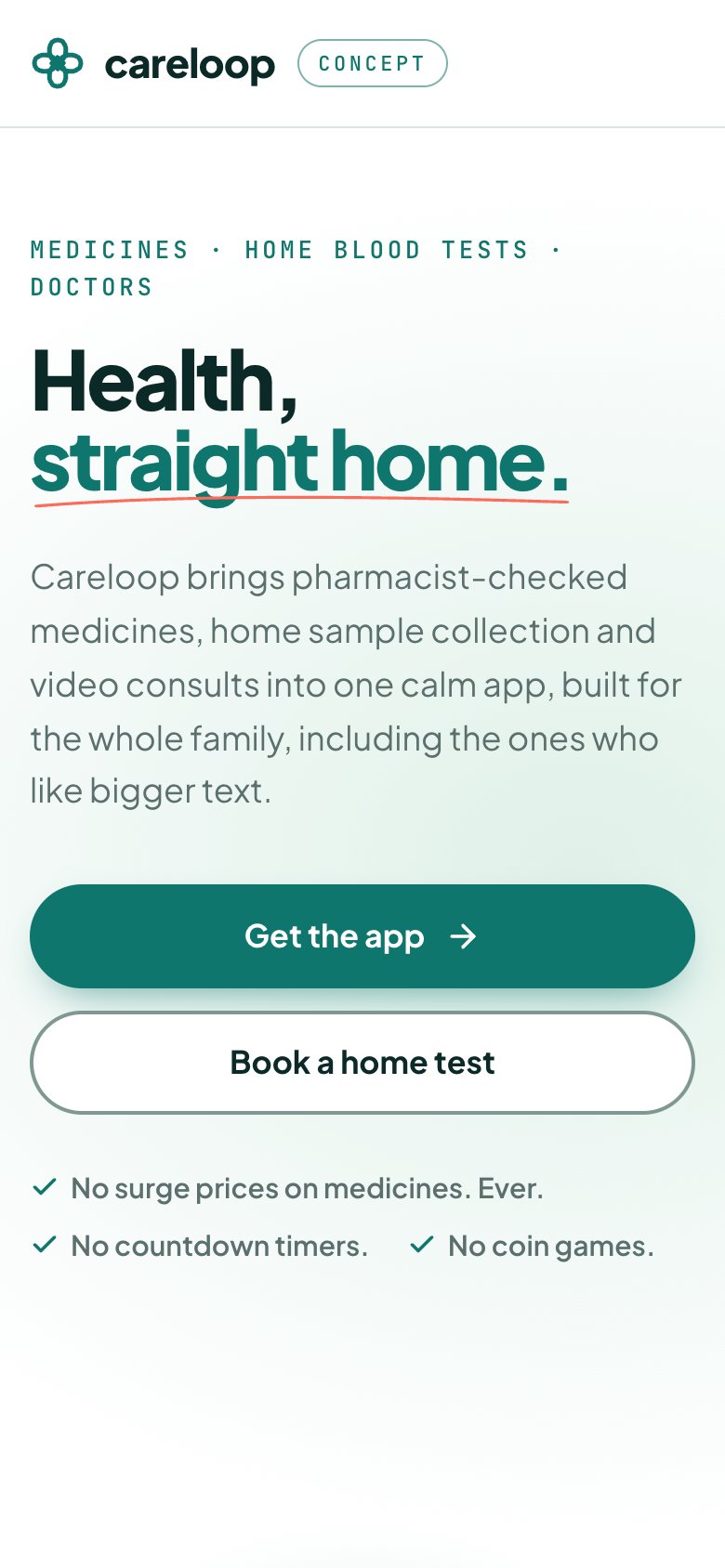
Our concept build Careloop is a health-at-home app that combines medicines, lab tests at home and doctor consults. It shows test booking, slot picking, collection tracking and report delivery, which map onto the customer-facing side of a lab. It is a concept, not a laboratory information system: it does not interface with analysers, run quality control or replace pathologist validation, and it is not a certified medical device.
The Saral builds custom apps and sites for Indian businesses. If you want a booking and tracking layer around your LIS, send us a brief and we can scope it. We would suggest trying an off-the-shelf product first unless your model clearly needs more.
More on starting a diagnostic lab
- Start hereThe full playbook →Models, licences, startup costs and the steps to your first customer.
- Go deeperWhat to buy →Analysers, cold chain, collection kit and consumables for a pathology lab, costed, with what to delay.
- Go deeperWho to hire →Pathologist, technologists, phlebotomists and riders in hiring order, with pay estimates and vetting tasks.
- Go deeperGetting customers →Doctors, societies, employers, aggregators and WhatsApp: how a new lab finds its first 10 customers.
- Go deeperFinding suppliers →Reagent distributors, consumables, reference labs, waste collectors and couriers, with vetting and terms.
Questions people ask
Do I need a LIS to start a pathology lab?
Not on day one if you are tiny, but you should adopt one as soon as you handle more than a few dozen patients a day. A LIS links barcode, analyser result and signed report, reducing transcription errors and giving an audit trail. Spreadsheets cannot reliably track amended reports, quality control or sample status at that scale.
What is an analyser interface and why does it matter?
It is a connection that sends results from the analyser to the LIS automatically, usually using standards like ASTM or HL7, and in the better setups lets the analyser fetch the test orders by barcode. It matters because typing numbers by hand is a major source of error. Always check the vendor supports your exact analyser model.
How much does lab software cost in India?
As a rough estimate, small-lab software costs ₹1,000–10,000 a month as a subscription, or ₹30,000–2 lakh as a one-time licence, with multi-centre and integrated systems costing more. We have not verified any vendor's pricing, so get written quotes and compare the three-year total including interfaces, support and any per-report fees.
Is patient data on a cloud LIS safe?
It can be, but you must check. Ask where data is stored, how it is encrypted, who can see which reports, whether there is an audit trail and how backups and exports work. Under India's data protection law you remain responsible for patients' health data, so read the vendor contract and our DPDP checklist before you sign.
When should I build custom software for my lab?
When your model depends on a workflow that off-the-shelf tools cannot handle, such as a multi-city home-collection network, family profiles, corporate integrations or a branded app. Single-site labs rarely need it. Even then, keep analyser interfaces and result validation in a proven LIS and build the customer and logistics layer around it.