Run the first month on WhatsApp Business, a shared sheet and a free routing map. That is enough for up to roughly 30 orders a day. Buy a hosted ordering and dispatch product when you pass that, and commission a custom three-sided app only when your rules, such as zone pricing or multi-stop batching, no longer fit what products allow.
Prices below are ballpark estimates, and product pricing changes often; check each vendor's current plan. We have not verified any vendor's price, so none is quoted by name.
What the software has to do, by job
A food delivery order touches four people and a payment, and each needs a different screen. Listing the jobs first tells you which tool category to shop for.
| Job | Who uses it | What goes wrong without it |
|---|---|---|
| Menu and ordering | Eater | Phone orders with wrong items and addresses; no record of what was promised |
| Accept order and set prep time | Restaurant | Kitchen misses orders; riders wait outside |
| Assign rider and track location | Dispatcher and rider | Wrong rider assigned; no one knows who is stuck |
| Navigate and capture proof of delivery | Rider | Late drops, wrong floors, disputes about delivery |
| Payments, refunds and settlements | You and your partners | Weekly restaurant payouts become an argument |
| Cash on delivery reconciliation | Rider coordinator | Cash leaks between a rider's pocket and your bank |
| Reports: late orders, refunds by restaurant, orders per rider-hour | You | You cannot tell which part of the operation is losing money |
Weeks 1 to 8: WhatsApp, a sheet and a map
Before you pay for software, learn how orders really flow. You can do that with tools you already have, for a few thousand rupees a month.
- WhatsApp Business with a catalogue, quick replies for the order template and labels such as New, Preparing, Out and Delivered.
- A shared Google Sheet with one row per order: time, customer, address, partner, items, amount, payment mode, rider, picked-up time, delivered time and notes. Add a second tab for rider cash.
- Google Maps links and live location sharing for riders; a group per active rider for dispatching.
- UPI QR codes or payment links from your bank or a payment aggregator. Reconcile each evening against the sheet.
- A simple weekly restaurant statement built from the sheet: orders, gross sales, commission, deductions and payout.
What breaks first: duplicate orders in WhatsApp, a dispatcher who cannot see all riders at once, and the weekly settlement taking half a day. Those three are the signals to move on. If your sheet is already hard to read, you are near the limit.
Months 2 to 6: ordering page, dispatch tool and POS links
Most small operators move to off-the-shelf tools by category. Shop for the category, test with your own partner list and avoid products that charge per order at a rate close to what you earn.
| Category | What it replaces | Check before buying | Ballpark cost shape (estimate) |
|---|---|---|---|
| Hosted online ordering page or white-label app | WhatsApp menu and manual order entry | Multi-restaurant support, not just single-restaurant; order-accept screen; custom commission rules | Monthly subscription, sometimes plus a per-order fee or one-time setup |
| Delivery or last-mile dispatch software | Calls and WhatsApp to riders | Rider app, live map, auto-assign, proof of delivery, batch orders, COD tracking | Per rider or per order per month |
| Restaurant POS with online order integration | Printed or typed KOTs | Whether it accepts your orders directly; kitchen printing; menu sync | Per outlet per month, set by the POS vendor |
| Payment aggregator or payment gateway | UPI QR and manual reconciliation | Settlement time, refund API, split payments to restaurants; regulated provider; fees per transaction | A percentage plus fixed fee per transaction; read the vendor's current rates |
| Customer messaging and CRM | Manual broadcasts | Opt-in handling, templates approved by WhatsApp, repeat-order segments | Monthly; WhatsApp conversation charges apply |
| Accounting or GST billing | Your sheet | GST-ready invoices; commission invoices to restaurants; TDS tracking; handles e-commerce operator rules your CA identifies | Monthly per user; see our GST billing software guide |
- Run a trial with five partner restaurants and 5 to 8 riders for two weeks before moving everyone.
- Test the ugly cases: cancellation after pickup, address not found, customer unreachable, partial refund, restaurant closing mid-order.
- Ask where your data lives and how to export it, with customers, orders and rider history in a file format you can take away.
- Check the settlement report produces the exact statement you send to restaurants each week.
Whichever tool you pick, collect customer data lawfully and keep it secure. Our DPDP Act checklist lists what to ask a vendor about storage, consent and deletion.
When off-the-shelf stops fitting, and when custom pays
Custom software is worth the money when your operating rules are what customers and partners pay you for, and no hosted product can encode them. It is not worth it just to have your own logo on an app.
| Signal | What it usually means | What custom would cover |
|---|---|---|
| You pay more in per-order fees than a monthly build budget would cost over 12 months | Volume has outgrown a usage-based tool | Own ordering and dispatch with no per-order tax |
| Your pricing logic is unusual: zone-based fees, surge in rain, tiered commissions, free-delivery thresholds by area | Tools allow one or two simple rules | A pricing engine and an admin to change rules without a developer |
| You run campus or society delivery with fixed delivery points and slots | Generic address-based apps are clumsy for it | Slot booking, pickup points and bulk drops |
| Riders carry multiple orders and you want smarter batching | Auto-assign picks nearest rider but not best batch | Batching rules, rider load and prep-time-aware dispatch |
| You want an Open Bill that shows every rupee, or a restaurant-facing settlement view | Transparency is your selling point | Itemised bills, commission statements and payout history for each side |
| You need integration with local restaurant billing systems | Off-the-shelf connectors do not exist | Custom order push into a specific POS or printer |
A custom platform has four surfaces to build: customer app, restaurant screen, rider app and ops dashboard, plus payments and notifications underneath. A first version is typically a matter of weeks, but prices vary widely; our guide to app development costs in India and the hyperlocal delivery app guide explain the drivers. Pay attention to UPI payment handling early, since refunds and settlements are the hardest part to fix later.
The concept build and The Saral
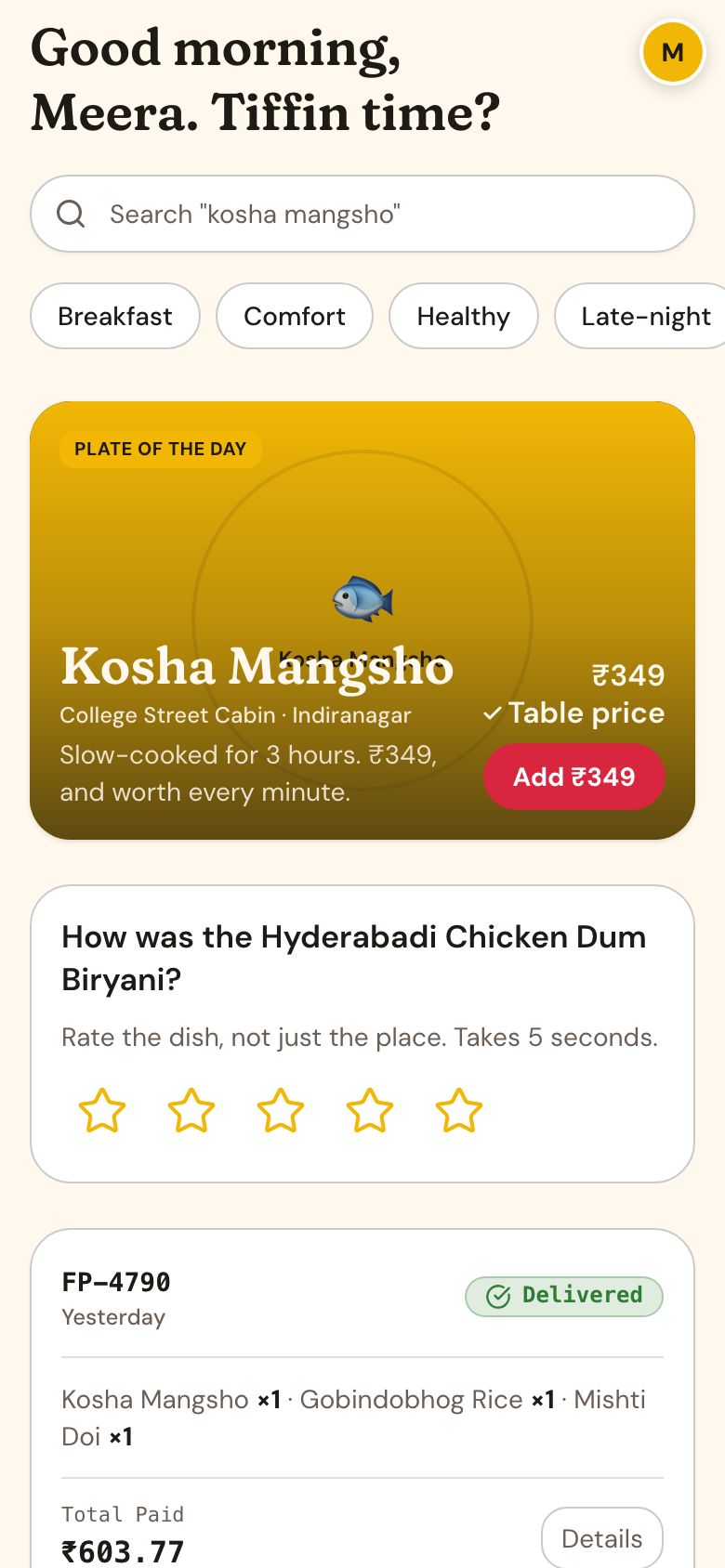
We built FullPlate as a concept to show how the four surfaces share one order: an eater app with an Open Bill, a kitchen tablet that moves an order from New to Picked up and a rider app with zones, drops and earnings. It shows how the pieces could fit together. It is a concept, not a product with live restaurants, and it does not include your restaurants, payment gateway setup, licences, rider operations or support.
The Saral builds custom apps like this for operators who have outgrown off-the-shelf tools. If you are at that stage, see what a food delivery app involves, or send us a brief with your rules and volumes. If you are not there yet, a sheet and WhatsApp is the right answer, and you should not build before you have orders.
More on starting a food delivery business
- Start hereThe full playbook →Models, licences, startup costs and the steps to your first customer.
- Go deeperWhat to buy →Bags, bikes, phones, insurance and a dispatch desk, costed, and what to hold off buying.
- Go deeperWho to hire →Riders, dispatcher, support and restaurant sales: order, pay, vetting and contract types.
- Go deeperGetting customers →Win restaurants first, then eaters: first 10 partners, launch offers, WhatsApp and retention.
Questions people ask
What software do I need to start a food delivery business?
Start with WhatsApp Business, a shared Google Sheet and map links for riders. That handles roughly the first 30 orders a day. Then add a multi-restaurant ordering page, a dispatch tool with a rider app and a payment gateway that supports refunds and settlements. Move to a custom platform only when your rules outgrow those tools.
Can I use a single-restaurant ordering plugin for a multi-restaurant platform?
Usually not well. Single-restaurant tools lack separate partner logins, commission rules, per-restaurant payouts and a shared rider pool. Look for products built for marketplaces or multi-vendor ordering, and test with five real partners and two weeks of orders before committing to one.
When is a custom food delivery app worth it?
When your pricing, batching or settlement rules are your edge and no product can encode them, or when per-order fees to a hosted tool exceed what a build would cost over a year. Have a few months of real orders and a one-page description of your rules first. Do not build only to have a branded app.
How do I handle restaurant payouts in software?
Record every order with gross value, commission, taxes and deductions, then generate a weekly statement per restaurant and pay it on a fixed day. Early on a sheet works; later a payment aggregator with split settlement or a dispatch product with payout reports helps. Ask your CA how commission invoices and any GST on the platform's role should be handled.
Should I join ONDC or build my own app?
They answer different needs. ONDC can bring buyers through other apps without you building a consumer app, while your own app builds a customer list you own and lets you control the experience. Many operators do a bit of both. We have not verified current ONDC terms, so read the network's published rules before deciding.