Start with a GST billing app with barcode support, a WhatsApp Business catalogue and one shared sheet for personalised and corporate orders. That runs a small gift shop well. Add a proper stock and order system when you have hamper kits to track, a festive rush that causes errors, or repeat corporate accounts that need quotes and reorders.
A gift shop's software needs are odd: many low-value items, a few custom jobs with proofs, bundles made from several stock items, and a festive peak that stresses everything. Pick tools by those four problems rather than by feature lists.
The day-one counter: billing, barcodes and UPI
For a shop with a few hundred stock lines, a GST billing app that supports barcode scanning and item variants (size, colour, flavour) is the first tool. It prints bills, tracks stock and produces the GST reports your CA needs.
| Need | Cheapest thing that works | What it covers | What it misses |
|---|---|---|---|
| Billing and GST invoices | A mobile or desktop GST billing app with a free or low-cost plan | Invoices, item list, GST rates, daily sales report | Custom jobs with proofs, hamper kits, multi-step quotes |
| Barcode labels | A label printer plus the billing app's label function; for unlabelled items, print your own SKU stickers | Faster billing and stock counts | Items with no barcode need a labelling day when stock arrives |
| Payments | A UPI QR stand and a soundbox from your bank or a payment app | Instant confirmation by voice | Does not reconcile with bills; match at day end |
| Customer notes | A notes field or a sheet with name, phone, occasion and date | Reminders and repeat gifting | No automatic reminders |
Set item categories by occasion and by supplier from the start (for example, Diwali, Evergreen, Blanks, Packaging). It lets you see what sold and what is stuck in a single report, and it makes festive reordering a ten-minute task.
Personalised orders: proofs, status and turnaround
A custom order is a small project: a customer message, a design file, an approval, a production step and a hand-over. Losing any of these is how misspelt mugs are made.
- A shared sheet with one row per order: order ID, customer, phone, item, text or photo link, proof sent, proof approved, advance paid, due date, status (new, proofed, in production, ready, delivered).
- A fixed naming rule for artwork files, such as OrderID_Item_Version, in a shared drive folder. This is the single habit that saves most reprints.
- A proof template in a design tool with the mockup and the written text visible, sent with a simple instruction: reply "approved" to confirm.
- A job card printed per order and placed with the blank, showing the text, size, due date and any special instruction.
- A daily production list sorted by due time, so the person running the press never guesses what is next.
When this sheet becomes a daily scramble, usually past 15 to 20 custom orders a day or when two people edit it at once, it is time for an order tool with statuses, proof upload, customer notifications and a due-date board.
Hampers and kits: bundles built from stock
A hamper is a kit made from several stock items. If the billing app cannot explain a kit, you will sell hampers and still show the contents as unsold stock.
| Approach | How it works | When it breaks |
|---|---|---|
| Plain item list | Create a hamper as its own item and deduct manually | Contents drift from stock; you cannot see that three hampers used up all the chocolate boxes |
| Bundle or kit feature in the billing app | Define a hamper as a recipe; selling one deducts each component | Not every low-cost app has it; verify before you pay |
| Hamper spreadsheet | A sheet that lists each hamper type, its components, cost and selling price, with a column to count how many to build | Fine for ten hamper types; manual stock updates become error prone |
Work out the cost of a hamper every time: components, box, filler, ribbon, card, labour minutes and any branded tag. The common error is to price the hamper from the content alone and ignore the box and labour.
Corporate quotes, orders and payment follow-up
Corporate accounts need paperwork a counter bill does not give you.
- Quote template with itemised contents, quantity slabs, GST shown separately, validity date, delivery date and payment terms.
- Order tracker for each client: items, branding files, delivery addresses (often several), proof-of-delivery photos and invoice status.
- Reminder list for pending payments with invoice date, due date and the person to chase; this is where a small notebook often loses money.
- A simple client list with last year's order so you can open the next festive conversation in August, not in November.
- E-invoice and e-way bill readiness if your turnover or the goods' value crosses the rules; confirm the current thresholds with a CA, as I have not verified them.
A light CRM, even a spreadsheet with a status column, is enough at first. The business inbox CRM solution shows what moving enquiries from WhatsApp and email into one place looks like.
When an online store is worth building
Selling gifts online can start with a catalogue, then a hosted store, then something more custom. The right moment depends on how much of your volume is out-of-town senders and corporate buyers.
| Level | Typical tools | Use it when | Leaves a gap |
|---|---|---|---|
| WhatsApp Business catalogue and Instagram | Free app features | Fewer than 10 online orders a day | Manual payment, manual stock, no personalisation form |
| Hosted store builder with a payments plugin | A hosted ecommerce platform and a payment gateway | Regular online orders and a product range under a few hundred items | Personalisation fields, gift notes and kits may need paid add-ons |
| Custom storefront with personalisation, hampers and bulk quotes | Built to your catalogue and flow | Online orders are a large share and your process is stable | Needs maintenance, a content person and a budget for hosting and support |
Custom starts to pay when your site must do things a template store does badly: a personalisation preview with name and photo, a hamper builder that checks stock, gift notes and scheduled delivery, a bulk quote form for companies, and wishlists or reminders for repeat occasions. If you are selling five SKUs with no personalisation, it does not.
Shipping, courier and returns
- Courier aggregators let you compare rates and print labels; check rates for fragile and prepaid parcels and the process for damage claims.
- Packaging checks: drop-test a packed mug from waist height before you launch a mug line. Photograph every parcel before dispatch.
- Cut-off times per city are best shown at checkout, particularly for Rakhi and Valentine's Day.
- Returns policy: personalised items are usually non-returnable unless faulty; state this clearly at checkout.
- Cash on delivery raises return and refusal rates for custom items; prepaid with a small advance is safer.
Our WhatsApp for business apps guide covers automatic order updates that cut down "where is my gift" messages.
Concept build and The Saral
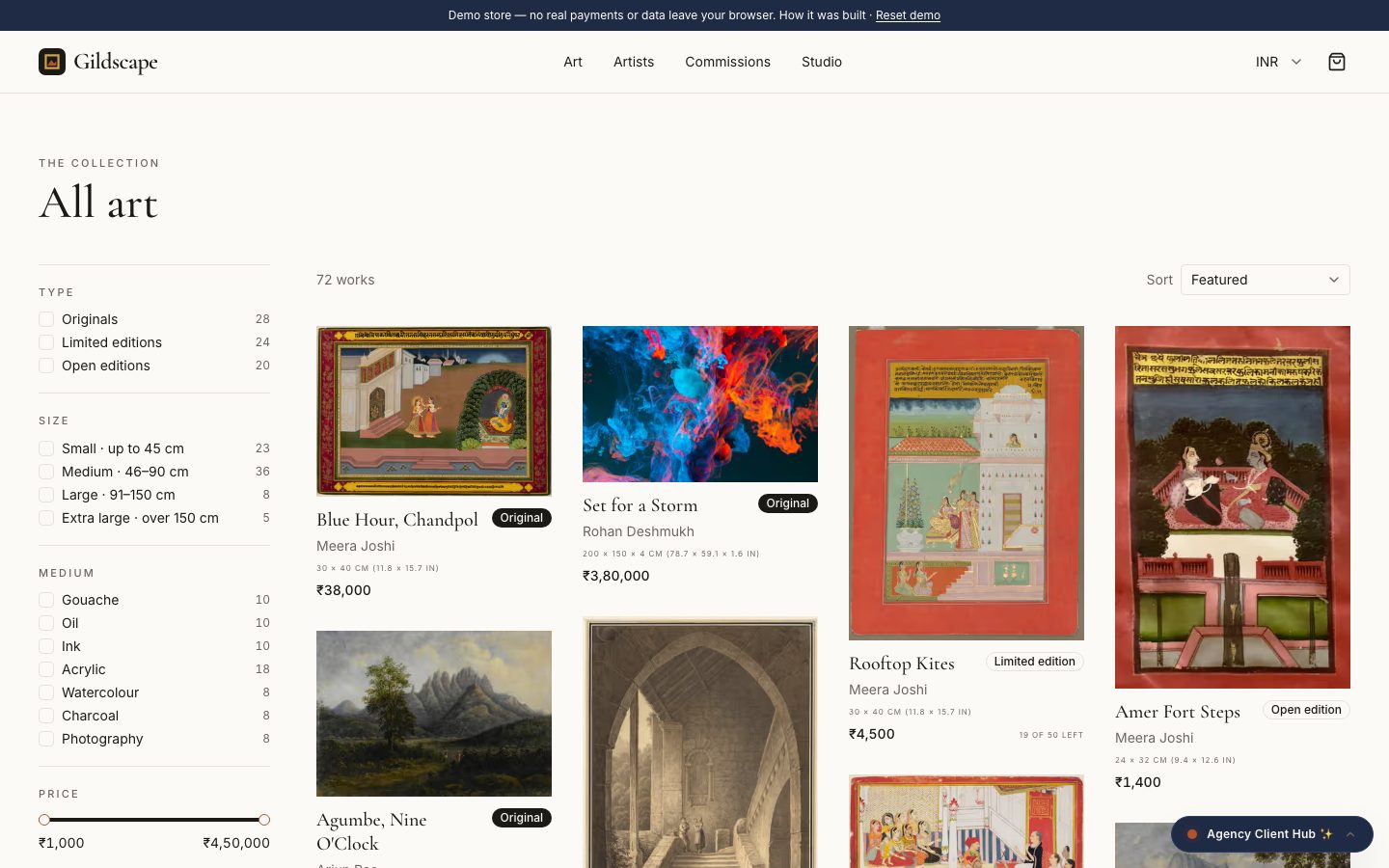
Our concept build Gildscape is an artist storefront and art marketplace, not a gift shop. It shows a curated catalogue and a commission flow, from brief to proof to approval, which is the same shape as a personalised gift order, and gift-note and wishlist ideas carry over. It does not cover billing, GST invoices, hamper kits, stock counting or courier integration.
The Saral builds ecommerce sites and order tools at a fixed price, if you reach the point where templates no longer fit. See the ecommerce website solution or send a brief. If you have not reached those signals, a billing app, the order sheet above and a WhatsApp catalogue will take you a long way.
More on starting a gift shop
- Start hereThe full playbook →Models, licences, startup costs and the steps to your first customer.
- Go deeperWhat to buy →Personalisation machines, display, wrapping bench and festive stock, costed, plus what to skip.
- Go deeperGetting customers →Festive calendar, corporate hamper selling, WhatsApp orders, launch pricing and repeat buyers.
- Go deeperFinding suppliers →Wholesale hubs, manufacturer clusters, blanks and hamper suppliers, vetting, terms and backups.
Questions people ask
What software does a small gift shop need first?
A GST billing app with barcode support, a UPI QR with soundbox, a WhatsApp Business catalogue and one shared sheet for personalised and corporate orders. That setup handles billing, stock and basic order tracking for most shops. Add a proper order or ecommerce system only when volume, hampers or corporate accounts make the sheet hard to manage.
How do I track hampers made from several stock items?
Use a billing or inventory app with a bundle or kit feature, where selling a hamper deducts each component. If your app lacks it, keep a hamper sheet with each recipe, cost and number built, and update stock by hand. Test any app with one real hamper recipe in a free trial before paying.
How should I manage personalised gift orders?
Use one row per order in a shared sheet with text or photo link, proof sent, proof approved, advance paid, due date and status. Name artwork files by order ID and version, send a mockup for written approval, and print a job card for the production table. Move to a proper order tool once daily custom volume makes the sheet error prone.
When is a custom gifting website worth building?
When online orders are a big share of sales and your process is stable, and you need features templates do badly: a personalisation preview, a hamper builder that checks stock, scheduled gift delivery, bulk quote forms and reminders. If you sell a few products without personalisation, a hosted store is cheaper and quicker. Check current vendor pricing before deciding.
Do I need e-invoicing for corporate gifting?
It depends on your turnover and the rules in force. Corporate clients will usually expect a proper GST invoice, and larger businesses may fall under e-invoicing or e-way bill requirements for goods movement. I haven't verified the current thresholds, so confirm with your CA and make sure your billing app can generate compliant invoices.