Start with a spreadsheet that tracks each artisan, each piece and each advance, plus a hosted online store with UPI and a GST billing tool. Software becomes a real project only when you have many makers, commission requests and payouts to split, which is a marketplace problem rather than a store problem.
Handicraft stock is not like a catalogue of identical SKUs. A block-printed stole is unique in its print registration, a pot has one glaze, and a painting is a single original. Software that assumes ten thousand identical units will fight you.
What is unusual about handmade data
Before choosing tools, list the records you actually need to keep. Handicraft businesses have four that ordinary shops don't.
| Record | Why it exists | Example fields |
|---|---|---|
| Artisan register | You owe them money, credit and a story | Name, craft, cluster, phone, UPI or bank, ID if any, GI authorised-user status if relevant, consent to use name and photos |
| Order to artisan (job order) | Advances and specs are tracked per batch | Design, spec sheet link, quantity, rate per piece, advances paid, due date, received and rejected counts |
| Piece or lot record | One-of-a-kind and small-batch stock | Piece ID, photo, maker, material, dimensions, cost, status (in stock, held, sold, damaged) |
| Customer order and custom request | Variations and made-to-order items | Product, size and colour requested, deposit, promised date, artisan assigned |
Whatever tool you use, make sure it can mark an item 'sold' the moment a buyer pays, because the classic failure is selling the same one-of-a-kind piece to two people on Instagram and the store at once.
Day one: a spreadsheet, a hosted store and UPI
For the first 3–6 months, a shared spreadsheet and a hosted store are enough, and cost very little.
| Job | Cheapest thing that works | Rough cost (estimate) | Where it breaks |
|---|---|---|---|
| Artisan register and job orders | Google Sheets or Excel with one tab for artisans and one for job orders | ₹0 | When two people edit and lose track of advances |
| Piece and stock tracking | Sheet with one row per piece, a photo link and a status column | ₹0 | Above a few hundred active pieces |
| Online store with cart and UPI | A hosted store builder with a payments gateway | Plans from a few hundred to a few thousand ₹ a month, plus gateway fees; check each current price | One-of-a-kind items, commissions and artist profiles are awkward to model |
| Quick orders from Instagram | WhatsApp Business catalogue, UPI QR and a payment-link tool | Free to low | Manual tracking of who paid for what |
| GST invoices | Any invoicing tool that produces GST-compliant bills; read the GST billing software guide | From free to a few thousand ₹ a year; check current plans | When you need purchase from unregistered artisans handled correctly; ask your CA |
| Shipping labels and tracking | A courier aggregator's dashboard | Pay per shipment | Fragile-handling flags and insurance are separate steps |
The one rule on the store: mark each one-of-a-kind item as quantity one, take it off the listing when sold, and keep a 'made to order, ships in X days' option for repeatable designs. Read ecommerce website guide for India before you commit to a platform, and adding UPI payments for gateway choices.
When the sheet starts to hurt
These signs mean it is time for proper stock and order tools:
- You keep paying an artisan against an advance you forgot or double-counted.
- Two buyers have bought the same piece in a week.
- You spend an hour a day copying orders from Instagram DMs into the sheet.
- A corporate order of 200 pieces has three artisans, three deadlines and staggered advances.
- Your accountant asks for purchases from each artisan and you cannot produce them quickly.
| Need | Off-the-shelf category | What to look for |
|---|---|---|
| Stock with photos and variants | Inventory or ecommerce back-office tool | Per-piece records, barcodes or QR labels, low-stock alerts, multi-location |
| Purchase orders and advances to makers | Light ERP or billing-with-purchase tool | Supplier ledger, advance against PO, part receipts, GST purchase entries |
| Order management across channels | Multichannel order tool | Syncs store, marketplace and manual orders; blocks double-selling |
| Customer follow-up | A simple CRM or WhatsApp tool | Tags such as 'corporate', 'collector', 'NRI'; broadcast lists with opt-in |
| Export paperwork | A shipping or export documentation tool, or a customs broker's service | Invoice, packing list and shipping-bill data in one place |
Look for something your artisans can use too. A voice note and a photo on WhatsApp is how most of them will report progress, so a tool that demands a laptop will not be used. The business-inbox category in our business inbox CRM solution page is one way to keep those threads attached to orders.
Artisan payouts, commissions and tax records
If you only buy from artisans and sell under your own brand, payments to them are purchases. If you let artisans list and sell through you, you are running a marketplace, and payments, commissions, tax collection and payout timing become part of the product. This is a major jump in complexity.
| Model | Money flow | What the software must do |
|---|---|---|
| You buy, then sell | You pay the artisan, you collect from the buyer | Purchase ledger, advances, GST documentation on your side |
| Consignment | Artisan owns stock until sold, then you pay a share | Per-artisan stock status, sale reports, settlement statement |
| Marketplace with commission | Buyer pays you or a gateway; artisan is paid after deduction | Artisan accounts, commission rules, payout schedule, refunds, tax handling; confirm with a CA and your payment provider, and read the marketplace app guide |
For records: keep one folder per artisan, with photographs of work in progress, payment proof and any agreed specification. At year-end that folder is your purchase evidence, your provenance and your story.
When custom software pays off
Custom software is worth considering when your process is the business and off-the-shelf tools force workarounds that cost more than a build.
| Signal | Why custom may help | What it would cover |
|---|---|---|
| Dozens of artisans and rising | Spreadsheets cannot manage their onboarding, approvals and payouts | Artisan sign-up and approval, profiles, listings, commission rules, payout runs |
| Many commissions and made-to-order work | Chat threads do not give a clear status | Request form, quotes, deposits, milestone updates, delivery |
| One-of-a-kind originals | Standard stores do not hold unique pieces and editions well | Edition counts, 'sold' states, certificates of authenticity |
| Repeat buyers and collectors | You want a studio and a gallery rather than a catalogue | Collections, wishlists, drop alerts |
Rough budgets for a multi-artisan marketplace start in the lakhs and rise with payments, KYC and reporting; the playbook gives ranges, and website development cost in India and app development cost in India explain what drives price. If your whole business is one brand and a few makers, a good hosted store is almost always cheaper and faster.
A concept to look at, and The Saral
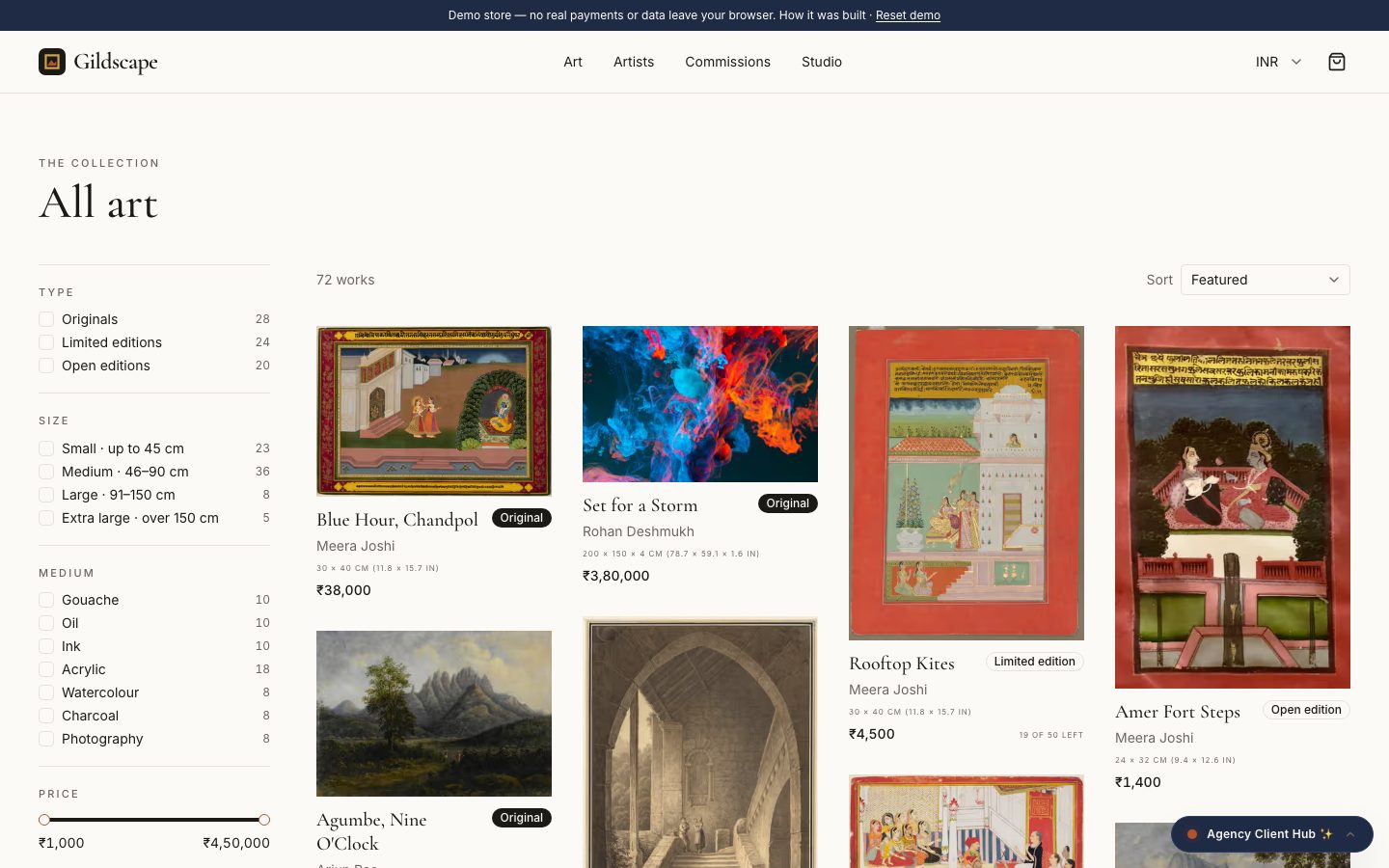
Our concept build Gildscape is an artist storefront and art marketplace with commissions, a cart and an artist studio. It shows how one-of-a-kind pieces, artist profiles and commission requests can fit together on a page. It is a demonstration, not a ready-made product: it does not cover artisan KYC or payouts, GST or export documents, courier integration or inventory across channels.
The Saral builds websites and apps for small businesses. If you reach the point where the signals above are true, we can scope a marketplace or storefront with you, and tell you honestly if a hosted store would do. Read about a marketplace app first, and back to the handicraft playbook.
More on starting a handicraft business
- Start hereThe full playbook →Models, licences, startup costs and the steps to your first customer.
- Go deeperWhat to buy →Samples, packing bench, fragile packaging, photo kit and a first batch, costed, plus what to hold off on.
- Go deeperGetting customers →Fairs, making-videos, gifting, stockists and marketplaces, the first 10 buyers and launch pricing.
- Go deeperFinding suppliers →Craft clusters, vetting artisans, advances and terms, GI tags, backups and export-material rules.
Questions people ask
What software do I need for a handicraft business?
Start with a shared spreadsheet for artisans, advances and one-of-a-kind pieces, a hosted online store with UPI, and a GST invoicing tool. Add inventory and order tools when you sell across channels or a piece is sold twice. Move to custom software only when you run many artisans, commissions and payouts.
How do I stop selling the same one-of-a-kind piece twice?
Give each piece an ID, list it with quantity one, and mark it sold or on hold as soon as a buyer pays. If you sell on Instagram, WhatsApp and a store, use one stock sheet as the master or a multichannel order tool that blocks double-selling. Take the listing down immediately after the sale.
Can I run a multi-artisan marketplace on a normal online store?
Not well. Standard stores assume one seller, so artisan accounts, commissions and split payouts are awkward and may need plug-ins or manual work. A small group of makers can be managed by hand. With dozens, consider a marketplace platform or custom build, and take professional advice on payment and tax handling.
How do I keep records of purchases from artisans for GST?
Keep a purchase ledger per artisan with payment proof and the specification. How you document purchases from unregistered artisans differs from registered suppliers, so ask your CA before the first filing. A billing tool with purchase entries, discussed in our GST billing software guide, makes this easier.
When is custom software worth it for handicrafts?
When artisan onboarding, commissions, editions of originals and payouts are central to your business and workarounds cost you more time or lost sales than a build would. For one brand with a few makers, a hosted store and a spreadsheet are usually cheaper and quicker. Cost a custom build including maintenance first.