A parlour needs software for five jobs: billing scoops, combos and take-home tubs, tracking tubs and cones, costing each flavour, logging freezer temperatures, and taking party and delivery orders. A POS app plus two or three sheets handle that for a long time.
Custom software pays only when party orders, delivery slots or a tub subscription outgrow a sheet. This page goes through each job, names the cheapest tool that works and says when to move on. The basics of the business are in the ice cream parlour playbook.
At the counter: a POS that understands scoops
Ice cream billing has quirks that general retail apps handle badly. A sundae is a scoop count plus toppings. A cone has a size and a type. A combo has fixed items with a price below the sum. A tub has a litre size and a flavour list. Your POS needs to sell all of these quickly and keep the stock numbers right.
| Need | What to look for | Category (examples are not recommendations) |
|---|---|---|
| Fast entry for scoops and add-ons | Variants for cup, cone and size, add-on toppings, quick buttons for the top ten items | Restaurant POS apps such as Petpooja-style billing |
| Combos and offers | Price-based combos, kids' scoop at set hours, loyalty points | Restaurant POS with offers; or a retail billing app |
| Tax invoices | Item-wise tax settings you have confirmed with your CA, a daily tax report | See our GST billing guide |
| UPI and card | A dynamic QR per bill that matches the order, reconciled daily | UPI apps plus the POS's payment-mode report |
| Offline mode | Bills still work when the network or power drops | Choose a POS with local save and sync |
| Multiple counters | Kitchen or topping station screen only if you are busy enough | Not needed for a small parlour |
Check how the POS reports sales by item, not just by day. Knowing that pistachio sold nine scoops and sitaphal sold sixty shows you what to stock and what to drop.
Stock by tub and cone: what to count and how often
Counting ice cream by litre is inexact, because tubs are open in the cabinet. A workable method is to count sealed tubs in back storage, estimate the open tubs in the cabinet by eye as a quarter, half or three-quarters, and compare against what the POS says was sold.
- Daily close sheet: flavour, opened tubs at close, sealed tubs left, tubs received, tubs thrown out and why.
- Yield check: divide the litres of tubs used by the scoops billed. If a 5-litre tub should give about 50 scoops of a set size and it gives 42, scoops are oversized or giveaways are happening.
- Cone and cup count: a cone should be used once per cone scoop; a gap between cones used and cones billed is leakage.
- Expiry watch: a column for the earliest expiry date by flavour, checked weekly.
- Reorder triggers: a number of sealed tubs per flavour below which you call the distributor, adjusted for season.
A shared Google Sheet filled at close takes five minutes and shows wastage and over-portioning before they become a month of losses. Move to an inventory module in your POS only when you have several flavours and counters and the sheet is no longer filled in.
Costing a flavour before you price it
Each flavour has its own cost. Pistachio, Belgian chocolate and mango in season cost very different amounts, and a flat price per scoop hides which ones earn money. For in-house production a costing sheet is the most useful file you will own.
| Column | What goes in it | Example (illustrative) |
|---|---|---|
| Batch size | Litres of finished product from one recipe | 10 litres |
| Ingredient cost | Milk, cream, sugar, mix, paste, inclusions at current rates | Updated whenever a supplier invoice arrives |
| Yield loss | Product lost in churning, draw-off and tasting | A few percent; measure it |
| Power and gas share | Estimated from your bill and batches per day | Rough per-litre share |
| Packaging per scoop | Cone or cup, spoon, napkin | Counted per serve |
| Cost per scoop | Total cost divided by scoops per batch | Compare with selling price |
Update ingredient rates monthly, and re-run the sheet before summer, before festivals and when dairy or dry fruit prices move. For resale, the same sheet works with tub cost and scoops per tub.
Temperature logs and cut-day records
Food-safety inspections and your own peace of mind both rely on a record that freezers stayed cold. A paper log by the freezer is acceptable. A digital probe with an alert is better because it tells you in the night.
- Paper or sheet log: freezer ID, time, reading, initials, and a column for action taken. Check twice a day.
- Wireless probe with alerts: a sensor in each freezer sends an app alert when it rises above a limit. Prices vary; ask for a demo in your own space.
- Cut-day sheet: time the power failed, backup started, freezer readings and stock discarded. Over a year it shows whether your backup is adequate.
- Cleaning log: dates for defrosting, coil cleaning and deep-cleaning of dipping wells.
- Licence file: a folder for your FSSAI licence, supplier licence copies and inspection notes.
Whether you must keep a particular log, and in what format, depends on your licence category and local officer. Ask your food safety consultant; this page is not legal advice.
Party bookings, delivery slots and tubs by subscription
This is the one area where a spreadsheet eventually strains. A booking has a date, time, address, flavours, quantity, advance paid, packing type, rider and handover note. When you have five a week, a sheet works. When you have twenty a week with changes and cancellations, errors creep in.
| Stage | Tool | Good for | When to move on |
|---|---|---|---|
| Under 10 bookings a week | A shared sheet plus WhatsApp Business with saved replies | Date, flavours, advance, status | Double bookings or missed handovers |
| 10 to 30 bookings a week | A booking form feeding a sheet, plus a payment link for advances | Self-serve party orders with a UPI advance | Customers asking for slots and reminders you cannot keep up with |
| Online orders for tubs and packs | A store builder or ordering page with delivery slots | Take-home tubs and gifting without app commission | Peak days where slot capacity or freezer stock must be limited |
| Tub subscription or monthly club | A subscription tool or a custom build | Recurring pints, skips and pauses | More than a few dozen members with pauses and failed payments |
See subscription app guide and hyperlocal delivery app guide for how those systems work and what they cost to build.
When a custom build pays off, and the Brewmont concept
Custom software is worth it when it removes a recurring cost or error that off-the-shelf tools do not cover. For a parlour, that is almost always the ordering side: slot-based delivery with a cap on tubs per hour, party packs with a deposit, a pint club and stock held for a given date. It rarely makes sense for billing or temperature logs.
- Likely worth it: slot capacity tied to freezer stock, a party-pack builder with deposit and reminders, multi-outlet reporting by flavour.
- Not worth it: a custom POS, a custom temperature logger or a custom loyalty app before a simple card works.
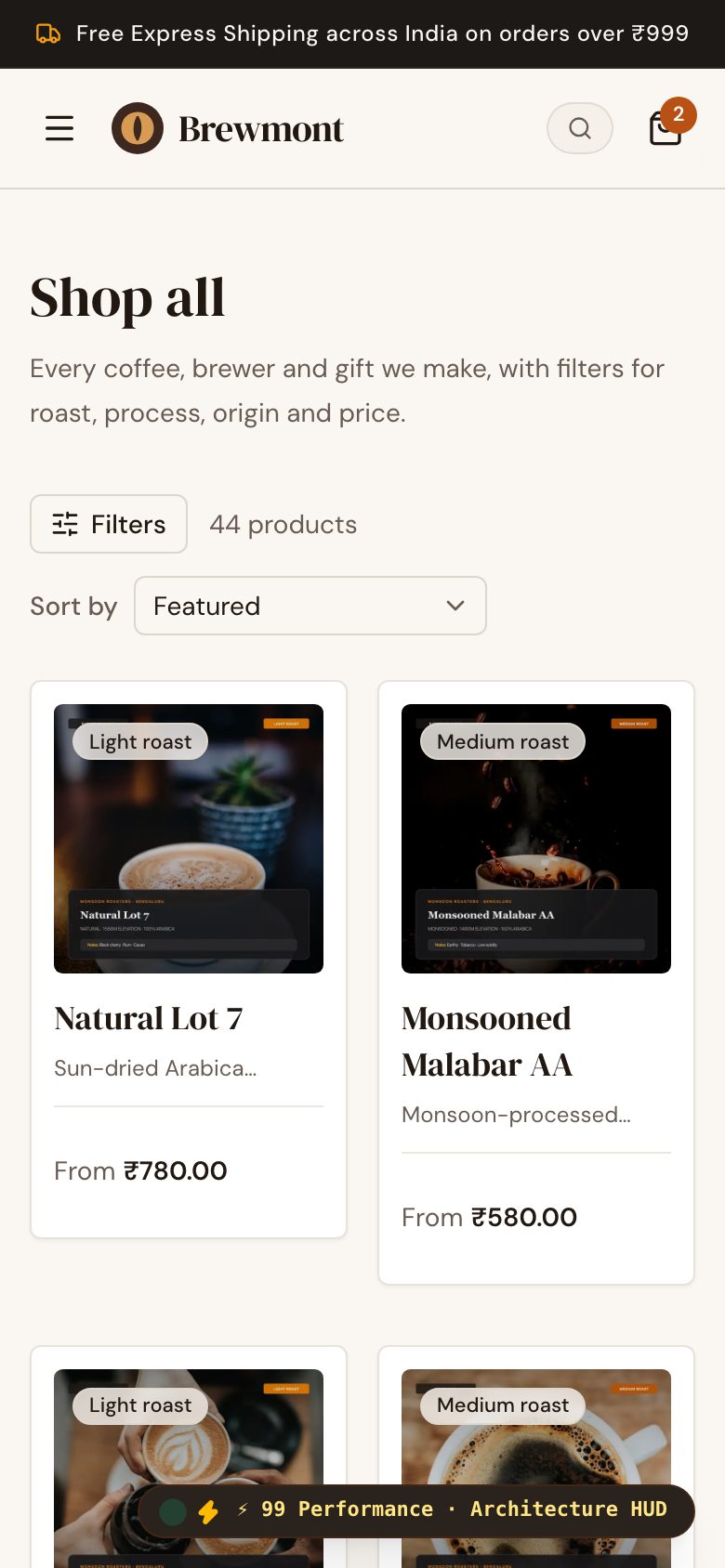
Our concept build Brewmont is a coffee storefront, not an ice cream product. Its tasting-flight idea could become a four-mini-scoop sampler, its shop and checkout could take tub and party-pack orders, and its subscription idea could become a pint club. It does not do ice cream billing, flavour costing or freezer monitoring. The Saral can build the ordering side as a custom project; start from a restaurant website and send us a brief if your volumes justify it.
More on starting a ice cream parlour
- Start hereThe full playbook →Models, licences, startup costs and the steps to your first customer.
- Go deeperWhat to buy →Dipping cabinets, deep freezers, batch freezers and power backup, costed, plus what to leave for later.
- Go deeperGetting customers →Footfall, party tubs, delivery that survives melting, launch pricing and a winter plan for a parlour.
- Go deeperFinding suppliers →Brand distributors, base mixes, dairy, cones and toppings, with cold-chain vetting, terms and backups.
Questions people ask
What software does an ice cream parlour need first?
A billing app that handles scoops, cones, combos and GST, a UPI QR and a simple stock sheet are enough at the start. Add a freezer temperature log, on paper or with a probe, and a booking sheet for parties. Online ordering and subscriptions come later, once enquiries outgrow WhatsApp and a sheet.
How do I track stock when tubs are open in the cabinet?
Count sealed tubs in back storage, estimate open tubs as a quarter, half or three-quarters, and compare with POS sales. Then check yield: if a tub should give a certain number of scoops and gives fewer, scoops are oversized or giveaways are happening. A daily close sheet takes about five minutes.
How do I cost a flavour?
Add the cost of every ingredient in a batch, adjust for loss in churning, add a share of power and packaging, then divide by the scoops the batch gives. Update rates monthly and before summer. Costing shows that flavours like pistachio or Belgian chocolate need a different price than vanilla, which a flat price per scoop hides.
Do I need temperature monitoring software?
Not at first. A paper or sheet log checked twice a day is acceptable for most small parlours. A wireless probe with alerts is worth it if power cuts are frequent or you hold large stock, because it warns you at night. Ask your food safety consultant what records your licence expects.
When should I build a custom ordering app?
When slot-based delivery, party-pack deposits or a tub subscription outgrow sheets and off-the-shelf store tools, often at dozens of orders a week with changes and cancellations. Billing and temperature logs rarely justify custom work. Run a month on a form and payment link first so you know which steps break.