Start with a Google Sheet and WhatsApp Business. A sheet can hold standing orders, tomorrow's totals, route lists and balances for the first 100–200 households. Move to an off-the-shelf delivery or billing app when pauses and monthly bills eat an hour a day, and think about custom software only when you have several routes and a specific gap no product covers.
A milk round has an unusual data problem: hundreds of tiny, recurring orders that change nightly, a hard cutoff, returnable crates or bottles, and money that moves in ₹60 daily pieces. This page sets out what to track, the cheapest tool that works at each size, and when a custom build is worth the cost. The subscription app guide and hyperlocal delivery guide go wider.
What the software actually has to know
Before choosing a tool, list the facts it must hold. Milk delivery looks simple, but five pieces of information change every night, and a mistake in any of them means a missed litre or a wrong bill.
| Data | Changes how often | Why getting it wrong hurts |
|---|---|---|
| Standing order per household (product, quantity, delivery days) | Weekly or monthly | Wrong quantity delivered daily until someone notices |
| Overrides: pause, skip, extra for guests, one-off change | Nightly, up to the cutoff | A paused flat still gets milk, or a guest weekend goes dry |
| Route and stop order (tower, wing, floor, flat) | When customers join or leave | A rider zig-zags, and the last stops get milk after 7 |
| Empties and deposits (bottles, crates, cans) | Daily | Stock of bottles falls, nobody knows who has them |
| Balance (wallet or monthly dues) and payments | Daily, with payments any time | Chasing dues by memory, arguments over statements |
Also decide your cutoff. A fixed nightly time, say 10 pm, is the control point: after it, totals lock, procurement is sent and route sheets are printed. Whichever software you use must make that time a hard line.
Under 150 households: one sheet, one WhatsApp number
A spreadsheet is the right tool at this size, as long as it is laid out with discipline. Messy sheets are the reason founders think they need an app before they do.
- Tab 1, Customers. One row per household: ID, name, society, tower, flat, phone, route, product, litres, delivery days, wallet or monthly, start date.
- Tab 2, Tomorrow. A formula tab that reads Customers and Overrides and shows only what will go out tomorrow, sorted by route and stop order.
- Tab 3, Overrides. A row per change received before the cutoff: date, customer ID, action, quantity. Customers message, you enter; do not edit the Customers tab for one-off changes.
- Tab 4, Ledger. Daily debits from deliveries, credits from payments, and a running balance per household.
- Tab 5, Empties. Bottles and crates out and back per household.
- WhatsApp Business for the number customers message, with labels for trial, active and paused, quick replies for pricing and a catalogue of your products.
- Google My Maps or a printed route list so each rider has a stop order they can follow with a glance.
This costs nothing but your hour each night. It stops working when you spend more than about an hour a day on the cutoff, when two people edit the same sheet and overwrite each other, or when disputes about what was delivered start to appear. That usually happens somewhere between 150 and 300 households.
300 to 800 households: pick tools by job, not by one big app
At this size, separate the jobs and use a product for each, or one tool that does most of them. Search for a milk-delivery or subscription-management app and read what it offers; there are several in the Indian market, so treat any list as a starting point and test two or three with real data.
| Job | Type of tool | What to look for |
|---|---|---|
| Customer calendar, pause and skip, cutoff | A milk or subscription delivery app with a customer-facing page | A nightly cutoff you can set, pause and skip by date, and that the rider list updates automatically |
| Rider route sheet and proof of delivery | A route-planning or delivery-management app | Stops sorted by tower and floor, per-stop items and empties, and offline use for basements |
| Collecting money | UPI QR, payment links or a wallet; UPI AutoPay for recurring | Settlement time, refund handling and whether the customer sees a clear receipt; compare fees yourself, as I have not verified any provider's pricing |
| Accounts, GST and invoices | Billing and accounting software such as Tally, Zoho Books or Vyapar-type apps | GST invoicing for taxable items, tracking of what you owe suppliers and a CA-friendly export; see the GST billing guide |
| Customer messages | WhatsApp Business app, then the API through a provider | Templates for cutoff reminders and statements; opt-in; see WhatsApp for business apps |
| Quality and temperature log | A simple sheet or a form | Date, supplier, fat, SNF, temperature, who tested |
A common failing is buying a general grocery app for a milk problem. Milk's difference is the recurring order with a nightly change window; a grocery cart that asks the customer to reorder every day will be abandoned. Test whether your shortlist handles a standing order with a one-tap pause.
Recurring payments through UPI AutoPay have per-transaction caps and notification rules set by NPCI and the banks. I have not verified current limits, so check the latest NPCI and RBI guidance or ask your payment provider. See our guide on UPI payments in your app.
Wallet, monthly bill or autopay: choose the collection model first
Software follows policy. Decide how you collect before you configure any tool, because it changes your cash flow more than any feature will.
| Model | Cash flow | Admin load | Customer experience |
|---|---|---|---|
| Prepaid wallet topped up in ₹500–2,000 chunks | Best; you hold the money before delivering | Low; the daily debit is automatic | Customers dislike a low balance warning only if it is a surprise; send a reminder at a set level |
| Monthly bill after delivery | Worst; you finance a month of milk | High; chasing, disputes and partial payments | Simple for customers who like to settle once |
| UPI AutoPay or a mandate | Good; money debits on a schedule | Medium; failed debits and mandate renewals | Seamless when it works; some banks and apps fail more often |
| Cash on delivery by the rider | Slow and risky | Very high; rider cash handling | Familiar, but best phased out |
Whatever you pick, send a clear daily or weekly statement: each date, litres, price, amount, balance. Most disputes in this trade are decided by the statement, not the milk.
When a custom app pays and what it would cover
Custom software is worth considering when your own process is the product, when you run enough routes that small inefficiencies are large, or when no off-the-shelf tool handles a piece of your model. It is a poor idea for a business under a few hundred households, where the real work is routes and milk quality.
| Sign it is time | What custom would solve |
|---|---|
| Two or more staff spend an hour a day reconciling pauses, extras and wallets | A customer app with calendar changes up to a hard cutoff and automatic wallet debits |
| Riders still work from printed or hand-written sheets and mistakes cost you customers | A rider app with stop order, per-stop items, empties to collect and proof of delivery |
| Procurement is guessed from yesterday's numbers | Nightly aggregation of tomorrow's litres by product and route, sent to the supplier |
| You sell milk plus curd, paneer, eggs and bread and want one morning run | A catalogue with per-product cutoffs and stock-aware limits |
| You have a brand and want customers on your own app rather than a rented platform | A branded customer app with referrals, statements and in-app support |
Before commissioning anything, run your shortlist of off-the-shelf tools on a month of real orders and note exactly what failed. Bring that list to a developer: a precise problem statement cuts the quote more than any negotiation. Budget for ongoing hosting, SMS or WhatsApp costs and bug fixes, not just the first build.
Our concept build, and where The Saral fits
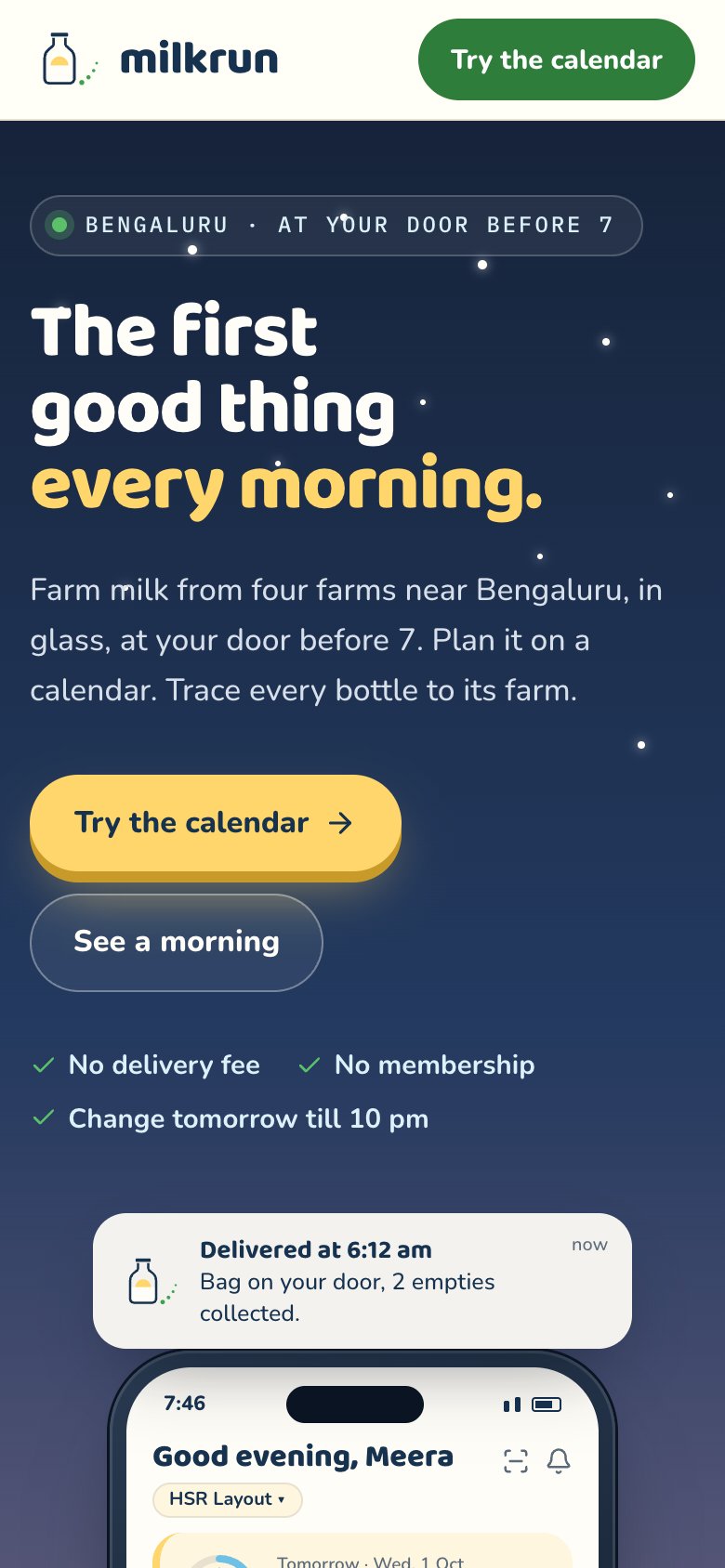
For the custom path, our concept build Milkrun is a demonstration of a milk-and-essentials subscription: a calendar-first customer app with a cutoff countdown, a bottle wallet, a pre-dawn route manifest with empty-bottle pickups for the partner side, and nightly demand totals for procurement. It is a concept, not a live service, and it does not include your payment gateway, your supplier integrations or your tax setup; those are decided with you.
If you decide to build, The Saral can scope a version for your routes and your cutoff, starting from the subscription delivery app pattern, or help you decide to stay with sheets a while longer. Use the contact page to share your household count, number of routes and current process.
More on starting a milk delivery business
- Start hereThe full playbook →Models, licences, startup costs and the steps to your first customer.
- Go deeperWhat to buy →Chiller, crates, testing kit and bikes, costed, with what to rent or skip until 300 homes.
- Go deeperWho to hire →Riders, floaters, a receiving hand and a route captain, with pay, vetting and contracts.
- Go deeperGetting customers →Society-by-society acquisition: RWA access, trial mornings, launch pricing and keeping them.
- Go deeperFinding suppliers →Brand agencies, farmers and cooperatives compared: how to vet, price on fat/SNF and avoid adulteration.
Questions people ask
Can I run a milk delivery business on Google Sheets?
Yes, for roughly the first 100–200 households. Keep separate tabs for customers, nightly overrides, a ledger and empties, and use a formula tab to list tomorrow's deliveries by route. It starts to fail when cutoff work takes over an hour a day, when two people edit at once, or when billing disputes appear.
Is there ready-made software for milk delivery in India?
Yes, several milk and subscription delivery apps exist, plus general route and billing tools. Features and pricing change, so test two or three on a real month of orders. Check that standing orders, one-tap pause, a nightly cutoff, wallet billing and a rider route sheet all work before you pay.
Should I collect payment by wallet, monthly bill or UPI AutoPay?
Prepaid wallets protect cash flow best because you pay suppliers daily. Monthly bills are simplest for customers but make you finance a month of milk. UPI AutoPay is a good middle option, though failed debits need handling, and recurring-payment rules and limits should be checked with your provider.
When is a custom app worth building for milk delivery?
When reconciling pauses, wallets and routes takes staff an hour a day, riders still use paper, procurement is guesswork, or you want your own branded customer app. Under a few hundred households, sheets or an existing app are cheaper. Test off-the-shelf tools first and bring the exact gaps to a developer.