Start with a weight-based billing app that prints GST receipts, a UPI QR, and a spreadsheet for festival orders. Add a shared WhatsApp catalogue, and keep recipe costing and raw material stock in simple sheets until the numbers outgrow them. Custom software only pays when festival orders, corporate gifting and online sales overload the sheets.
A sweet shop has jobs that ordinary retail software handles badly: items sold by the gram, trays that go off in a day or two, batches that turn milk and ghee into kilos of different sweets, and a few weeks of the year that decide the profit. The software below is organised around those jobs.
The jobs your software must do
| Job | Why it is awkward for a sweet shop | Where it lives first |
|---|---|---|
| Sell by weight | Customers ask for 350 g of three different sweets; price is per kg | Billing app connected to a counter scale, or a scale that prints labels |
| Issue a GST bill | Sweets, namkeen, ghee and boxes can have different treatment; boxes need a clear invoice | Billing app with HSN and GST support |
| Take festival orders | Hundreds of orders with weight, date, pickup slot, advance and delivery address | A shared order sheet or a simple order form |
| Plan production | Pre-orders and expected walk-ins turn into kg of each sweet and kg of milk, ghee and sugar | A sheet with recipes and yields |
| Track freshness and wastage | Milk sweets go off in a day or two; unsold trays are lost margin | Daily closing log |
| Handle corporate gifting | Quotations, slabs, logos, many delivery addresses, GST invoices, payment after the festival | Sheets plus an invoicing tool |
| Keep stock and purchases | Ghee tins, dry fruit, sugar, boxes bought in bulk before festivals | Stock sheet or a lightweight inventory tool |
Counter billing: weight, GST and UPI
The first purchase is billing that understands grams. Many Indian retail billing apps and desktop POS packages support weight-based items, GST invoices with HSN, a UPI QR on the receipt and daily sales reports. Some connect to a digital scale through a serial or USB port; others use a label-printing scale. Ask for a demo using your own items before you buy.
- Items entered per kg with the price per kg, and quantity typed in grams or read from the scale.
- Combo boxes (an assorted 500 g box at one price) as a separate item, so you can track box sales.
- GST rates by item. Mithai and namkeen are generally taxed at 5 percent, with changes in 2025 for packaged namkeen, but confirm item by item with your CA, since classification matters.
- Receipts by WhatsApp or print and a customer phone number field for your festival list.
- Day-end report that shows sales by item in kg, so tomorrow's production uses what actually sold.
- Offline mode. Counters in festival week cannot wait for a slow connection.
For a deeper look at choosing GST billing, read our GST billing software guide and the overview of a billing app. Keep the books in an accounting package your accountant already uses (Tally, Zoho Books or similar) and ask whether your billing app can export to it.
The festival order book on a sheet
A shared spreadsheet is a perfectly good order book for your first few festivals if you set it up with discipline. One row per order, with columns for date taken, customer, phone, item, weight or box type, number, price, advance paid, balance, pickup date and slot, delivery address and status.
- A summary tab that totals kg per sweet per day, so the head karigar sees tomorrow's production at a glance.
- A pickup-slot tab with a count per slot so no hour is overbooked.
- A corporate tab with company, contact, quantity per slab, logo needs, delivery list link, invoice number and payment status.
- Colour or status for ready, packed, collected and delivered, updated at the boxing table.
- A printed sheet for the packers with piece counts per box and a tick box for the check.
Once orders run into the hundreds or several people edit at once, the sheet starts to break: duplicate rows, lost advances, wrong totals. A WhatsApp Business catalogue with order messages feeding a sheet or a small form-to-sheet tool can carry you a little further. See WhatsApp for business apps.
Recipe costing, production and stock
Margins in mithai disappear through yield, not through price. A recipe sheet that records, per sweet, the kg of milk, khoya, sugar, ghee and dry fruit, the finished kg and the cost per kg tells you which items to push and which to drop.
- Recipe tab: each sweet with ingredients, quantities, expected yield and current cost per kg using today's ghee and dry-fruit rates.
- Daily production log: batch, quantity made, time, karigar, and tray date.
- Closing wastage log: what is thrown away or sold at a discount, by item.
- Stock sheet: ghee tins, dry fruit, sugar, besan, boxes, with a reorder level before each festival.
- Supplier rate tab: last price paid and date, to spot when a supplier raises price quietly.
Inventory tools used by small food shops can hold raw materials, recipes and batch costing, but check whether they handle yield and loss, since a mithai shop buys milk and sells kilos of sweet. If a tool cannot, stay on sheets. See also what kirana stores and restaurants use for stock; the overlap is smaller than it looks.
Selling online and taking payments
Selling mithai online has a few hard limits. Milk sweets suit same-day local delivery and pickup, while dry sweets and namkeen can ship by courier. Labels, weights and boxes must meet FSSAI and Legal Metrology expectations, which your adviser should review.
- Phase one: WhatsApp catalogue and UPI payment links for festival pre-orders with pickup.
- Phase two: a hosted store builder or a simple store plugin for dry-fruit boxes and namkeen with a courier partner.
- Phase three: a custom [ecommerce website](/app/ecommerce-website) when you need box building, date and slot rules, corporate ordering and repeat reorders.
- Payments: UPI and card links through a payment gateway; see UPI payments in your app.
- Delivery: local riders or aggregator delivery for fresh sweets; courier aggregators for dry boxes. Plan breakage and heat in summer.
Food delivery marketplaces can add sales but take a commission; check the current commission and your margin on a box before you list. We have not verified any platform's present rates.
When custom software pays, and what it would cover
Custom software is rarely right for a single counter shop. It starts to pay when you have several outlets, a large corporate gifting line, or online orders that your team re-types into sheets. Signs: orders lost between WhatsApp and the sheet, late deliveries because slots were over-sold, stock-outs of ghee in festival week, and an owner who spends nights reconciling advances.
- Box builder where a customer assembles an assorted box by weight, with live price and weight.
- Slot and capacity rules that stop pickups or deliveries being oversold.
- Corporate ordering with slabs, logo upload, multiple delivery addresses and invoicing.
- Production view that converts orders into kg per sweet per day for the karigars.
- Customer list and reorder with last year's box ready to repeat.
Get a written scope and a fixed price before any build; see our app development cost guide for how to judge quotes.
A concept to look at, and where The Saral fits
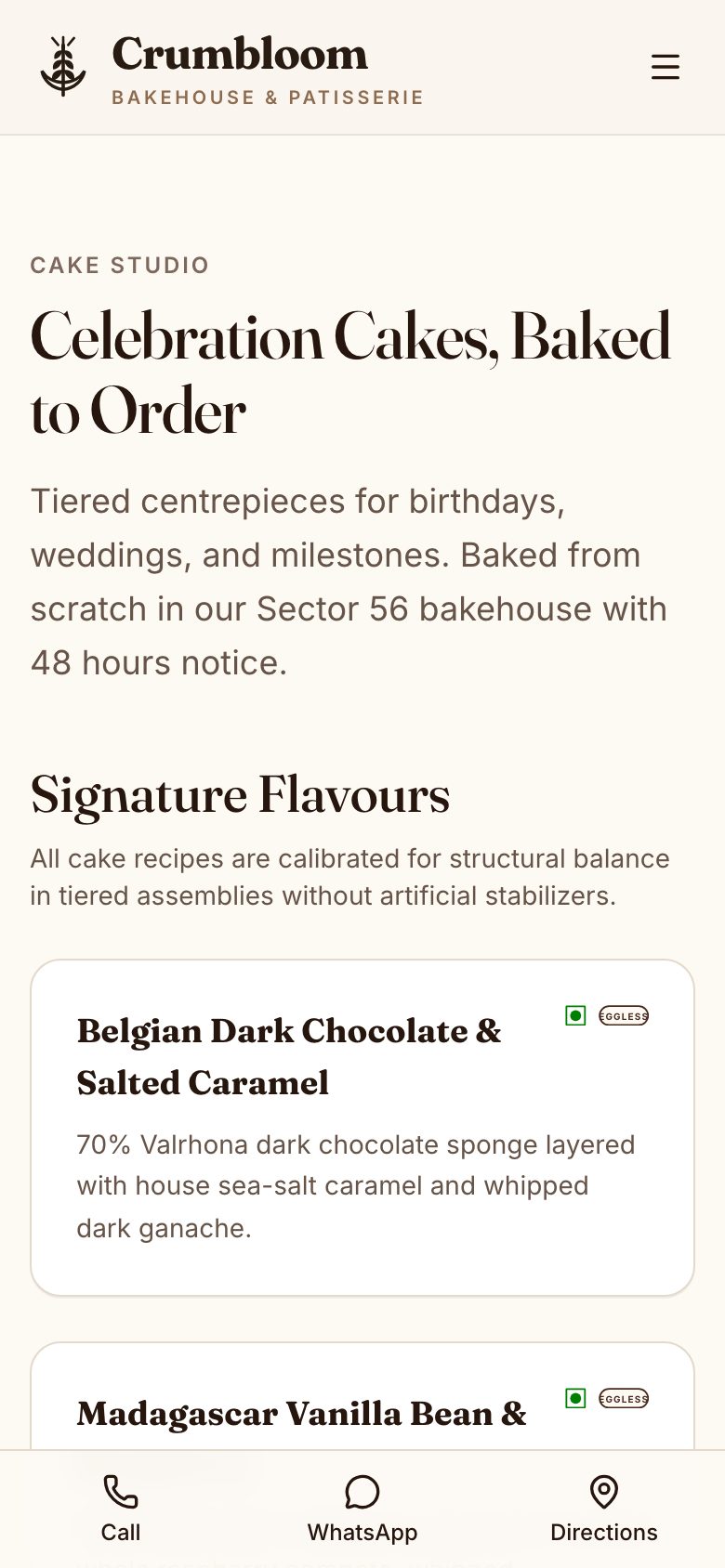
Our concept build Crumbloom is a bakery and cake studio, not a mithai shop. It shows a box builder where an assorted box is filled piece by piece, a live view of what is fresh today, and pre-orders with pickup slots, which are the parts a sweet shop would borrow.
It does not do weight-based counter billing, GST invoicing, recipe yields, raw material stock or courier rules for sweets, and it has no real shop data behind it. Those would be built for your kitchen. The Saral builds custom web and mobile software for small businesses; if you want to scope something like a festival order and gifting site, send us a brief.
More on starting a sweet shop
- Start hereThe full playbook →Models, licences, startup costs and the steps to your first customer.
- Go deeperWhat to buy →Bhatti, kadhais, kettles, chillers, scales and box stock, costed, with what to hold back.
- Go deeperWho to hire →Head halwai, karigars, packers and counter staff, with pay, vetting and festival temps.
- Go deeperGetting customers →Festival pre-orders, corporate gifting, first 10 customers, launch pricing and repeat buyers.
- Go deeperFinding suppliers →Milk, khoya, ghee, dry fruit, vark and box suppliers, with checks, credit terms and backups.
Questions people ask
What billing software suits a sweet shop?
Look for billing that sells by weight, prints GST invoices with HSN, shows a UPI QR, works offline and ideally connects to a counter scale. Ask for a demo using your own items, including a 350 g mixed order and an assorted box. Many Indian retail billing apps cover this, so compare a few rather than choosing the first.
Can I manage festival orders in a spreadsheet?
Yes, for the first few festivals. Use one row per order with date, weight or box type, advance, pickup slot and status, plus a summary tab that totals kg per sweet per day for the karigars. It starts to fail when many people edit at once or orders reach the hundreds, which is when a form or custom system helps.
What GST applies to mithai and namkeen?
Sweetmeats and namkeen are generally taxed at 5 percent, and the September 2025 rate changes brought packaged namkeen down to 5 percent as well, according to the GST Council's announcement. Classification can still vary by product and how it is sold, so confirm item by item with your CA before setting up billing. This is not tax advice.
Do I need an app for my sweet shop?
Usually not at first. A WhatsApp Business catalogue, UPI payment links and a good Google Business Profile cover most local ordering. An app or custom site becomes worth it when you have repeat customers who reorder boxes, large corporate gifting, or several outlets. Test the demand with simple tools before commissioning a build.
How do I track wastage and recipe cost?
Keep a recipe sheet with inputs, finished kg and cost per kg, plus a daily log of production and unsold or discounted trays by item. Update ghee, khoya and dry-fruit rates when you buy. Within a month you will see which sweets have poor yield or heavy wastage and which deserve more counter space.