A tiffin service needs software for five jobs: knowing tomorrow's meal count, recording skips and pauses, giving the rider a route list, tracking returned containers, and collecting renewals on time. Under about 40 customers, a sheet, a WhatsApp group and UPI do all five. Past that, add an off-the-shelf billing tool and a route planner. Custom software pays only when the rules of your business are not in anyone else's product.
The mistake to avoid is buying a restaurant POS or a full food-delivery app for what is really a subscription business. This page lists the daily jobs, the cheapest tool that does each one at each size, and where a custom build starts to make sense.
The five daily jobs, and the question each answers
| Job | The question it answers | What goes wrong without it |
|---|---|---|
| Tomorrow's count | How many boxes, of which type, by when? | Cooking 10% too much or leaving a customer without lunch |
| Skips and pauses | Who has stopped, till when, and does the meal carry over? | Delivering to an empty flat or a disputed bill |
| Route list | Which door, in which order, with what note? | Late lunch and a rider who forgets the no-onion box |
| Containers | Who holds how many tiffins, and who owes a return? | A steady loss of steel boxes |
| Renewals and receipts | Who has paid, who is due, who is overdue? | Chasing money by phone every evening |
Write the rules before you pick a tool: a night-before cut-off for changes, whether skipped meals carry over, how long a pause can be, and the deposit for steel tiffins. Software will enforce whatever you write; it cannot invent policy for you.
Under 40 customers: a sheet and a phone
At this size the owner knows every customer by name, and a good sheet beats an app that nobody opens. Costs about nothing.
- Google Sheets or Excel with three tabs: customers (name, address, plan, meal type, notes, renewal date), a daily calendar (one row per customer, one column per date, marked yes or skip) and a payments log.
- A Google Form for new orders, with fields for diet, allergy, landmark and a phone number the rider can call.
- A WhatsApp Business account with a catalogue of plans, a quick reply for the menu, a label per customer type and a Broadcast list for the weekly menu. See our guide on WhatsApp for business apps for the limits of broadcasts.
- UPI QR and payment links from your bank or a payments app. Record each payment in the log the same evening.
- A printed route sheet sorted by building and floor, with a column for tiffins collected and a note column.
The routine: at a fixed time each night, lock the sheet, count the boxes by type and send the count to the cook. It takes ten minutes and prevents most waste. The failure mode is the owner's phone: skips arrive in personal chats, voice notes and missed calls. Tell customers one channel for changes.
40 to 150 meals a day: add billing, a route planner and a CRM
| Need | Category of tool | What to look for | Estimated cost per month |
|---|---|---|---|
| Invoices, receipts, GST | Billing or accounting software (examples to compare: Vyapar, Zoho Books, Tally) | Recurring invoices, UPI links, payment reminders, GST reports | ₹0–1,500 |
| Customer calendar and skips | A subscription or meal-plan tool, or a form plus sheet with an Apps Script | A customer-facing calendar and a cut-off, which few billing tools provide | ₹0–3,000 |
| Route lists | A route planner or a delivery-management app | Stop sequencing, a driver view, proof of delivery | ₹0–3,000 per rider |
| Enquiries and follow-ups | A simple CRM or WhatsApp Business API provider | Tags for source and plan, reminders for renewal | ₹0–2,500 |
| Menu publishing | Canva templates and a Google Business Profile | A weekly menu card and photos | ₹0–500 |
A restaurant POS or a cloud-kitchen order manager is rarely right at this stage. They assume walk-in or one-off orders, not a calendar of recurring meals, so you end up retyping your monthly customers into it every day.
Recurring payments are the other upgrade. UPI AutoPay mandates and recurring-payment features at payment gateways can pull a monthly amount without chasing; compare their fees and what customers must do to set them up in the UPI payments guide. Check the current rules for the mandate limits yourself.
Customer data: the part people forget
You hold names, addresses, phone numbers, diets and sometimes health conditions such as diabetes or allergies, in your sheet and chats. India's data protection law applies to businesses that process personal data, with phased rules.
- Keep the master sheet private: share route sheets, not the full customer list, with riders, and remove access when a rider leaves.
- Ask for consent before adding someone to a broadcast list, and make it easy to opt out.
- Store allergy information carefully, and back it up. A lost sheet of preferences is a day of mistakes.
- Export a copy weekly from whatever tool you use. See our DPDP checklist for the general points; this page has not reviewed current rules, so ask a lawyer where it matters.
When custom software starts to pay
Custom software is a fixed cost, and a tiffin margin is thin, so it should replace real hours or real losses. The test is simple: is a rule in your business impossible in any tool you can buy, and does it cost you money every week?
| Sign | Why it points to custom | What it would need to cover |
|---|---|---|
| You spend over an hour a day on skips, pauses and counts | A customer-facing calendar with a cut-off removes the phone calls | Calendar, pause and carry-over rules, nightly count to the kitchen |
| Steel tiffins keep disappearing | A deposit and return ledger is not in standard billing tools | Containers with each customer, deposit in a wallet, returned on pickup |
| Customers on 3 or more plans in different cycles | Prorated renewals and wallet logic outgrow sheets | Wallet, mandates, statements, renewal reminders |
| Two or more kitchens or 150+ meals a day | Counts, routes and stock must be consolidated | Kitchen view, route builder, rider app, admin dashboard |
| Corporate customers need a monthly consolidated bill | Per-employee ordering and a single invoice | Employee lists, meal selection, cost centre invoices |
Before commissioning anything, run your rules in a sheet for a month and write down where it hurts. Ask for a fixed quote against that list, and read our subscription app guide on what a monthly-plan product includes.
A concept to look at, and The Saral
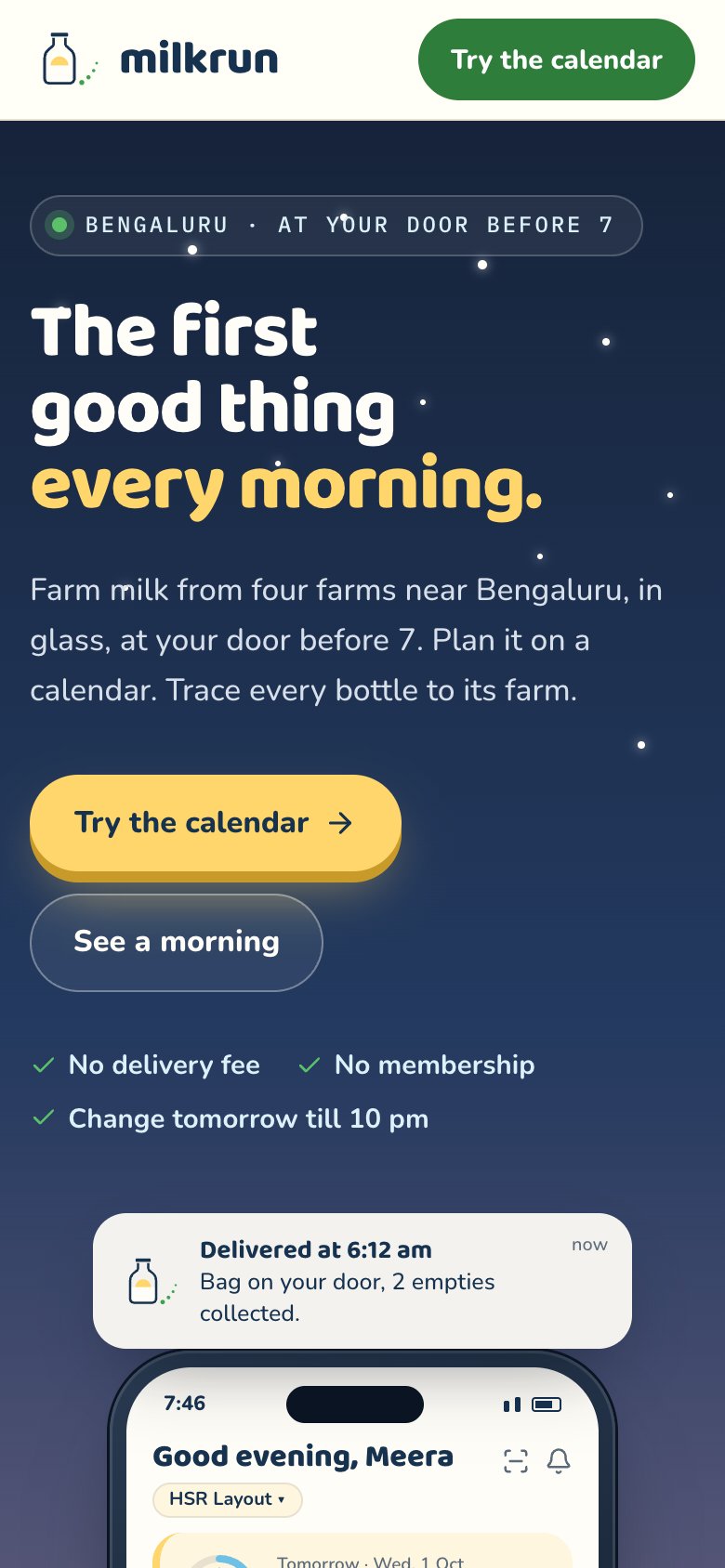
Milkrun is our concept for a daily dairy subscription in Bengaluru, built as a prototype with sample data. It has a month calendar with daily, alternate-day and weekday patterns, a 10 pm cut-off for tomorrow's order, an away mode, a wallet that never goes negative, a returnable-bottle deposit ledger, a runner app with a route list and an ops dashboard. Those are the same mechanics a tiffin service needs, with meals instead of bottles.
It does not cover tiffin menus, per-meal diets, kitchen counts by dish or a real payment gateway; the payments, proof photos and quality data in it are simulated. You can click through the live concept at milkrun.thesaral.com. If you want a version adapted for a tiffin service, The Saral can quote a subscription delivery app from a brief, and the playbook shows where it fits in the larger plan.
More on starting a tiffin service
- Start hereThe full playbook →Models, licences, startup costs and the steps to your first customer.
- Go deeperWhat to buy →Burners, vessels, containers, packing and delivery kit, costed, with what to hold off on.
- Go deeperGetting customers →PGs, offices and societies, a trial week, launch pricing and keeping subscribers month after month.
- Go deeperFinding suppliers →Mandi vegetables, grain wholesalers, dairy, gas and packaging: how to buy, vet and keep backups.
Questions people ask
What software does a small tiffin service need?
Under about 40 customers, a Google Sheet for customers, a daily calendar and a payments log, a WhatsApp Business account and UPI links are enough. Add billing software for recurring invoices and a route planner once you pass roughly 40 to 150 meals a day. Start with the cheapest tool and keep your data exportable.
Can I use a restaurant POS for a tiffin business?
Usually not well. Restaurant POS and cloud-kitchen tools are built around one-off orders, while a tiffin service sells recurring monthly plans with skips and pauses. You end up re-entering each customer daily. A sheet or a subscription-style tool fits better, with a billing app for invoices and GST on top.
How do I automate monthly tiffin payments?
Send each customer a UPI payment link or an invoice from a billing tool, and move everyone onto one renewal date. For fully automatic pulls, look at UPI AutoPay or a payment gateway's recurring-payment product. Compare fees and check the current mandate rules yourself, since limits and requirements change.
When should a tiffin service build a custom app?
When a rule of your business is not available in any tool and costs you money every week, for example a skip cut-off, a container deposit ledger, or consolidated corporate billing. As a rule of thumb, discuss it from roughly 150 meals a day or two kitchens, after running the rules in a sheet for a month.
How do I keep customer data safe in a tiffin business?
Keep the master customer sheet private, share only route sheets with riders, and remove access when a rider leaves. Get consent before adding people to broadcast lists, store allergy notes carefully, and export a backup weekly. The DPDP Act applies to personal data, so ask a lawyer about current rules.