For one to three trucks, a trip register in a spreadsheet, a GPS tracker, WhatsApp and the GST e-way bill portal are enough. Add a GST billing tool when invoices pile up, add a transport management system when you manage a dozen vehicles, and consider custom software only when your lanes or contracts need something off-the-shelf tools cannot do.
Pricing for tools changes often, and I have not verified current plans for any product named here. Costs given are rough estimates of what to budget and not quotes.
What the software has to do
Transport software is not one product. It is six small jobs, and you can solve each with a different tool at a different stage.
| Job | What goes wrong without it | Cheapest tool that works |
|---|---|---|
| Trip register and LR | Trips, LRs and PODs live on scraps of paper and in the munshi's memory | A shared spreadsheet and numbered LR pads |
| E-way bills | Wrong or missing e-way bills lead to detention and penalties at check-posts | The GST e-way bill portal and its mobile app, or the bulk upload tool |
| Vehicle tracking | You learn the truck is late when the consignee calls you | A GPS tracker and its app |
| Driver advances and trip P&L | Nobody knows which trips actually made money | A sheet with advance, diesel, toll and freight per trip |
| Freight billing and collections | Invoices go late, PODs go missing and aging is invisible | A GST billing tool or accounting software |
| Compliance calendar | A missed fitness, insurance or permit date grounds a truck | A sheet with expiry dates and phone reminders |
Stage 1: one to three vehicles
At this size, software cost is mainly your time. The goal is to know where each truck is and whether each trip made money.
- Trip sheet: one row per trip with date, vehicle, driver, LR number, consignor, consignee, goods, weight, freight, advance paid, diesel litres and cost, tolls, other expenses, POD received (yes or no) and payment received (yes or no). Add a profit column. Use Google Sheets so the munshi and owner see the same file.
- GPS tracker app: fit a tracker with ignition and fuel sensors and use its app for live location, route history and alerts.
- E-way bills: use the official GST e-way bill portal. Register your transporter ID so you can generate or update the vehicle number on a bill.
- WhatsApp Business: a catalogue is not needed. Use labels for shippers and drivers, broadcast daily availability and send live-location links.
- Compliance tab: a sheet listing each vehicle's fitness, permit, insurance, PUC, road tax and driver licence expiry dates with a formula that highlights dates in the next 30 days.
- Basic accounts: a GST-compliant billing tool; see our GST billing software guide.
Tax, e-way bill and GST invoice rules apply as per the current notifications. Confirm with a CA. This page is not tax advice.
Stage 2: four to fifteen vehicles
The spreadsheet starts to break once two people edit it constantly, a driver calls the office for every update, and invoices slip. This is the stage to move to off-the-shelf tools for each job.
| Need | Off-the-shelf option | What to check before you buy |
|---|---|---|
| Transport management (LR, trips, billing, vehicle and driver records) | Indian TMS products aimed at transporters, such as those offered by transport software vendors; ask transporters on your lane what they use | Does it generate LRs in your format, handle part-loads and freight bills, and let you export your data? |
| Fleet tracking and fuel monitoring | Your GPS vendor's fleet dashboard, with fuel sensors and trip reports | Data subscription cost per vehicle, accuracy of fuel readings and report exports |
| Billing and GST | A GST billing or accounting package, many with e-invoicing support | E-invoicing and e-way bill integration, TDS on freight and credit-note handling |
| Driver and POD capture | A driver app that takes photo PODs and trip status updates | Works on low-end Android phones and in regional languages |
| Load matching and return loads | Freight marketplaces and load boards | Commission terms, payment protection and rate transparency; I have not verified any product's terms |
- Keep one source of truth. Pick the TMS or sheet that holds the trip record and make every other tool feed it.
- Own your data. Make sure you can export trips, customers and invoices in CSV or Excel at any time. Transporters who cannot export their own data are stuck with the vendor.
- Test with one lane first before moving the whole business.
- Train the munshi and drivers in short sessions; a tool nobody uses is a cost, not a system.
Stage 3: above fifteen vehicles or contract logistics
At this size, contract clients start asking for dashboards, SLAs and monthly reports. The work moves from recording trips to managing exceptions.
- Shipment visibility: a live table of every shipment with status, ETA and the next action, filterable by lane, client and vehicle.
- Exception handling: a queue of late deliveries, stranded trucks, detention, damage and missing PODs with an owner, a due time and a note.
- Fleet health: tyre, service and compliance calendars per vehicle with automated reminders.
- Shipper reporting: on-time percentage, detention hours, claims and freight billed by lane and by month.
- Driver records: licence, training, accident history, trip performance and fuel efficiency.
A good TMS covers part of this. If your contracts include special reporting, integrations with a client's ERP or warehouse system, or custom SLAs, you reach the edge of what off-the-shelf products do.
When custom software is worth it
Custom is worth it only when a standard tool measurably fails you. Many transporters never need it, and that is fine.
| Signal | Custom is probably worth it | Stay with off-the-shelf |
|---|---|---|
| Your workflow | Your lanes, billing or SLA rules do not fit any TMS you tried | A TMS covers 80% of your needs after configuration |
| Client integrations | A large client requires API or EDI links or branded tracking pages | Clients accept emailed reports and tracking links |
| Scale | Hundreds of vehicles or thousands of shipments a day | Under about 30 vehicles |
| Differentiator | Your data and tooling are part of what you sell, as with a freight marketplace or aggregator | Software is a back-office cost |
| Cost | Per-vehicle subscriptions now exceed the amortised cost of a build plus maintenance | Subscriptions are small next to the cost of building |
Read what an app costs in India, what a logistics app involves and the MVP guide before commissioning anything. Start with the smallest slice that removes a spreadsheet, usually the exceptions and shipment view.
A concept to look at
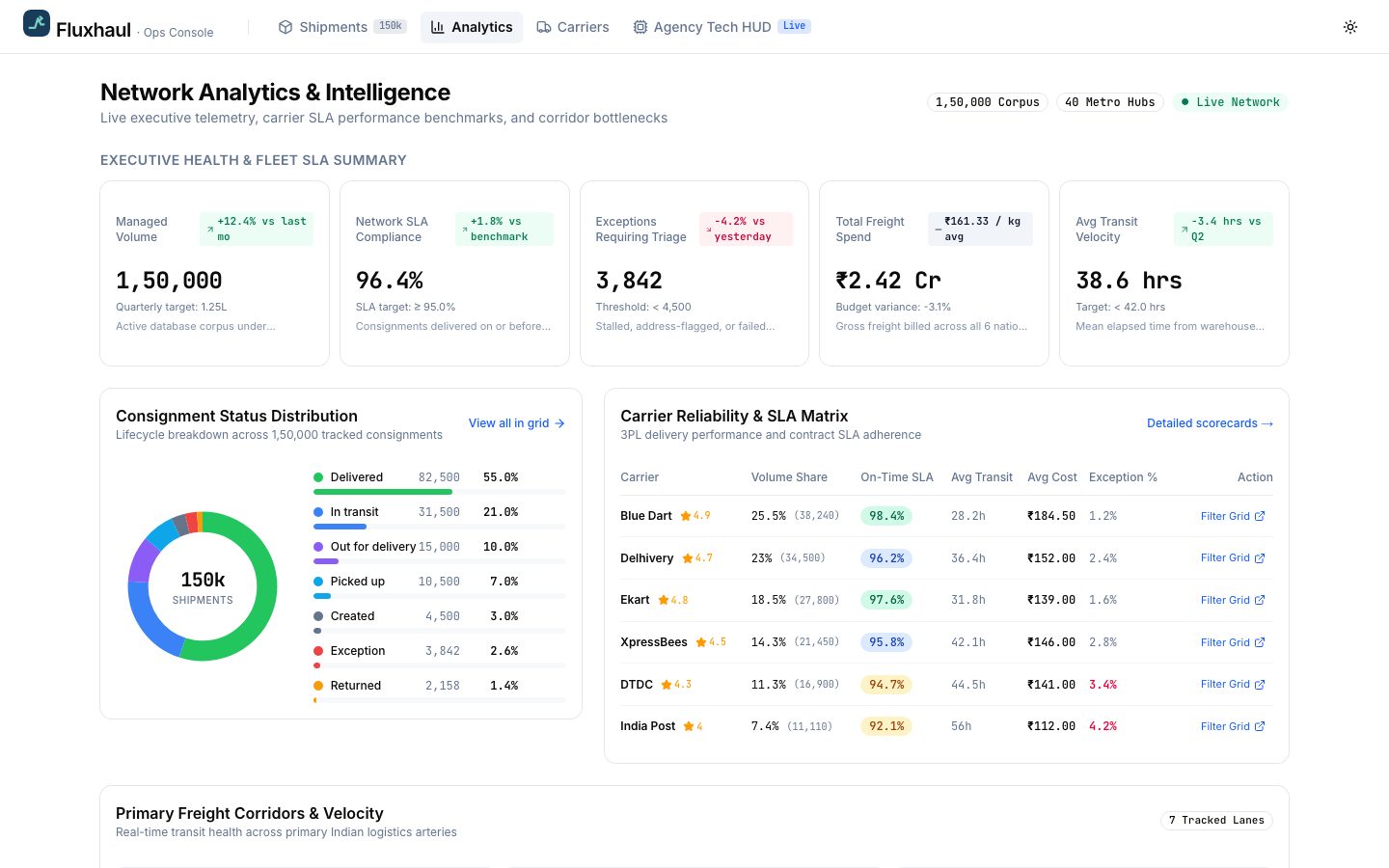
Only after you know what your own workflow needs, it can help to see what a finished ops console looks like. The Saral studio built Fluxhaul as a concept freight console, with a large shipment table, an exception centre, fleet health and lane analytics.
- Open the concept app: fluxhaul.thesaral.com, a demo with sample data, not a live product.
- Read the case study: Fluxhaul on our work page covers the design choices, such as keeping a very large shipment table smooth and keyboard friendly.
- For city and last-mile work, see the concept HornOK.
- To scope something similar, the logistics app solution page lists what we build and how projects work.
Fluxhaul is a studio concept build. It does not represent a client, and its data is made up. Use it as a reference for the kinds of screens an ops team needs, not as proof of results.
More on starting a transport business
- Start hereThe full playbook →Models, licences, startup costs and the steps to your first customer.
- Go deeperWhat to buy →Which truck to buy for which load, what goes on it, and what to skip until you have loads.
- Go deeperWho to hire →Drivers, munshi, dispatcher and mechanic in hiring order, with pay estimates and checks.
- Go deeperGetting customers →Finding shippers and return loads, quoting rates and getting paid on time.
Questions people ask
What software does a small transport business need?
For one to three trucks, a shared trip sheet, a GPS tracker app, WhatsApp and the GST e-way bill portal are enough, plus a billing tool for GST invoices. Add a transport management system once you run around five or more vehicles, or when invoices, PODs and collections are slipping through the cracks.
Do I need a transport management system (TMS)?
Not at the start. A TMS pays off when you have enough vehicles and trips that a spreadsheet slows you down, typically from about five to fifteen vehicles. Check that it generates LRs in your format, supports freight billing and lets you export your data before you commit to a vendor.
How much does transport software cost in India?
As a rough estimate, tracking and software together often run in the low hundreds to about ₹1,500 per vehicle per month, depending on vendor and features. A custom ops console costs far more upfront, typically in lakhs. Prices change often, so get current quotes and compare over three years.
Can I generate e-way bills without software?
Yes. You can generate and update e-way bills on the official GST e-way bill portal or its mobile app, and update the vehicle number if the truck changes. Software becomes useful when volumes are high, because bills can be created from invoices in bulk. Confirm current rules with a CA.
When should a transporter build custom software?
Build custom only when off-the-shelf tools fail on something that matters, such as client integrations, unusual SLA reporting or a marketplace model, and when scale makes subscriptions costly. Most fleets under 30 vehicles do better with a TMS and a GPS tool. Start with the smallest slice that replaces a painful spreadsheet.