A used car dealer needs software for six jobs: tracking stock and costs per car, tracking RC transfers, handling enquiries, billing, accounting and showing cars online. At the start a Google Sheet and WhatsApp Business do all six. Move to off-the-shelf accounting and a simple website at around 10 to 15 cars, and consider a custom dealer system only when spreadsheets are visibly costing you cars or money.
The mistake is buying a dealer management or buyer app before you have a consistent stock list and a process. Software makes a messy process faster, not better.
What the software has to do, car by car
Everything in a used car business hangs off one record: the car. Each car needs a purchase price, reconditioning costs, a status and a paper trail.
| Job | What you track | Cheapest tool that works |
|---|---|---|
| Stock register | Reg number, make, model, variant, year, kilometres, owners, purchase date and price, status, listing price | Google Sheet with one row per car |
| Reconditioning costs | Each repair, part, labour and who approved it; total cost per car | A second sheet tab linked by the registration number |
| Documents and RC transfer | RC, insurance, loan closure, NOC, transfer applications and dates | A tracker tab with a status per document and a due date |
| Enquiries and follow-ups | Name, phone, car of interest, source, next action date | WhatsApp Business labels, then a CRM tab or app |
| Billing and GST | Purchase invoices, sale invoices, margin working | Accounting software your CA works with |
| Listings and website | Photos, descriptions, price, status | Portal dashboards, then a simple website |
Stage one: a sheet and WhatsApp Business (0 to 10 cars)
A single Google Sheet shared with your mechanic and documentation agent is enough. The trick is the columns, and the discipline of updating them the same day.
- Stock tab columns: registration number, make, model, variant, year, fuel, kilometres, owners, colour, purchase date, purchase price, status (inspected, in workshop, listed, token, sold), listed price, days in stock.
- Cost tab: one row per expense with the registration number, date, vendor, description, amount and approver. A SUMIF on the stock tab shows total cost per car and live margin.
- Document tab: one row per car with a tick for RC verified, loan status, challans, insurance, NOC, transfer filed, new RC received.
- Days-in-stock flag: conditional formatting that turns a row red after 30 days and darker at 45.
- WhatsApp Business: catalogue of cars, labels (new, test drive, finance, negotiating) and quick replies.
- Google Drive folder per car with photos, the inspection report PDF and scanned documents named by registration number.
Sheets hold customer phone numbers and ID copies. Restrict access, switch on two-step sign-in and avoid sharing links publicly. If you handle personal data at scale, read our DPDP Act checklist; not legal advice.
Stage two: off-the-shelf accounting and a simple website (10 to 40 cars)
At this size, errors in the sheet start to cost money, and your CA needs clean books. Add proper tools, but keep the car record in the sheet until it hurts.
| Need | Typical options | Cost note |
|---|---|---|
| GST billing and accounts | Tally, Zoho Books, Vyapar, Busy or similar Indian accounting tools | Plans vary and change; current prices are not verified here. Ask your CA which one they can work in |
| Margin-scheme handling | Confirm with your CA whether the tool supports the used vehicle margin working you need | Tools differ; do not assume it is built in |
| Website with car listings | Hosted site builder or a template site with a stock page per car | Roughly ₹1–3 lakh for a developer-built site as an estimate; site builders cost less |
| Enquiry and follow-up tracking | A free or low-cost CRM, or a CRM tab and WhatsApp labels | Cheaper than a missed lead |
| Photos, video and 360 views | Phone on a gimbal and a consistent backdrop | ₹3,000–10,000 for kit; do not buy a 360 rig yet |
- Give every car a page with a URL so you can share one link per car on WhatsApp and portals.
- Keep one master record. If the website, portal and sheet each have their own price, they will disagree.
- Add a test-drive booking form that writes to your sheet or WhatsApp.
Our guide to choosing an app development company and website cost guide help if you hire someone to build the site.
When custom software starts to pay
You have likely outgrown sheets and generic tools when several of these are true:
- You have 40 or more cars and more than one location, and different people overwrite each other's rows.
- You lose cars to missed follow-ups or price errors because the stock, enquiry and finance records disagree.
- Buyers want to book inspections, test drives and finance online, and your website cannot connect to your stock.
- You work with a team of inspectors in the field who need a form with photos, a checklist and a report on the phone.
- You run a consignment or marketplace model, with several sellers and a commission to track.
- You need delivery tracking between a hub and a buyer's home, and RC transfer status visible to the buyer.
| Pain | Custom feature that fixes it |
|---|---|
| Inspection quality varies by person | Inspector app with a fixed checklist, photo prompts and an auto-generated report |
| Buyers ask the same questions again and again | Public car page with inspection report, owner history and finance estimate |
| RC transfers stall unseen | A workflow with a status, a due date and an alert per car |
| Margin is guessed | Per-car cost ledger with live margin and days in stock |
| Leads fall through | Lead assignment, reminders and source tracking |
A bespoke build typically costs from a few lakh for a focused tool to far more for a full buyer and inspector app; our app development cost guide gives broad ranges. Do not build before you have used a sheet for a season and know exactly what it fails at.
A reference for what a dealer app can look like
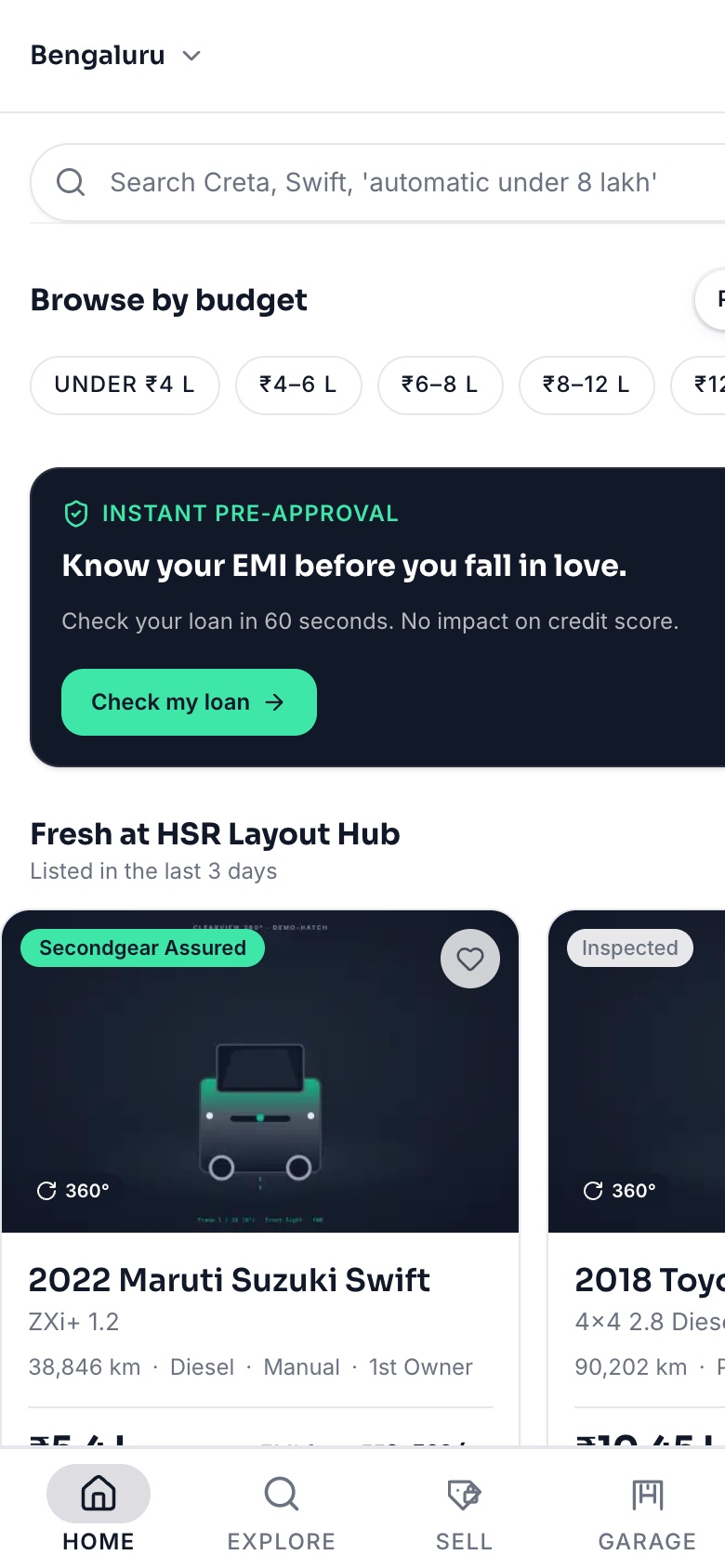
If you reach the custom stage, look at a working example before writing a spec. We built Secondgear as a concept used-car marketplace, with inspections, finance and hub delivery, and wrote up the thinking in its case study. It is a concept build, not a live dealer, but it shows how the inspection report, finance and delivery flows can fit together.
The Saral builds this type of app. The marketplace app solution page outlines what that kind of project involves, and the marketplace app guide covers cost and scope in more depth.
The concept app is a demonstration. Evaluate any vendor, including us, on references you can contact, a fixed scope and who owns the code.
Mistakes to avoid
- Paying for a DMS before a clean process. Fix your checklist, then digitise it.
- Letting photos live only on phones. Back up to a shared drive with the registration number as the folder name.
- Keeping prices in three places. One master record, updated once.
- Skipping access control. Staff leave; revoke their access the same day.
- Ignoring offline use. Inspectors in basements and auction yards lose signal; test any field app without network.
- Buying a tool your CA cannot read. Ask your accountant before you buy accounting software.
More on starting a used car business
- Start hereThe full playbook →Models, licences, startup costs and the steps to your first customer.
- Go deeperWhat to buy →Inspection tools, lot set-up and reconditioning kit, costed, plus the stock you should not buy.
- Go deeperWho to hire →The mechanic, paperwork agent and sales roles you need, with estimated pay and how to vet each.
- Go deeperGetting customers →Listing portals, WhatsApp, exchanges and finance tie-ups, plus a plan for the first ten sales.
- Go deeperFinding suppliers →Where cars and parts come from, how to vet each source and how to negotiate.
Questions people ask
What software does a used car dealer need?
At the start, a Google Sheet for stock, costs and documents, plus WhatsApp Business for enquiries. Add accounting software your CA can use once you pass about 10 cars, and a simple website with one page per car around 10 to 15 cars. Custom dealer software becomes worth it only when the sheet visibly loses you money.
Is there dealer management software for used cars in India?
Yes, several vendors sell dealer management and used-car inventory tools, but their features and prices are not verified here, so ask for demos and written quotes. Check that they handle per-car costs, document tracking and your CA's GST margin working. A sheet is usually enough until you have about 40 cars or several locations.
How do I track RC transfer status?
Use a tracker with one row per car showing each step: RC verified, loan closed, transfer forms filed, RTO acknowledgment and new RC received, with a date and an owner for each. Colour any row older than your usual timeline. The deal is only closed in your books once the new RC shows the buyer.
When should a used car dealer build a custom app?
When you have around 40 or more cars, several staff or locations, and regular losses from missed follow-ups, stale prices or stuck transfers, or when buyers want to book inspections and finance online. Run a sheet for a season first so you know exactly which problems the app has to solve.
Do I need a website if I list on car portals?
Yes, a simple one is worth having. Portals charge per listing and show your competitors beside you, while your own site gives each car a shareable link, builds your brand on Google and takes enquiries and test-drive bookings directly. Keep it simple, with a page per car and your inspection report.