Audio D2C · Commerce & D2C
Bassline
Turn it up.
A D2C audio brand: web store, companion app and unboxing.
The idea
A loud, youth-centric consumer electronics lifestyle label built on product drops, streetwear collaborations, and bass-heavy acoustics. Demonstrates high-performance D2C headless commerce combined with an intuitive Bluetooth companion app.
Features high-impact 3D product viewports, custom audio frequency tuning profiles, firmware updates, and drop countdown events.
- 01
Interactive 3D Earbud Exploder
Deconstruct the earbuds into dynamic drivers, acoustic chambers, and silicone tips.
- 02
Soundstage Visualizer
Dynamic multi-band equalizer adjusting in real-time with simulated bass-boosted audio samples.
- 03
Limited Drop Waiting Room
Live countdown queue for artist collaboration drops with real-time stock depletion indicators.
The problem
A direct-to-consumer audio brand has three jobs at once: sell a product people cannot hear through a screen, run limited launches without crashing or angering the people who missed out, and keep the customer once the box is open. Most small D2C stores manage the first, borrow a plugin for the second and ignore the third.
Indian D2C adds its own friction: pincodes that cannot be served, cash on delivery that does not suit a limited drop, GST-inclusive prices that need to be shown honestly, and a returns policy that has to survive a courier visit.
Bassline is a concept build for a fictional earbuds, headphones and speakers label. It covers a web store with a drop system, a companion app with a working five-band equaliser, an ops console for launch day, and the swap-and-warranty flow after purchase. It is a studio concept with sample products, not a shipping brand.
Who it is for
- Shopper comparing earbudsA product page that shows the product (a 3D case that opens as you scroll), a sound signature, a compare table and reviews, then a checkout that is quick and clear about delivery.
- Launch-day buyerA drop with a countdown, a lobby, a fair order of entry instead of a race, and a clear answer when units run out.
- Owner of the budsPairing, battery, a curve they can shape and hear, firmware that tells the truth when it fails, and a warranty and swap path that does not need an email chain.
What we built
Every side of Bassline, live.
Each one opens the real build in a new tab. On a laptop the apps sit in a phone frame; on a phone they run full screen.
Web store
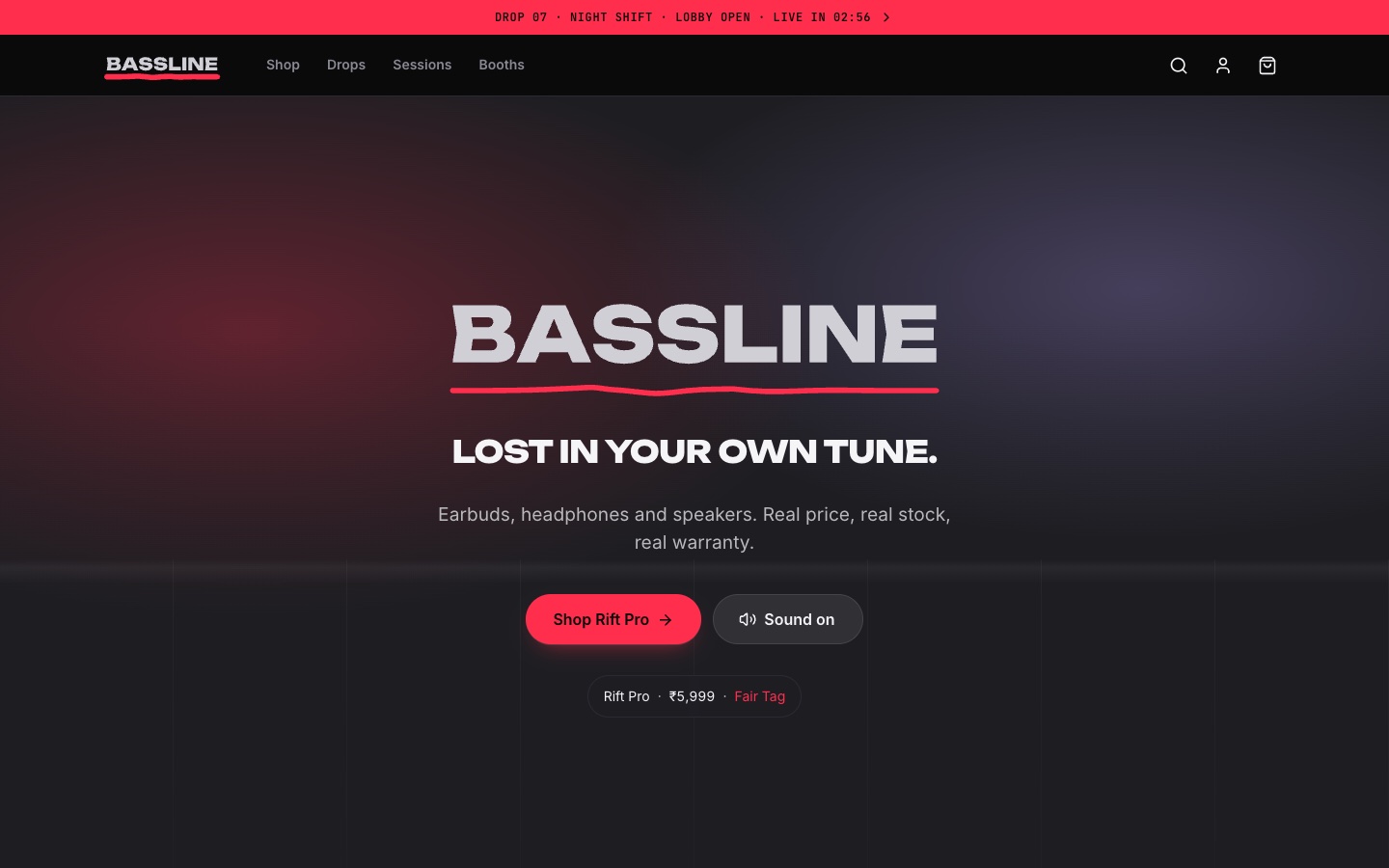
PROD BUILDHigh-conversion storefront, drop countdown, 3D product visualizer, and reviews.
Web store
High-conversion storefront, drop countdown, 3D product visualizer, and reviews.
Open /website ↗Soundstage equalizer, ANC mode toggles, touch gesture mapping, and "Find My Buds".
Companion app
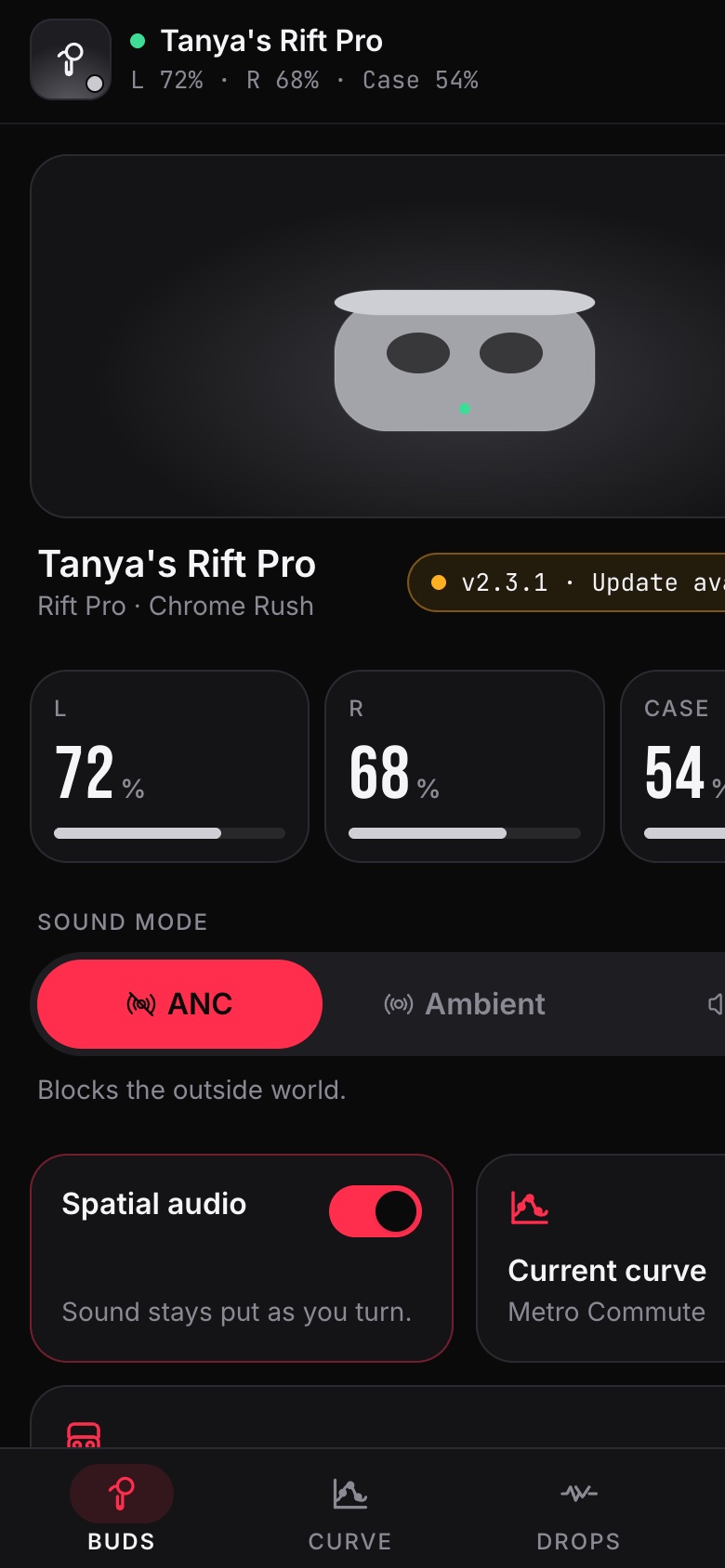
Soundstage equalizer, ANC mode toggles, touch gesture mapping, and "Find My Buds".
Open /app ↗Drop Console
PROD BUILDInventory release control, flash-sale traffic throttling, and SKU revenue metrics.
Drop Console
Inventory release control, flash-sale traffic throttling, and SKU revenue metrics.
Open /ops ↗Brand book
PROD BUILDLive audio waveforms, street-culture typography, packaging dielines, and motion identity.
Brand book
Live audio waveforms, street-culture typography, packaging dielines, and motion identity.
Open /brand ↗In detail
Surface by surface
Web store · /website
The web store has a home page with a drop band, a shop with filters and compare, product pages for ten sample products (eight standard, two limited), a cart and a checkout of contact, address with pincode check, delivery and payment steps, order tracking, a Sessions page for artist collabs, a Fair Tag page, stores, support, and a warranty registration page that validates a serial number. The product page uses a three.js case viewer whose lid opens as you scroll, with a poster and image-sequence fallback when WebGL2 is not available.
Companion app · /app
The companion app is a phone-frame prototype with tabs for Buds, Curve, Drops, Crew and Settings. Pairing is a simulated discovery sequence; there is no Bluetooth connection. Buds shows battery for each bud and the case. Curve is a five-band equaliser you drag, with real audio. A radar screen pings for a lost bud, a firmware screen runs a staged update, and a support screen starts a swap. The whole app has an English and a Hindi dictionary.
Drop Console · /ops
The ops console has an overview, a drops manager with a form for scheduling a drop, a launch wall meant for a TV on launch day, an inventory matrix, orders, and a swaps queue. The launch wall and the Drop Room share live numbers over a browser channel, so open tabs show the same sell-through.
Brand book · /brand
The brand book covers the Signal Red, Matte Obsidian and Chrome palette, display and mono type for specs, the waveform wordmark whose line reacts to audio, and the packaging system: a plastic-free sleeve and pulp tray, a limited-edition drawer box and a listening-booth kiosk.
Why it works this way
Design and product decisions
A fair drop, not a refresh race
The drop room moves through a lobby, a shuffled entry order, a live queue and a unit hold. Entry is not decided by who clicks first: the build assigns a shuffled position so a slow connection does not lose to a fast one. In the demo only Drop 07 has the queue; the others show the countdown and status states.
Be honest when it fails
Firmware needs at least 30 percent battery, shows download, transfer and install as separate stages, and a failing run is built to stall at 62 percent with a retry. Payment failure copy says nothing was charged. The brand voice here is the product: nothing pretends to have worked.
Let people hear the curve
The equaliser does not draw a graph and stop. Five bands (60 Hz low shelf, then 250 Hz, 1 kHz and 4 kHz peaking, and a 12 kHz high shelf) change a Web Audio filter chain in real time, over a range of 12 dB either way in 0.5 dB steps. An A/B switch cross-fades between flat and your curve over 80 ms, and an automatic headroom reduces gain when you boost.
Swaps instead of return forms
A swap collects a unit within 48 hours and ships a new sealed one. A second swap on the same serial turns into a full refund, and the wizard calculates which case applies from the serial's history.
Engineering notes
Under the hood
Next.js with three.js and Web Audio
Next.js, React, Zustand and Motion, plus three, react-three-fiber and drei for the case viewer. The equaliser builds an AudioContext inside a tap handler because iOS Safari only starts audio from a gesture, and its preview loop is synthesised in code (96 BPM, kick, sub, keys, snare, hats) so no audio file ships with the project.
Live drop simulation across tabs
The queue is a seeded simulation (a seeded random generator, fixed conversion and service rates) with story time compressed by a factor of 6.6. Stats and status events travel over a named browser channel, and one tab acts as the driver so several tabs do not each run their own queue.
Pure delivery and serial logic
Delivery quotes come from a pure function of pincode: invalid pincodes or ones starting 79 are unserviceable in the demo, a short list of hub pincodes gets a Today by 9 PM Rush option for ₹99 with a 1 PM cutoff, metro prefixes get one to two days, and tier-two prefixes a longer window. Serial numbers follow a regular expression with a product code, year and six digits.
Local details
Built for India
UPI, cards, netbanking and COD
The payment step offers all four, with UPI first and a QR option. Nothing connects to a gateway. Login is a code sent by text with no password.
GST shown inside the price
Prices are GST inclusive, and the order summary extracts the 18 percent that is already inside the total instead of adding it on top, so the number a shopper saw is the number they pay.
Pincode-led delivery
The address and delivery steps check the pincode before payment and says plainly if delivery is not possible, with an alternative of collecting from a listening booth. Rush same-day applies only in hub pincodes.
What this is, and is not
This is a concept build. Products, prices, drops, reviews, collab artists and queue numbers are sample data, and the queue is a simulation rather than real load. There is no Bluetooth pairing, no real firmware, no payment gateway, no courier integration and no inventory backend. The equaliser changes a browser audio preview, not actual earbuds. The 3D case is a visual model rather than a manufacturing file. A launch would need a commerce backend or a headless store behind the front end, a payment gateway with UPI and refunds, a courier and returns partner, real device firmware and pairing, load testing of the drop queue, and a legal review of warranty terms.
Last updated 2026-11-07
Brand system
Building something like Bassline? Let's talk.
We'll walk you through this build on a call and map what yours would need.