Fitness · Health & fitness
Groundwork
From the ground up.
Fitness studios and home workouts with member and trainer apps.
The idea
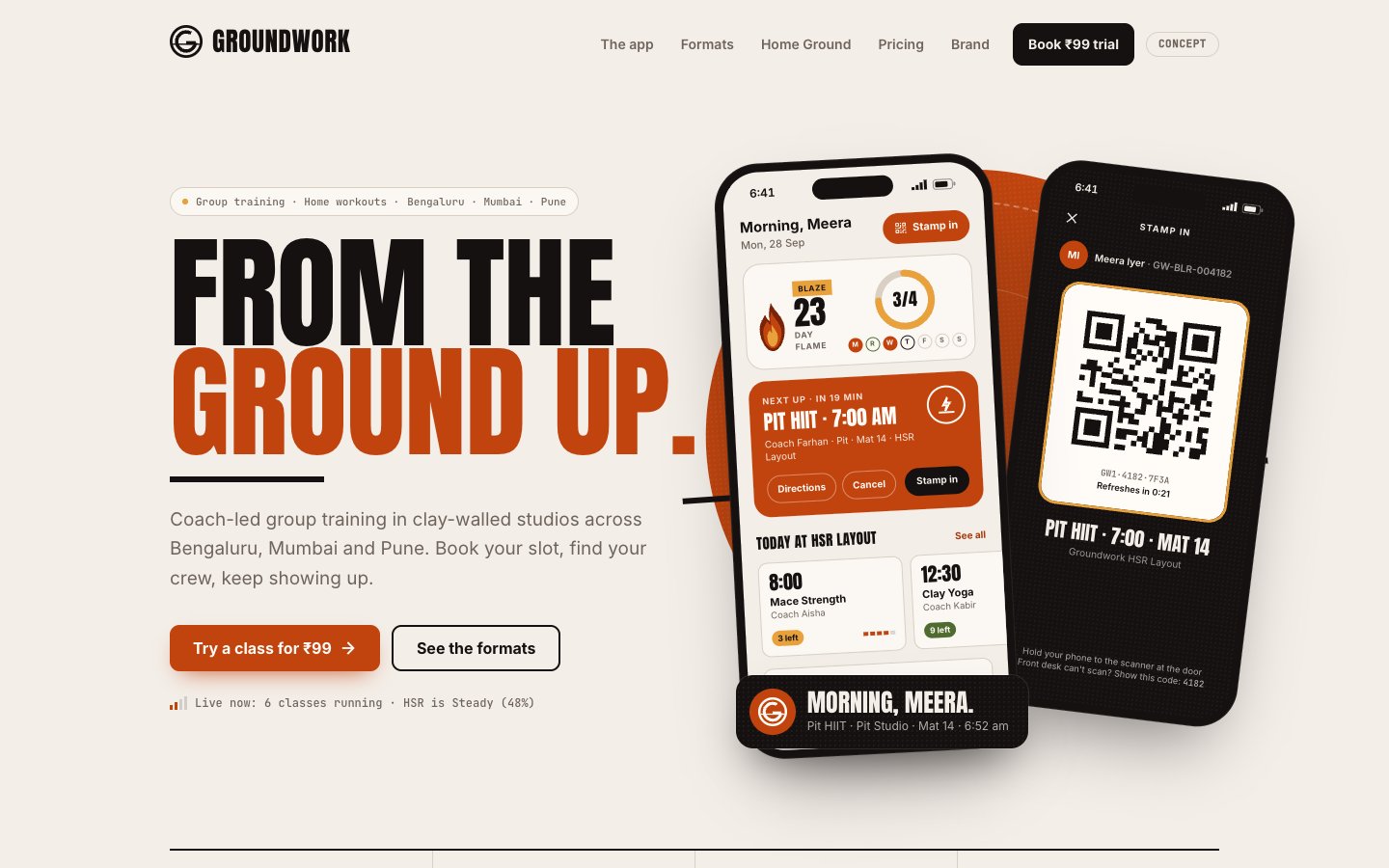
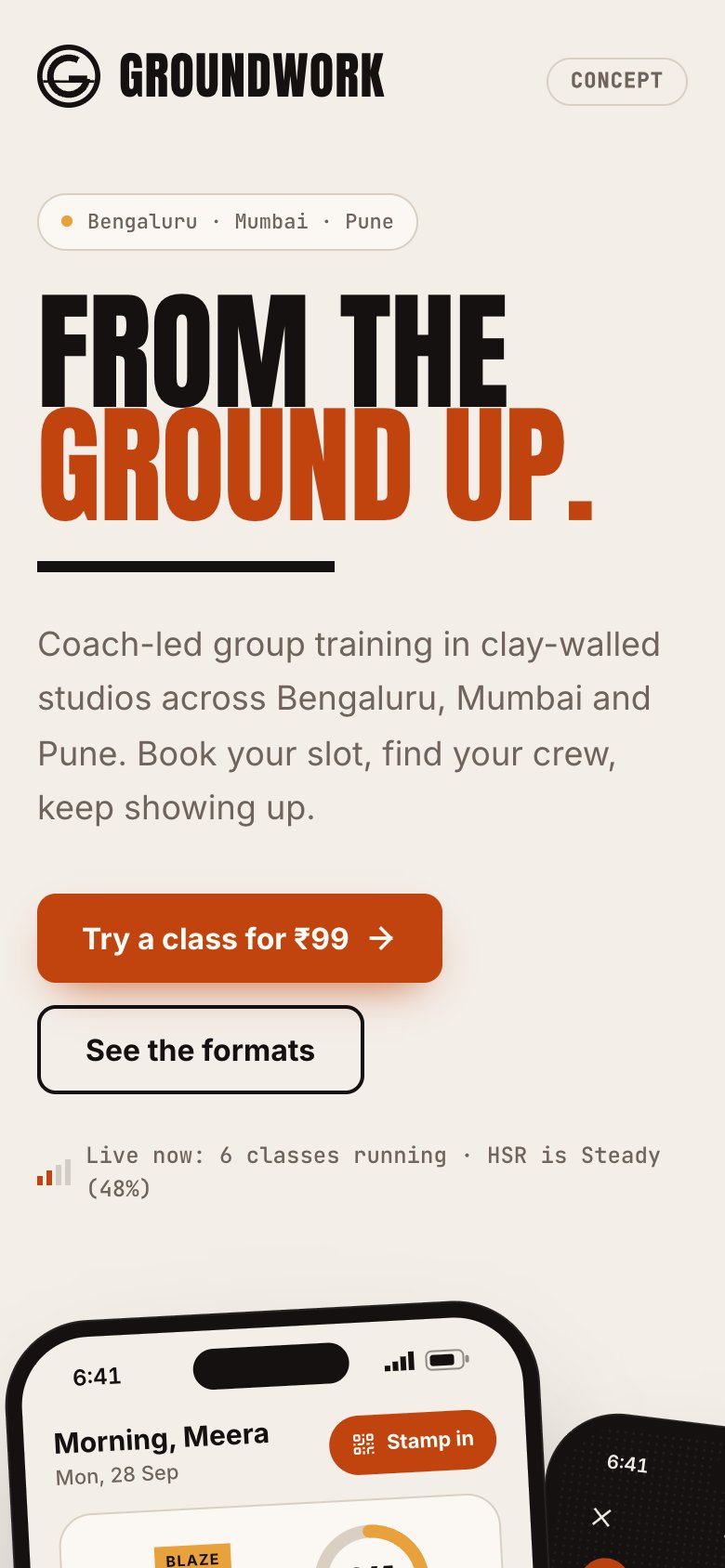
The antidote to corporate, pastel fitness fads. Inspired by the Indian akhada wrestling tradition: grounded, high-intensity, and community-driven. Focuses on functional movement, macebell workouts, and bodyweight conditioning.
Connects member workout streaks, class reservations, and home video guides with gym trainers managing class attendance and form feedback.
- 01
The Pit Booking
Fast slot reservation showing exact floor spots, trainer profiles, and intensity ratings.
- 02
Streak Forge
Motivational habit tracking with workout consistency milestones and community high-fives.
- 03
Form Guide
Video tutorials with multi-angle playback for traditional mace and bodyweight techniques.
The problem
Group fitness studios in Indian cities lose money in two quiet places: members who book a class and do not show up, and members who drift away after a few weeks. Both are mostly behaviour problems. A booking app that simply lists slots does nothing about either, and a gym floor with no sense of how busy it is leaves people guessing when to come.
Groundwork is a concept fitness brand set in Bengaluru, Mumbai and Pune. The build explores how a booking system can carry the culture of a studio: clear rules about cancelling, a streak that tolerates rest days, a floor-load view so people can pick a quiet hour, and a home-workout player for days they cannot travel.
Who it is for
- MemberBook a spot in a class, see how crowded the floor will be, check in at the door, keep a streak going and work out at home when travel is hard.
- CoachSee today's sessions and rosters, run the class from a phone, claim or request cover for a session, and see earnings after tax deduction.
- Front-desk and centre managerWatch check-ins, class fill, no-shows, renewals and incidents, and scan members in at the door.
- Corporate buyerEstimate what a team membership would cost for a given headcount and adoption rate.
What we built
Every side of Groundwork, live.
Each one opens the real build in a new tab. On a laptop the apps sit in a phone frame; on a phone they run full screen.
Studio class scheduling, workout streaks, digital pass, and home video workouts.
Member app
Studio class scheduling, workout streaks, digital pass, and home video workouts.
Open /app ↗Roster management, class check-ins, performance benchmarks, and member progress notes.
Trainer app
Roster management, class check-ins, performance benchmarks, and member progress notes.
Open /trainer ↗Studio Ops
PROD BUILDGym floor capacity, equipment maintenance logs, and membership retention analytics.
Studio Ops
Gym floor capacity, equipment maintenance logs, and membership retention analytics.
Open /ops ↗Website
PROD BUILDPhilosophy manifesto, studio tour, coach bios, and membership tier pricing.
Website
Philosophy manifesto, studio tour, coach bios, and membership tier pricing.
Open /home ↗Brand book
PROD BUILDAkhada-inspired raw typography, sweat-and-chalk imagery, and apparel lines.
Brand book
Akhada-inspired raw typography, sweat-and-chalk imagery, and apparel lines.
Open /brand ↗In detail
Surface by surface
Member app · /app
The member app covers onboarding, a schedule with format filters, class sheets, bookings, plans and membership, a pass with a QR, a Stamp In screen for the door, a stamp book of awards, progress charts, crews, a supply shop, privacy and a report-an-issue screen. A Train section holds the home-workout player. Cancelling, pausing and transferring a booking each have their own bottom sheet, so the rules are shown at the moment they matter.
Trainer app · /trainer
The coach app has Today, Week, Roster, Earnings and Me screens. A class mode runs a live session with the roster and ends in a wrap screen. Coaches can request cover for a session and claim cover offered by others.
Studio Ops · /ops
In the code this surface is the front-desk console under /desk rather than /ops. It has a dashboard with check-ins, class fill, no-shows today, renewals due in seven days, revenue month to date and open incidents. It also has schedule, members, coaches, leads and incident pages, plus a door screen that opens the camera to scan member passes or accepts a manual check-in.
Website · /home
The website has pages for formats, centres, membership, home ground, teams, community, fair play, careers and FAQ. Interactive pieces include a format quiz, a centre finder, a cost-per-class calculator, a team cost calculator and a trial sign-up form. A testimonials strip is labelled as concept testimonials.
Brand book · /brand
The brand kit is built in the same repo: the Clay Red, Soil Black, Chalk White and Turmeric palette, a clay-stamp visual language that also appears in the stamp awards, and print and slide exports. The visual direction takes cues from traditional Indian wrestling grounds and chalk-and-sweat training.
Why it works this way
Design and product decisions
Cancel rules written into the product
Cancelling at least 60 minutes ahead is free, and releasing a spot more than 6 hours early earns 15 Grit points. Cancelling inside 60 minutes costs 20. A no-show earns a yellow card only if the class was full or had a waitlist, and three cards in 30 days pause booking for 48 hours. A class that was not full waives the card, which is a fairer rule than a flat penalty.
Check-in has a window
A booking can be stamped in from 30 minutes before the class to 10 minutes after the start. The door screen and member pass use the same rule, so early and late arrivals are treated consistently.
Streaks that allow rest
The streak counts rest days: two uncovered days per ISO week are treated as rest, not as a break. If a day is missed, the streak shows as cracked and offers a mend until 11:59 pm that day. Tiers run from ember and spark through flame, blaze, kiln and forge, with milestones at 7, 21, 50, 100 and later days. Punishing rest is a common reason people quit.
Show the floor load before they travel
A floor-load widget estimates how busy each centre is by hour, using a base curve with peaks around 7 am and 7 pm and a per-centre multiplier. Members can choose a quieter time, and the desk can see the same shape.
Engineering notes
Under the hood
Next.js with typed state
A Next.js and React project with zustand stores for bookings, activity, stamps, member settings, desk, community, the coach app and the player, persisted in the browser with a safe storage wrapper. Zod validates data shapes, and date libraries handle time zones for Indian Standard Time.
A workout player engine
The home-workout player is a state machine with ready, countdown, playing, paused and finished states. It runs block timers and rep targets, speaks cues through speech synthesis, plays a drum metronome from the Web Audio oscillator, and asks the browser to keep the screen awake while it runs.
Door scanning in the browser
The door screen requests the rear camera for scanning member passes. Passes carry a token generated from the member number and booking, and a QR image is drawn client-side with a QR package.
Local details
Built for India
Three cities, with city pricing
Centres sit in Bengaluru, Mumbai and Pune and plan prices and drop-in prices vary by city. All amounts are in rupees, and the member and desk views use Indian Standard Time.
Coach payouts with TDS
The coach earnings screen shows a TDS withholding line under Section 194J, the section commonly applied to professional fees. It is shown as a sample deduction, not tax advice.
Formats rooted in local training
Classes include mace strength, rope burn, sandbag build, drum cardio and clay yoga alongside HIIT and grappling, with a quiz that asks about joints (knees, back, shoulders) as well as goals.
What this is, and is not
Groundwork is a front-end prototype with sample data. There is no payment gateway, no real membership billing, no door hardware and no server: bookings, streaks and stamps live in the browser. The floor-load view is a modelled curve, not a sensor feed. The equipment-maintenance log in the catalogue is not built, retention reporting stops at an at-risk member list, and the format quiz scoring is a simple rule set, not a recommendation engine. A real launch would need billing, a booking backend with concurrency control, access control hardware, and staff rostering.
Last updated 2026-11-07
Brand system
Building something like Groundwork? Let's talk.
We'll walk you through this build on a call and map what yours would need.