Jewellery · Commerce & D2C
Karatly
Made to be kept.
Fine jewellery with live gold-rate breakdowns, AR try-on and store visits.
The idea
Bringing quiet luxury and radical price transparency to Indian fine jewellery. Breaks down every ring, pendant, and bangle price into live market gold weight, certified diamond grading, and fair making charges.
Features augmented reality (AR) virtual try-ons for hands and ears alongside a luxury "Try at Home" concierge service booking.
- 01
Live Gold Rate Breakdown
Transparent pricing widget showing exact bullion market spot price and crafting fee separation.
- 02
AR Ring Hand Try-On
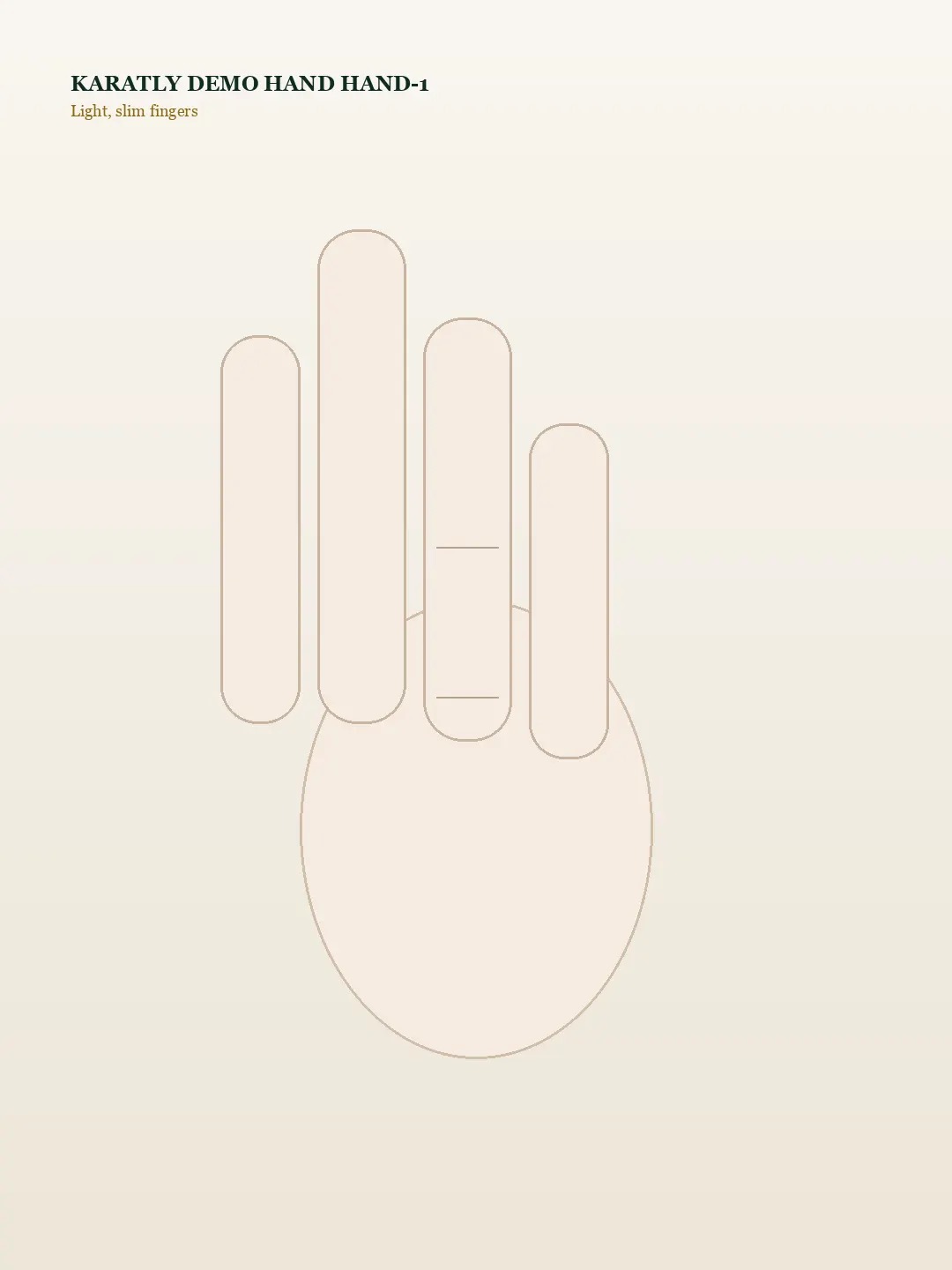
Point your camera at your finger to visualize diamond carats, band metal colors, and proportions.
- 03
Try-at-Home Booking
Select up to 5 designs for a private, insured home viewing with a trained jewellery stylist.
The problem
Jewellery is where Indian shoppers most want to see and trust before paying, and where the price is hardest to read. A tag shows one number, but it is gold weight times the day's rate, plus making charges, stones and GST, and the rate moves during the day. Online stores often hide that working, which makes buyers suspicious.
Karatly is a concept build for a fictional fine-jewellery label that shows the working. Each product page breaks the price into gold, stones, making and GST, a rate lock holds the rate through checkout, and a buyback value is stated before purchase. For the trust gap it adds a camera try-on, a try-at-home trunk of up to five pieces, and a hallmark check by HUID. Products, certificates and the rate are sample data.
Who it is for
- Buyer of a gift or first fine pieceTo understand what the price is made of, try the piece on without a shop trip, and know what it is worth sold back.
- Concierge or stylistA day list, a packed trunk with checked inventory, a home-visit session and a terminal to take payment.
- Atelier operatorThe live rate and making policy, a bench board from brief to dispatch, hallmark records, a vault and visits and orders in progress.
What we built
Every side of Karatly, live.
Each one opens the real build in a new tab. On a laptop the apps sit in a phone frame; on a phone they run full screen.
Boutique Storefront
PROD BUILDLive bullion gold rate ticker, diamond 4Cs selector, AR try-on, and custom engraving.
Boutique Storefront
Live bullion gold rate ticker, diamond 4Cs selector, AR try-on, and custom engraving.
Open /shop ↗Home trial appointments, luxury trunk inventory, and mobile card payment terminal.
Concierge app
Home trial appointments, luxury trunk inventory, and mobile card payment terminal.
Open /concierge ↗Atelier Ops
PROD BUILDCertified hallmarking records, inventory vault security, and custom order artisan bench.
Atelier Ops
Certified hallmarking records, inventory vault security, and custom order artisan bench.
Open /ops ↗In detail
Surface by surface
Boutique Storefront · /shop
The boutique has categories for rings, earrings, bangles, pendants, mangalsutra and nose pins, product pages with a price breakdown, size sheet and engraving preview, a wishlist, bag, checkout and a certificate page keyed by HUID. A solitaire builder prices a stone by carat, colour, clarity, cut and natural or lab origin. A try-on page works for rings and earrings, and a trunk flow books a home visit with up to five pieces.
Concierge app · /concierge
The stylist's phone app has a Today list with an incoming request layer, inventory, a trunk-pack screen, a run screen for the drive, a session screen and a payment terminal that accepts card or UPI. A visit runs requested, packing, sealed, en route, arrived, in session, settled and returned.
Atelier Ops · /ops
Atelier Ops is a desktop control room with an overview, a rates screen with a 720-hour history and making policy, a bench board (brief, CAD, wax, casting, setting, polishing, hallmarking, QC, dispatch), hallmark records, a vault, a visits board and orders. One event stream feeds all three apps.
Why it works this way
Design and product decisions
Price as separate lines
Gold (purity, net weight times rate per gram), stones, making charges as a percentage of gold value, optional engraving at 750 rupees and GST at 3 percent. These are the lines on a jeweller's invoice, and showing them moves the question from whether the price is fair to whether the design is worth it.
A ten-minute rate lock
Gold moves during the day, so checkout can lock the rate and count the time down. Without it a buyer could see one price in the bag and another at payment and read it as a trick.
Buyback and exchange up front
The breakdown carries an exchange value equal to gold plus stone value against a new piece, and a buyback at 90 percent of gold value, both from the same rate as the price. Stating what a piece is worth later is a trust signal specific to jewellery.
Solitaires priced by the four Cs
Carat from 0.3 to 1.5, with multipliers for colour, clarity and cut, and lab origin cutting the stone price to 18 percent. A four-Cs sheet explains each term, so a buyer sees why VVS1 costs more than SI1.
Engineering notes
Under the hood
Try-on runs in the browser
Rings use a hand-landmark model and earrings a face-landmark model from MediaPipe, served from the app's own public folder. Poses are smoothed before drawing, a capability check covers camera and WebGL, and a demo-hand fallback runs when the camera or model is unavailable.
Rate as a function of time
Prices are integer paise. The demo rate is deterministic noise by the hour around 11,840 rupees per gram for 24K, with 22K, 18K and 14K by purity factor, and a seeded history file backs the charts. It is not a market feed.
Stores, events and two languages
Next.js 16, React 19, Zustand and Recharts, with persisted stores for bag, wishlist, orders, visits, rates and trunk, and visit and order state machines. A small i18n layer carries English and Hindi for storefront copy, while ops screens stay in English.
Local details
Built for India
Purity and tax
Purities are 24K, 22K (0.916), 18K, 14K and platinum 950. GST is 3 percent on the subtotal, and making charges are a separate percentage line, as in a shop.
HUID hallmark check
Each sample piece has a six-character HUID, and the site opens a digital certificate with purity and record details. It follows the shape of BIS hallmarking, but the codes are sample data and nothing queries a registry.
Cities, categories and payment
Sample salons are in Bengaluru, Mumbai, Delhi NCR and Hyderabad. The catalogue includes mangalsutra, nose pins and bangles, and storefront checkout uses a mock UPI sheet.
What this is, and is not
Karatly is a concept build made by the studio. The products, stones, HUID codes, certificates, salons, stylists, buyback offer and gold rate are sample data, and the rate is a generated curve. Payments are simulated, and there is no inventory, vault, courier, insurance or hallmark registry. The try-on is an approximation drawn over a camera frame and will not match a real piece's size. A real launch would need a live rate source, a commerce backend, KYC and PAN rules for high-value sales, insured logistics, a BIS-registered hallmarking chain and a legal buyback policy.
Last updated 2026-11-07
Brand system
Building something like Karatly? Let's talk.
We'll walk you through this build on a call and map what yours would need.