Going out · Lifestyle & entertainment
Outpass
Your pass to tonight.
One app for going out: tables, movie seats, gig tickets and splitting the bill.
The idea
Book a table, grab movie seats, get gig tickets and split the bill with friends — in one place. The name plays on the hostel outpass: permission to go out and have fun.
Nocturnal and editorial: aubergine nights, marigold light and magazine layouts. It reads like a culture guide, not a booking utility, and comes with venue and gate-scanner apps.
- 01
Holopass
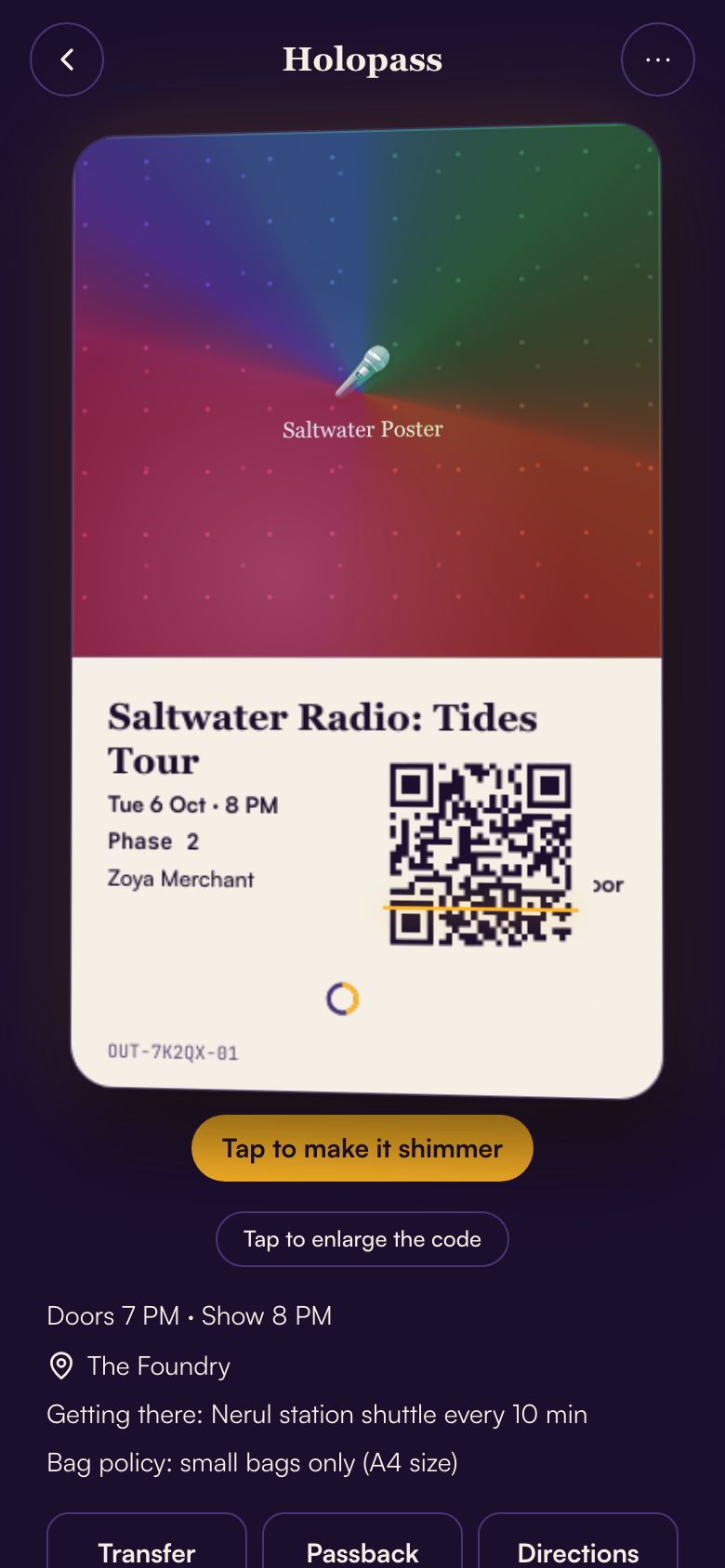
A wallet ticket with a moving holographic QR.
- 02
Seat map
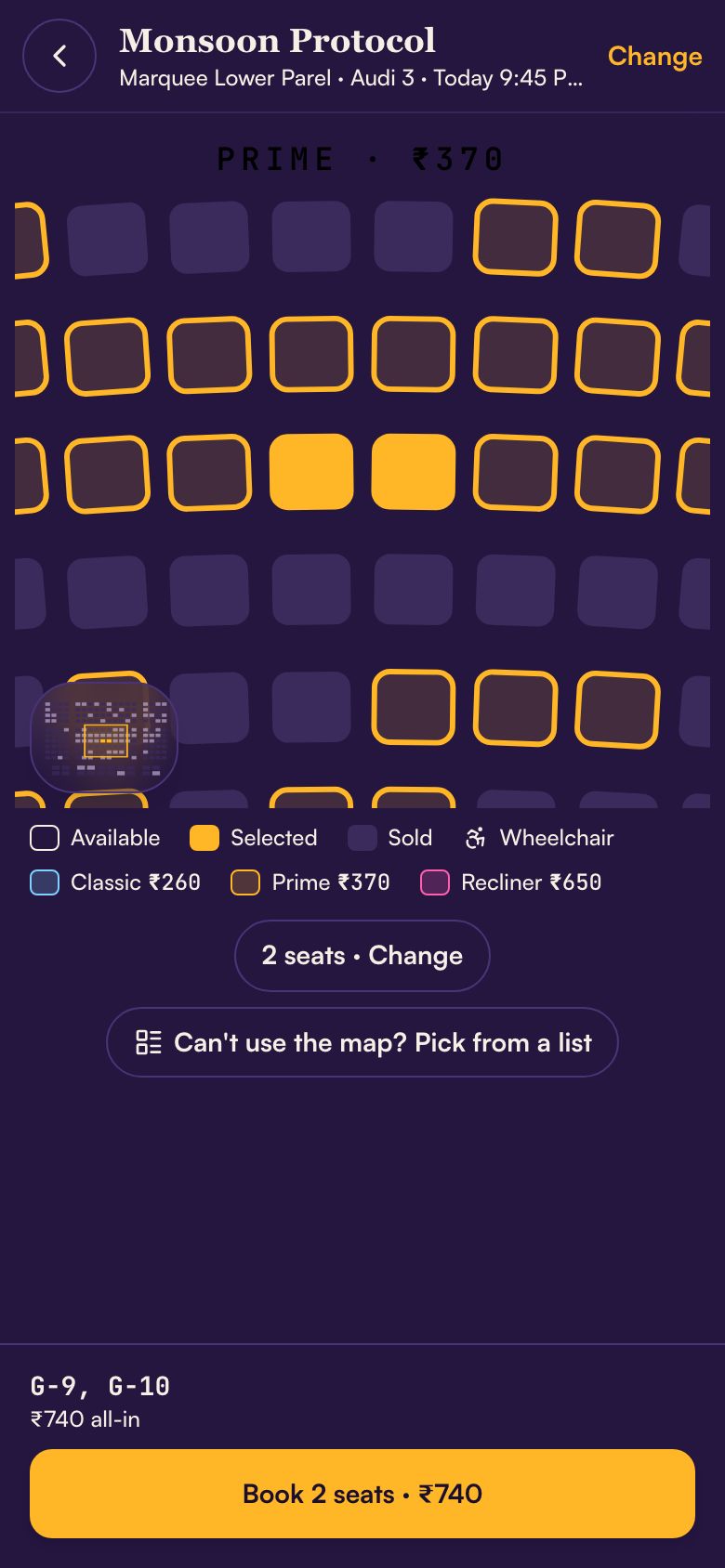
Pinch-zoom, seat categories and a best-seats auto-pick.
- 03
TablePay
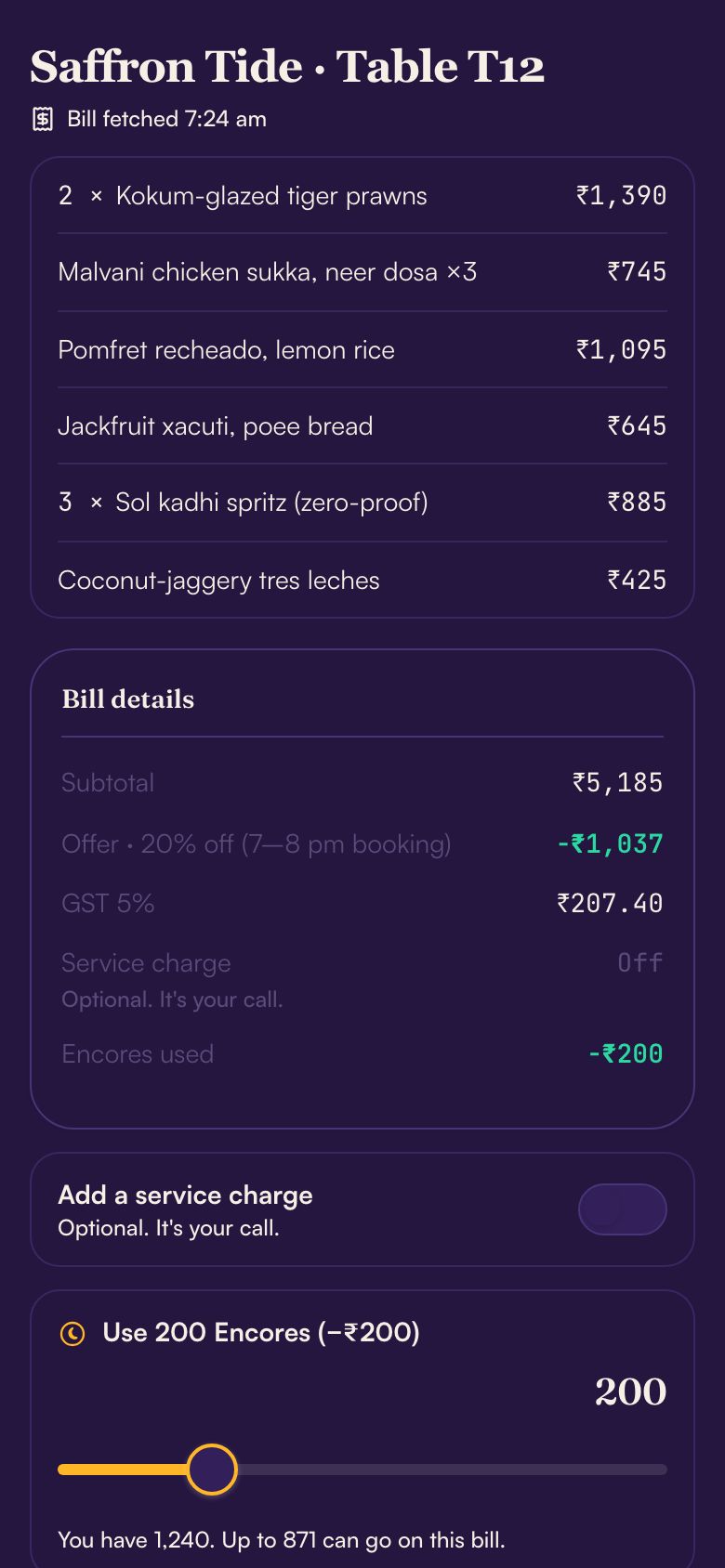
Fetch the bill at the table, apply the offer, pay your share.
The problem
Going out in an Indian city is booked across too many places: a table on one app, a film on another, an event ticket on a third, and a bill split on a fourth, with a group chat holding it together. Each handoff leaks something. Fees appear at the last step, resold tickets cost many times their face value, and screenshots of QR codes get copied.
Venues and gates have their own version of the problem. A restaurant host juggles reservations, walk-ins and table turns on paper or a phone. A gate crew has a few seconds per person and needs a clear yes or no, not a debate about a screenshot.
Who it is for
- Someone planning a night outSee what is on tonight, reserve a table or pick seats, and agree a plan with friends without a long chat thread.
- A group of friendsVote on where to go, pay a shared bill and have each person pay exactly their share.
- Venue host or managerA live floor plan, a reservation timeline, a walk-in waitlist and a bill screen that matches what the table sees.
What we built
Every side of Outpass, live.
Each one opens the real build in a new tab. On a laptop the apps sit in a phone frame; on a phone they run full screen.
Customer app
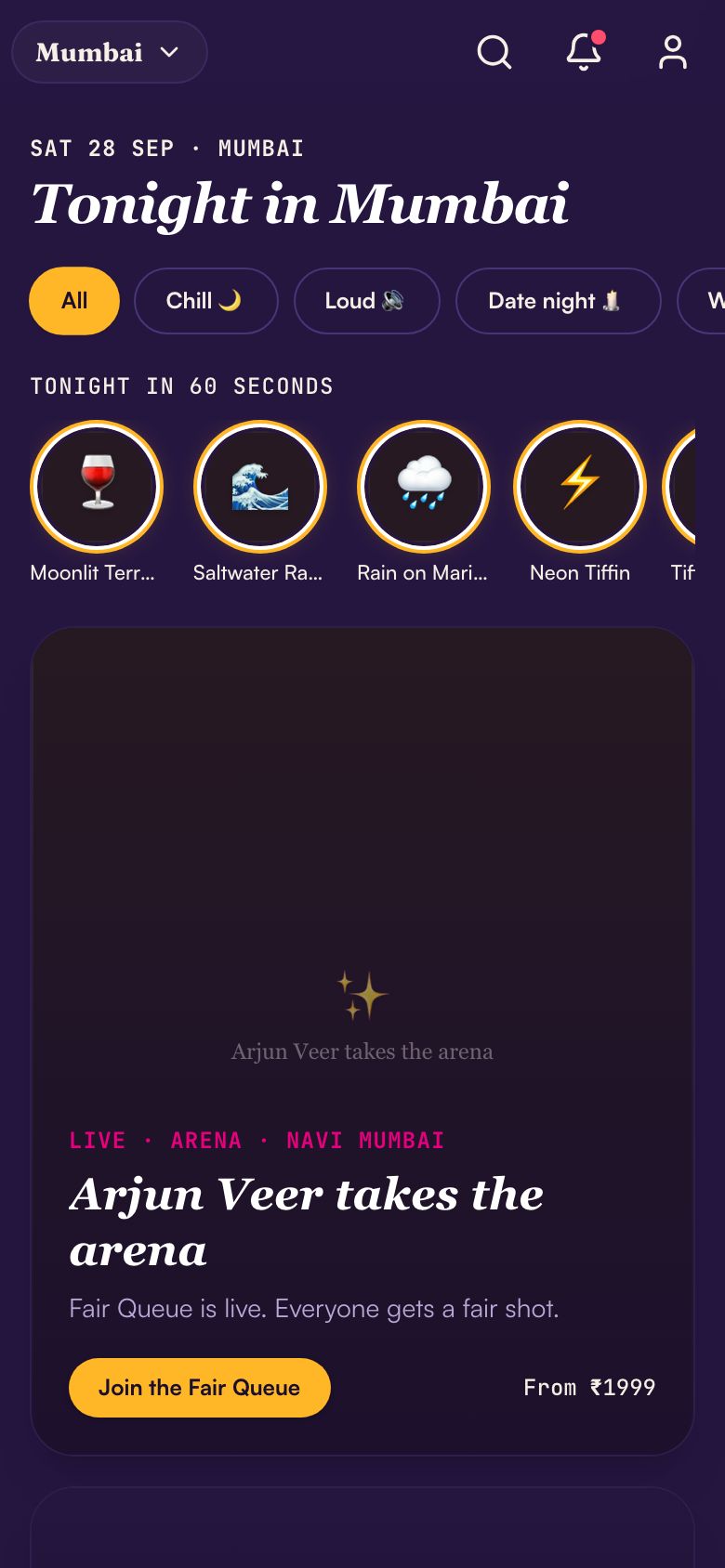
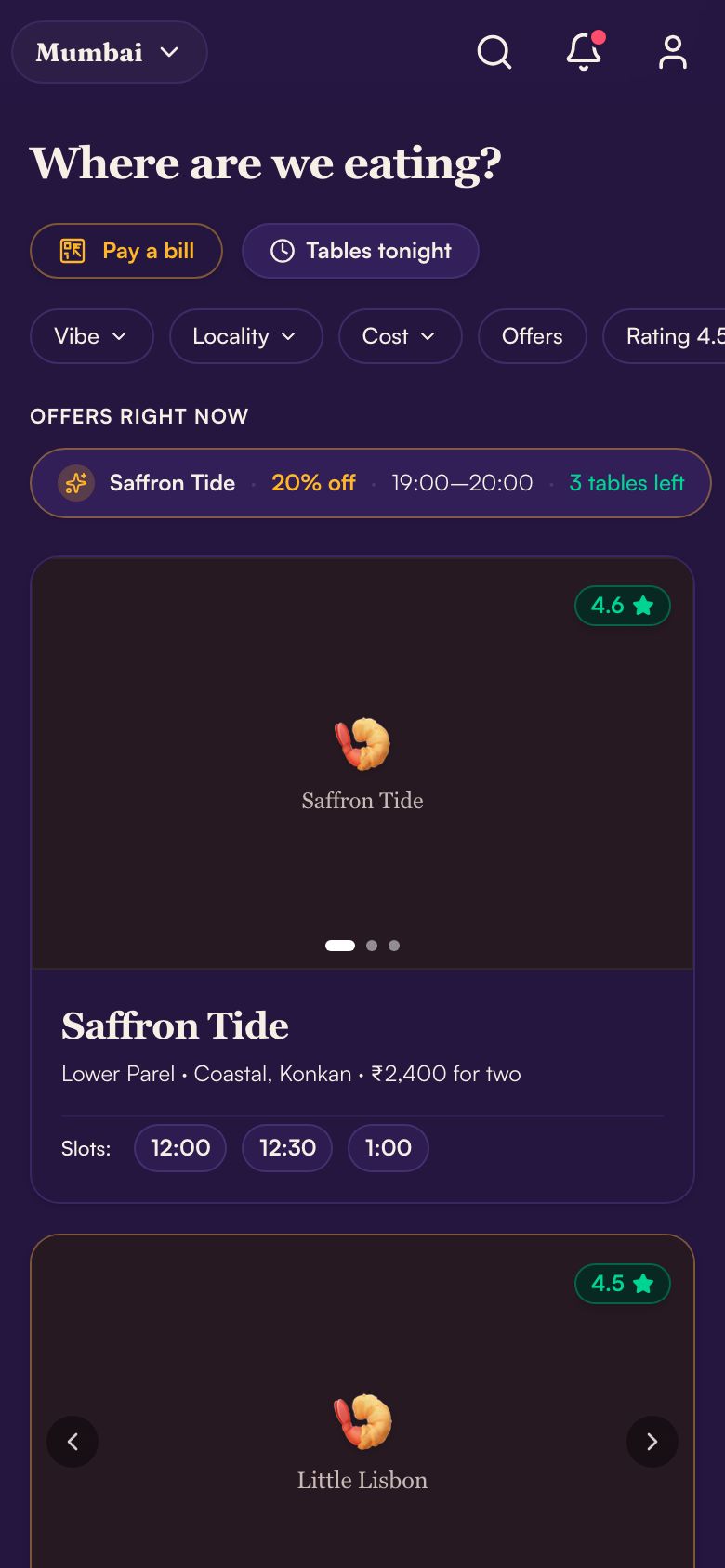
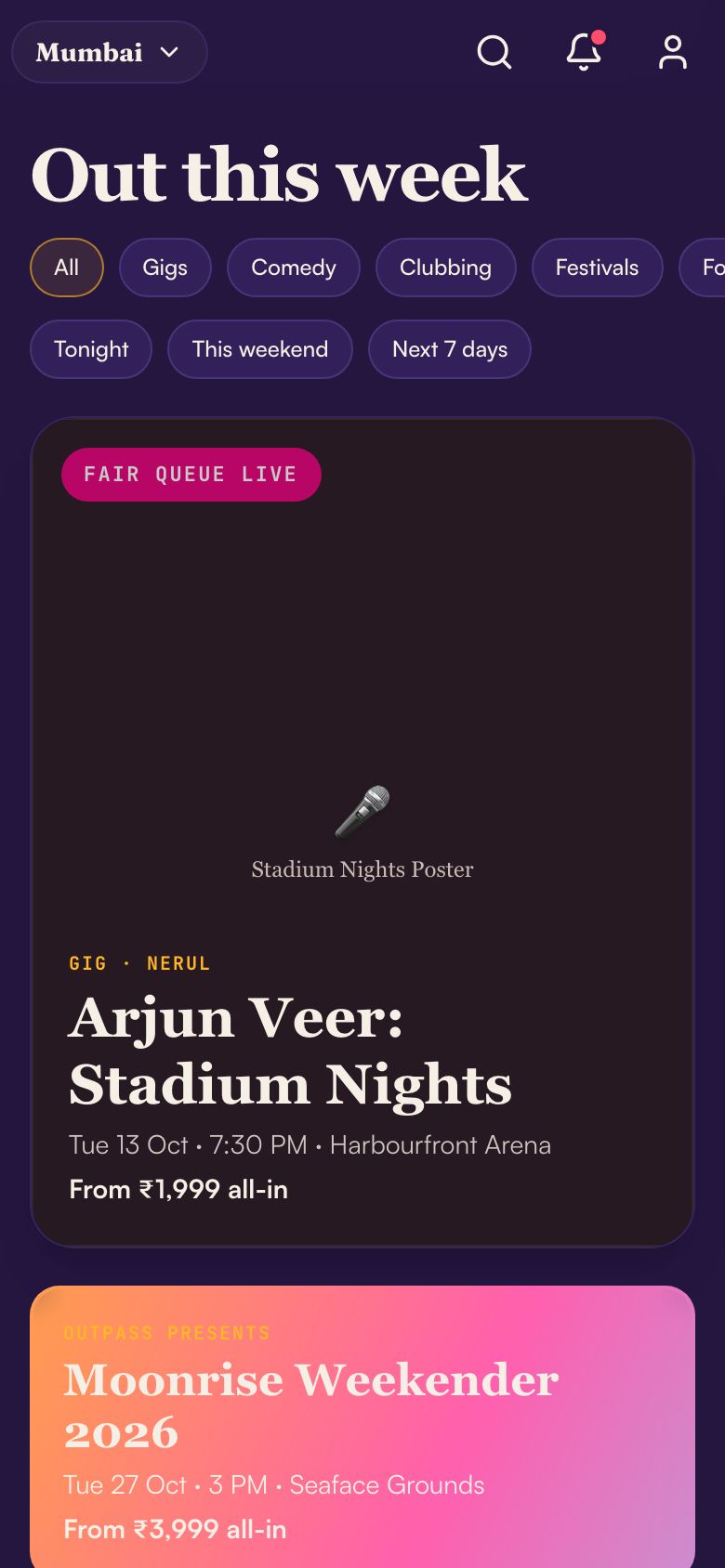
Tonight feed, dining slots, seat maps, gigs and TablePay.
Open /app/solutions ↗Reservations timeline, walk-in waitlist and table layout.
Venue app
Reservations timeline, walk-in waitlist and table layout.
Open /venue ↗Scan the ticket; a full-screen green or red result and live entry count.
Gate scanner
Scan the ticket; a full-screen green or red result and live entry count.
Open /scan ↗Website
PROD BUILDThis week in the city, as a magazine grid.
Website
This week in the city, as a magazine grid.
Open /website ↗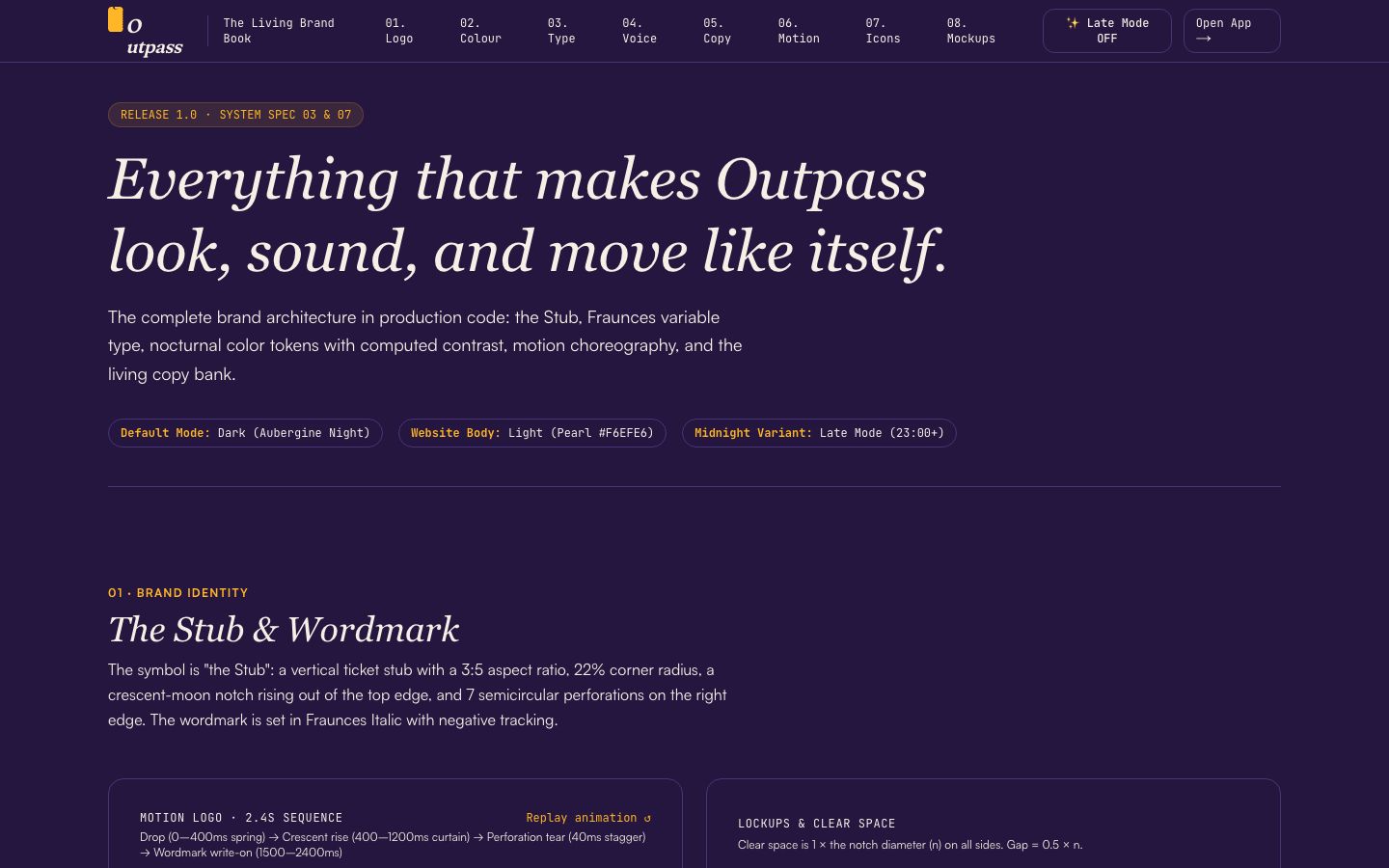
Brand book
Gradients, a token matrix with live contrast, and event collateral.
Open /brand ↗Synced demo
PROD BUILDCustomer, venue and gate on one clock.
Synced demo
Customer, venue and gate on one clock.
Open /demo ↗In detail
Surface by surface
Venue app · /venue
The Host app is a tablet layout for a restaurant: a table floor plan, a reservation timeline, a walk-in waitlist, service views, reports and charts. Moving a reservation to another table is checked by code that looks at seats and at overlapping bookings, using a booking length of 90, 105 or 120 minutes depending on party size.
Gate scanner · /scan
The Gate scanner is a handheld view for door staff. It reads a QR code with the device camera, checks it, and fills the screen with a one-word result such as LET THEM IN, ALREADY IN, WRONG GATE, CODE EXPIRED or NOT FOUND, with different vibration patterns for each.
Website · /website
The in-world website is laid out like a city magazine: what is on this week, how it works, pages for venues and organisers, a fair-ticketing promise page and careers and press pages.
Brand book · /brand
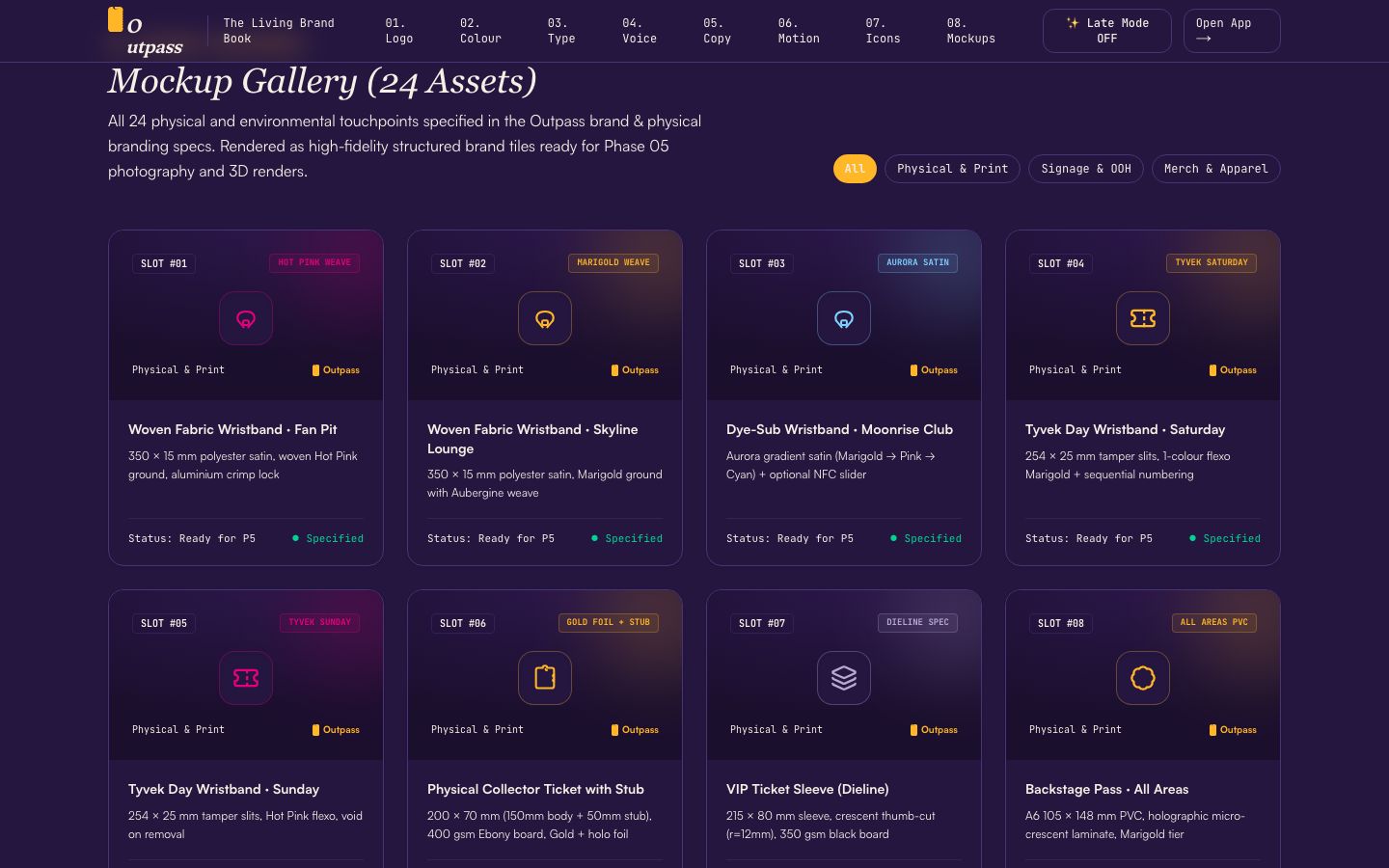
The brand book shows gradients, a colour token matrix with live contrast checks and event collateral such as passes, wristbands and posters. Because the colours are tokens, the contrast readout updates as a token changes.
Synced demo · /demo
The synced demo runs the customer app, the venue app and the gate on one shared clock, so a booking, a table and a scan can be shown in a single walkthrough.
Why it works this way
Design and product decisions
A pass that cannot be screenshotted
The Holopass shows a QR whose contents change every 20 seconds. The payload is OUTPASS1, the ticket id, a time window and an eight-character code derived from a per-ticket secret, and the gate accepts the current window plus or minus one. A copied screenshot goes stale within about a minute, which is the point.
Gate results ordered by precedence
Validation checks a malformed code, an unknown ticket, a stale window, a wrong code, a ticket already used and a wrong gate, in that order. An unknown serial never reveals whether a ticket exists. Staff get a wrong-gate result that names the correct gate, rather than a plain rejection.
A queue that is fair on purpose
For a big on-sale the Fair Queue puts everyone in a waiting room for 6 seconds, then moves position along a curve over a 90 second demo run, from a sample start of 4,212 to zero. The point of the design is that a fixed waiting room and a smooth curve replace a click race.
Bill maths in whole paise
TablePay applies an offer first, then 5 percent GST on the discounted amount, then an optional 0, 5 or 10 percent service charge, and then Encores (loyalty credits) can cover at most 20 percent of the bill. Splitting works equally, by items or by custom amounts and always adds back to the total, with rounding paise assigned to a named person.
Engineering notes
Under the hood
Front-end prototype with shared packages
Next.js, React, TypeScript, zustand for persisted stores, zod for data shapes and shared workspace packages for UI and simulation. Charts use Recharts, drag and drop on the host floor uses dnd-kit and gestures use use-gesture. The API layer is async functions over sample data with a simulated delay, with no server.
Real QR decoding, scripted trust
The gate scanner reads frames from the camera with jsQR and passes the decoded text to a pure validation function. The rotating code uses a 32-bit FNV hash, which is fine to show the idea but is not a security mechanism. A production build would sign codes server-side.
Simulation runners per feature
Separate runners drive booking, seat-hold contention, Huddle voting and bill splitting, and a bus links the app, venue and gate windows in one browser. Persisted stores use a storage wrapper that falls back to memory in private browsing.
Local details
Built for India
GST on a restaurant bill
The bill uses a 5 percent GST rate applied after the offer and an optional service charge that the guest can set to zero. Showing the service charge as a choice reflects how guests now treat it.
Three metro cities
Sample data is organised under Mumbai, Bengaluru and Delhi NCR, with venues, events and showtimes tagged by city, and a Double Bill idea that pairs a dinner with a film within a 10 minute walk.
Group planning the way friends really do it
Huddle turns a group chat poll into a board with options, reactions and a winner reveal, then ends in a booking card that slides up under the winning option. Splitting at the table assumes the person with the card pays and others settle their share, as is common here.
What this is, and is not
This is a concept build. Venues, events, films, seat maps, tickets, queue positions and every figure on the gate and ops screens are sample data. No payment is processed, nothing is sent over a network, and the Holopass hash is not secure enough for real ticketing. The Hindi file covers interface chrome only. A real launch would need venue and organiser onboarding, a payments and payout provider with GST invoicing for tickets, server-signed passes, a ticket-inventory source of truth, resale and refund policy that follows consumer law, and offline behaviour at the gate when the network drops.
Last updated 2026-11-07
More screens
Brand system
Building something like Outpass? Let's talk.
We'll walk you through this build on a call and map what yours would need.