Fashion D2C · Commerce & D2C
Threadline
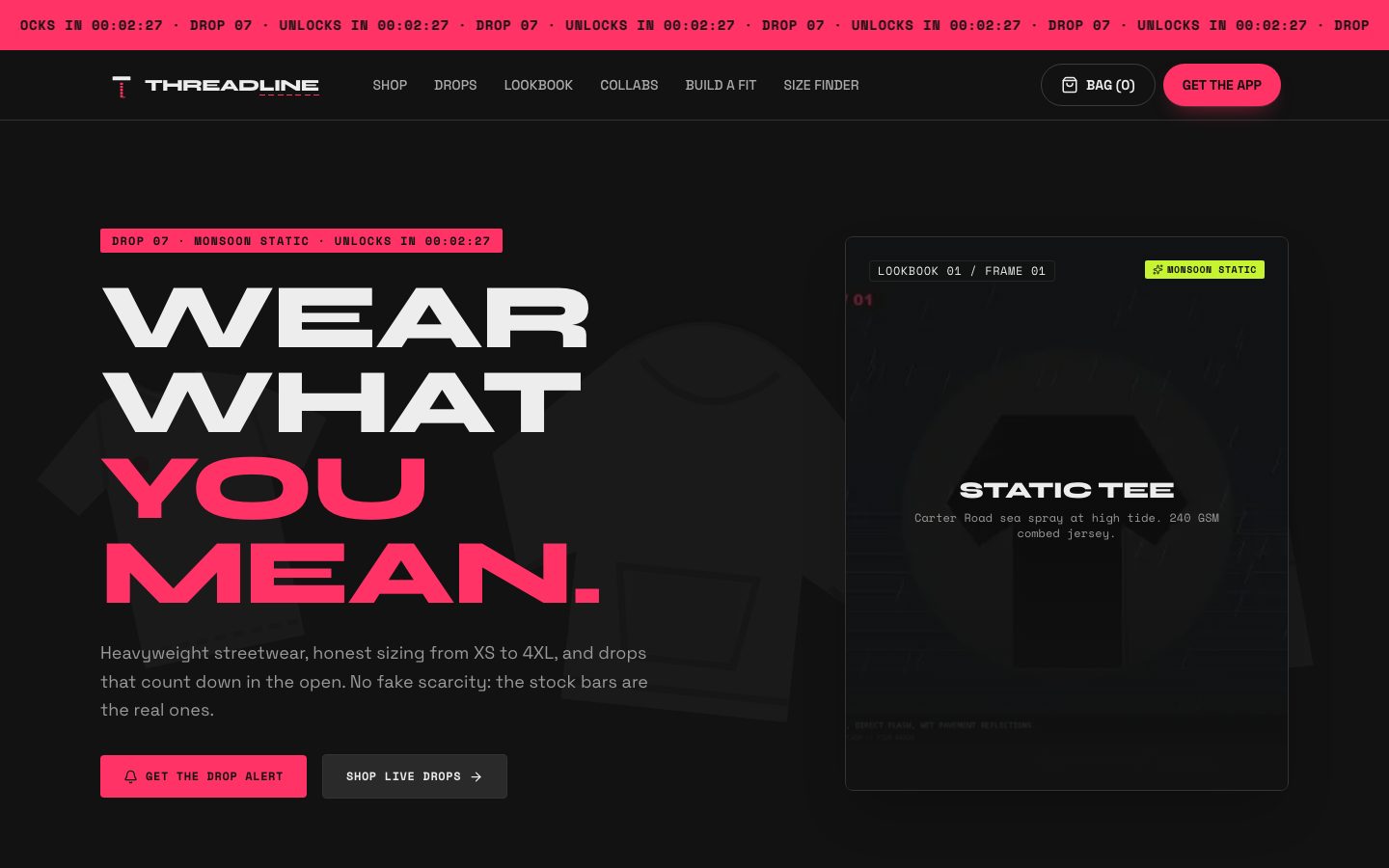
Wear what you mean.
Youth streetwear drops with an outfit builder, size finder and lookbooks.
The idea
Catering to Gen Z Indian fashion aesthetics: bold silhouettes, heavyweight graphic tees, and streetwear collaborations. Built with a mobile-first editorial shopping lookbook and rapid drop countdown mechanics.
Includes an interactive outfit builder helping shoppers match cargo trousers, oversized hoodies, and accessories with instant bundle savings.
- 01
Interactive Outfit Canvas
Drag-and-drop clothing items onto a mannequin to test color combinations and total pricing.
- 02
Drop Timer Lock
Exclusive collection unlocks at zero seconds with live checkout throttling for hype releases.
- 03
TrueFit Measurement Guide
Camera or size-comparison tool matching customer height/weight against apparel fit models.
The problem
A streetwear label that sells in limited drops has two problems most stores do not. At the minute a drop opens, thousands hit one page, the site slows, scripts grab stock and real customers see a sold-out stamp. And oversized tees have no obvious size logic, so buyers order two sizes and return one.
Threadline is a concept build for a fictional youth streetwear brand that treats both as design problems. The drop is a timed lock with a queue and a held cart. Sizing is a guided finder using height, weight, build and preferred fit. An outfit builder aims to raise basket size by showing pieces together. The brand, drops and collabs are fictional and all numbers are sample data.
Who it is for
- Club member waiting for a dropTo know when the drop opens, whether early access applies, their place in the queue and how long the cart is held.
- First-time buyer unsure of sizeA size for an oversized cut without reading a chart, and a model of similar height and weight to compare with.
- Drop operatorTo arm a drop, throttle admissions, watch size stock, check fabric lots and see why items come back.
What we built
Every side of Threadline, live.
Each one opens the real build in a new tab. On a laptop the apps sit in a phone frame; on a phone they run full screen.
Storefront
PROD BUILDDrop release grid, size finder engine, interactive outfit builder, and lookbook.
Storefront
Drop release grid, size finder engine, interactive outfit builder, and lookbook.
Open /shop ↗Early access notifications, member discounts, order tracking, and community styling wall.
VIP Drop app
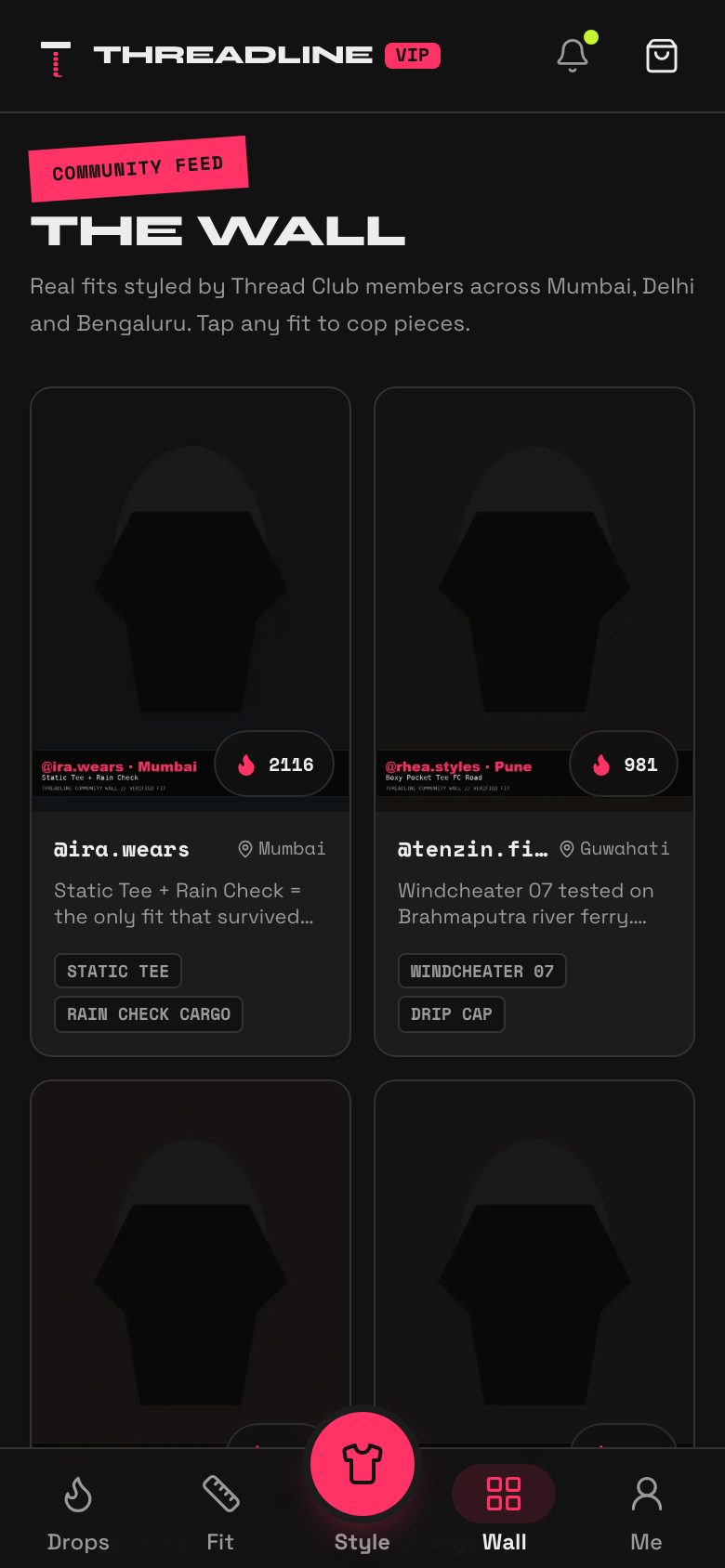
Early access notifications, member discounts, order tracking, and community styling wall.
Open /app ↗Apparel Studio
PROD BUILDDrop inventory allocation, returns rate analytics, and fabric supply logs.
Apparel Studio
Drop inventory allocation, returns rate analytics, and fabric supply logs.
Open /ops ↗In detail
Surface by surface
Storefront · /shop
The storefront has 48 products across tees, hoodies, jackets, cargos, caps, socks, totes and patches, plus lookbooks with tappable products, a collab page, a desktop size finder and an outfit builder. Product pages carry an inline fit panel and a Complete the Fit strip. Drop pages show stock per size. Checkout takes address and pincode and pays through a mock UPI sheet.
VIP Drop app · /app
The VIP drop app is the member's phone view with tabs for drops, outfit, fit, wall and club. A drop starts as a lock card with a countdown, then a queue, then an admitted panel with a ten-minute cart hold ring. Members can run the size finder, post to a styling wall, and start an exchange or return from an order by picking a reason.
Apparel Studio · /ops
The apparel studio is a desktop control room: a live panel with a throttle, orders feed, size heat grid and bot counter, a drops page that arms a drop, an allocation grid by channel and size, fabric lots with tested weight and shrinkage, and a returns page with reasons and charts. Stock and orders are shared with the other apps.
Why it works this way
Design and product decisions
A timed lock instead of a product page
Before a drop opens the member sees a flip-digit countdown that pulses in the last ten seconds, then a lock that opens with a tape sweep. The queue models 120 admissions per ten seconds from position 1,284 with a time estimate and a ten-minute hold. A visible rule is easier to wait in than a spinner.
Tiers move the start time
Loose Thread is free, Tight Knit starts at 5,000 rupees of spend and Inner Circle at 15,000. Higher tiers get 10 and 30 minutes of early access, 5 and 10 percent off and free shipping, while Loose Thread pays 99 rupees under 999. Early access is what makes a member feel recognised.
Discounts never stack
The bag compares the tier discount with the outfit bundle discount and applies the larger. Bundles are 10 percent for two pieces, 15 for three, 20 for four or more, and patches do not count. One labelled discount is easier to trust than stacked codes.
A size with a stated confidence
The finder estimates chest from height, weight and build, adds ease for fit and preference, and picks the smallest chart size that is large enough. A pit-to-pit measurement from a tee the customer owns replaces the estimate. Confidence is clamped between 60 and 98, so it never claims certainty.
Engineering notes
Under the hood
Persisted stores, no server
Next.js 16, React 19, Zustand, Zod and Tailwind, with stores for bag, stock, queue, fit, outfits, orders and wall, persisted to localStorage with a memory fallback. There is no payment gateway, inventory database or queue service.
A simulated queue on a clock
A controller ticks every 500 ms at 20 times story speed, moves the position down at the throttle rate and emits an admitted event at zero. A hold past ten minutes expires. The throttle is editable in the control room and changes what a member sees.
Authored analytics, not measured ones
The claim that the size finder cuts returns by 54 percent comes from two constants in the code, 21.4 and 9.8 percent. The bot counter rises by a random amount on each stock change, and the returns chart is fixed data. They show what a control room could display, not what the studio observed.
Local details
Built for India
UPI, pincode and free-shipping threshold
Checkout asks for a pincode, offers UPI and netbanking through a mock sheet, and stores prices in paise. Shipping is free from 999 rupees for the lowest tier and always for the higher two.
Sizing in centimetres and kilograms
The chart runs XS to 4XL, and the finder picks the fit model nearest in height and weight, which says more than a generic chart. Asking for the measurement of a tee already owned matches how buyers often compare.
Domestic supply chain in the ops data
Sample fabric lots are tied to partner mills in Tiruppur, Erode, Ludhiana and Surat, with GSM, tested weight and shrinkage percent. The returns page includes a reverse-pickup cost line.
What this is, and is not
Threadline is a concept build made by the studio. The brand, drops, collabs, products, members, mills and every figure are fictional or sample data, and the return and bot numbers are authored, not measured. The queue is a simulation with no real traffic handling, bot detection or inventory locking. Checkout is a mock, and the interface is English only. A real launch would need a commerce backend, edge rate limiting, stock reservation, a payment gateway, GST invoicing, courier and reverse pickup, and size data from real garments.
Last updated 2026-11-07
Brand system
Building something like Threadline? Let's talk.
We'll walk you through this build on a call and map what yours would need.