Instant house help · Home & local services
TidyBee
A tidy home, in 10 minutes.
On-demand house help billed by the half-hour, built on dignity and trust.
The idea
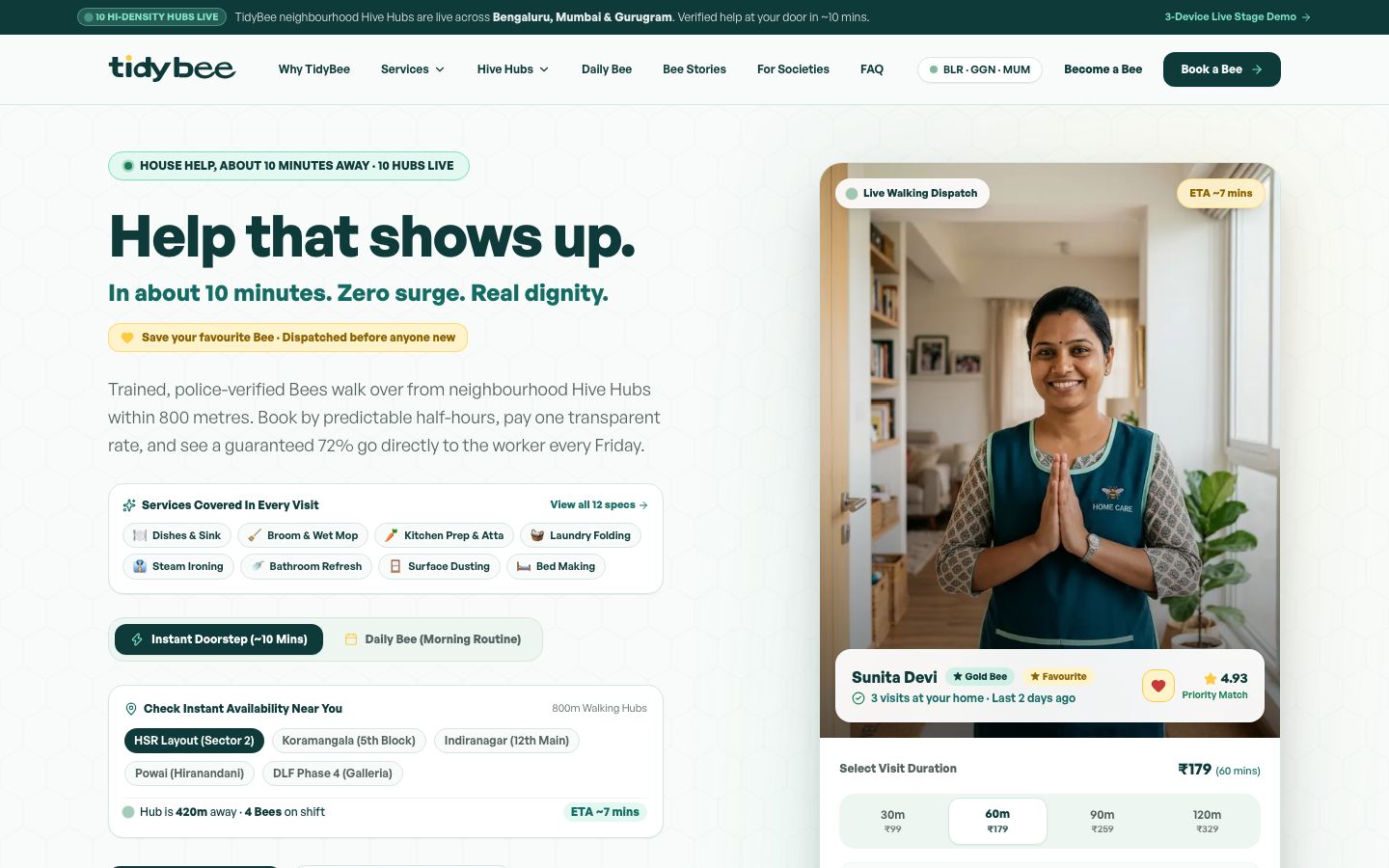
House help — sweeping, mopping, dishes, laundry, kitchen prep — arriving in about ten minutes and billed by the half-hour.
The pros are Bees with names, faces and training badges, not anonymous workers. Trust, safety and fair pay are made visible in the UI, and the Bee app is big-button and icon-first, with Hindi and regional languages.
- 01
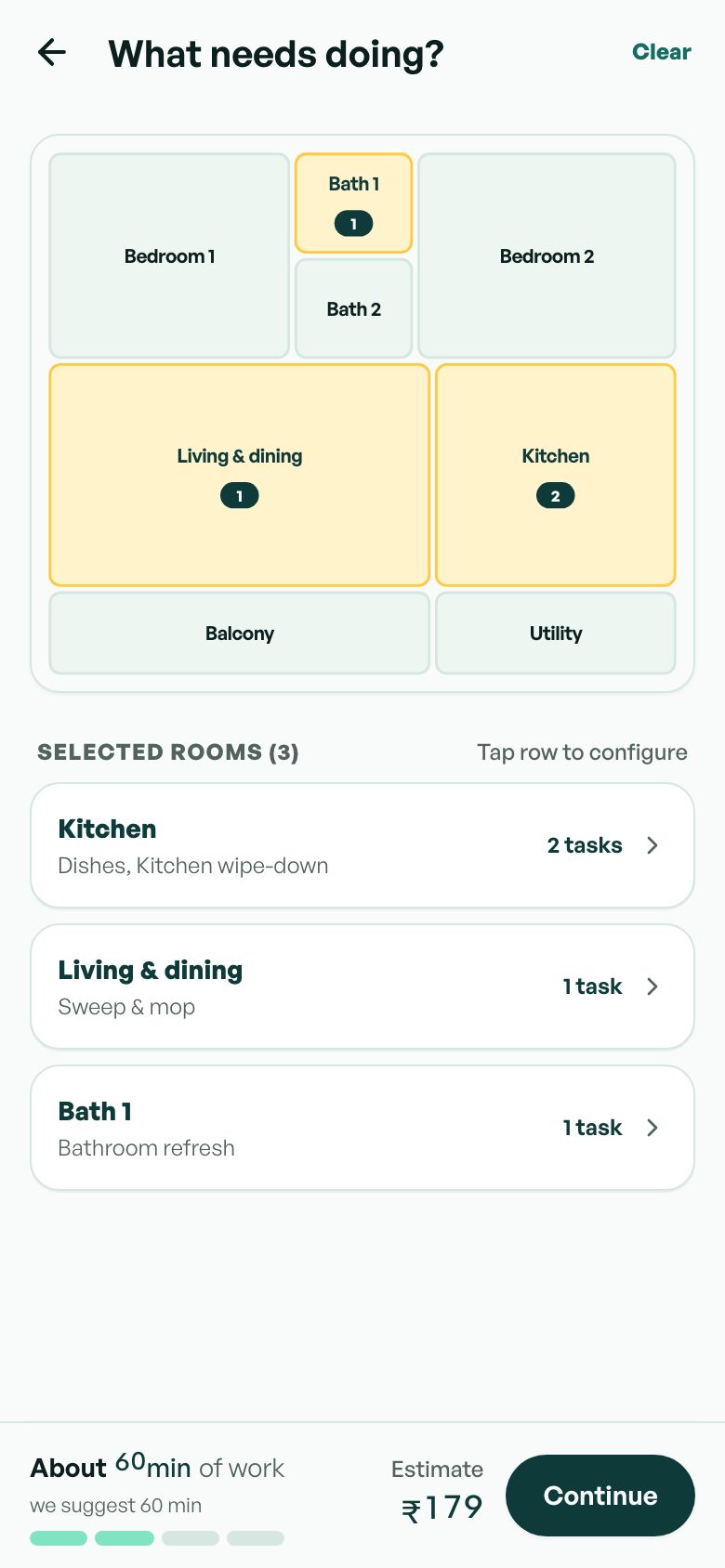
Floor-plan booking
Tap the rooms you want done; price and time update live.
- 02
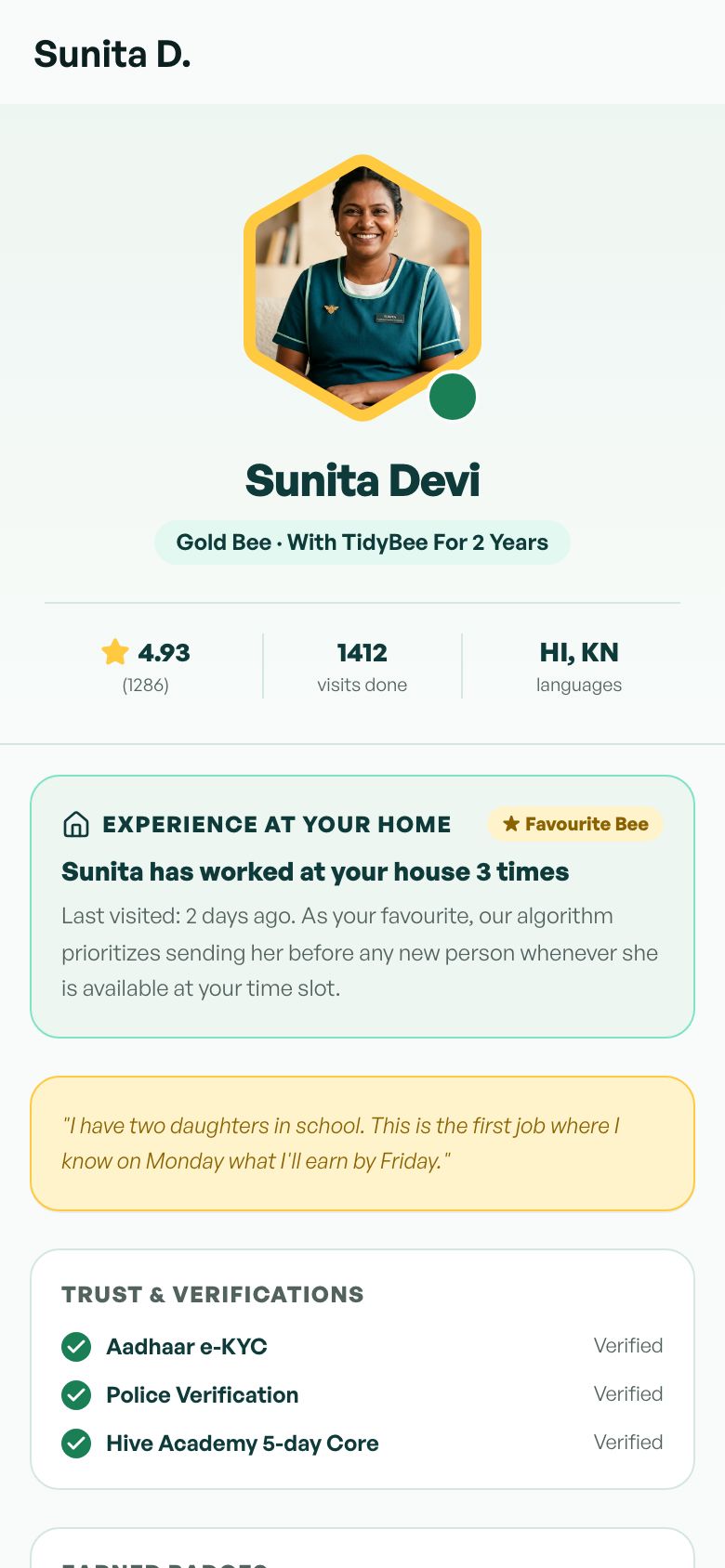
Bee card
Name, languages, rating and verification badges up front.
- 03
Hive Care
Insurance, SOS and weekly payout, built into the pro app.
The problem
Hiring help at home in Indian cities is still mostly a phone call, a neighbour's recommendation and a monthly arrangement. It works until the person is on leave, or you need two hours of help on a Tuesday, or you simply do not know who is in your house. Instant help apps promise a fix, but they usually book a service by category and leave the worker as an interchangeable name.
This concept explores a different shape: book by time, in 30 minute blocks, and make the person visible. The customer taps rooms on a floor plan, the app estimates how long the work will take, and a named helper (a Bee) is matched, with a delivery-style OTP to start the session.
Who it is for
- Household customerGet a defined amount of help, know the price in advance and see who is coming before they arrive.
- Bee (home helper)Large, simple screens, earnings explained line by line, a clear payday, and help one press away if something goes wrong.
- Hive hub operatorSee sessions, arrival times and coverage across localities, and answer SOS requests from either side.
What we built
Every side of TidyBee, live.
Each one opens the real build in a new tab. On a laptop the apps sit in a phone frame; on a phone they run full screen.
Customer app
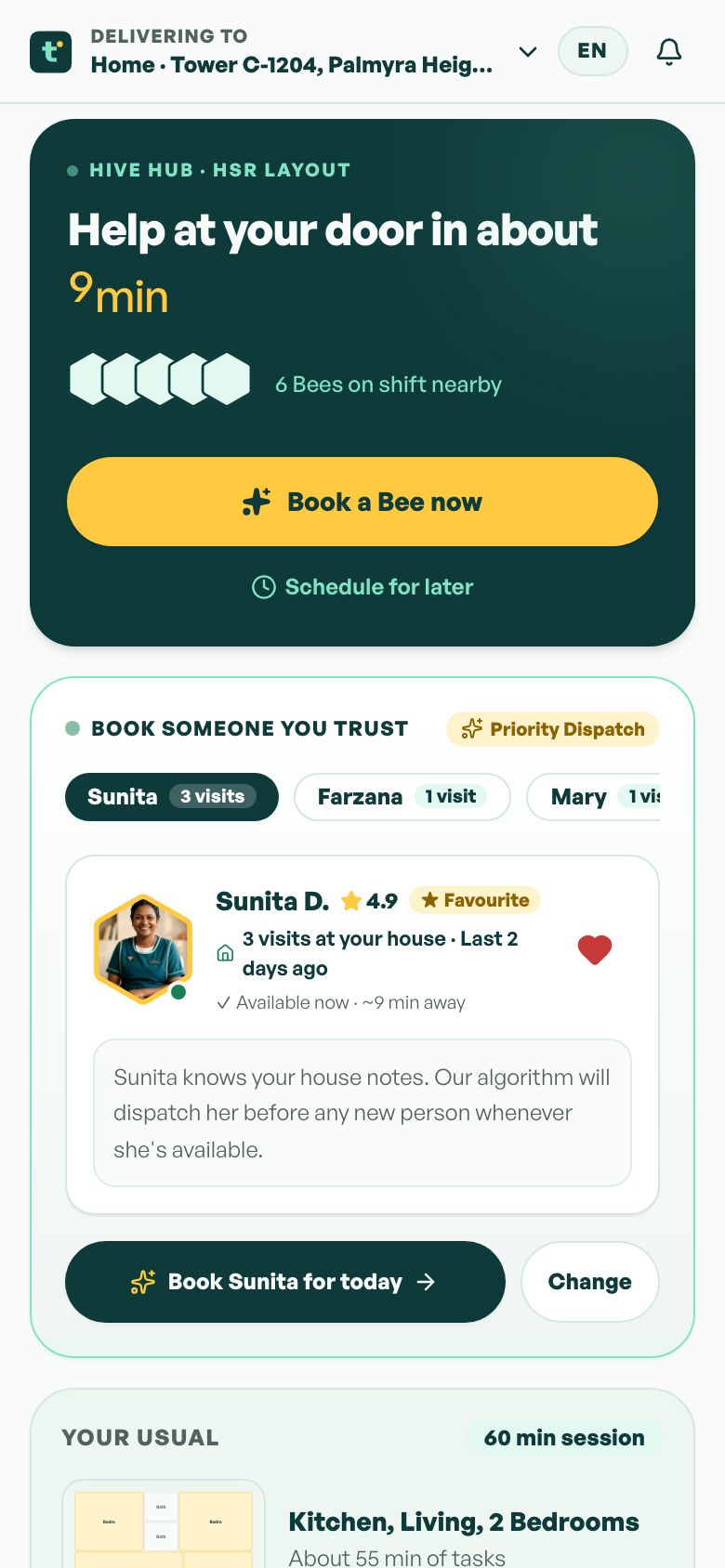
Tap rooms on a floor plan, pick a duration, meet your Bee.
Open /app/solutions ↗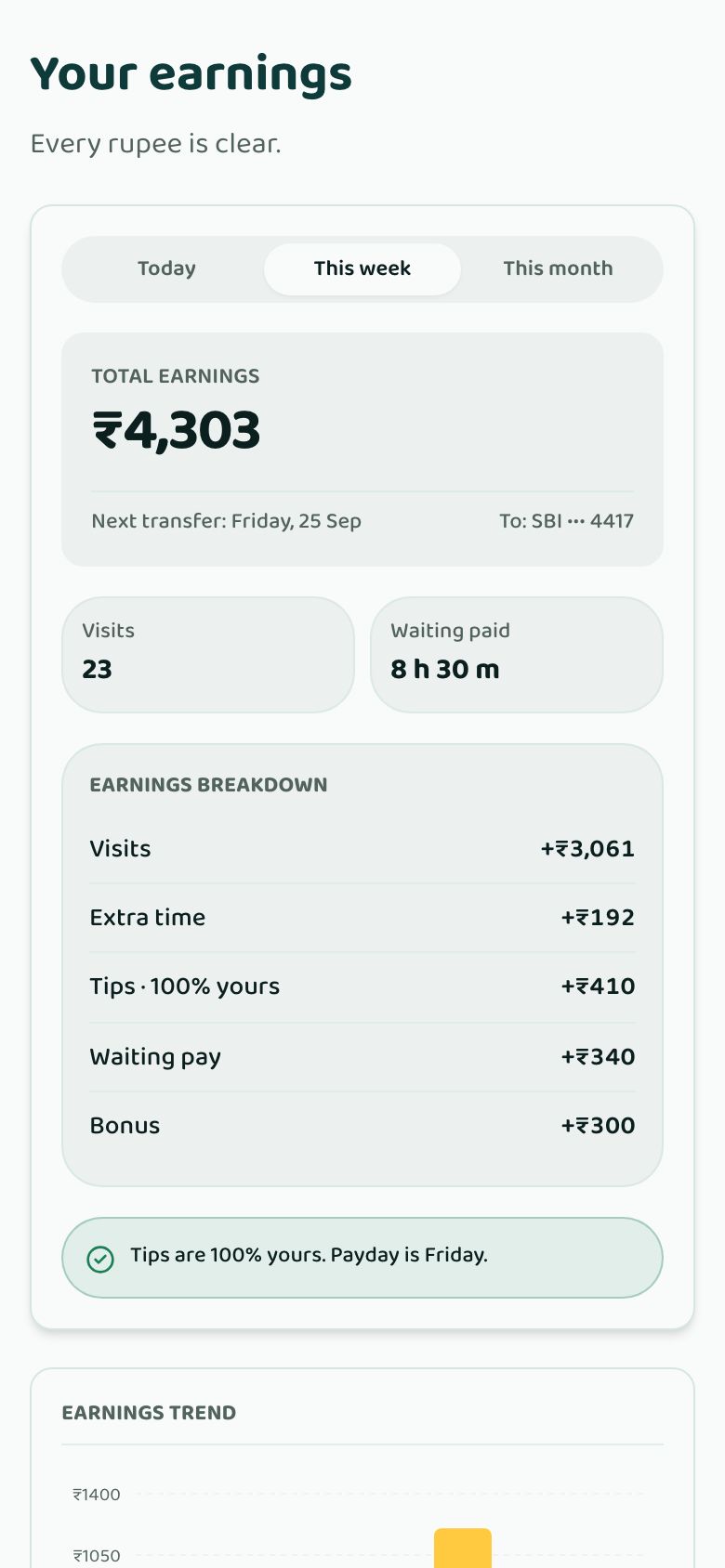
Bee app
Earnings, payday Friday and Hive Care — tips 100% the Bee's.
Open /pro ↗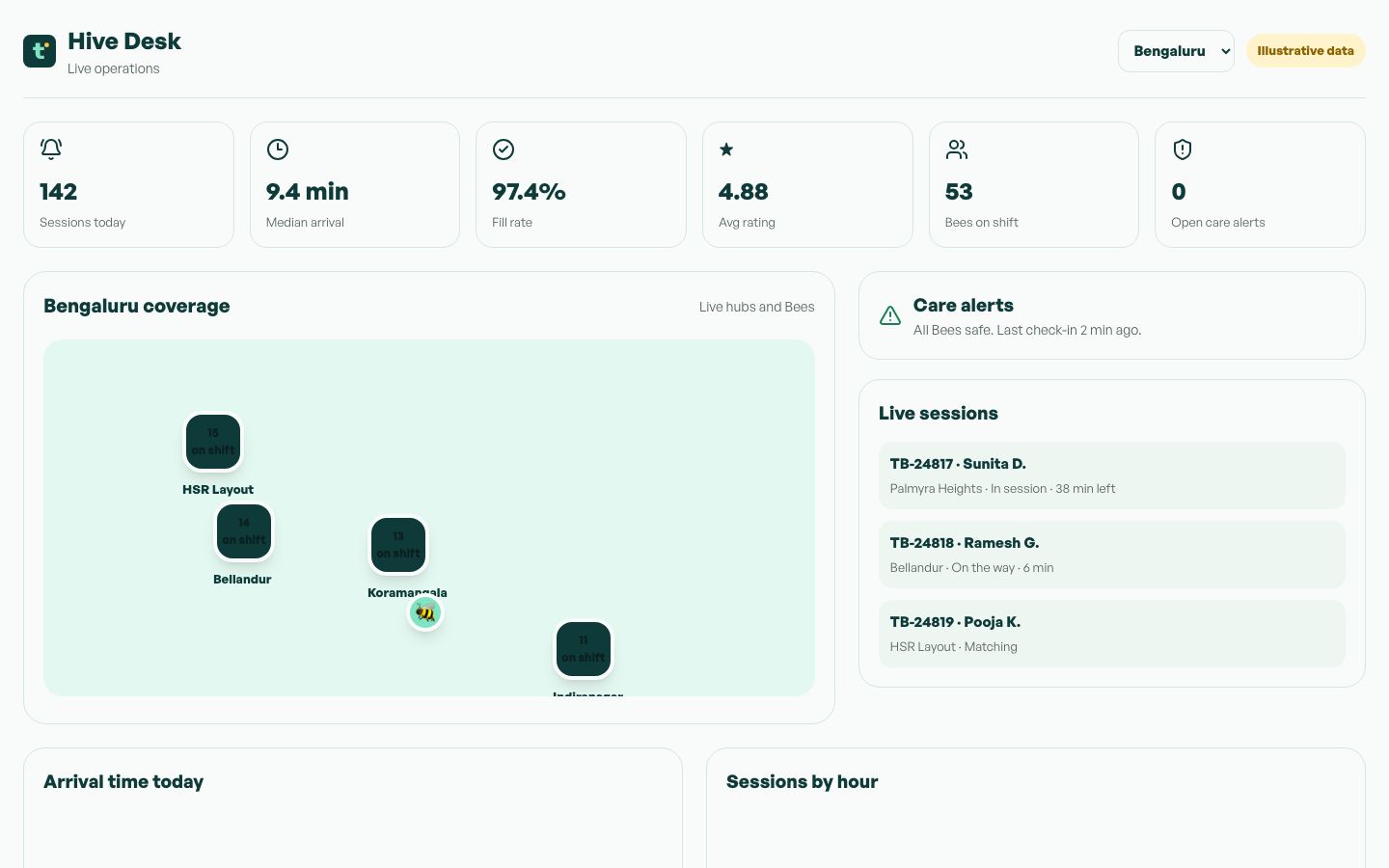
Hive Desk
Sessions today, median arrival time, a coverage map and live sessions.
Open /ops ↗Website
Book help or become a Bee, plus safety, societies and stories.
Open /home ↗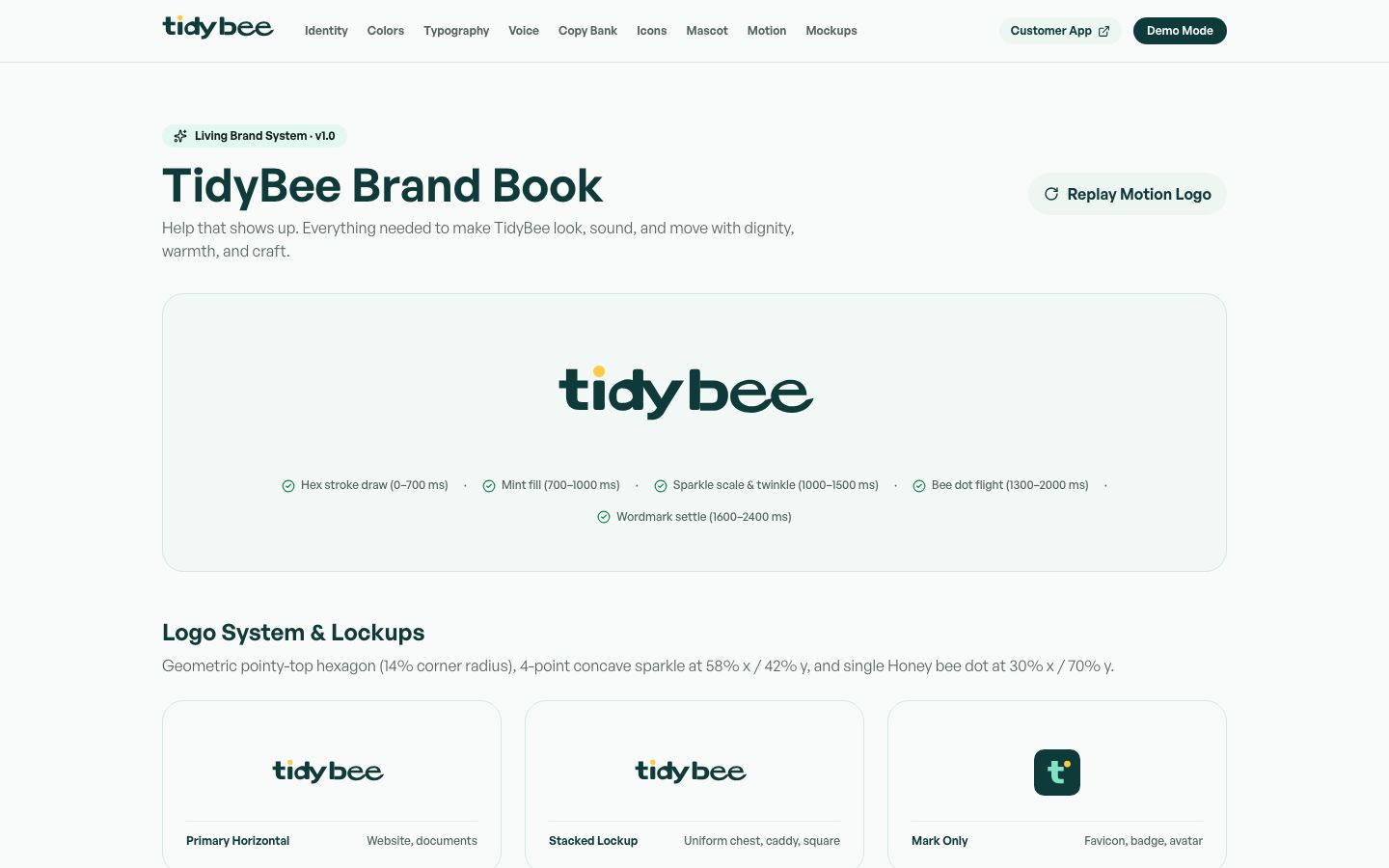
Brand book
The honeycomb hexagon, Pip the mascot and motion logo.
Open /brand ↗Synced demo
PROD BUILDCustomer, Bee and Hive Desk on one live clock.
Synced demo
Customer, Bee and Hive Desk on one live clock.
Open /demo ↗In detail
Surface by surface
Bee app · /pro
The Bee app is its own tabbed app: home, job, earnings, Hive Care, break and a language choice. Earnings are shown as visits, extra time, tips, waiting pay and bonus, with a weekly target and a Friday payout list.
Hive Desk · /ops
Hive Desk is the desktop view for operators, with a city switch for Bengaluru, Gurugram and Mumbai and a badge that says the numbers are illustrative. It shows six headline tiles (sessions today, median arrival, fill rate, average rating, Bees on shift, open care alerts), a hub panel showing Bees on shift per hub (tiles, not a real map), a short list of live sessions and two bar charts.
Website · /home
The in-world website explains how booking works, pricing, the safety approach, partner societies, becoming a Bee, careers and press.
Brand book · /brand
The brand book covers the honeycomb hexagon, a mascot called Pip, uniform and kit mockups and motion for the logo. Mint, deep teal and honey are the working palette, and the hexagon doubles as the pattern on printed pieces.
Synced demo · /demo
The synced demo puts the customer app, the Bee app and the Hive Desk on one simulated clock, so booking in one view starts an arrival in another.
Why it works this way
Design and product decisions
Time-based pricing, with extensions priced the same way
The price table is Rs 99 for 30 minutes, 179 for 60, 259 for 90 and 329 for 120. A session can be extended in 30 minute steps at Rs 89 each. Bundling by time rather than by task avoids a catalogue of fine-print prices and lets the estimate screen do the persuading.
An estimate built from rooms and home size
Each task has a base time, and some vary by room kind, by option (a full sink is 20 minutes, a party sink 35) or by units. The total is scaled by the home's size factor, five minutes of settling in is added, and the result rounds up to the next five. If the estimate passes 120 minutes the app says the job is too big instead of quoting a wrong block.
Show where the money goes
Every booking splits into the Bee's share (72 percent of the undiscounted price), a 5 percent Hive Care contribution and the platform's remainder, shown in a fair-share bar. Tips are added after the split and the Bee app labels them as 100 percent hers. The reasoning is that fairness claims are worth little unless the arithmetic is visible.
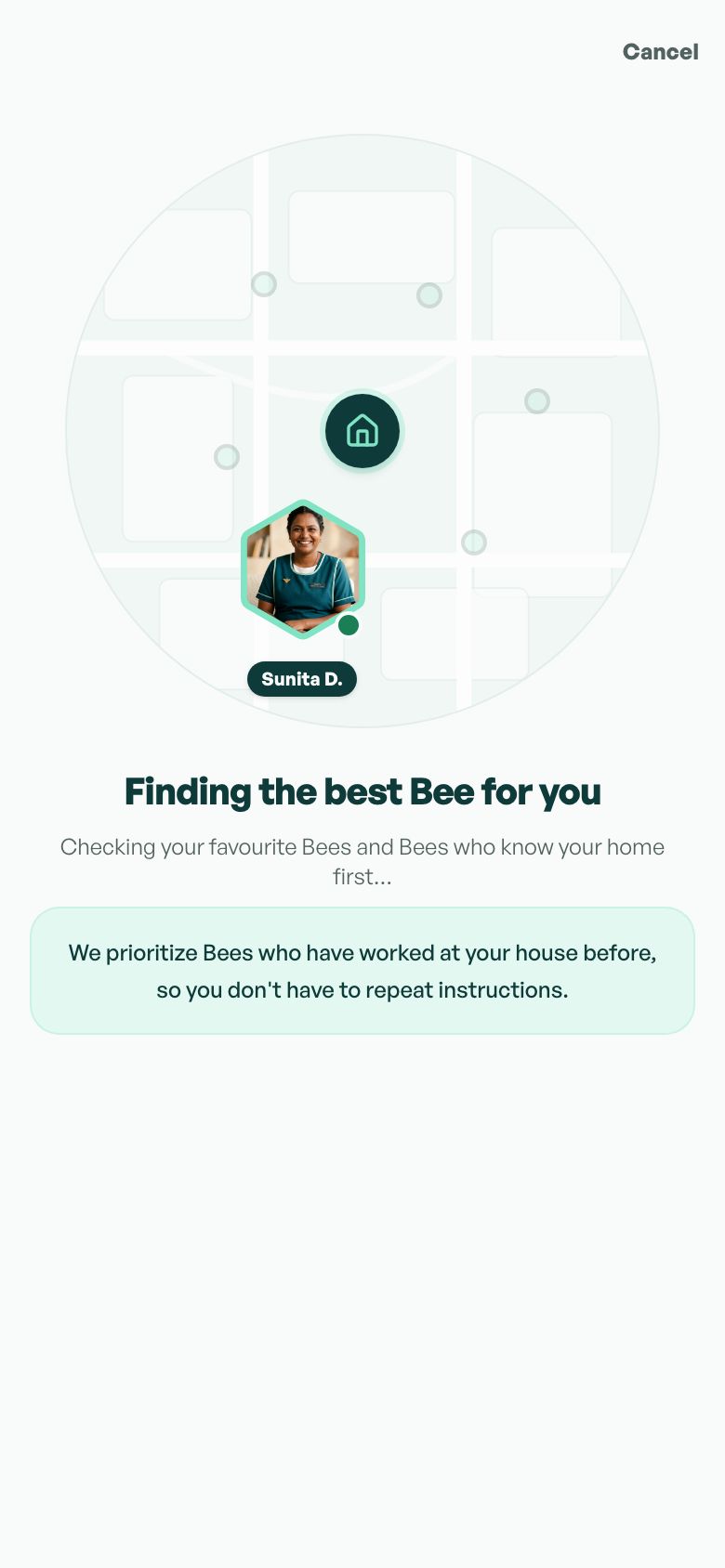
Familiar Bees before new ones
The matching code first honours a Bee the customer asked for, then favourites who have visited this home, then anyone who has visited, then favourites, then the best new match, with a last-resort fallback. Blocked Bees are never offered and the pool is limited to the same hub and the Bee's shift hours. Familiarity ranks above speed because trust is the product.
Engineering notes
Under the hood
Front-end prototype, no backend
Next.js, React, Tailwind and zustand, with shared workspace packages for UI, tracking, partner and simulation code. lib/api.ts is a set of async functions over in-memory sample data with simulated latency. No booking, payment or message leaves the browser.
A session state machine
A session moves through draft, requested, matching, no Bee, assigned, en route, arriving, at door, in session, wrapping up, completed, rated or cancelled. Timers differ between demo mode (a 30 minute story is three minutes of wall clock) and a slower realistic mode. A separate machine models the SOS flow and a third models the Bee's job.
Rules covered by unit tests
The pricing, matching, floor plan and session logic have their own test files, which keeps the arithmetic honest while the screens change. Matching reads visit history from sample sessions to decide who counts as familiar.
Local details
Built for India
Hubs by locality, in three cities
Sample hubs are named by neighbourhood: HSR Layout, Koramangala, Indiranagar and Bellandur in Bengaluru, Sector 56, DLF Phase 4 and Sohna Road in Gurugram, and Powai in Mumbai. Bees only match to homes in their own hub, which is how local services actually run.
The Bee app in five languages
The Bee app has string files for English, Hindi, Kannada, Marathi and Bengali, with a language screen to choose. The aim is that the worker does not need to read English to understand her earnings.
Payday on Friday, paid to a bank account
The earnings screen lists payouts to a masked bank account and states that payday is Friday. A weekly visit target carries a Rs 300 bonus in the sample. These are sample figures, but the weekly rhythm matches how many home workers prefer to be paid.
What this is, and is not
This is a concept build. Bees, customers, homes, sessions, payouts, policy details and phone numbers are all sample data. There is no real matching service, no payment, no SMS and no location tracking, and the OTP is a fixed demo code. A real launch needs identity and police verification for helpers, a legal position on whether Bees are employees or contractors, insurance that actually exists, payment and payout rails, a support team behind the SOS button, and consent flows for homes and families. It also needs real supply in each locality, which no app can design its way around.
Last updated 2026-11-07
More screens
Brand system
Building something like TidyBee? Let's talk.
We'll walk you through this build on a call and map what yours would need.