Insurance · Fintech
Umbrello
Cover that makes sense.
Plain-English insurance: instant quotes, side-by-side comparison and a claim tracker.
The idea
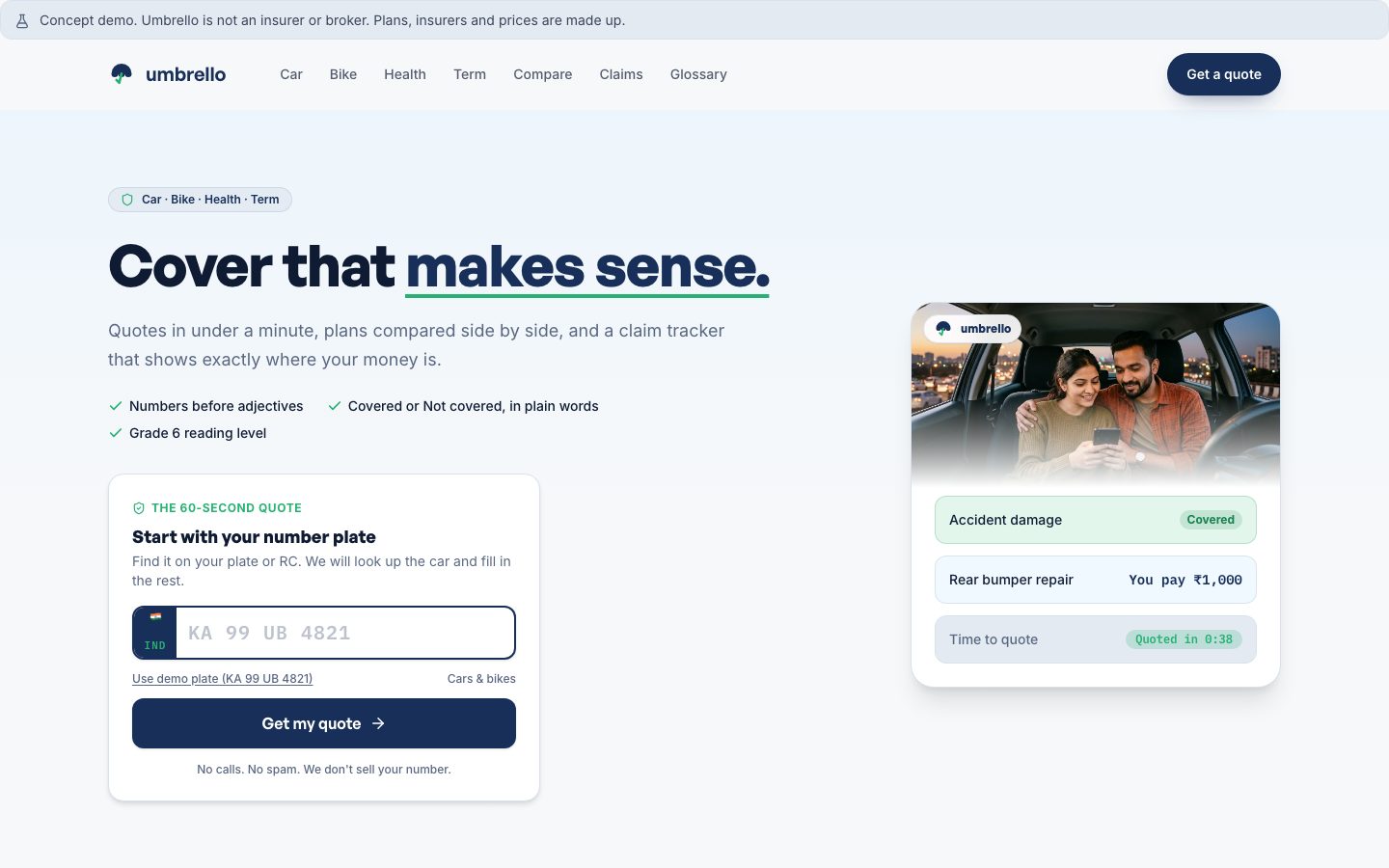
Eliminating complex legal jargon and predatory hidden clauses in Indian insurance. Offers car, two-wheeler, health, and term life insurance with instant quotes generated in under 60 seconds.
Features a radical claim tracker that visualizes the exact adjuster stage, surveyor assignment, garage approval, and reimbursement timeline.
- 01
The 60-Second Quote
Input registration number to automatically pull vehicle specs and instant tiered plan quotes.
- 02
No-Fine-Print Breakdown
Interactive toggles clearly highlighting what is covered vs. what is strictly excluded.
- 03
Visual Claim Tracker
Step-by-step progress pipeline showing surveyor inspection, garage approval, and payout.
The problem
Buying motor or health insurance in India usually means a long form, plans with different add-ons, and a premium that shifts at the last step. The harder moment comes after an accident: wait for a surveyor, then an estimate, then an approval, with little visibility. Why depreciation is deducted when you bought zero-dep cover is answered only in the policy wording.
Umbrello is a concept build of a plainer journey: a quote from a registration number, a policy explained in words a school student could follow, and a claim tracker that shows each stage. It also builds the surveyor's phone and the claims desk, because a tracker is only honest if the people behind it use the same data. The insurers, plans and customers are fictional.
Who it is for
- Car or bike ownerA price from a plate number and a clear view of what each tier covers, with add-ons and GST on separate lines.
- Customer filing a claimTo register a claim from the phone and see its stage, and what the insurer pays against what they pay.
- Surveyor, claims desk and garageA photo checklist and damage tagger in the field, a queue ordered by deadline risk at the desk, and a job board at the garage.
What we built
Every side of Umbrello, live.
Each one opens the real build in a new tab. On a laptop the apps sit in a phone frame; on a phone they run full screen.
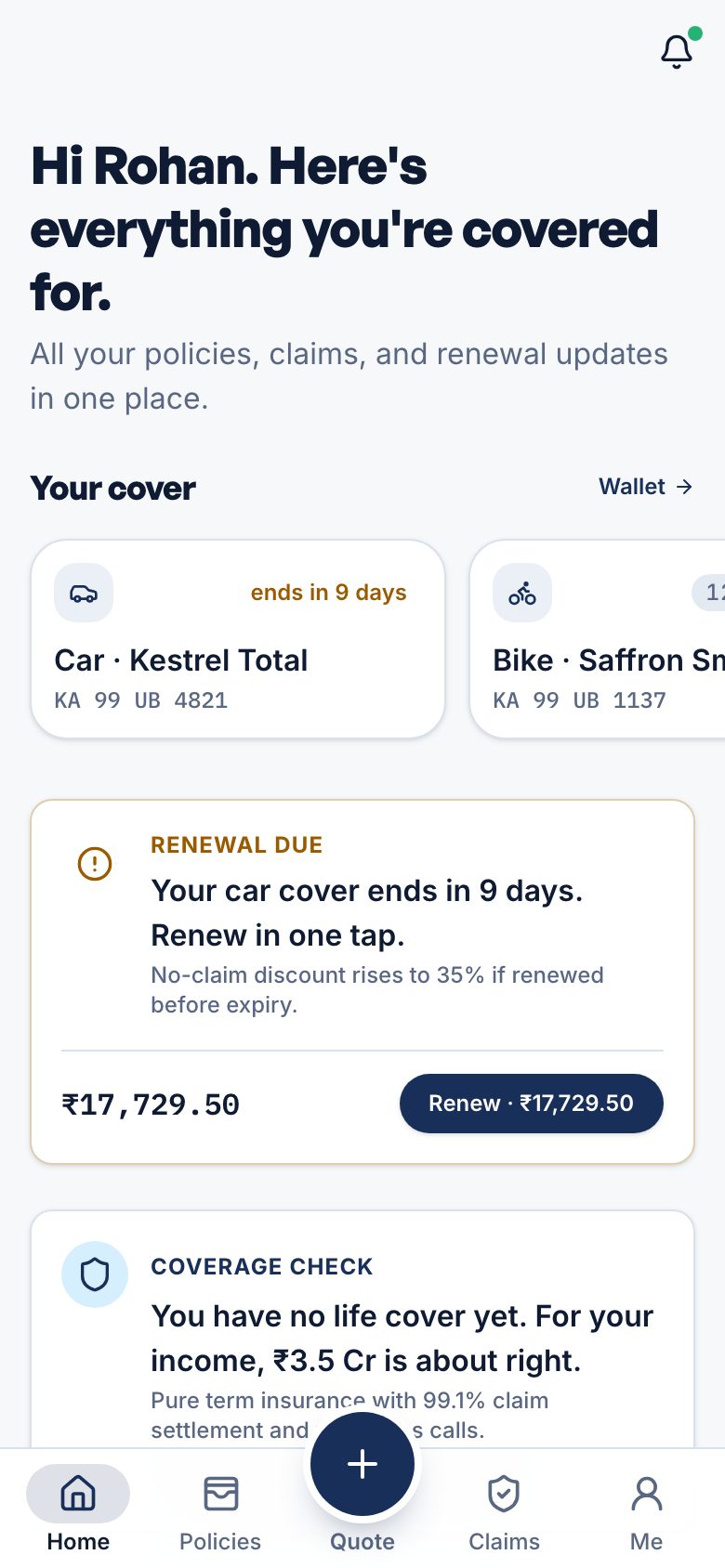
Quote generator, policy wallet, one-tap renewal, and live claim tracker.
Customer app
Quote generator, policy wallet, one-tap renewal, and live claim tracker.
Open /app ↗Vehicle damage photo assessment, repair estimate approvals, and cashless settlements.
Surveyor / Garage portal
Vehicle damage photo assessment, repair estimate approvals, and cashless settlements.
Open /claims ↗Website
PROD BUILDPlain-language policy comparison charts, premium calculators, and claim ratios.
Website
Plain-language policy comparison charts, premium calculators, and claim ratios.
Open /home ↗In detail
Surface by surface
Customer app · /app
The customer app has quote flows for car, bike, health and term. The car flow takes a registration, shows three tiers with an IDV slider, then a plan page, checkout, policy wallet and renewals. The plan page has Covered, Not covered and Depends tabs and accident scenarios showing what each tier pays. Claims screens file a claim and follow it on a stage tracker.
Surveyor / Garage portal · /claims
The claims desk is a desktop dashboard: an overview, a queue sorted by remaining service-level time, a claim detail with an audit trail, an estimate table where lines are accepted or reduced, and analytics. A garage portal at /claims/garage has a job board, an estimate builder and a repair-stage updater. The surveyor app at /surveyor feeds both with assignments, a photo checklist and a damage tagger.
Website · /home
The website has car, bike, health and term pages with premium calculators, a compare page, claim-ratio tables, a glossary, FAQ and about pages. Compare and claim ratios list fictional insurers on settlement ratio, days to settle, cashless garages and complaints per 10,000 policies. A /demo stage runs the customer, surveyor and desk apps together.
Why it works this way
Design and product decisions
A quote with the working visible
Basic, Smart and Total tiers show own-damage, third-party, add-ons and 18 percent GST as separate lines. In the pricing code Basic is third-party plus owner-driver personal accident cover, Smart adds own damage, and Total adds zero-depreciation, engine protect, roadside assistance, consumables and no-claim-bonus protect.
Plain language is enforced
A banned-words list rules out phrases such as peace of mind, subject to, indemnify and seamless. The plan page gives "depends" its own tab, since copy that avoids that word usually hides it.
What-if scenarios in rupees
Five car scenarios, such as rear-ended at a signal or a flooded basement, show a pay bar of what the insurer pays and what the customer pays per tier. In the flood sample Basic pays nothing, Smart pays part because engine water damage needs Engine Protect, and Total leaves only the deductible.
A claim tracker with an explicit settlement rule
A claim runs filed, surveyor assigned, inspected, estimate submitted, approved, in repair, ready, settled, with a rejected branch. With zero-dep the customer pays only the deductible; without it they also bear depreciation by material (50 percent on plastic and rubber, 30 on fibre, none on glass, an age scale on metal), and the tracker shows the amount saved.
Engineering notes
Under the hood
Front end with pure pricing functions
Next.js 16, React 19, Zustand and Tailwind. Motor, health and term pricing are pure functions shared by the website calculators and the app, with money in paise. There is no server and no insurer integration.
Rules you can read
IDV falls with vehicle age from a 5 percent cut under six months to 55 percent past five years. Own-damage uses about 3 percent for a young car and 1.76 percent for a young bike, times an insurer multiplier. Health premium scales by the eldest member's age band, 0.45 per extra adult and 0.25 per child. Term interpolates a per-crore rate by age with a smoker factor.
Three apps share one simulated claim
The claim state machine is broadcast over a browser channel, so a photo captured in the surveyor app moves the stage the customer and the desk see. The registry lookup returns a sample car for any unknown plate, and photo capture records a placeholder, not a camera frame.
Local details
Built for India
Motor structure as sold in India
Third-party premium is a slab by engine size, for example 2,094 rupees up to 1000 cc for a car, plus a flat owner-driver personal accident premium. No-claim bonus steps run 20, 25, 35, 45 and 50 percent, and 18 percent GST sits on its own line.
Cashless garages and lakh-crore amounts
Insurers carry a cashless-garage count, and claims route to a network garage board. Term cover is suggested as 15 times annual income rounded to a 50-lakh slab and priced per crore, and plates follow the state format, such as KA 99 UB 4821.
UPI sheet for payment
Checkout and renewal use a mock UPI sheet that simulates confirmation only. No real insurer, aggregator or gateway is named or connected.
What this is, and is not
Umbrello is a concept build made by the studio. Insurers, plans, claim ratios, surveyors, garages and customer stories are fictional sample data, and the premium formulas are simplified illustrations, not filed rates. It is not an insurance intermediary and has no backend, KYC, policy issuance, payment or vehicle registry. The interface is English only. A real launch would need a licensed insurer or intermediary, real rating and underwriting, KYC and consent flows, an image-checked photo pipeline and claim-system integration.
Last updated 2026-11-07
Brand system
Building something like Umbrello? Let's talk.
We'll walk you through this build on a call and map what yours would need.