EV scooter · Mobility & logistics
Voltride
Charged for India.
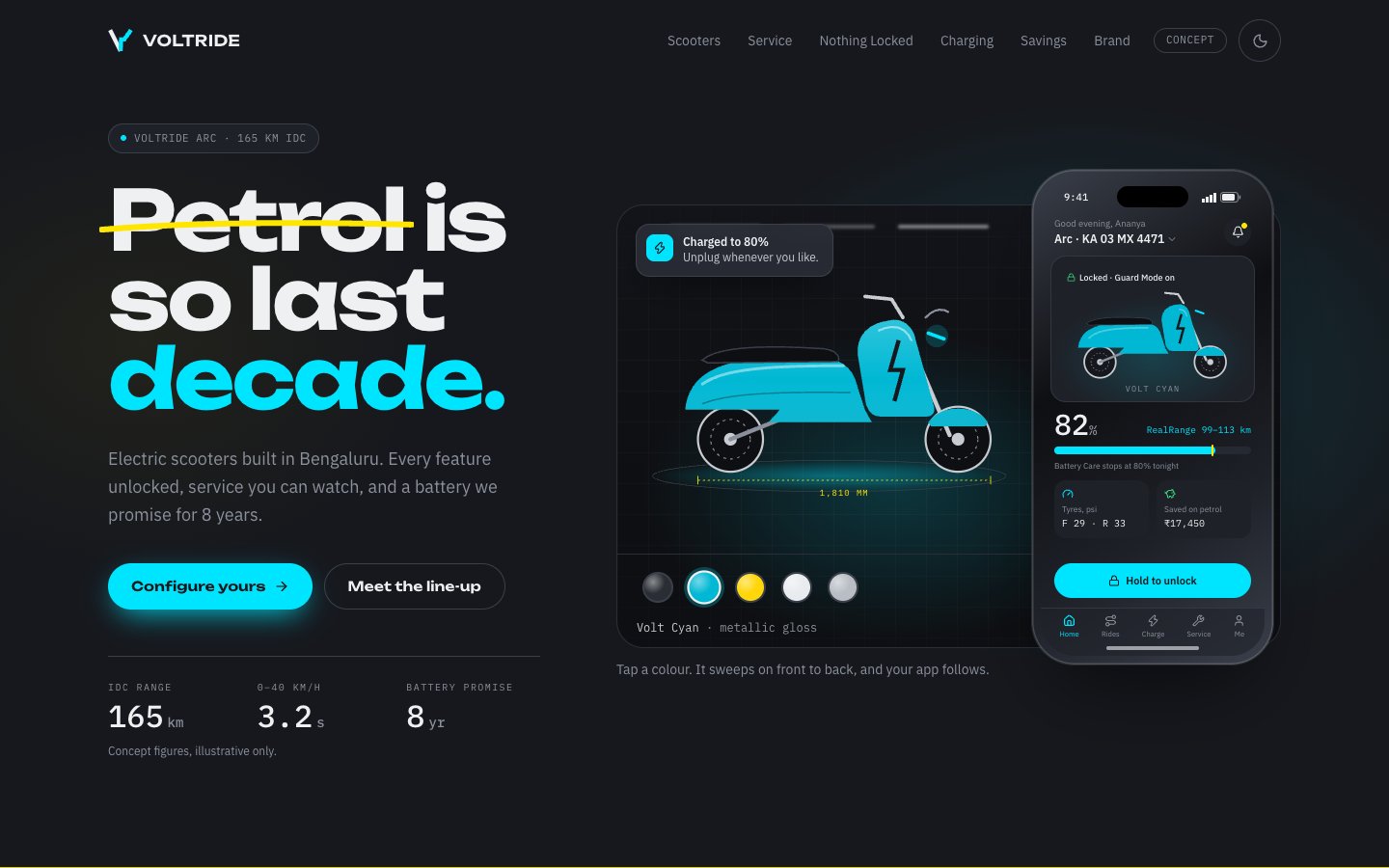
A connected EV scooter: owner app, service tech app and a website configurator.
The idea
India’s smart electric mobility benchmark. Demonstrates complete physical-to-digital product design: telemetry-driven companion app, remote keyless security, real-time battery health diagnostics, and a 3D vehicle customizer.
Showcases how smart hardware communicates with service tech centres, warranty records, and an urban fast-charging infrastructure network.
- 01
Interactive 3D Configurator
Real-time WebGL scooter turntable with paint finishes, performance packs, and instant EMI breakdown.
- 02
Remote Command Center
One-tap remote boot unlock, beacon headlights, and live geofence theft alerts.
- 03
Range True-Predictor
Dynamic range estimation adjusting dynamically for pillion rider weight and hill incline.
The problem
An electric scooter is half hardware and half software, and most Indian buyers meet the software part badly: a range number that falls short on the first hot afternoon, a battery they cannot judge, a service centre that cannot tell them what is wrong until the scooter is on a lift. The worry is rarely the motor. It is range, charging, resale and who will fix it.
Voltride is a concept scooter brand built to explore that whole chain in one product: a website where you configure and price a scooter, an owner app that treats range and battery health as honest estimates, a technician app that reads fault codes off the vehicle, and an operations dashboard for fleet, charging stations, software rollouts and service.
Who it is for
- Scooter ownerKnow how far the scooter will really go today, lock and track it, charge on the road, book service and trust the battery.
- Service technicianConnect to the scooter, read fault codes in plain language, run guided tests and get a job from pickup to sign-off without paper.
- Buyer on the websiteCompare three models, configure paint and trims, see an on-road price for their city and work out petrol savings.
- Operations leadSee the fleet, charging station health, firmware rollout progress and service queue in one place.
What we built
Every side of Voltride, live.
Each one opens the real build in a new tab. On a laptop the apps sit in a phone frame; on a phone they run full screen.
Live 3D scooter status, battery %, range predictor, geofencing, and ride analytics.
Owner app
Live 3D scooter status, battery %, range predictor, geofencing, and ride analytics.
Open /app ↗CAN-bus diagnostic scanner, battery cell health reports, and maintenance logs.
Service Tech
CAN-bus diagnostic scanner, battery cell health reports, and maintenance logs.
Open /tech ↗In detail
Surface by surface
Owner app · /app
The owner app is a phone-framed prototype with a home screen for the active scooter, ride history, three ride modes (Eco, Ride and Warp), a guard mode with safe zones and a siren test, public charging with station and port sheets, a charging session screen, a battery health report, a service area with booking and invoices, and a software screen for updates. Ride detail pages, notifications, settings and a safety page are included.
Service Tech · /tech
The technician app starts a shift, shows a job queue with SLA chips, and walks each job through connect, diagnose, quote, parts, work, quality check and sign-off. The connect step simulates pairing with the scooter and reports its controllers online. The diagnose step lists fault codes and six guided tests, such as cell balance, insulation, motor spin, charger handshake, tyre-pressure relearn and lights and horn.
Why it works this way
Design and product decisions
Range as a band, not a single number
The range screen computes a centre figure and a minimum and maximum around it. Temperature, a pillion rider and ride mode all change energy use, and the band is 6.5 percent either side by default, tightening to 5.2 percent once the scooter has five rides and runs firmware 4.2 or later. Showing a band is more honest than a single number that will be wrong.
Three scooters, one data file
Pulse, Arc and Surge cover four battery variants from 2.6 to 4.85 kWh usable, at sample prices from 97,999 to 1,84,999 rupees. Eco, Ride and Warp figures for top speed and 0 to 40 km/h time live in the same file, so the compare table is only a view of it.
Fault codes written twice
Each of the 25 fault codes has a technician description and a separate customer explanation. For example, a low rear tyre reads as "losing air slowly, usually a small nail or a leaky valve" for the owner, with the pressure threshold and likely causes for the technician. The same data feeds both apps, so they never disagree.
Price breakdown with the awkward lines left in
The configurator builds ex-showroom price from the variant, wheels, seat, accessories and paint, then adds an illustrative RTO line, one year of insurance, an optional care plan and a subsidy deduction for eligible variants. The subsidy line is worded as subject to scheme funds, because buyers see that caveat in real quotes.
Engineering notes
Under the hood
Next.js with a 3D stage
The site uses Next.js and React, with three.js through react-three-fiber and drei. Each model ships as a high and a low detail file, and a low-power hook plus a fallback carousel handle devices that cannot run the 3D view.
A CAN bus built in code
Ten controllers (vehicle control, battery, motor, charger, tyre pressure, brakes and others) are defined with firmware versions. Signals are encoded into 8-byte frames with scale, offset and signed or unsigned lengths, so the technician screens decode data that behaves like real bus frames. It is generated from a simulated vehicle state, not read from hardware.
Simulation lifecycles
A shared simulation clock drives separate lifecycles for rides, charging, over-the-air updates, safety events, service jobs and rollouts. State sits in small stores that sync across the owner, technician and ops surfaces, so a fault raised in one place shows in the others.
Local details
Built for India
Petrol versus electric in rupees
The savings calculator defaults to 35 km a day over 26 days, petrol at 105 rupees a litre and 45 km/L, home power at 8 rupees a unit and public charging at 16. It then reports monthly saving, payback against a 92,000 rupee petrol baseline, and CO2. The inputs are editable, because every household's numbers differ.
City-aware pricing
On-road price depends on the selected city's RTO rate. Six cities are modelled: Bengaluru, Mumbai, Pune, Delhi NCR, Hyderabad and Chennai. The RTO values are illustrative and several are set to zero.
Battery promise in plain terms
The ownership page lays out a standard 3 year or 50,000 km warranty and an 8 year or 1,00,000 km battery cover, plus a 5,999 rupee extension. The numbers are sample terms for the concept.
What this is, and is not
Voltride is a front-end prototype with sample data and no connected vehicle. Telemetry, CAN frames, stations, fleet figures, battery health and service jobs are generated locally. The configurator prices a build but does not take orders or EMI. There is no payment, no real mapping of public chargers, and no safety-critical firmware. A production version would need a telematics unit and cloud backend, certified battery and charger integration, dealer and service systems, and regulatory homologation.
Last updated 2026-11-07
Brand system
Building something like Voltride? Let's talk.
We'll walk you through this build on a call and map what yours would need.