Hostels · Travel & stays
Wanderbunk
Stay curious.
Backpacker hostels with a guest app and a travel community.
The idea
Tailored for solo backpackers, digital nomads, and young explorers discovering Manali, Goa, Rishikesh, and Ladakh. Offers community-first dorm and private room bookings, local trek meetups, and common-room event calendars.
The guest app doubles as an in-hostel social network, allowing travelers to connect with room-mates, plan shared cab rides, and split cafe bills.
- 01
Interactive Bunk Selector
3D bunk bed visualizer letting guests choose top or bottom bunk, near windows or lockers.
- 02
Common Room Bulletin
Real-time board of guest-organized sunset treks, board game tournaments, and jam sessions.
- 03
Digital Key Card
NFC/BLE room door unlocking directly from the traveler’s phone.
The problem
Backpacker hostels in India sell a bed, but travellers choose them for the people. Most booking flows treat a dorm like a hotel room: pick dates, pay, get a confirmation. The things that decide a stay (which bunk, who is in the room, what is happening tonight, whether a woman travelling alone will feel safe) are left to a phone call or a review written by a stranger.
The operator side is just as manual. Desk staff juggle bed allocation on paper or in a spreadsheet, housekeeping runs on shouted messages, and foreign guests must be registered on Form C within a short window. Miss it and the property is exposed.
This concept build explores one product that serves both sides: a guest app that behaves like a small social network inside the hostel, and a staff app that keeps beds, rooms, events, Form C and safety reports in one place. It is a studio concept with sample data, not an operating hostel chain.
Who it is for
- Solo backpacker or first-time hostel guestPick a specific bed (top or bottom, near the window or the lockers), see honest facts like tested wifi speed and quiet hours, and know who else is around.
- Woman travelling aloneA women-only dorm option with a female night crew, and a way to raise a concern quietly without walking to the desk.
- Hostel desk and housekeeping crewA bed grid that shows today at a glance, a check-in flow that captures ID, and a Form C queue that shows how long is left.
What we built
Every side of Wanderbunk, live.
Each one opens the real build in a new tab. On a laptop the apps sit in a phone frame; on a phone they run full screen.
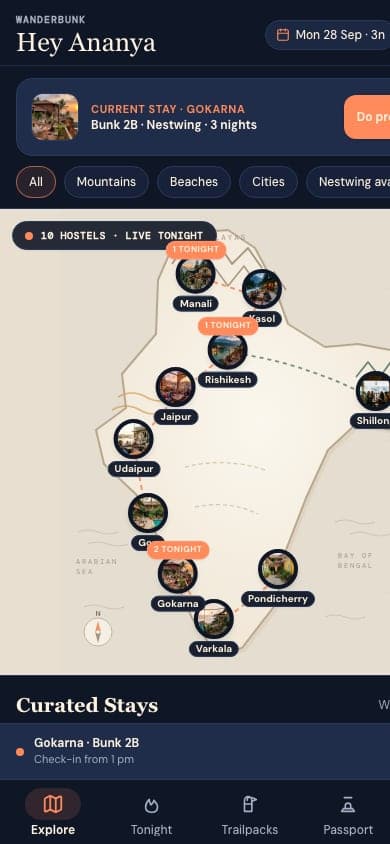
Illustrated destination map, bunk picker (top vs bottom!), digital key, and social board.
Guest app
Illustrated destination map, bunk picker (top vs bottom!), digital key, and social board.
Open /app ↗Bed availability matrix, guest check-in/out, room turnover, and activity desk.
Property staff
Bed availability matrix, guest check-in/out, room turnover, and activity desk.
Open /desk ↗Website
PROD BUILDDestination guides, nomad workcation passes, travel stories, and booking engine.
Website
Destination guides, nomad workcation passes, travel stories, and booking engine.
Open /home ↗Brand book
PROD BUILDSticker-bomb graphic language, hand-drawn badges, and interior signage.
Brand book
Sticker-bomb graphic language, hand-drawn badges, and interior signage.
Open /brand ↗In detail
Surface by surface
Guest app · /app
The guest app starts from an illustrated map of India with ten sample hostel pins (Manali, Kasol, Rishikesh, Goa, Gokarna, Varkala, Udaipur, Jaipur, Pondicherry, Shillong). A hostel page lists dorms and private rooms, then opens Bunkview: an isometric dorm where you tap a bed to select it. After booking come pre-check-in steps with an ID scan screen, a digital keycard, a Tonight tab with events and RSVPs, trip groups, a shop, and a Passport that collects a stamp for each stay. A Glowline sheet lets a guest report a safety concern from inside the app.
Property staff · /desk
The staff app lives under the build's /staff route. Its core is an occupancy grid by bed and day with drag-to-move, a check-in stepper, a housekeeping board, an event composer, a Form C queue, a safety board and shift notes. The grid enforces room rules in code: a booking in a women-only dorm can only move to another women-only bed, and the reverse. Actions here update what the guest app shows, because both tabs listen to the same browser message channel.
Website · /home
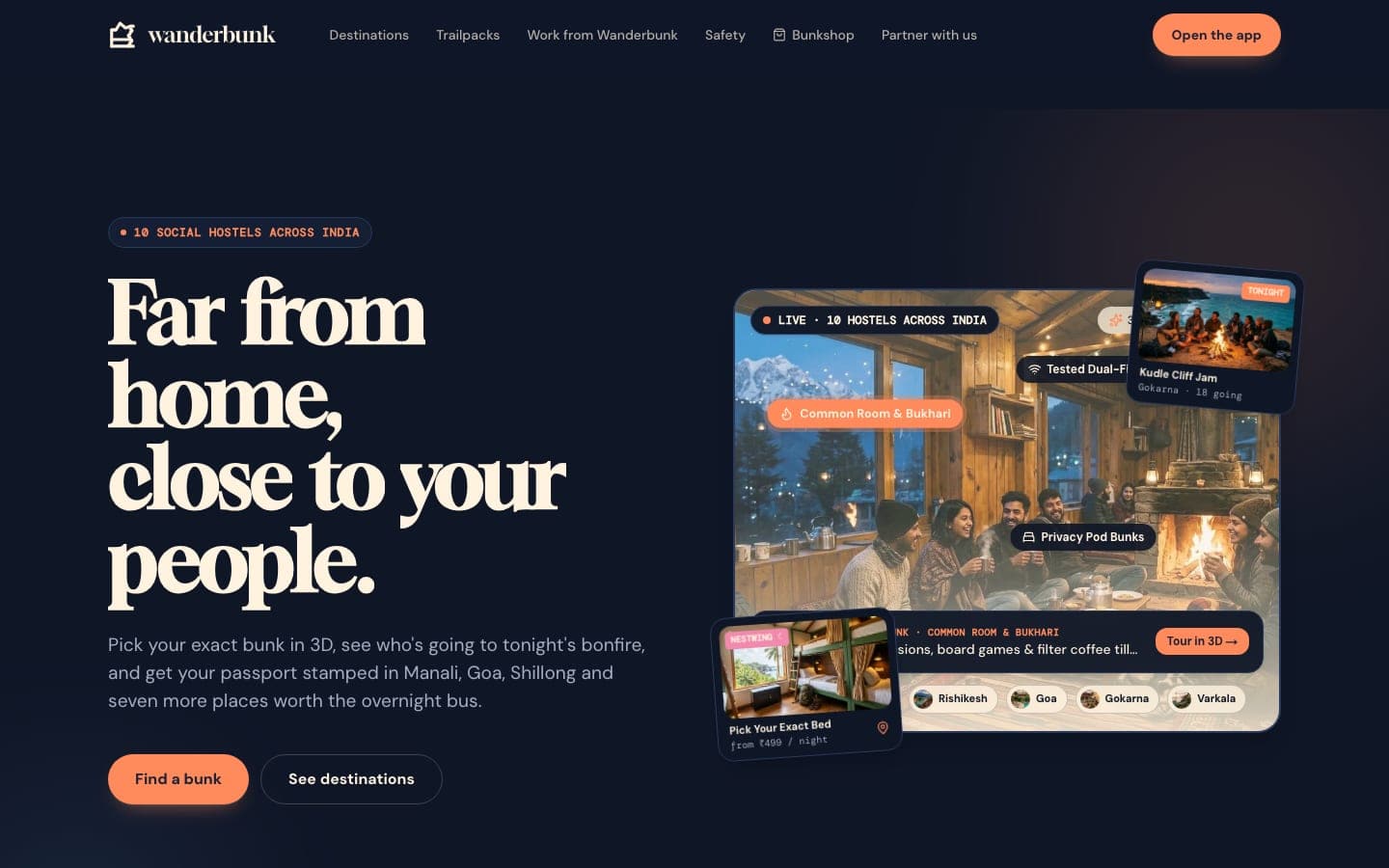
The public website covers destinations, trailpacks (curated group trips with calendar), a work-from-Wanderbunk page with a monthly cost calculator, a partner page with a franchise estimator, a shop with a bag, safety and FAQ pages, and a press page. Destination pages are generated from the same hostel data the app reads, so a fact such as altitude or quiet hours is written once.
Brand book · /brand
The brand book documents the sticker-bomb system: sunset orange, sea blue, sand and pine, Gloock for display and DM Sans for text, a handwritten accent face, and the mural and keycard designs that each hostel carries. It is where the physical side of the concept (signage, key cards, merch) is specified.
Why it works this way
Design and product decisions
Bed choice is the booking
Instead of a quantity stepper, the guest opens an isometric dorm and picks one bed. The dorm types in the data are mixed, women-only (Nestwing) and Deskbunk, in 4, 6, 8 and 10-bed layouts. Letting people choose the exact bunk removes the most common hostel complaint before it happens.
Safety is a first-class screen, not a footer link
The Glowline sheet offers seven report categories (harassment, unwanted person, medical, theft, noise, feel unsafe, other) and a location such as my dorm. A report moves from raised to acknowledged to resolved, and the staff safety board shows it with a response timer. The status steps are timed in the demo, so the flow can be shown without a second device.
Loyalty that changes the price
Each stay adds a stamp to the Passport. Three stamps make a Roamer, six a Nomad, ten a Trailblazer. In the pricing function, Nomad takes 10 percent and Trailblazer 15 percent off direct bookings before GST, so the stamp collection has a real effect at checkout.
Long stays priced as a plan
Deskbunk plans are a flat sample price of ₹5,999 a week or ₹17,999 a month. The website calculator adds 5 percent GST and an optional meal plan. The default Manali dorm with breakfast comes to ₹23,759 a month, which is easier for a remote worker to compare than a nightly rate.
Engineering notes
Under the hood
Front-end prototype on Next.js and React
The app is a Next.js project with React, Zustand for state and Motion for animation, sharing UI and simulation packages with the studio's other concept builds. There is no backend: the hostel, dorm, bed, event and trip data are TypeScript files plus generated JSON for guests, bookings and housekeeping tasks.
Guest and staff stay in sync across tabs
A sync bridge listens on a BroadcastChannel. When the staff tab marks a bed fresh or publishes an event, or a guest raises a Glowline report, the other tab updates. A scripted demo run of about 95 seconds drives the whole story at adjustable speed.
Pricing and estimators are pure functions
Stay pricing, the workation monthly cost, the trip budget (nights times dorm rate plus trip price, plus 5 percent, plus ₹299 per paid event) and the franchise estimate are small functions that can be unit-tested. The stay function also supports a 15 percent weekend uplift and a peak multiplier, but the booking quote currently passes zero weekend nights.
Local details
Built for India
GST on stays and plans
Stay totals add 5 percent GST after the tier discount, and the line is shown separately on the review-and-pay sheet. Plan and trip costs in the calculators carry the same 5 percent.
Form C for foreign guests
The staff app has a Form C queue with country, masked passport number, visa type and a countdown. The submit sheet is labelled as registration with the Bureau of Immigration. Nothing is actually filed: it is a workflow design.
Language and place
A short typed Hindi string table (under 80 lines) covers onboarding, explore and hostel screens, with feature names such as Nestwing and Keycard kept in English on purpose. Hostel data includes altitude, nearest bus drop, power backup, alcohol policy and quiet hours for hill and beach towns.
What this is, and is not
This is a concept build. The hostels, guests, prices, ratings, review counts, wifi tests and Form C entries are sample data written for the demo. There is no server, no real payment, no door-lock integration, no live ID verification and no filing with any authority. A launch would need a property management backend with real inventory, a payment gateway with refunds, a channel manager, a legal review of how ID and Form C data is stored, and proper authentication for staff. Hindi covers only part of the guest app.
Last updated 2026-11-07
Brand system
Building something like Wanderbunk? Let's talk.
We'll walk you through this build on a call and map what yours would need.