Quick commerce · Food & grocery
Zippit
Close by. Not rushed.
A neighbourhood quick-commerce marketplace: many local shops, one cart, one runner.
The idea
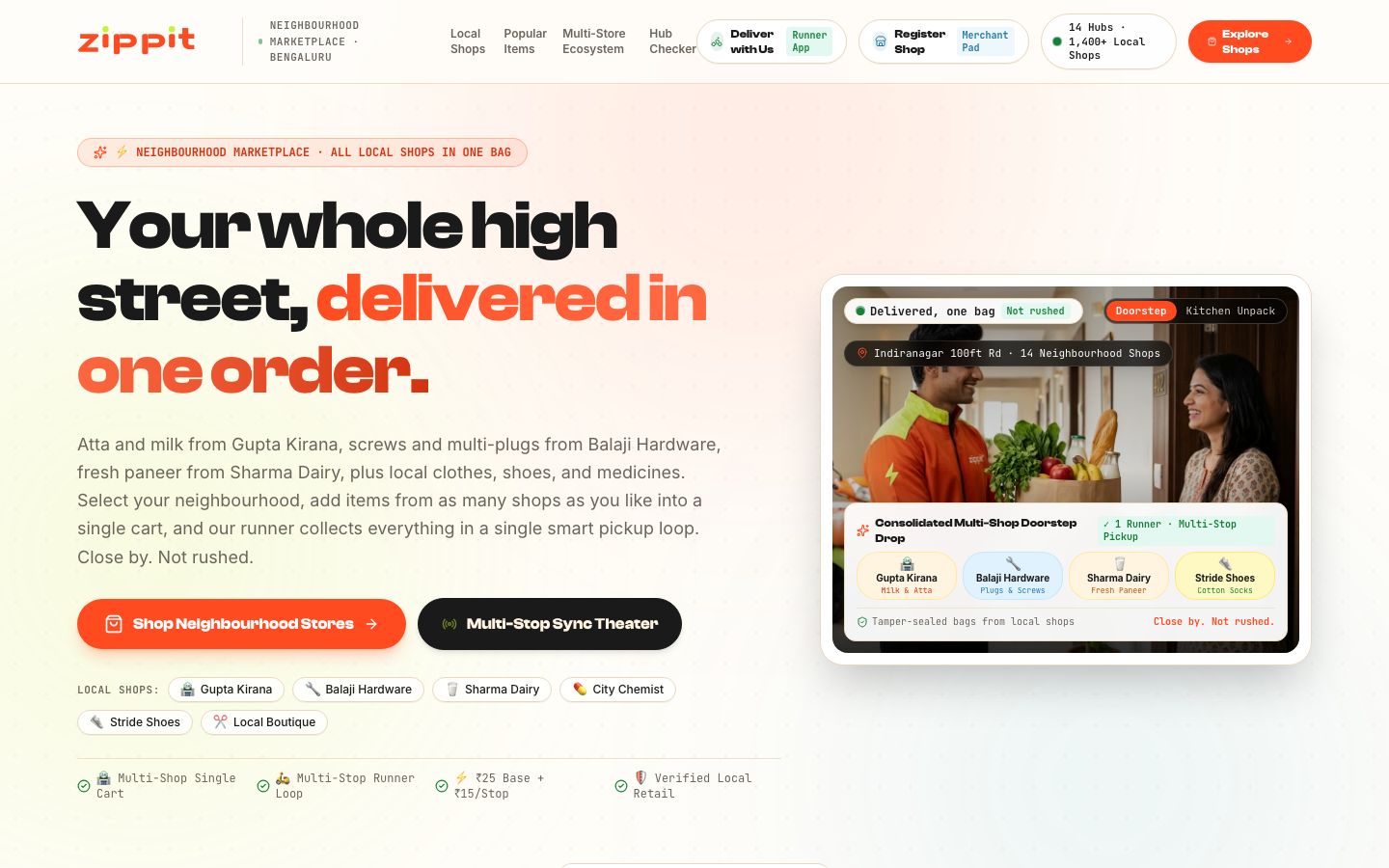
Zippit turns the local high street into an on-demand superstore. Instead of capital-heavy dark stores, it connects registered neighbourhood shops — kirana, hardware, dairy, pharmacy, stationery — within a 1.5 km radius.
Customers fill one cart from as many shops as they like. A single runner completes a smart multi-stop loop and delivers everything in one go. Fast because it's close, not because riders are rushed.
- 01
Multi-store cart
Items grouped by shop with a transparent multi-stop fee bar.
- 02
Multi-stop tracking
Shop 1 → Shop 2 → doorstep on a live map, with item-level pickup status.
- 03
Saved-trips receipt
“Zippit saved you 42 min and 3 market trips” — a shareable card.
The problem
Quick commerce in Indian cities usually means a company-run dark store, a stock list the company chose, and a rider on a tight clock. The neighbourhood shops that already stock most of what people need (the kirana, the dairy, the chemist, the stationer) are left out, or are reduced to a supplier.
This concept asks a different question: can the high street itself act as the warehouse? A shopper adds items from several nearby shops into one cart, and a single runner walks a short loop through those shops and then to the door. The promise is fast because it is close, not fast because someone is hurried.
Who it is for
- CustomerFill one cart from the kirana, dairy and chemist near home and see exactly what the extra shops cost before paying.
- Runner (rider)A clear itinerary of pickups in order, a pay figure that rewards extra stops, and an app that works in Kannada or Hindi.
- Shop counter staff (picker)A queue of orders to pack, items grouped by zone so fresh and chilled things are handled correctly, and a route through the shelves.
What we built
Every side of Zippit, live.
Each one opens the real build in a new tab. On a laptop the apps sit in a phone frame; on a phone they run full screen.
Customer app
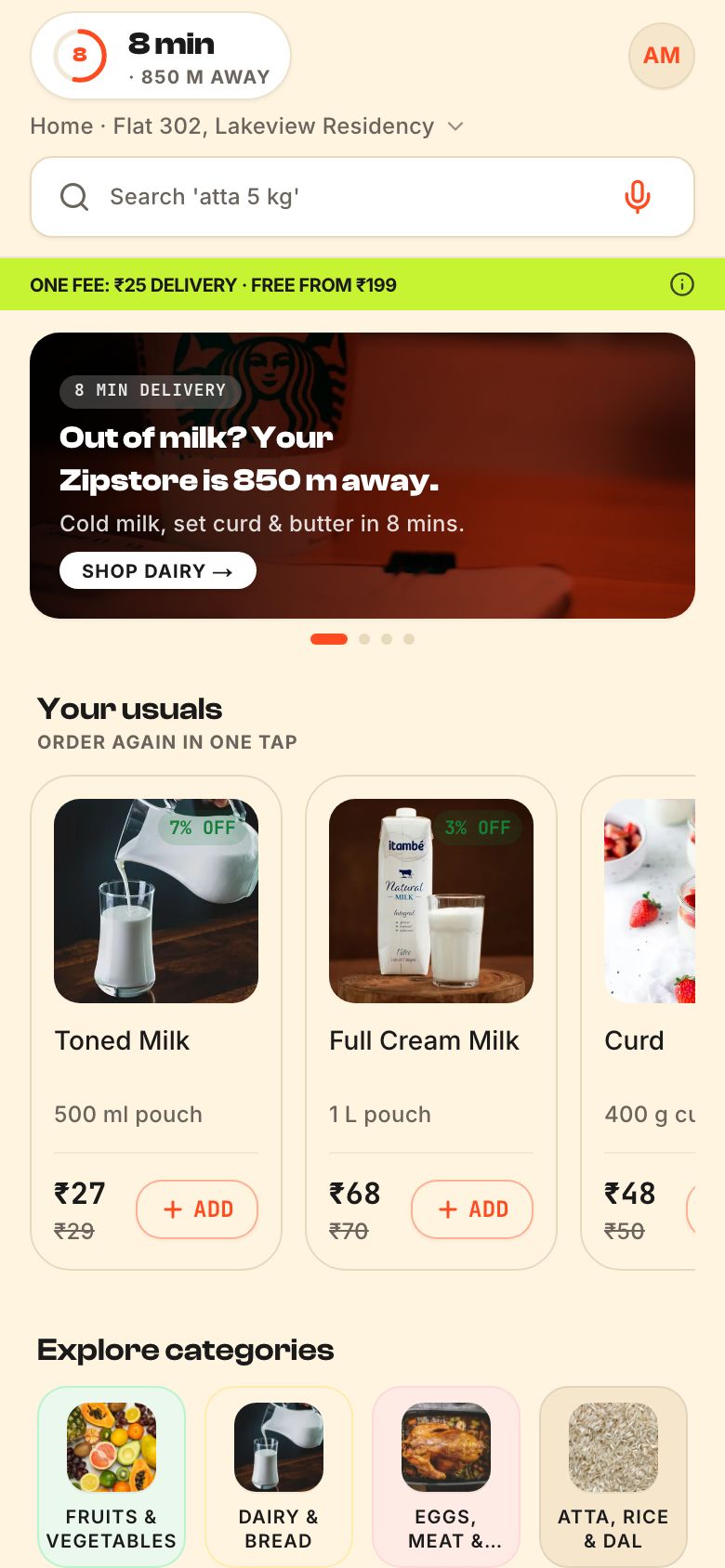
Area hub, cross-shop search, a multi-store cart and live multi-stop tracking.
Open /app/solutions ↗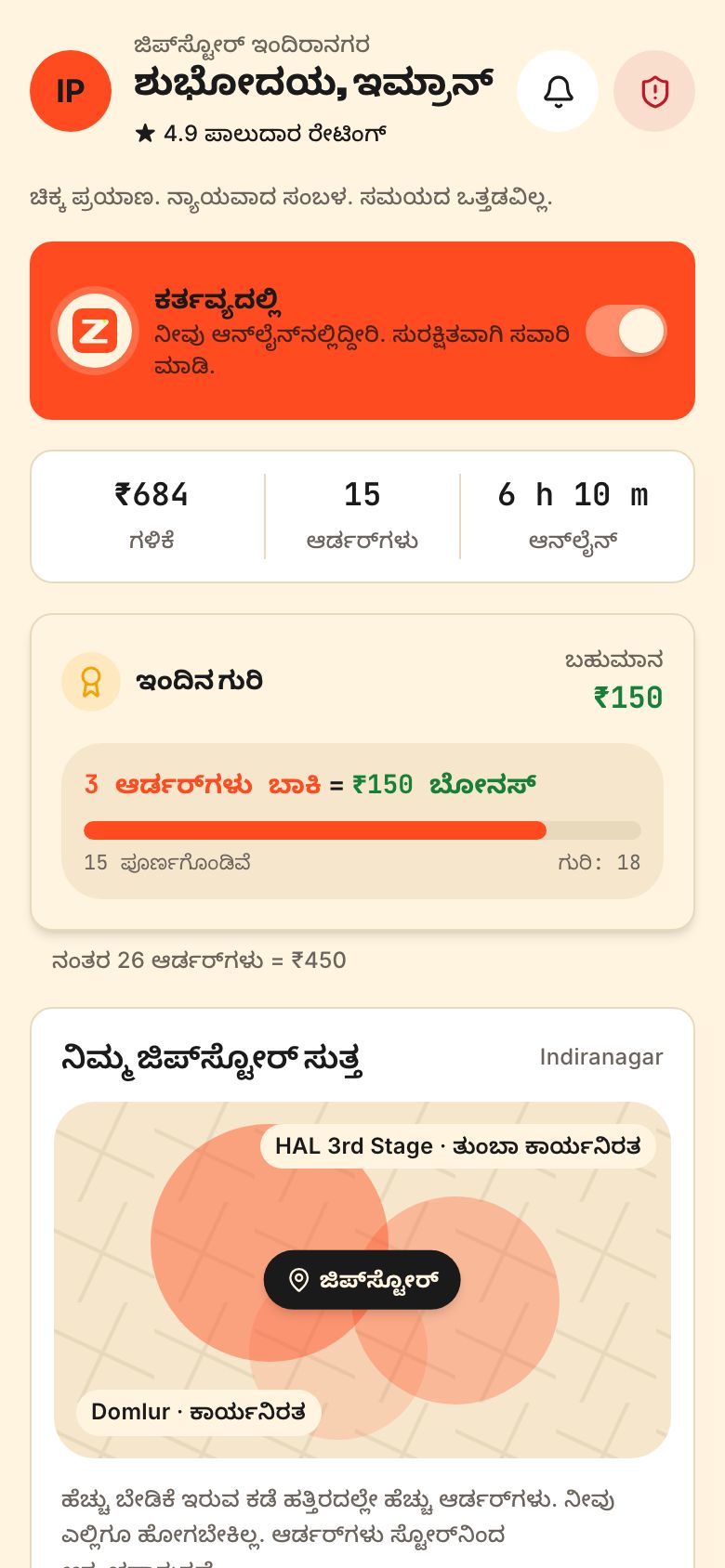
Rider app
Duty toggle, multi-stop waypoint itinerary and earnings, in Kannada too.
Open /rider ↗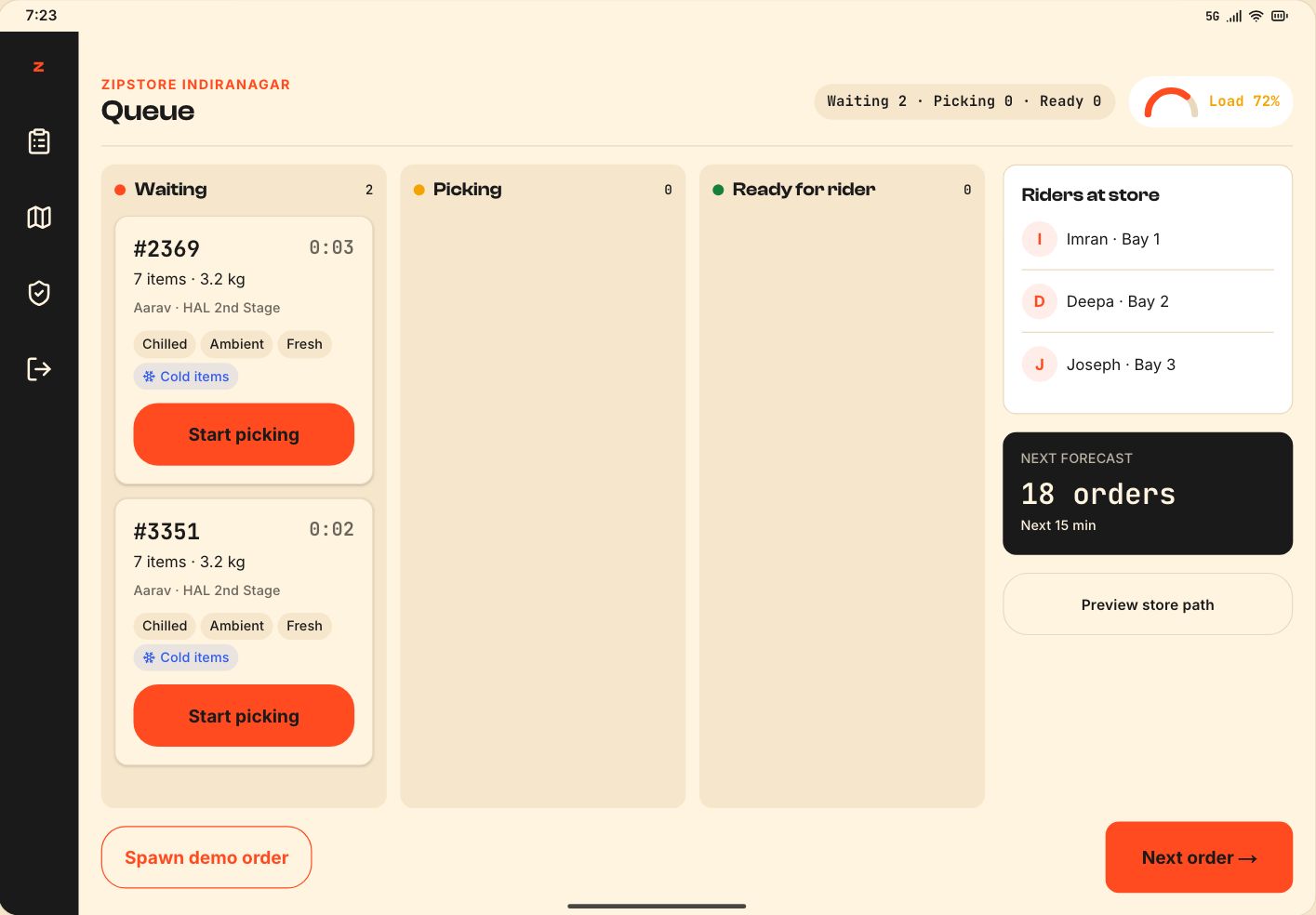
Picker tablet
The shop-counter queue with chilled and fresh tags and a 15-minute forecast.
Open /picker ↗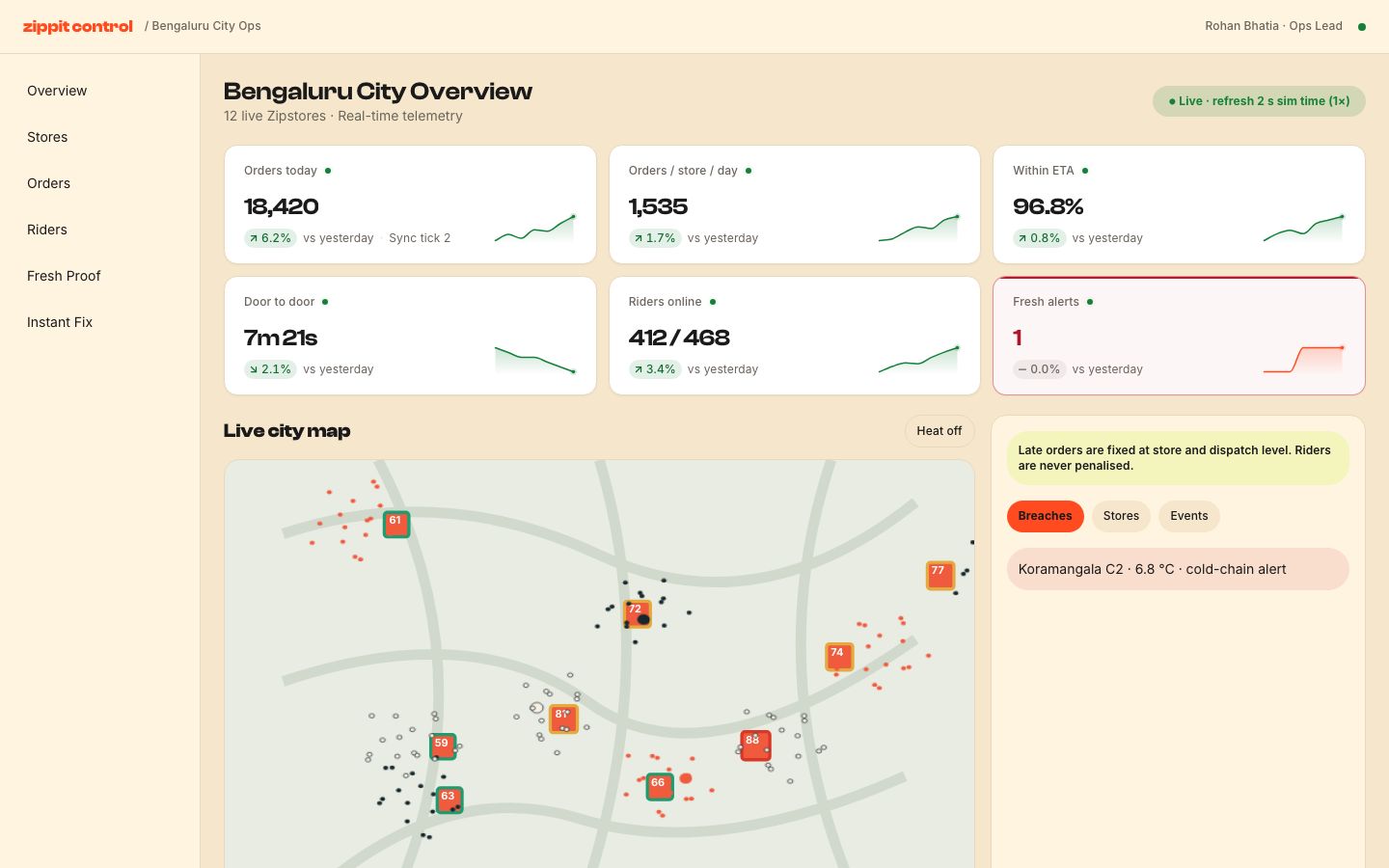
Ops console
City overview: orders, within-ETA rate, riders online and a live store map.
Open /ops ↗Website
The marketing site for customers and shopkeepers.
Open /home ↗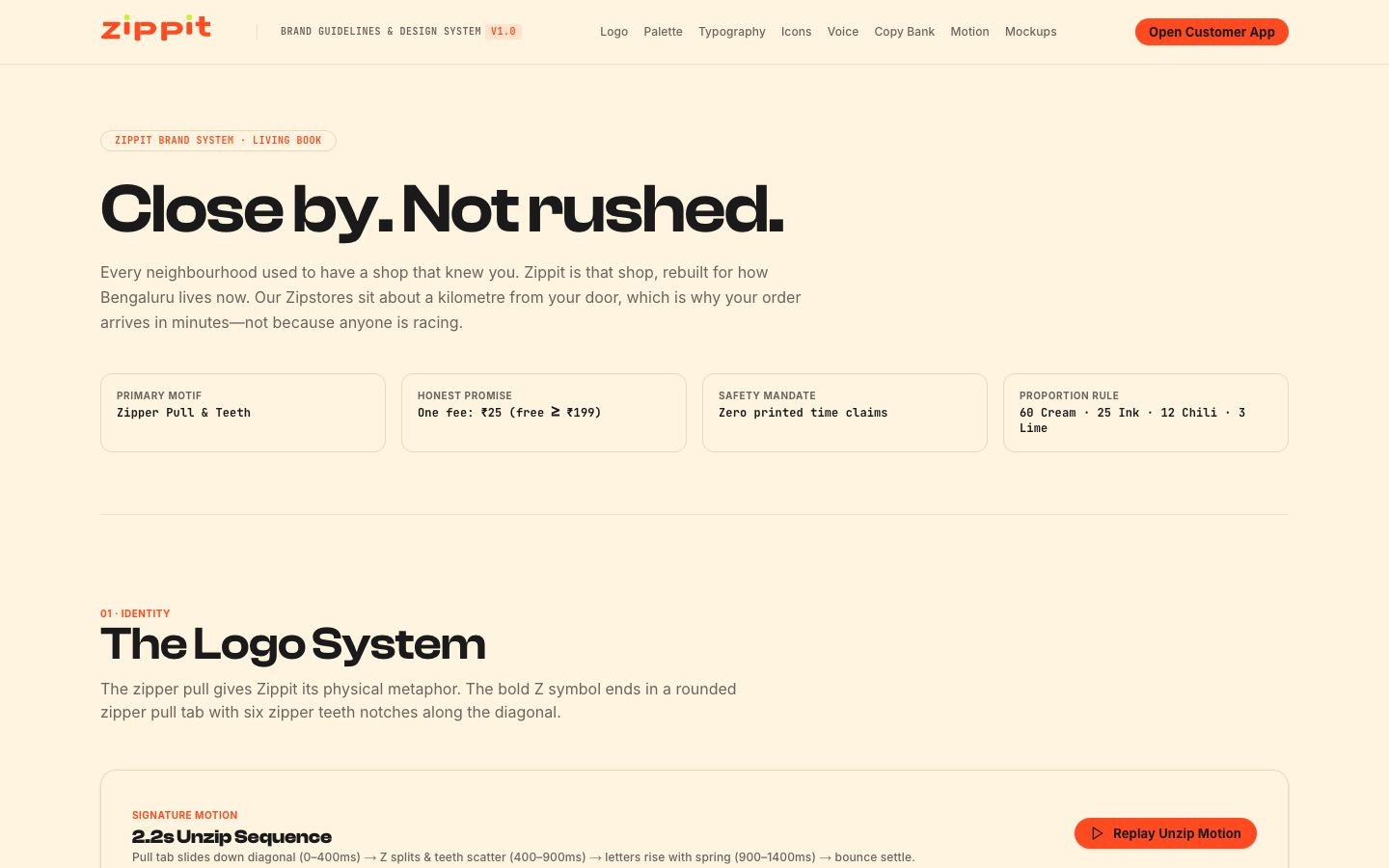
Brand book
The zipper-pull Z, colour, type, voice and motion.
Open /brand ↗In detail
Surface by surface
Rider app · /rider
The rider app has login, a home with an on-duty state, an offer overlay, a job screen, earnings, help and profile. The job screen walks the runner through pickups and ends with the customer's delivery OTP.
Picker tablet · /picker
The picker tablet is the shop-counter side: login, a queue, a pick screen with a store map and barcode-style scan input, a pack screen, a fresh-items screen and a shift screen.
Ops console · /ops
The ops console is a desktop view of the same simulated city: orders, riders online and a live map of the sample shops. It reads from the same shared state as the other surfaces rather than from its own copy, so what a customer does in the app shows up here.
Website · /home
The in-world marketing website speaks to customers, shopkeepers and runners, and is separate from the portfolio landing page at the root of the project. It carries the Zippit positioning, how the loop works and recruitment and press pages.
Brand book · /brand
The brand book covers the zipper-pull Z mark, colour, type, voice, motion and mockups, using Chili Orange, Cream, Ink and a lime accent.
Why it works this way
Design and product decisions
A fee that scales with shops, with a visible waiver
The bill charges a base delivery fee of Rs 25 for the first pickup and Rs 15 for each extra shop, with at most four shops per order. Delivery is waived once items cross Rs 399 (Rs 199 for the monthly membership). The reason is trust: the customer sees why a three-shop cart costs more, and sees the threshold that removes it.
Runner pay tied to stops, not only distance
Rider pay in the code is a base of Rs 30 per order inside 1.5 km, Rs 8 per km beyond, Rs 10 for every pickup after the first, and a Rs 12 rain bonus. Paying per stop stops a multi-shop loop from being the worst job on the board. Milestone bonuses (Rs 100, 250 and 450 at 10, 18 and 26 orders) sit on top.
Close, not rushed, as a product rule
Tracking speed in the simulation drops in rain mode (2.8 m/s against 3.5), and the order machine gives each shop a packing time per line and a 45 second dwell at each counter. Time estimates are built from those parts, so an ETA grows when a cart has more lines or more shops instead of staying at a fixed headline number.
Tip and wallet kept separate from the item price
Tips are fixed choices of Rs 0, 10, 20 or 30. Wallet credit can only offset items after the coupon, never delivery or tip. Keeping these as separate lines makes the receipt readable and keeps the rider's tip from being swallowed by a discount.
Engineering notes
Under the hood
Front-end prototype on shared packages
Each surface is a Next.js and React app using Tailwind, zustand for state and zod schemas for the curated data. UI, commerce, partner, tracking and simulation code live in shared workspace packages that the other concept builds reuse. There is no server: the data layer in lib/api.ts reads sample JSON-like modules and adds fake delay.
A simulated clock drives the whole order
An order state machine moves placed, picking, packed, handover, en route, arriving and delivered on timers computed from line count and route length. A multi-stop plan adds events for each shop. The same clock is shared by every surface so a status change appears everywhere.
Waypoint and shelf routing in plain code
Street distance is the straight line times 1.3, and waypoints for a run are built from the order's shops in lib/waypoints.ts. The picker's shelf route is a shortest-walk search over a store layout in lib/pickPath.ts. Maps use MapLibre through the tracking package, with Turf helpers for distance and bearing.
Local details
Built for India
Shops India already has
The merchant categories are kirana, dairy, pharmacy, hardware, stationery, apparel and footwear, each with a default prep time (3 minutes for dairy, 8 for apparel). All shop names are fictional, and a Koramangala shop can reuse an Indiranagar catalogue so sample data is not duplicated.
UPI and cash as payment options
The payment type allows three sample UPI apps, a raw UPI ID and cash on delivery. These are mock apps in a fake sheet; no payment network is called. The wording on failure is written for a user who has seen a UPI debit-and-reverse before.
Rider app in Hindi and Kannada
The rider strings are translated in three files (English, Hindi and Kannada) and chosen by the language preference. The customer app has English and Hindi files; its Kannada setting currently falls back to English, which a production build would fix.
What this is, and is not
This is a concept build. Shops, products, orders, coupons and runners are sample data, and every figure on a screen (fees, ETAs, earnings, order counts) is illustrative. There is no backend, no real payment, no real SMS OTP and no real GPS. The picker surface still uses a single store layout from an earlier single-store design, and some multi-shop work is marked deferred in the project's own status notes. Shop onboarding and KYC, GST invoicing per merchant, refunds, settlement to shops and real-time location from runners would all be needed for a launch, plus a decision on who carries liability for a multi-shop order.
Last updated 2026-11-07
Brand system
Building something like Zippit? Let's talk.
We'll walk you through this build on a call and map what yours would need.