An insurance agency needs one thing above all: a reliable record of every policy, its renewal date and the person to call. A well-built spreadsheet does that for the first 150 to 300 policies. After that, a CRM or an agency management system with automatic reminders and a document vault saves the time you would lose to missed renewals.
Custom software is a late step and a regulated one. It makes sense only when you have a repeatable service your own customers keep asking for, and it must work with licensed insurers and your data duties, not around them.
What the software has to hold
Think in records, not features. Each customer can have several policies; each policy has a type, an insurer, a number, dates, a sum insured, a premium, a nominee and, for motor, a vehicle; each claim has stages and documents. Whatever you use must handle that structure.
| Record | Fields that matter | Why it is easy to get wrong |
|---|---|---|
| Customer | Name, phone, WhatsApp consent, address, family links, language, date of birth, KYC status | Family members get entered as separate strangers, so you cannot see household cover |
| Policy | Insurer, product, policy number, start and end date, sum insured, premium, payment mode, nominee, add-ons, renewal status | Renewal date and policy end date get confused when a policy is renewed late |
| Vehicle (motor) | Registration number, make, model, year, IDV, NCB status, previous insurer and policy end date | NCB and previous-policy details are lost at renewal |
| Member (health) | Insured members, dates of birth, pre-existing conditions declared, waiting-period dates, portability history | Declared medical history must match what was in the proposal; keep a copy |
| Claim | Date of loss, claim number, stage, documents sent, queries, contacts at insurer or TPA, amount and outcome | Call notes live in people's phones, not the system |
| Commission | Policy, expected commission, date received, reconciliation status | Underpaid commission goes unnoticed without a monthly reconciliation |
| Consent and disclosure log | What was explained, what the customer asked for, documents handed over | Needed if a mis-selling complaint is raised |
Up to about 200 policies: a sheet and a folder
At the start, the cheapest thing that works is a spreadsheet with one row per policy and a second tab for customers. Add a column called days to renewal using the end date, sort by it each morning and filter for the next 45 days. Use a shared drive folder per customer for scanned schedules, proposal forms and claim papers, named by policy number.
- Use drop-downs for insurer, product and status so you can filter reliably.
- Conditional formatting turns rows red when 15 days or fewer remain.
- Keep a separate tab for commission expected versus received; reconcile it monthly against each insurer's statement.
- Restrict sharing to people who need it, turn on two-step sign-in and keep an offline backup. Health records and ID copies are sensitive personal data; see the DPDP Act checklist.
- Use WhatsApp Business for reminders with a saved message template and a label for 'asked for reminder'. Send only to people who agreed.
Cost is close to zero beyond your phone and a cloud storage plan. This is where most new agents stay for the first six to nine months, and it is fine. The failure mode is not the tool but the habit: a sheet nobody opens on a Monday.
200 to 1,500 policies: CRM, reminders and a vault
When the sheet slows down, or a second person starts handling calls, move to a lightweight CRM or an insurance-specific agency management tool.
| Tool type | What it gives you | Ballpark cost (estimate) | Watch out for |
|---|---|---|---|
| General small-business CRM with tasks and reminders | Contacts, deals, follow-up tasks, notes, email and WhatsApp integration through partners | Free to a few thousand rupees per user per month | No insurance fields by default; you will need custom fields for policies and vehicles |
| Insurance agency or POSP management software (offered by Indian vendors) | Policy and renewal tracking, commission sheets, templates for reminders, sometimes insurer-specific upload | Roughly ₹10,000 to ₹40,000 a year for a small agency; the playbook's estimate, verify current prices with vendors | Check whether data can be exported if you leave; check where servers are located |
| WhatsApp Business API through a provider | Template reminders, replies and a shared inbox for a team | Provider fee plus per-conversation charges; prices change, check current rates | Opt-in rules and template approvals; see WhatsApp for business apps |
| E-sign and document vault | Signed proposal forms, KYC copies and consent records in one place | Free to a few thousand rupees a month | Confirm what e-signature forms the insurer accepts |
| Accounting software | Commission income, GST and expense records | Roughly ₹5,000 to ₹15,000 a year for small-business plans | Ask your chartered accountant how to treat commission and any GST obligation |
| Call recording and dialer | Evidence of what was said, quality checks | A few hundred rupees per user per month and up | Customers should be told calls are recorded; follow local rules |
Pick on workflow, not brand. During a free trial, enter 20 real policies, set reminders, try importing a spreadsheet and test exporting everything. If any of those fails, move on.
Features that save the most time
- Renewal workflow: a task and a message at 45, 15 and 3 days, with the customer's preferred language, and a status such as 'quoted', 'paid', 'lapsed', 'not renewing' so lapsed policies get a follow-up call.
- Household view: show all policies for a family on one screen, so you can answer 'what cover do we have?' quickly.
- Claim tracker: stages (intimated, documents sent, surveyor assigned, query raised, approved, paid or rejected) with dates, so you know exactly which call to make.
- Document requests: a WhatsApp or link-based request for documents with a checklist for motor and health claims.
- Commission reconciliation: an import of the insurer's statement matched against your expected commissions, flagging gaps.
- Audit trail: who changed what and when; this helps in a customer complaint or an insurer audit.
What software must not do: calculate a premium that the insurer's own system should issue, recommend a product as 'best', or promise a claim outcome. Keep quotes, issuance and claim decisions inside the insurer's own tools or licensed platforms.
When a custom portal is worth building
Custom software pays when you have a clear repeated need that off-the-shelf tools cover poorly, and enough customers to justify it. For an agency, that usually means one or more of these:
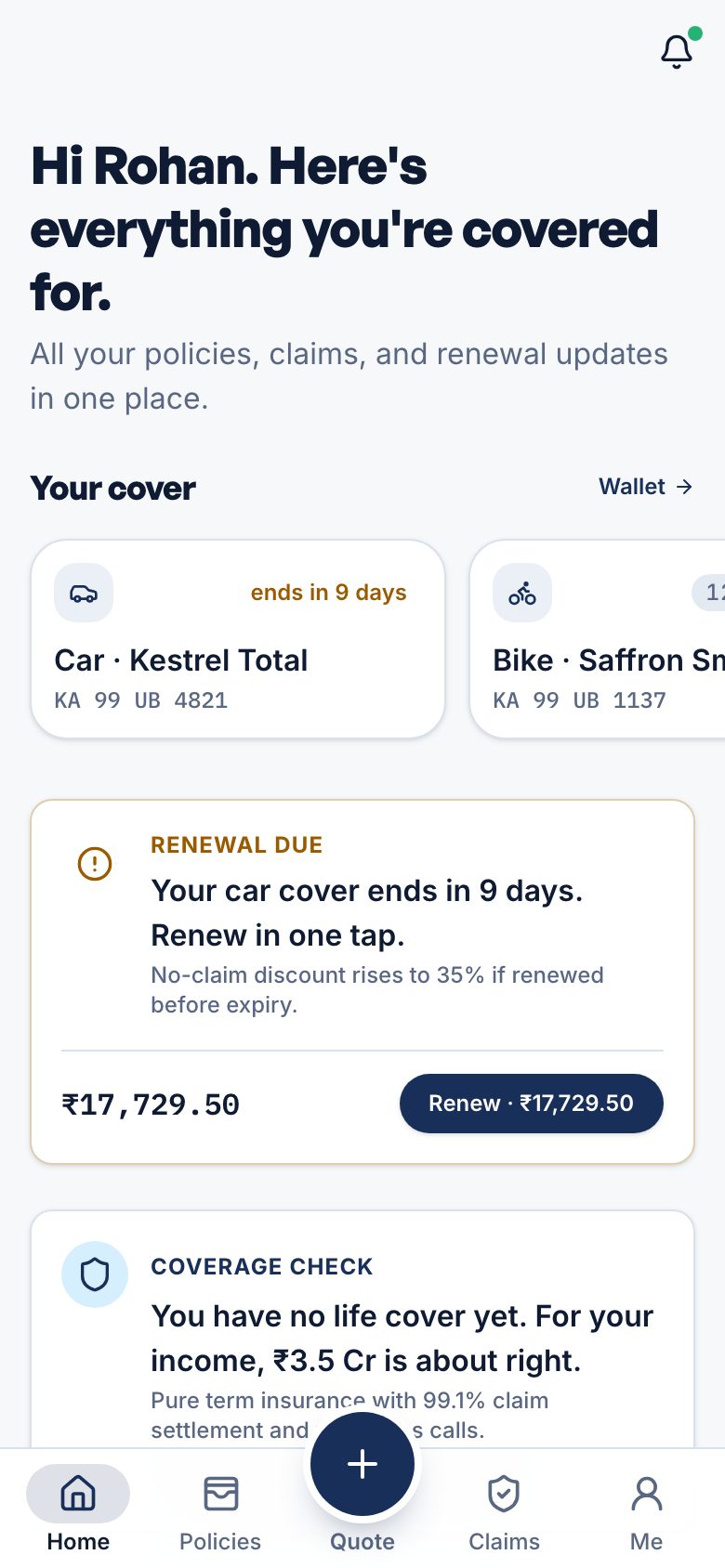
- A customer policy wallet where a family sees all policies across insurers, renewal dates and claim cards in one place, in their language.
- A claim tracker the customer can see, fed by your team's updates, so they stop calling to ask 'where is it?'
- Document upload with a checklist for claims, removing WhatsApp document chasing.
- Corporate client dashboards for SMEs managing employee group health, additions and deletions.
- Integrations with insurers' APIs, where they offer them to licensed partners, to pull policy status and renewal quotes.
Building in regulated finance has extra parts: consent records, secure storage of health and ID data, audit trails, a clear boundary between information and a regulated sale, and a licensed partner for quotes, issuance and payments. Read our fintech app guide and, if you collect payments, UPI payments in your app. Costs vary widely by scope; see app development cost in India for how to think about it.
Not legal or compliance advice. Before building anything that quotes, sells or collects premium, confirm with IRDAI, your insurer or intermediary and a lawyer which activities your licence covers.
Data and security basics
- Store identity and health documents in an encrypted drive or tool, not in personal WhatsApp chats or phone galleries.
- Give team members access by role, and remove access the day someone leaves.
- Ask customers' consent for storage, reminders and WhatsApp contact, and keep the record.
- Back up weekly, and test a restore once.
- Have a one-page plan for a lost phone or a suspected breach: who you tell, how you notify the insurer and customers. Check current breach-reporting duties.
Where our concept build fits, and The Saral
Umbrello is our concept build for this space: plain-English policy explanations, side-by-side comparisons of features and a claim tracker showing where a claim stands. It is a design and engineering exploration, not a licensed insurance product; it does not quote, sell or issue policies, does not replace an insurer's systems and does not manage commissions or renewals for you. It shows what a customer-facing layer could feel like on top of licensed partners.
If your own book has outgrown a CRM and you need a policy wallet, claim tracker or SME dashboard, The Saral can scope a build, starting from the fintech patterns in our fintech app work, with a fixed quote. Many agencies will be well served by the sheet-to-CRM path above and never need custom software.
More on starting a insurance agency
- Start hereThe full playbook →Models, licences, startup costs and the steps to your first customer.
- Go deeperGetting customers →Policy check-ups, garage and society tie-ups, WhatsApp renewals and referrals, with compliant claims.
- Go deeperFinding suppliers →Which insurers and partners to work with: appointment, panel, payout terms, service quality and red flags.
Questions people ask
What is the best software for an insurance agent in India?
There is no single best tool. A spreadsheet with a renewal-days column and a shared folder works for the first 150 to 300 policies. After that, a CRM or an insurance agency management tool with reminders, household view and claim tracking is worth paying for. Trial any tool with your real policies and check you can export your data.
Can I use WhatsApp to send renewal reminders?
Yes, if customers have agreed to receive messages from you. Use WhatsApp Business with saved templates for a small book, or an official API provider for a team. Keep reminders factual (policy, date, how to renew), give an easy opt-out, and avoid sending product pitches in the same message.
Is it safe to keep customer policy documents on Google Drive?
It can be, with care. Use a business account, two-step sign-in, restricted sharing and role-based access, and avoid sharing links publicly. Health records and ID copies are sensitive personal data under India's data protection rules. Keep a record of consent, delete what you no longer need, and confirm with your insurer what they expect.
When should an insurance agency build its own app?
When customers repeatedly ask for something your current tools cannot do, such as a family policy wallet or a live claim tracker, and when you hold enough policies to justify the cost. Many agencies never need one. If you build, plan for consent, security, audit trails and licensed partners for quotes and payments.
Can software quote and issue policies for me?
Only through the insurer's own systems or a licensed platform that is permitted to do so. Your own tools should record and track policies rather than calculate and issue them. If a vendor offers quoting or issuance, ask which licence it works under and confirm it with your insurer and IRDAI's current rules.