A maid service starts on a shared spreadsheet, WhatsApp Business and UPI collect requests, and that is enough for up to roughly 30–40 homes. The jobs the software must do are narrow: know who is meant to be where, confirm they arrived, find a replacement fast, collect fees in advance and pay workers on a fixed day.
Custom software is rarely worth it before you have repeat on-demand bookings, many workers on fluctuating shifts and a real cost from missed visits. Most agencies are better off with an off-the-shelf booking or field-service tool first. Prices below are estimates; confirm current plans on each vendor's site.
The six jobs, whatever tool you pick
Ignore feature lists. A maid service lives or dies on six small jobs, and every tool should be judged on how well it does them.
| Job | What breaks without it | Cheapest workable tool |
|---|---|---|
| Roster: who goes to which home, when | Two workers at one house and none at another | Google Sheet with one row per home and a column per time slot |
| Attendance: did she arrive? | You find out from an angry customer at 10 am | A morning call or a shared WhatsApp 'reached' message with a location pin |
| Replacement dispatch | Calls to ten workers while the family waits | A floating-pool sheet with phone numbers and a broadcast list |
| Booking and enquiries | Messages lost in personal chats | WhatsApp Business with labels and quick replies |
| Collections and invoices | Late fees fund late wages | UPI collect requests or payment links; monthly invoice by sheet |
| Worker pay, leave and advances | Disputes about days worked and advances | Attendance sheet that feeds a payroll sheet, payslip by message |
Sheets and WhatsApp: set up properly
A spreadsheet is a real system if it is built with discipline. Most agencies break it by letting three people edit different versions.
- Customers tab: home ID, society, flat, contact, tasks included, visit time, monthly fee, start date, fee due date, assigned worker, backup worker.
- Workers tab: worker ID, phone, home area, verification status and date, pay rate, weekly off, leave balance, advance balance.
- Daily tab: one row per visit with scheduled time, 'reached' time, finished time and a replacement flag. Filter by date each morning.
- Money tab: fees due, received, UPI reference and the month's worker wage.
- WhatsApp Business: use labels such as New enquiry, Trial, Active, Cancelled, and saved replies for price, tasks and cover promise. The free app is enough to start; confirm the current limits and any API charges on Meta's pages.
- Google Forms: a checkout form workers fill at the end of each visit, with a photo field for deep cleans and breakages.
Lock down who can edit, keep a read-only copy for owners, and treat the sheet as personal data because it holds addresses and phone numbers; our DPDP checklist is a good first read.
Off-the-shelf tools worth a look
Once you pass roughly 30–40 homes, or the morning attendance round takes more than half an hour, a purpose-built tool saves real time. These are categories to shortlist from, and none of them was built for Indian domestic work, so test with your own roster.
| Category | What it adds | Where it falls short for a maid service |
|---|---|---|
| Appointment and booking tools | Online booking page, reminders, payment links | Weak at recurring daily visits with a fixed worker and cover swap |
| Field-service and dispatch software for cleaning and home services | Job scheduling, route view, check-in and checkout, invoices | Priced per user in dollars, which adds up for many part-time workers; built for crews, not one worker per home |
| Attendance and HR apps for Indian small business | GPS or selfie attendance, leave and salary slips, PF and ESI reports | No customer side; you still need booking and a roster elsewhere |
| Accounting and GST invoicing software | Invoices, receivables, GST returns | Not a scheduling tool; see our GST billing software guide |
| Light CRM or shared inbox | Customer notes, follow-ups, WhatsApp-linked chats | You still build the roster yourself; see business inbox and CRM |
A practical stack at this stage is a booking and customer tool, an HR or attendance app for worker records and pay, and your accounting software. Connect them by exporting a CSV once a month. Avoid anything that makes workers install three apps.
Many workers use a basic Android phone, share it with family and prefer a regional language or voice. Test any worker-side tool with your actual workers before you buy.
When custom software starts to pay
Custom is justified when your rules do not fit any tool and the cost of the gap is measurable in rupees. Here is a quick test.
- You have 100+ regular homes, or hundreds of hourly bookings a week.
- More than one visit in twenty is missed or late, and each miss costs a refund or a cancelled customer.
- Customers want to book, reschedule and pay themselves, and your coordinator spends most of a day on messages.
- You pay workers in several ways, such as monthly wage, per-visit pay and bonus, and reconciliation takes days.
- You want to own the customer data instead of renting it from a marketplace.
If you tick three or more, scope it. A first build usually covers a customer app or WhatsApp-based booking, a worker app with attendance and visit checklists, an admin roster with replacement dispatch, UPI collections and a payroll export. Our home services app guide walks through what to specify, and app development cost in India gives sensible budget thinking.
Features that matter for this trade
Generic booking apps miss details that a maid service cannot live without. Put these in any specification or off-the-shelf comparison.
- Recurring bookings with a fixed worker and automatic cover when she is on leave, without the family rebooking.
- Short-notice replacement: an alert to the floating pool and a first-to-accept rule, with distance shown.
- Check-in and check-out with a location stamp, and a checklist per home, since each family's tasks differ.
- Family-side confirmation: a message with the worker's photo and name before each first visit.
- Per-half-hour or per-task pricing for on-demand sessions.
- Breakage and complaint log with photos, so disputes are about evidence.
- Worker-side clarity: her weekly schedule, earnings, advances and leave in her language.
- Data protection: limited access to worker ID and addresses, with an audit trail.
Our concept build and what it does not cover
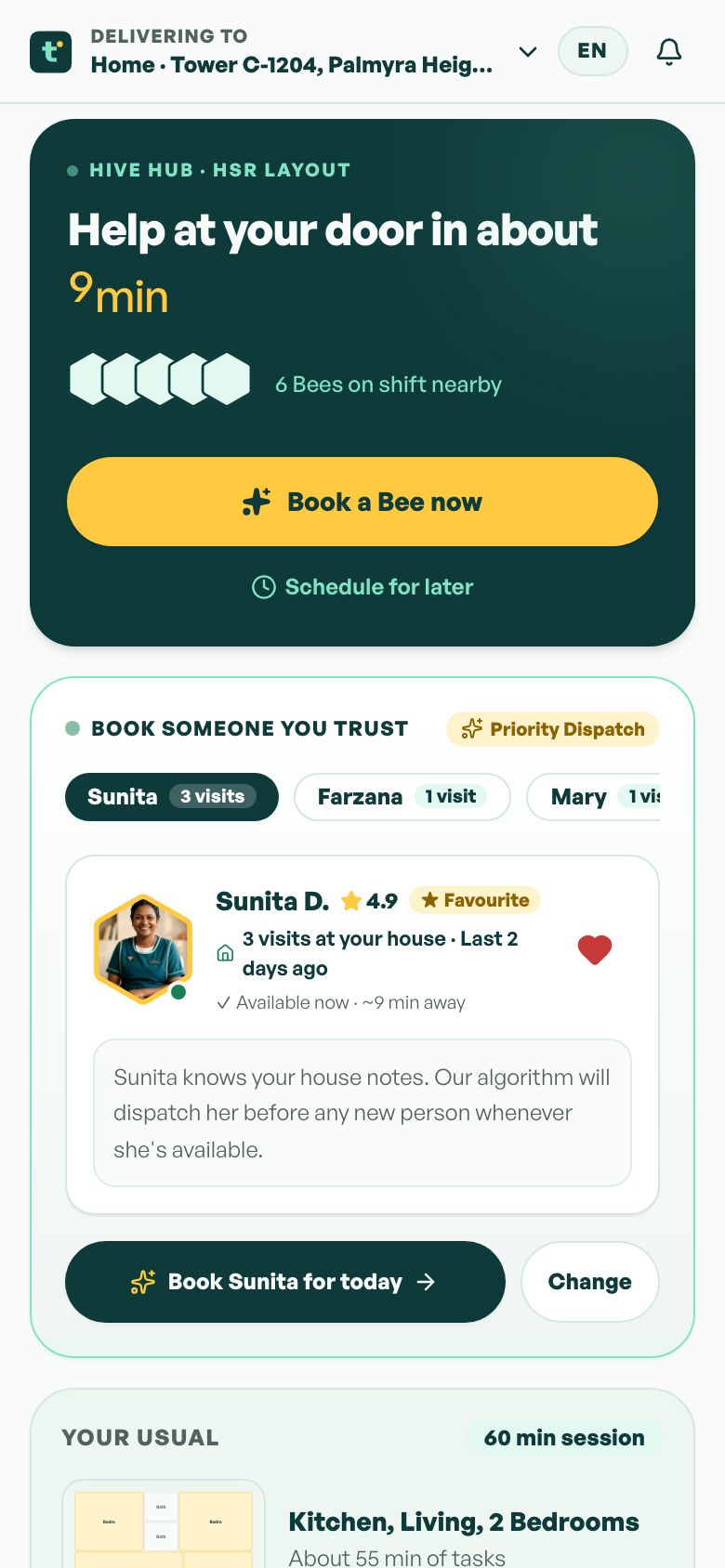
Our TidyBee concept build shows how an on-demand booking flow for house help could work, with sessions billed by the half-hour. It is a concept: it does not run a live agency, hold your worker data or replace verification, payroll or insurance. You can open the live concept at tidybee.thesaral.com.
If you outgrow sheets and off-the-shelf tools, The Saral builds custom home-services products on a fixed scope, including booking, worker apps and dispatch. We would first ask you to run the sheet version for a month, because that shows what the software really needs to do. See also our home services app solution.
More on starting a maid service
- Start hereThe full playbook →Models, licences, startup costs and the steps to your first customer.
- Go deeperWhat to buy →Cleaning kits, a few machines, uniforms, ID and cover, costed, and what to rent or skip.
- Go deeperWho to hire →Workers, a supervisor and a coordinator: pay, sourcing, police verification and written terms.
- Go deeperGetting customers →Society tie-ups, WhatsApp, Maps, a trial visit and pricing that keeps families past month one.
Questions people ask
What software does a maid service need to start?
Almost none. A shared Google Sheet for roster and attendance, WhatsApp Business for enquiries and UPI collect requests for fees are enough for the first 30–40 homes. Add an attendance or HR app for worker pay once you have more than ten workers, and accounting software when GST invoicing begins.
Can I use Google Sheets to run a maid agency?
Yes, if it is set up carefully. Keep separate tabs for customers, workers, daily visits and money, give editing rights to one or two people, and filter by date each morning. It breaks down when several people edit versions, when attendance rounds take too long, or when customers want to self-book.
Is there a ready-made app for maid services in India?
There are home-services platforms and field-service tools, but most were built for service companies with crews rather than for one worker serving a family daily. Test any tool with your own roster, a trial month and a few real workers on basic phones before you commit; we haven't verified current features or pricing for any vendor.
When should I build a custom app for my maid service?
Consider it at roughly 100 homes or heavy hourly bookings, when missed visits cost real money, customers want to self-book, and your coordinator spends most of a day on messages. Before that, sheets and off-the-shelf tools are cheaper and teach you what the software must do.
How do I track worker attendance for domestic workers?
Use a morning call or a 'reached' WhatsApp message with a location pin for the first month, then an attendance app with check-in and selfie or location if the volume grows. Keep it simple, test on a basic Android phone, offer regional language and tell workers what data you collect and why.