Win your first ten moves through three things: a verified Google Business Profile, a few brokers and housing societies who already see moves coming, and a written, itemised quote that is clearer than anything the customer has seen before. Ads and aggregator leads come after you can handle a complaint.
A moving customer buys rarely, compares three companies and is wary of hidden charges. Your marketing is mostly about proving you are real and predictable. Price figures below are estimates to adapt, not market rates.
Why this trade is different to market
A customer books you perhaps once in five years, so there is almost no brand loyalty to rely on. They start with a search a week or two before the move, call three numbers and book the one that sounds organised. Reviews and a clear quote beat a clever slogan.
- Short decision window: most bookings are made one to three weeks before the move date; last-minute month-end calls happen too, which you can only handle if you hold crew capacity.
- Fear of fraud: advance payments to unknown movers and goods that never arrive are widely discussed. Show a real address, proper invoices and an inventory signed on both ends.
- Spikes: demand rises at month-end, around the start of the school year and during job-transfer cycles. Plan capacity before you plan advertising.
- Who decides: in households it is often the person who runs the family logistics; in offices it is an admin, facility or HR manager who values paperwork.
Channels that work for a mover, in order of payoff
| Channel | How it works for a mover | Early cost (estimate) | Effort |
|---|---|---|---|
| Google Business Profile and Maps | 'Packers and movers near me' is the main search; photos of your crew, truck and packing work, and real reviews | Free to set up; a few thousand rupees for photos | High, ongoing |
| Brokers and property dealers | They know who is renting out and who is moving next month; offer a fixed referral fee per completed move | A referral fee you agree in advance, as a percentage or fixed amount | Medium |
| Housing societies and RWAs | Get on the society's vendor list, put a flyer on the notice board, offer a move-out day slot | ₹2,000–5,000 for flyers | Medium |
| Corporate HR and admin desks | Transfers and joining relocations; offer one point of contact and GST invoices | Time for proposals | Medium, high value |
| Builders and new-project sales teams | Customers who just bought a flat need a move-in; leave a brochure with the sales team | Low | Medium |
| Rental and relocation agents | Tenants moving between flats are frequent; partner with a few agents | Referral fee | Medium |
| WhatsApp Business | Quote templates, a product catalogue of services, and status updates on moving day | Free | Low |
| Paid search and marketplace leads | Lead platforms such as Justdial and IndiaMART sell enquiries; verify pricing and lead quality before paying | Platform-dependent, we have not verified current rates | Medium |
Our local SEO guide for India walks through the profile, categories and review steps. For a mover, add photos of boxes labelled by room and a short description of what is included in each service.
Your first ten customers
Do not wait for strangers. These are the people who can give you moves in your first two months.
- Offer your family, friends and former colleagues a move at cost plus materials, in return for photos and an honest Google review.
- Walk into five property-dealer offices in a locality and leave a card and a one-page rate sheet.
- Speak to the secretary of two or three societies about a vendor slot and a society-member discount.
- Offer one local mover or relocation desk a partnership: you take their overflow on peak days.
- Email or call HR and admin heads at companies with new hires, offering a trial move for a staff member.
- Ask every customer, at the final delivery receipt, for a review and one introduction.
- Send a short follow-up on WhatsApp three days after the move, and ask whether anything was damaged or missing.
Keep a record of where each customer came from. A sheet with name, source, quote, outcome and review status is enough, and it tells you which broker or society is worth a second visit.
Quotes and launch pricing that build trust
Price is the first thing customers compare, but surprise charges are the first thing they complain about. Send a quote that states exactly what is included.
| Line on the quote | What to write | Estimated range for a local 2-BHK (planning only) |
|---|---|---|
| Packing labour and materials | Boxes, bubble wrap, film, tape, blankets, quantity per room | ₹3,000–7,000 |
| Vehicle and driver | Vehicle size, distance, waiting time included | ₹3,000–8,000 within a city |
| Loading and unloading | Crew size, floors, lift or stairs | ₹2,000–5,000 |
| Dismantling and reassembly | Beds, wardrobes, wall units, TV mounting | ₹500–2,000 per item |
| Insurance (optional) | Declared value and what the policy covers | A small percentage of declared value, depending on the insurer |
| Parking, toll and permissions | Who pays, and what happens if the society charges a move fee | At actuals, stated upfront |
- Launch offer: a first-month discount on packing materials for moves booked through a broker or society, rather than a cut on labour.
- Advance: take a modest booking advance (UPI) and the balance on delivery. A large advance on a young firm reduces trust.
- Cancellation and waiting rules: write them down. Customers accept a clear rule; they resent one invented on the day.
- Peak-day pricing: say it openly, for example 'month-end weekend rate', and give the lower weekday date as an alternative.
Surveys, trust signals and moving-day experience
- Survey every move. A 10-minute video call, with the customer walking through each room, replaces guessing. A mistaken count of boxes or an unknown spiral staircase is a main cause of price arguments.
- Signed inventory. Both at loading and unloading, with condition notes and photos of pre-existing marks.
- Crew introduction. Tell the customer who is coming, the supervisor's name and phone number, and send a photo on WhatsApp the night before.
- Visible identity. Uniforms, a branded vehicle and a GST invoice show you are an operating business.
- Real photos. Show your crew and your packing process. Stock photos of trucks undermine trust.
Claims handled well become your best marketing. State your claims process on the quote: how to report damage, within what time and how decisions are made. Transit cover and clear packing standards make that promise believable.
Reviews, repeat business and referrals
Repeat business in this trade comes from three places: the customer's next move, their friends and family, and the company or broker who sends you work every month.
- Ask at the right moment: right after the last box is placed and the customer signs, with a short link or QR code to your Maps profile.
- Answer every review, including bad ones, with specifics and a promised fix. Prospects read your replies as closely as the stars.
- Corporate accounts: offer an annual rate card, a named coordinator and monthly invoicing. One HR desk can send a dozen moves a year.
- Broker loop: pay referral fees quickly and tell the broker how the move went. Brokers send work to the movers who do not make them look bad.
- Off-peak offers: discounts on weekday moves smooth your crew's calendar.
Do not buy or invent reviews. Platforms act against fake reviews, and customers can usually tell. Use only genuine feedback.
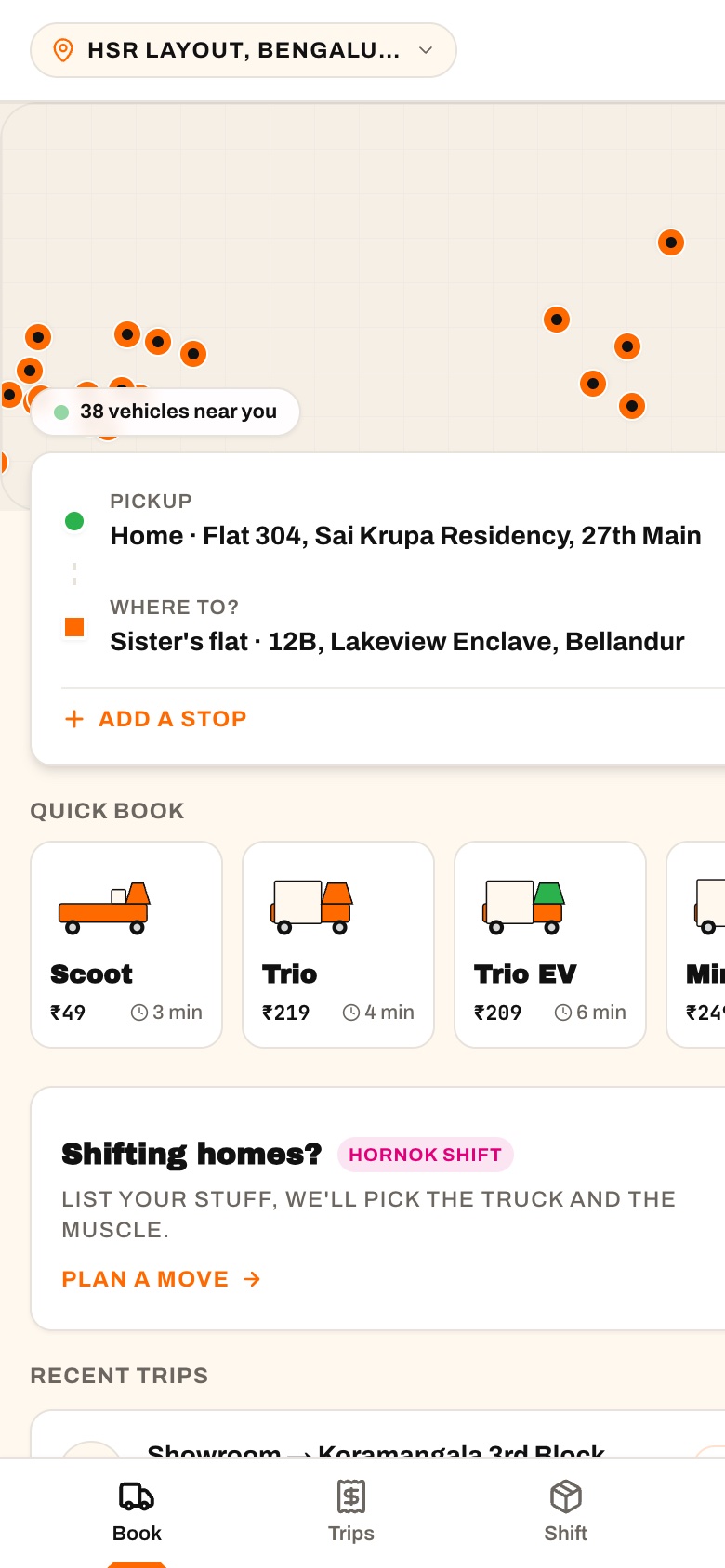
If you are building a booking flow with vehicle choice and helper add-ons, our HornOK concept build and the logistics app solution show one approach, and the how app costs work in India guide helps with budgeting.
More on starting a packers and movers business
- Start hereThe full playbook →Models, licences, startup costs and the steps to your first customer.
- Go deeperWhat to buy →Packing materials by the move, crew tools, vehicles to hire, and what not to buy yet.
- Go deeperWho to hire →Packers, loaders, supervisor, driver and estimator: hiring order, pay, vetting and contracts.
- Go deeperFinding suppliers →Vehicle owners, partner movers in other cities and packing material suppliers: vetting and terms.
Questions people ask
How do packers and movers get customers online?
Most customers find a mover by searching on Google Maps, so a verified Business Profile with real photos, honest reviews and a clear service description is the strongest channel. Add a WhatsApp Business number for quotes and a simple page listing your pricing method. Paid leads can supplement this once you have capacity and a record to show.
How do I get my first customers for a moving company?
Start with people you know, then property dealers, housing societies and HR desks. Offer a move at near cost in return for photos and a real review, and ask every customer for one introduction. Keep a simple sheet of the source of each booking so you can see which relationship is worth repeating.
Should I give discounts to win moves?
A modest launch discount on packing materials or a weekday slot is fine, but a very low price usually leads to surprise charges and bad reviews. Customers care more about a clear, itemised quote. Compete on transparency and on dates you can honour, and keep margin to pay your crew properly.
Are lead platforms like Justdial worth it for movers?
They can bring enquiries quickly, but the leads are shared with competitors and the pricing model varies, so test with a small budget and track how many become paid moves. We have not verified current platform pricing. Treat them as a supplement to Maps, broker and society relationships, not a replacement.
How do I get corporate relocation work?
Approach HR and admin heads with a one-page offer: a single point of contact, GST invoices, inventory sheets, insurance options and a trial move. Corporates value reliability and paperwork more than the lowest price. A good first move for one employee can lead to a rate agreement for the whole company.