Start with a GST billing app that tracks batch numbers and expiry dates, a WhatsApp Business account with a catalogue, and one spreadsheet of customers with pet name, food brand, bag size and last purchase date. That is enough for a shop's first year. Move to a retail POS with customer history when you pass a few hundred active customers.
The software questions that matter for a pet shop are not generic. Food expires, bags are heavy and delivered, customers reorder on a schedule, and some stock (like medicines) needs care. Pick tools for those four things. A custom app is only worth it once reorders and deliveries outgrow sheets and WhatsApp.
What a pet shop needs software to do
| Job | Why it matters here | Tool category |
|---|---|---|
| Bill with GST and print or share an invoice | Every sale needs a proper invoice; many packs share one brand with different rates and weights | GST billing or retail POS |
| Track batch and expiry per item | Food and treats expire; you need first-expiring, first-out and a list of stock to clear | POS with batch and expiry fields, or a stock sheet |
| Know what is running low | Heavy food has a supplier lead time; running out sends a regular to a rival | Reorder level per item in POS or inventory app |
| Remember each customer's pet and food | The bag's run-out date is the reminder date | Customer sheet, POS customer notes or a light CRM |
| Message customers on WhatsApp | Orders, reminders and delivery updates all happen on WhatsApp | WhatsApp Business app, then WhatsApp Business API through a provider |
| Plan home deliveries | Heavy bags and litter delivered to the same buildings on fixed days | Maps plus a route sheet; later a delivery-route tool |
| Take online orders | Part of your market orders online; you want those orders under your own name | WhatsApp catalogue, then a hosted store or ecommerce website |
Month one: the cheapest set that works
You do not need to spend more than a few thousand rupees a year to begin.
- A free or low-cost GST billing app that prints or shares invoices, supports barcodes and lets you add batch number and expiry date. Examples to compare: Vyapar, myBillBook and Zoho Books are commonly used by Indian small shops; I have not verified current plan prices, so check each vendor's pricing page.
- A WhatsApp Business account on a dedicated number, with a catalogue of your top 30 products, quick replies for opening hours and delivery area, and labels for 'New', 'Awaiting payment' and 'Out for delivery'. See what a WhatsApp-for-business setup covers.
- A Google Sheet for customers with columns for name, phone, pet name, species, breed, age, food brand and pack, daily amount, last purchase and next reminder date.
- A second sheet for suppliers and expiry, with item, batch, expiry date and quantity for the 20 lines that matter most.
- A Google Business Profile for local searches; see the local SEO guide.
Add a formula to the customer sheet: next reminder date equals last purchase date plus bag weight divided by daily amount, minus five days. Sort by that column each morning and message the first ten. That one formula is your retention engine.
When sheets start to creak: a retail POS with customer history
- You have more than a few hundred repeat customers, so scrolling a sheet to find them takes too long.
- Two people bill at the same time, and stock counts drift.
- You hold more than 500 SKUs across brands and pack sizes.
- You want reports by brand, category and margin rather than a monthly total.
- Your accountant wants clean GST returns without retyping.
Look for a POS that supports barcode scanning, batch and expiry, reorder levels, customer records with a free-text note per customer, multi-pack units (so a 20 kg bag and a 1 kg pack share a brand) and supplier purchase entries. Run it in parallel with your sheet for two weeks before switching off the sheet.
Plan for data export. Whatever you choose, make sure you can download your customer list, item list and sales history as a file. If a vendor shuts down or raises prices, your data should leave with you. The GST billing software guide lists the features to check.
Delivery and repeat orders
Delivery is where small pet shops win against online sellers on heavy items. It does not need a heavy system at the start.
| Volume | Setup | Estimated cost |
|---|---|---|
| Up to 10 deliveries a day | WhatsApp orders, a rider or the owner on a bike, a route sheet printed each morning, UPI on delivery | Fuel plus rider pay; no software beyond what you already have |
| 10–40 deliveries a day | Group orders by lane or building, fixed delivery days, a delivery-status message on WhatsApp | A part-time rider or a scooter lease; consider a low-cost delivery tool |
| 40 or more, or several riders | A route planner or delivery management tool, order tracking page, proof of delivery | Monthly subscription or custom build; check vendor pricing |
Autoship, or a monthly standing order, is the strongest retention tool for a pet shop. Start it on a sheet: customers who say 'send the same bag every 40 days' go on a list with a next-delivery date. A subscription-delivery system automates the same idea with payment and reminders; see the subscription delivery concept.
Regulated lines: keep records even in software
Your software should make it easy to do three things for any regulated or sensitive item.
- Keep batch and supplier details for medicated or prescription-type items you are allowed to sell, with the invoice copy, so a recall or complaint can be traced.
- Never offer a product for sale that the licence or rules do not allow you to stock. If you are unsure whether a flea, tick or worming product needs a prescription, ask your drug control office.
- Avoid any live-animal module. A supplies shop's software should not include sales of pet animals. Trade in pet animals needs registration with the State Animal Welfare Board, with record books and registers as part of the Pet Shop Rules, and wildlife law bans some species altogether. If you ever do get registered, ask the Board what records it requires before choosing a system.
When custom is worth it, and what a concept covers
Custom software pays off only when your edge is a service that no off-the-shelf tool does. For a pet shop that might be:
- A pet profile with weight, allergies, vaccine dates and daily food grams, used to flag unsuitable products and to time reorders. This is the strongest case for custom.
- Autoship with pause, skip and change-size controls, where the customer manages their own schedule.
- A combined booking system if you also run grooming slots or a visiting vet.
- A multi-store catalogue where several branches share one inventory.
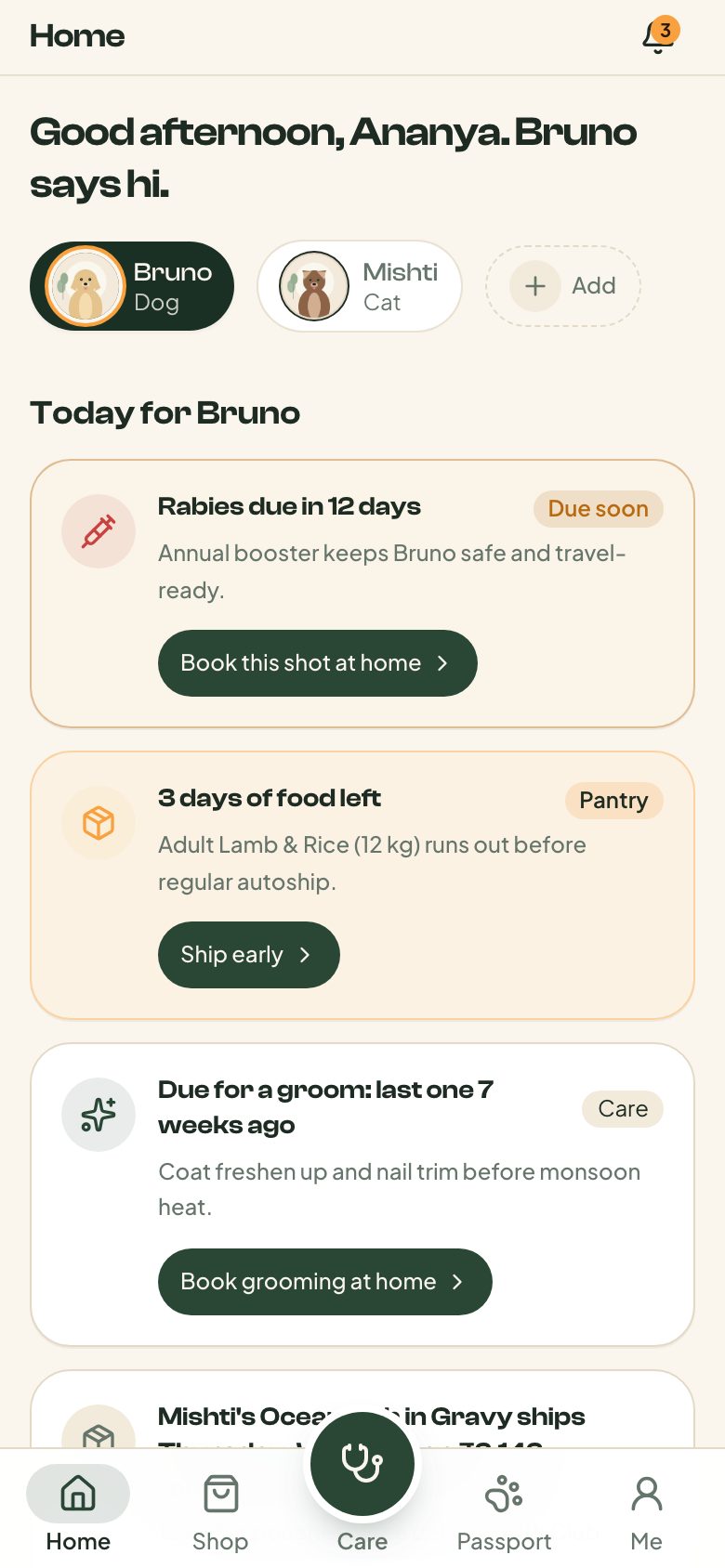
If you only need billing, stock and WhatsApp, buy a tool. If your plan is a repeat-order and care platform, a custom build can help. The Tailwise concept is a studio build we made to show how a pet profile, pantry meter, grooming and vet booking might fit together. It is a prototype with sample data and local state: it does not have live payments, real inventory, supplier integration, GST billing or a production backend, so it shows the flows rather than replacing a POS.
The Saral builds websites and apps for small businesses. If you reach the stage where a catalogue, repeat orders or a pet-parent app is worth building, the ecommerce website solution page explains what that scope looks like. Until then, a billing app, WhatsApp and a good sheet will do the job.
More on starting a pet shop
- Start hereThe full playbook →Models, licences, startup costs and the steps to your first customer.
- Go deeperWhat to buy →Racking for heavy bags, billing, opening stock by category and the live-animal line you leave out.
- Go deeperGetting customers →Vet and society referrals, adoption drives, launch pricing and the monthly food loop that keeps buyers.
- Go deeperFinding suppliers →Authorised food distributors, accessory wholesalers, credit terms, expiry returns and red flags.
Questions people ask
What software does a small pet shop need?
A GST billing app with batch and expiry fields, a WhatsApp Business account with a catalogue and a customer sheet that records each pet's name, food brand and bag size. That set handles billing, expiry, orders and reorder reminders. Move to a retail POS with customer history once you have a few hundred repeat customers or several people billing.
How do I track expiry dates for pet food?
Record the batch number and expiry month when stock arrives, in a POS with batch fields or a simple sheet, and sort by the earliest expiry each week. Place the earliest expiry at the front of the shelf. Mark down or return short-dated stock before it expires, and agree the return terms with the distributor.
Can I send food reorder reminders without a CRM?
Yes. Keep a sheet with the last purchase date, bag size and the pet's daily amount, and calculate the next reminder date from them. Each morning, message the customers whose date is within a few days. A bag of 10 kg for a dog eating 250 g a day lasts about 40 days. Use WhatsApp Business quick replies to speed it up.
Do I need a website for a pet shop?
Not on day one. A Google Business Profile and a WhatsApp catalogue are enough for local customers. A website becomes worth it when repeat orders, delivery areas and product pages need managing at volume, or when you want customers to order under your own brand rather than a marketplace's. Start simple and add a hosted store later.
When should a pet shop build a custom app?
Only when you offer something a billing app and WhatsApp cannot: a pet profile that flags unsuitable products, self-serve autoship or combined food, grooming and vet booking. If you just need billing and stock, an off-the-shelf tool is cheaper and safer. Build custom once repeat orders are the main business and you can describe exactly what the sheet fails at.