Start with a shared spreadsheet that gives every item its own row and ID, WhatsApp Business for the catalogue and a free UPI app for payments. Move to billing software once you issue regular GST invoices and a simple stock app when you pass a few dozen live items. Build custom only when you are running a marketplace with other sellers.
Used goods break the assumptions of normal retail software: every item is unique, bought at a different cost and sold at a different price, condition and photos matter, and each sale may need a margin calculation and a pickup. A tool built for identical SKUs can handle your billing but not your stock.
What the software must handle that retail tools do not
| Need | Why used goods differ | Minimum a tool must do |
|---|---|---|
| One record per item | No two items match; each has its own purchase cost and condition | Unique ID or tag, photos, grade, purchase price, date, seller |
| Purchase paperwork | You buy from unregistered households with no invoice | Purchase vouchers with seller ID details, attached photos |
| Repair and cleaning costs | Refurbishing cost changes your margin on each piece | Cost lines per item, linked to the item ID |
| Aged stock | Bulky items eat space; price should fall over time | Days in stock, flags for 14, 28 and 42 days |
| Margin billing | Tax may apply to margin, not the full price; ask your CA | Purchase and selling price per item and a margin calculation, or an export your accountant can use |
| Pickup and delivery | Each job has a place, a time slot and a helper | A job list with address, item, slot, status and payment |
| Warranty and returns | Short testing warranty per item | Warranty end date and a note of what was promised |
A sheet, a phone and WhatsApp (up to about 30 live items)
A well-built Google Sheet beats a half-configured system. Make one tab for stock, one for sellers, one for pickups and one for sales.
- Stock tab columns: item ID, category, brand and model, age, grade, photo folder link, purchase date, seller, purchase price, repair cost, listing price, status (bought, in repair, listed, reserved, sold), sold date, sold price, buyer.
- Item IDs: write the ID on masking tape on the item itself and in the photo filename, so photos never get mixed up.
- Formulas: days in stock, margin in ₹ and in percent, and a conditional-format flag when an item passes 28 days.
- Sellers tab: name, phone, area, ID document reference, items sold to you, rating. Keep ID images in a locked folder, not in chat.
- Pickups tab: date, slot, address, helper, vehicle, item IDs, expected payment, done.
- WhatsApp Business: catalogue, quick replies for grade and warranty, labels for new, quoted, scheduled and paid.
Cost: nearly zero. The risk is discipline: missing one row ruins the margin figures, and a shared sheet with many editors needs access control. See the DPDP checklist for what holding sellers' ID details means.
Billing and stock apps (about 30 to a few hundred items a month)
When you bill several times a week, use a GST-aware billing tool and a stock tool in place of the sheet. The categories to evaluate are billing and accounting software, inventory or POS apps with serial-number tracking, and a simple online catalogue.
| Tool category | What to check for a used-goods business | Typical cost (estimate) |
|---|---|---|
| GST billing and accounting | Can it record purchase vouchers from unregistered sellers? Does it support margin-scheme invoices, or can your CA export what is needed? | Free tiers to roughly ₹1,500-6,000 per year for basic plans |
| Inventory or POS with serial or IMEI tracking | Per-item cost, serial or batch tracking, bulk import, photo attachment | Free to about ₹500-2,000 per month for small stores |
| Online catalogue builder or store | Single-quantity listings, mark sold automatically, local pincode delivery rules | From about ₹500-2,000 per month plus payment fees |
| Route or job planner | Multiple stops, time windows, driver check-in | Often free for a few vehicles, or a shared calendar |
| Click-to-chat and CRM-lite | Contact labels, reminders for buy-back follow-up | Free to about ₹1,000 per month |
Retail systems assume identical stock, so test with ten real items: purchase, repair cost, sale and a margin report. If the tool cannot show the true margin per item or forces one SKU for 'sofa', pick another. Keep your sheet running in parallel for a month before you retire it.
What changes when you add pickups, a team and a second city
The next jump in complexity is logistics. With several helpers and daily pickups, you need a shared job list, status updates and proof of pickup and delivery. A shared calendar plus a form to collect pickup requests is often enough, with a route planner for multi-stop days.
- A form on your site or a WhatsApp link where sellers upload photos and an address.
- An automatic reply with a quote range and a slot confirmation.
- A status per job: quoted, scheduled, collected, paid, in stock.
- Photo proof at pickup, condition notes and payment reference.
- A weekly stock-ageing report so slow items are discounted rather than forgotten.
Read our notes on hyperlocal delivery apps if your volume grows, and the business inbox and CRM page for leads management.
When custom software starts to pay off
Custom is rarely worth it for a single dealer. Spreadsheets and off-the-shelf billing can carry you a long way. Custom starts to pay when you are no longer just buying and selling your own stock.
| Situation | Why off-the-shelf stops working | What custom would cover |
|---|---|---|
| You take consignment from many owners | Commission splits, payouts and statements per owner | Owner accounts, auto-split of sale proceeds, payout reports |
| You let others list goods on your platform | Verification, scams, reports, disputes, chat | Phone-verified sellers, OTP-gated contact, in-app chat with scam flags, a report and moderation queue |
| You run several godowns and pickup crews | Stock location, transfers, driver jobs | Multi-location stock, job assignment, proof-of-pickup |
| You grade at scale | Consistent checklists across staff | Grading forms with photos, score by category, automatic price suggestion |
A marketplace is a much larger project than a store, because you build for two sides plus moderation. See our marketplace guide, the app development cost guide and the marketplace app solution before committing.
Our concept build and The Saral
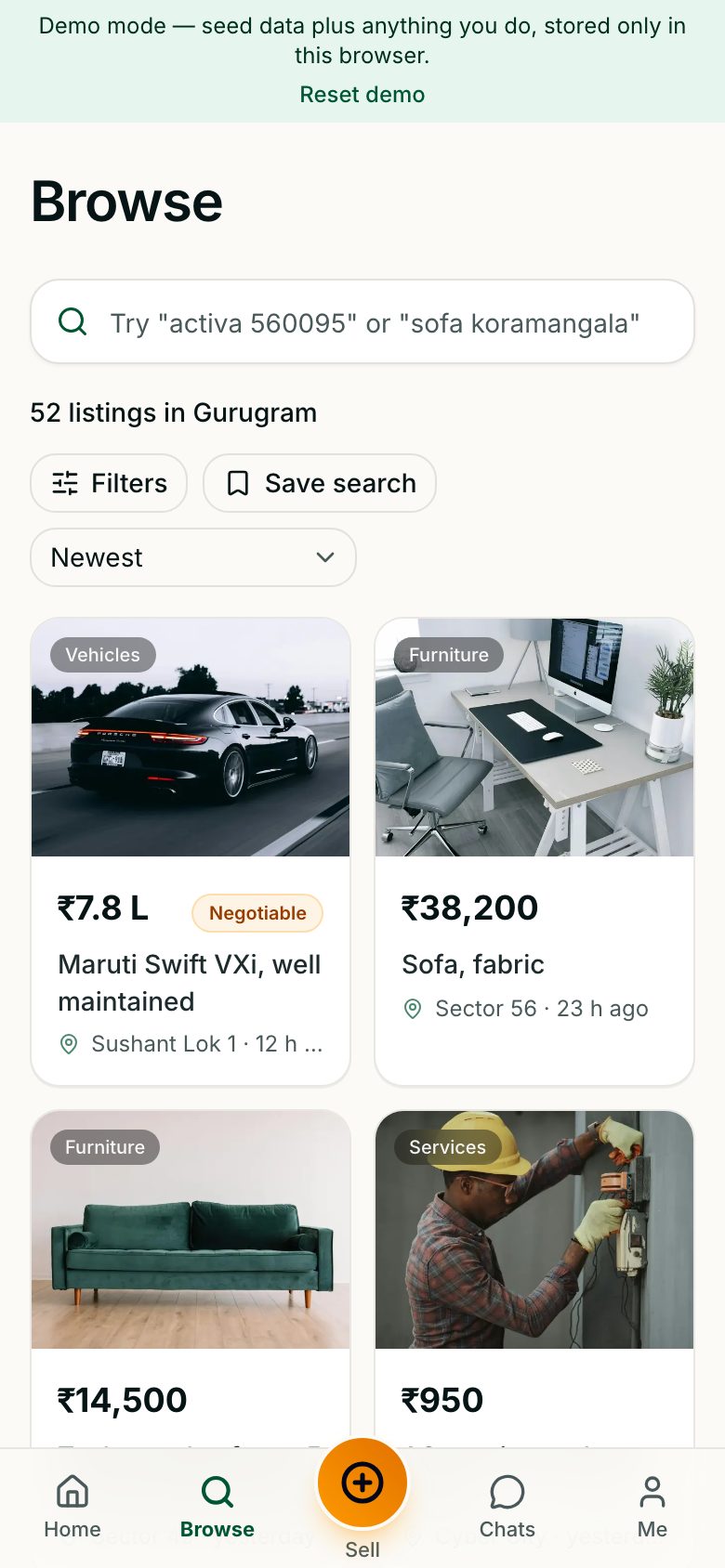
Vendly is our concept build of a hyperlocal classifieds marketplace: posting, browsing by locality, chat, reporting and moderation. It shows what the marketplace route can look like. It does not cover your stock costing, purchase vouchers, GST margin invoices, refurbishing costs or pickup scheduling; a dealer's back office would be additional work.
The Saral builds apps and websites for businesses like this. If you reach the point where you are opening your platform to other sellers, we can talk through scope honestly, including whether you should still use a sheet. Read the second-hand goods playbook and our guide on choosing an app development company first.
More on starting a second-hand goods business
- Start hereThe full playbook →Models, licences, startup costs and the steps to your first customer.
- Go deeperWhat to buy →Testing tools, cleaning kit, pickup vehicle and the first stock, costed, plus what to skip.
- Go deeperGetting customers →Society groups, movers, WhatsApp and honest grading: finding buyers and sellers in a local resale business.
- Go deeperFinding suppliers →Movers, brokers, offices, auctions and buy-back: where used stock comes from and how to vet it.
Questions people ask
Can I use normal retail billing software for used goods?
Yes for invoices, but check that it handles one-of-a-kind items. You need a per-item purchase cost, serial or batch tracking and a margin report, and ideally purchase vouchers from unregistered sellers. Test with ten real items before you migrate, and ask your CA how GST on the margin scheme should be recorded. If a tool cannot show true margin per item, choose another.
Is a spreadsheet enough to start?
Yes, up to roughly 30 live items, if you give every item an ID and log purchase price, repair cost and sale price. Add days-in-stock and a margin formula. It costs almost nothing. Move to billing and inventory software when you invoice several times a week or when more than one person edits the sheet.
How do I track items that arrive with no invoice?
Create a purchase voucher for each buy: seller name, address, phone, ID reference, item, price, date and photos. Store ID images safely and share them with no one. Many billing tools support purchase vouchers or self-invoices, and your CA can advise on the right document. Keep these records because they also protect you in a stolen-goods dispute.
When should I build a custom marketplace app?
Build custom only when other sellers list on your platform or you manage consignment and payouts at volume. Single-dealer trade runs well on a sheet, billing software and WhatsApp. A marketplace needs verification, chat, reports and daily moderation, so its cost and running effort are much higher. Start in one locality and compare quotes before committing.
Does Vendly replace my inventory and billing software?
No. Vendly is a concept for a local classifieds marketplace, covering posting, browsing, chat, reporting and moderation. It does not hold your purchase costs, margins, GST invoices or pickup jobs. Use it as a reference for what the buyer-and-seller side of a platform could look like, and keep your back-office tools for the dealer side.