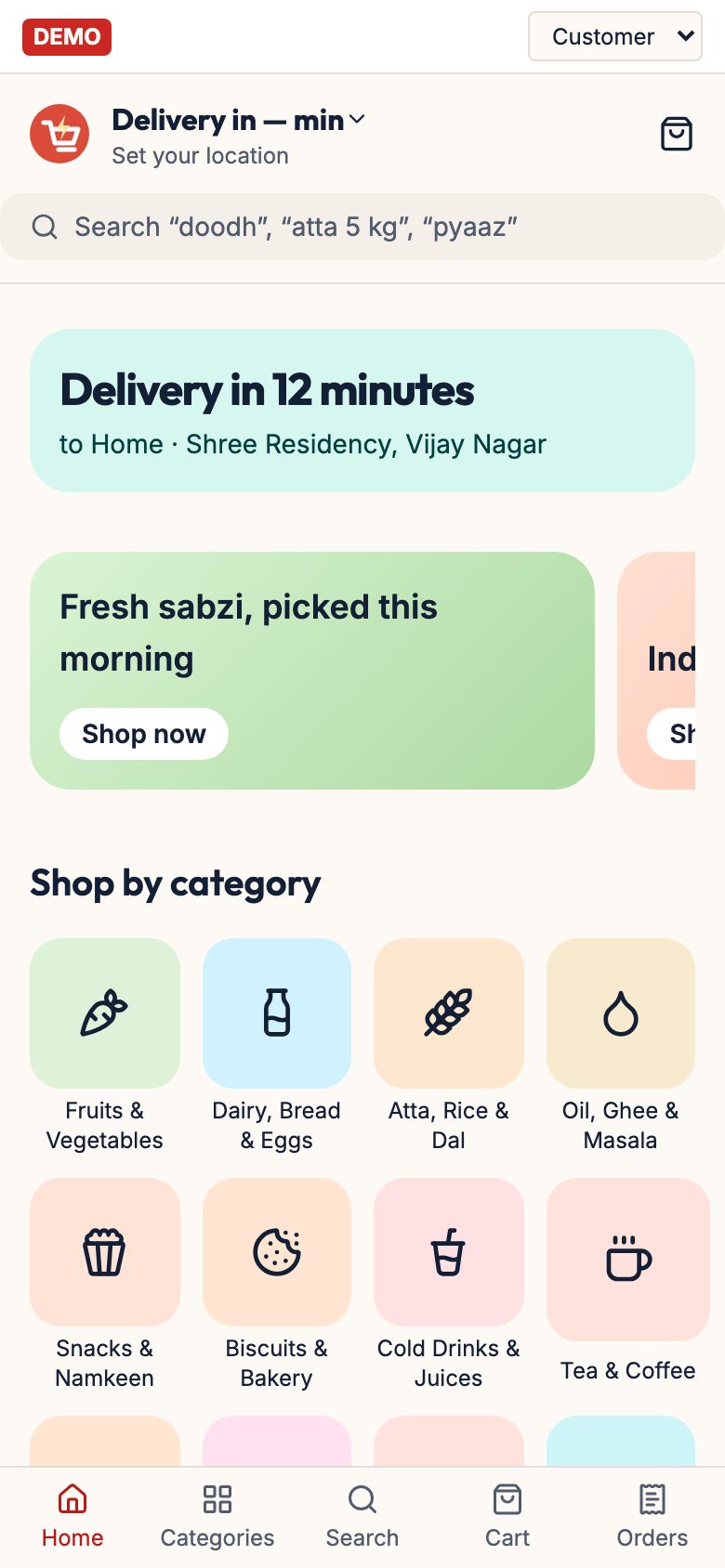
A new supermarket wins customers by becoming the default for a household's monthly and weekly basket within about 1 to 2 km. The channels that work are housing-society tie-ups, a visible launch on the street, WhatsApp ordering for regulars, a complete Google Business Profile and a loyalty offer on staples.
Do not compete on the price of everything. Online platforms and big chains win that fight. Instead, be cheapest on a short list of daily items people check, fair on the rest, and better on freshness, trust and convenience. The numbers below are ballpark planning figures.
Know the basket you are competing for
Households buy in two rhythms. A monthly staples run (atta, rice, dal, oil, sugar, detergent) which is large, planned and price-sensitive, and a top-up run several times a week for milk, vegetables, bread, eggs and forgotten items, which is convenience-driven.
Your new store has to win the top-up trip first because it is frequent and habit-forming, then earn the monthly trip once trust builds. That is why fresh, dairy and speed at the counter matter in the first 60 days more than the price of a 25 kg sack.
| Customer segment | What they buy | What wins them |
|---|---|---|
| Families in nearby societies | Monthly staples plus weekly fresh | Delivery, fair, consistent pricing, a reliable range |
| Working couples | Top-ups, ready-to-cook, snacks after 6 p.m. | Late hours, fast billing, WhatsApp orders |
| Elderly residents | Daily milk, vegetables, medicines-adjacent basics | Phone ordering, home delivery, familiar faces |
| Students and PG residents | Instant food, snacks, basic toiletries | Low unit prices, UPI, small packs |
| Local restaurants and small caterers | Bulk staples, oil, vegetables | Bulk pricing, credit with a limit, invoices with GSTIN |
Housing-society tie-ups: your best first channel
Gated societies and apartment complexes are a dense, repeat customer pool. The RWA or committee is the gatekeeper; treat it as a partnership, not an advertising slot.
- Meet the secretary or committee with a one-page offer: a society discount on staples, free delivery above a minimum order, and a dedicated contact number.
- Ask for a notice-board slot and an introduction in the society WhatsApp group after approval. Never join groups and spam.
- Run a weekend stall or tasting at the society gate with permission. Offer an easy first reason to try: a small free item with the first order.
- Offer a pre-printed monthly list (the grocery list families already keep) that can be sent by WhatsApp and delivered once or twice a week.
- Appoint a society ambassador: a resident who helps with questions and earns a small credit for referrals, within the society's rules.
Aim for two or three societies in the first month and a clear delivery window for each. A handful of regular households per society makes route planning efficient. See the grocery delivery app when you outgrow WhatsApp.
Launch week and launch pricing
A supermarket launch needs a reason to enter and a reason to come back. Both can be done without selling below cost.
- Pick 25 to 40 'price-check' items (milk, atta, rice, oil, sugar, eggs, tomato, onion, potato, popular biscuits and detergents). Price them within a few percent of the local competitor and online platforms; this is what shoppers compare.
- Fund offers from brand schemes. FMCG companies and distributors run launch and trade schemes; ask your distributor which are live before designing your own.
- Combos over blanket discounts. A 'monthly staples kit' priced in a bundle protects margin and raises basket size.
- A small-ticket welcome gift (a reusable bag or a free pack on the first bill above a set amount) is cheaper than a 10% blanket discount.
- An honest opening-week offer with an end date. Perpetual sales train customers to wait.
Advertised prices must not exceed MRP and pre-packed goods carry labelling rules under legal metrology; offers on regulated categories (and any 'free' claims) should be checked locally. Not legal advice.
A rule of thumb for planning: set an offer budget as a small share of expected first-month sales, track it daily, and cut any offer that attracts one-item buyers who do not return.
Visibility: Google Maps, signboard and WhatsApp
- Google Business Profile. Set the category (Supermarket or Grocery store), real photos of fresh, aisles and the counter, opening hours, a phone number and the delivery area. Add attributes like parking and payment methods. Ask happy customers for reviews on the day, in person; read our local SEO guide.
- Signboard and shop-front. A lit, readable board facing traffic, with the fresh section visible from the street. Kerb-side A-frame boards with a daily vegetable offer pull people in; check local signage rules.
- WhatsApp Business. Save regulars in a broadcast list that they have opted into, with a weekly offers message, a catalogue of 40 to 80 staples and a clear cut-off for same-day delivery. See WhatsApp for business apps.
- Leaflets with a map and a QR code handed out in nearby societies, offices and tuition centres, rather than a city-wide drop.
- Local Instagram and Facebook posts showing today's produce, new arrivals and festival hampers, to build a local following.
Your first 10 customers and first 100 households
- Customers 1 to 10: neighbours, shopkeepers on your street and committee members, invited to a soft opening, with a short feedback form. Ask what they could not find.
- Customers 10 to 50: societies and offices where you have a contact. Offer free delivery above a modest order value and a call back the next day.
- Households 50 to 100: a weekly rhythm of two or three societies visited with an offer, plus referrals credited on the next bill.
- Track the second visit. Of every 10 first-time shoppers, how many return within 14 days? That number tells you more than footfall.
Ask every first-week customer for a phone number at billing, with consent, so you can follow up after 7 days with a thank-you and a reorder reminder. Treat the number as personal data: store it safely, use it only for what they agreed to, and read our DPDP Act checklist.
Retention: loyalty, delivery and the daily-need hook
| Lever | How to run it | Watch out for |
|---|---|---|
| Points or cashback on staples | A small percentage returned as store credit on the next shop, with a clear expiry | Do not stack with other offers; keep the liability visible in the books |
| Monthly staples subscription | A fixed list delivered once or twice a month with a standing discount | Needs a reliable stock position on the items; see the subscription delivery app |
| Free delivery above a basket value | Set the minimum at your average basket plus a small stretch | Delivery cost per order should be tracked; gig riders vary in cost |
| Fresh quality promise | Photos of the day's produce on WhatsApp; easy replacement for a bad item | Replace on the spot; arguing costs more than the item |
| Festival hampers and pre-bookings | Diwali, Eid, Onam, Christmas and wedding-season boxes | Order dry-fruit and gift stock early with returns agreed |
Retention is mostly operations: stock available when people come, short queues at peak, no expired items on shelves, and a manager who fixes complaints that day. Marketing cannot recover from empty atta shelves. For delivery and ordering tools see software for a supermarket, and see how a grocery delivery app can work as a concept.
More on starting a supermarket
- Start hereThe full playbook →Models, licences, startup costs and the steps to your first customer.
- Go deeperWhat to buy →Gondolas, chillers, counters, scales, power backup and opening stock, costed and sequenced.
- Go deeperWho to hire →Store manager to cashiers to fresh staff, in hiring order, with pay ranges and vetting tasks.
- Go deeperFinding suppliers →FMCG distributors, staples, mandi produce, dairy and B2B apps: where to find and how to vet.
Questions people ask
How do I get my first customers for a new supermarket?
Start with the nearest societies: meet the RWA, offer a small society discount and delivery above a minimum order, and put a notice up with permission. Add a complete Google Business Profile and a soft opening for neighbours and shopkeepers. Most first customers come from within a kilometre or two, so walk your catchment before spending on ads.
Should I run big discounts at launch?
Use targeted offers rather than blanket discounts. Price 25 to 40 comparison items (milk, atta, oil, eggs, vegetables) competitively, run combos on staples, and fund promotions from brand schemes where possible. Deep discounts on everything attract one-time buyers and damage margin; an opening-week offer with a clear end date works better.
Is WhatsApp enough for orders at the start?
Yes, for the first months. A WhatsApp Business catalogue, a clear delivery cut-off and a picker who works from the order list handle dozens of households. Move to an app or website when order volume, repeat lists and delivery routes become hard to manage by chat, usually after daily orders reach the tens.
How can a small supermarket compete with online grocery apps?
Compete on freshness, trust, familiarity and a fast billing counter, and match the apps on a short list of price-check items. Offer fair, consistent pricing, easy replacements and phone ordering for older customers. You will not win every price comparison, but you can win the weekly relationship.
How do I measure whether customers are coming back?
Track the share of first-time shoppers who return within 14 days, the average basket value, and the share of bills linked to a phone number. These three numbers show whether your range, pricing and service work. Your billing software should report them weekly without manual counting.