A bookstore wins customers by being the place online listings cannot be: someone who knows what to recommend, a table of titles worth picking up, a special-order service, and a reason to come back every week. The first ten customers usually come from one school, one book club and one local reader's circle, not from advertising.
You will not beat online prices on bestsellers, and trying to will cost you margin you do not have. Compete on advice, speed for local needs, school and exam seasons, used books and events instead. This page covers what works, when, and what to charge.
Know what you are up against, then choose your ground
Online sellers discount new titles heavily and deliver to the door, so a customer who knows exactly the title and edition often orders online. That leaves a bookstore with the customers who do not know: the parent buying for a seven-year-old, the gift buyer, the student who needs a guide tomorrow, the browser who wants to be surprised.
| Customer | Why they come to a store | What wins them |
|---|---|---|
| Parent of a young child | Cannot judge a picture book from a thumbnail; wants age advice | A children's corner and a staff member who asks the child's age |
| Student with an urgent list | Needs the book today, not in three days | Stock of the current edition and a quick, honest answer on availability |
| Gift buyer | Wants guidance within a budget | A table of gift picks at ₹200, ₹500 and ₹1,000, and free gift wrapping |
| Regular reader | Wants recommendations and the feeling of a shop that knows them | Staff picks, a WhatsApp list of new arrivals, a loyalty card |
| Used-book hunter | Looks for rare, out-of-print or cheaper copies | A deep second-hand shelf and a buying counter |
Pick two of these as your core and design the store around them. A store near a school and a coaching hub lives off student lists; a residential-neighbourhood store lives off parents and gifts.
Schools: the largest single source of demand
Schools generate predictable demand, but the relationship is delicate. Some schools sell books and uniforms through their own counters or an appointed vendor; others hand parents a printed list. Learn how each nearby school works before approaching it.
- Ask for the list early, ideally January to March for an April start, so you can order, receive and pack before the rush.
- Offer a pre-order form that parents can fill on WhatsApp or at the counter, with a pickup date, so you buy against real demand.
- Pack and label sets by class, with a printed list inside, and offer home delivery for orders above a small value.
- Quote a transparent price, including any discount you offer, and put it in writing. A school that finds out two shops quote differently loses trust in both.
- Respect the school's channel. If a school only allows its appointed vendor, do not push; offer second-hand sets, stationery or reference books instead.
- Run a book fair on campus for a day, with a mix of reading titles and a share of sales donated as books for the school library. Parents meet your store through their children.
Do not promise discounts you have not secured from a distributor. A 10% discount on a title that gives you a 20% margin leaves you with half of what you expected, before delivery and bags.
School rules on selling books on campus differ by school, board and state. Check with the principal or the school's management before you approach, and do not offer commissions or gifts to staff in return for a recommendation.
Exam students and the buy-back loop
Exam-preparation books are a distinct business: previous-year papers, mock tests, guides for competitive exams and board exams, and short-lived notes. Demand follows exam calendars, which differ by stream, and editions change often.
- Stock for the exam, not the shelf. Board exams run in February–March; entrance and competitive tests cluster at other times of year. Check the nearest coaching centre's calendar and order before the batch starts, not after.
- Tie up with local [coaching institutes](/coaching-institute/start-a-business) so their recommended list is on your shelf; a student who is told to buy a book by a teacher buys it the same day.
- Run a buy-back and swap for last year's textbooks and guides. You pay a stated fraction of the cover price and resell at a higher fraction; the student then buys a new set from you.
- Post a short list on WhatsApp a week before each exam season: titles in stock, prices, a number to message.
- Never stock old editions as new. An old edition is worth less once the syllabus moves, and selling it as current wrecks trust.
Events that actually pay: small and regular
Bookstore events are an acquisition channel, not a profit centre. The ones that work are small, regular and local, because they make the shop a habit.
| Event | Cost to you (estimate) | What it does |
|---|---|---|
| Weekly children's story hour (Saturday morning) | ₹500–2,000 per session for a storyteller or a volunteer parent | Brings parents in weekly; they buy the book that was read |
| Monthly book club hosted in-store | ₹0–1,500 for snacks | Gives your core readers a reason to come back and a list of titles to stock |
| Local author reading or book launch | ₹3,000–15,000 for seating, refreshments and a poster | Draws the author's circle; ask the publisher for support on copies |
| School visit or book fair | ₹2,000–8,000 for transport, a table, bags | Introduces families to the store |
| Used-book swap day | ₹500–2,000 for signage | Pulls in the second-hand audience and builds your buying list |
Ask the publisher's sales representative about author-visit support; publishers sometimes help with copies on sale-or-return or promotional materials for readings, depending on the title and the relationship. Always order enough copies, take advance sign-ups, and have a billing counter ready: the event pays only if people can buy at the end of it.
Your first ten customers and the first month
- Customers 1–3: your own circle. Tell neighbours, colleagues and parents from your child's school that you have a children's shelf and take special orders. Give each one a personal recommendation, not a flyer.
- Customers 4–6: one school contact. A principal, librarian or class teacher who lets you drop a flyer or run a small display for parents.
- Customers 7–8: a book club or a reading group, offering your shop as a venue with a modest discount for members.
- Customers 9–10: Google and walk-ins. Fill in your Google Business Profile with photos of the shelves, the hours and a special-orders line.
For the first month, run one event a week, keep a notebook of every special order and every question you could not answer, and note which section customers touch most. That notebook is your second purchase order.
Launch pricing without destroying margin
Printed books carry a cover price (MRP) set by the publisher, and a bookstore cannot raise it. Your margin is the distributor's discount to you, as an estimate usually 25–40% of cover price depending on publisher, title type and your volume; school textbooks and some government titles often pay less. Every rupee you discount comes out of that margin.
| Offer | Margin impact (estimate) | When to use it |
|---|---|---|
| 10% off for members on a ₹399 title with a 35% trade margin | Margin falls to about 25% of cover price | For a known book-club or school-parent group |
| Buy three children's books, get a bookmark or tote free | Costs ₹15–40 per bill | A gift-with-purchase beats a discount for the same spend |
| Free gift wrapping above ₹500 | Costs ₹10–25 per wrap | Festive and birthday gifting |
| Student card: 5% off textbooks and guides | Costs 5 points of margin | Only on titles where your discount from the distributor is 30% or more |
| Second-hand: buy at a stated fraction of cover price, sell at a higher fraction | A used-book margin is often well above new, as an estimate | Your high-margin lever; promote it |
Selling beyond the counter and keeping readers
Once the counter works, add a simple online catalogue and a WhatsApp number for special orders; see our WhatsApp for business guide. A website or marketplace presence extends your reach to readers in your city and beyond; the e-commerce website guide covers the trade-offs. The software page covers what your billing needs to track to make it work.
- Staff-pick cards with a handwritten line on the shelf. They sell books and show the store has opinions.
- A WhatsApp broadcast list for new arrivals, with consent and an easy opt-out, no more than one message a week.
- A simple loyalty card: every tenth book, or a stamp per ₹500, with a small reward such as a bookmark or a used paperback.
- Reserve and notify: when a requested title arrives, message the customer the same day. This one habit is the best advertising a bookstore has.
- A reading-challenge or school-term list that reminds parents about the next set of age-appropriate titles.
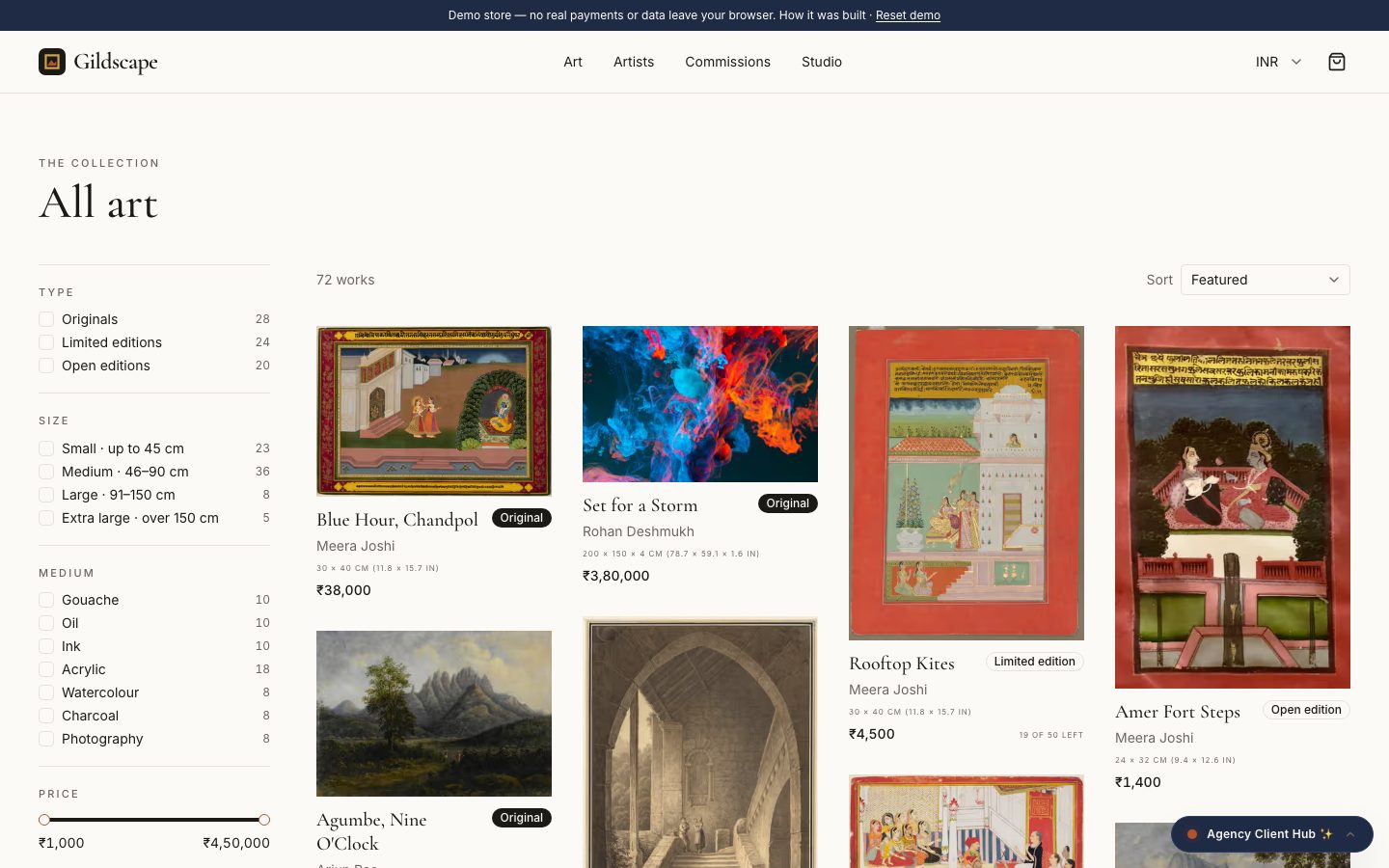
Our live concept Gildscape is an artist storefront and marketplace, not a bookstore, but it shows a curated, story-led catalogue that can inspire how you present your own picks online.
More on starting a bookstore
- Start hereThe full playbook →Models, licences, startup costs and the steps to your first customer.
- Go deeperWhat to buy →Shelving, ISBN billing and opening stock by section, costed, with the school-list buy and what to skip.
- Go deeperFinding suppliers →Publishers, distributors and wholesale markets: discounts, credit, returns and how to vet them.
Questions people ask
How do I get my first customers for a new bookstore?
Start with people you can reach personally: neighbours, parents from a school, and one book club. Offer special orders and a children's shelf, then host a weekly event. These routes build repeat visits faster than ads, and a Google Business Profile with photos and hours catches walk-in searches in your area.
Can a bookstore compete with online discounts?
Not on price for bestsellers, so compete on advice, speed and presence. Parents, gift buyers, students with urgent lists and used-book hunters value help and same-day availability. Add special orders, events and second-hand books, and avoid matching online discounts that would use up your 25–40% estimated margin.
How should I approach schools about book lists?
Ask early, in writing, and respect each school's existing arrangement. Offer a pre-order form, labelled sets by class and a clear price. Some schools use their own vendor; if so, offer second-hand sets, reference books or stationery instead. Do not offer gifts to staff to secure a recommendation.
Do author events and book clubs really sell books?
Small regular events sell more than rare big ones because they build habit. A weekly story hour brings parents who buy the book that was read; a monthly club gives you a predictable list of titles. Treat events as customer acquisition, with copies on hand and a counter ready.
What discount should I offer new customers?
Offer small, targeted discounts such as 5–10% for a school or club group, and prefer gifts like bookmarks or free wrapping. Your trade margin is likely about 25–40% of cover price as an estimate, so deeper cuts quickly erase profit, especially on textbooks that often pay less.