Buy shelving first, then billing with a barcode scanner, and only then stock, concentrated in a few sections you can defend: children's, one language or genre you know, and a thin layer of bestsellers. Most of your money should end up in books, so do not over-spend on fit-out; shelves that hold 2,000 titles well beat a beautiful room with 600.
As a ballpark, a 300–400 sq ft store in a tier-2 city needs about ₹1.5–3 lakh for fit-out and equipment and ₹3–6 lakh of opening stock. The usual mistake is buying one copy of everything, which leaves you with no depth on anything and a shelf full of titles that never turn. This page is about what goes in the cart; the playbook covers licences and the overall budget.
Shelving is your biggest fixed purchase
Books are heavy, uneven in size and sell by the spine, so shelving decides how many titles you can show and how fast a customer finds one. Unlike garments or gifts, a bookstore sells most of its stock spine-out, with only a few faces turned forward.
| Fixture | Estimated cost | What to specify |
|---|---|---|
| Wall shelving, about 7 ft high, 8–10 inch deep, adjustable shelves | ₹1,800–3,500 per running foot, fitted | Plywood or steel; 9-inch depth takes most paperbacks, add a few 12-inch shelves for coffee-table and art books |
| Floor gondolas or island units, 4–5 ft high | ₹12,000–30,000 each | Keep them low so you can see the whole room from the counter |
| Face-out display ledges and a front table | ₹10,000–40,000 | For new arrivals, staff picks and the title you want to push this week |
| Children's section: low shelves, floor cushions, a few picture-book bins | ₹25,000–80,000 | Bins for picture books that do not stand on a spine; keep it away from the door so children do not wander out |
| Steel rack for the stockroom or under-counter cartons | ₹6,000–15,000 | Cartons off the floor; monsoon damp is the enemy of paper |
| LED strip lighting along shelves | ₹15,000–45,000 | Even light on lower shelves, no direct sun on covers |
A 300 sq ft store with wall shelving on three sides and two floor units holds about 1,500–2,500 titles at one or two copies each, as an estimate. Plan the shelf count against the section list you drafted before you rent, not after.
Damp and light damage paper. If your building is old or near the coast, budget for a dehumidifier, keep the bottom shelf empty or for heavy reference books, and avoid placing paperbacks against an outer wall that seeps.
Billing and counter kit that understands ISBN
Every new book carries an ISBN barcode, usually the EAN-13 form beginning with 978 or 979. That is a gift: the scanner reads the code, the billing software looks up the title and price, and you do not need to print your own labels for new stock. Used books are the exception, because they have no stable price.
| Item | Estimated cost | Why a bookstore needs it |
|---|---|---|
| Laptop or desktop with a spare battery or UPS | ₹22,000–40,000 | Billing, ISBN lookup and a catalogue; a power cut during the school rush must not stop billing |
| 1D barcode scanner (handheld) | ₹1,500–3,500 | Reads ISBN-13 barcodes on the back cover; test it on glossy, curved and shrink-wrapped covers before buying |
| Thermal receipt printer, 3 inch | ₹4,500–9,000 | GST invoices and school-list bills; cheaper per bill than inkjet |
| Small barcode label printer | ₹6,000–12,000 | Used books, imported titles with no Indian barcode, stationery and any gift item you add |
| UPI QR stand with soundbox | ₹0–2,000 plus fees | Most bookstore bills are mid-sized and paid by UPI |
| Card swipe machine | ₹0–3,000 plus fees | Metro and campus-area stores see more card use; fees vary by bank |
| CCTV, 2–3 cameras | ₹8,000–20,000 | Pointed at the back table and the door; small, expensive paperbacks walk |
Opening stock by section: where ₹3–6 lakh goes
Stock is a bet on who walks in. The table shows one way to split ₹4 lakh at cost for a general store near a residential area with some schools; reshape it to your focus. The right column is the point: how deep to go.
| Section | Share of opening stock (estimate) | Depth |
|---|---|---|
| Children's: picture books, early readers, activity books, board books | 20–25% | Two to three copies of each proven title, because parents buy the same recommendation repeatedly |
| Bestselling fiction and non-fiction, English | 20–25% | Two copies of the current top 100, one of the backlist; the backlist is where margin lives |
| Regional-language fiction, poetry and children's titles (your city's language) | 10–20% | Buy from the local publishers; depth matters more here than breadth |
| Exam and career guides, if near coaching or colleges | 15–20% | Latest editions only; an old edition is dead stock the day the new one is announced |
| Self-help, business, biography, history, spirituality | 10–15% | One copy each of the recurring sellers |
| Reference: dictionaries, atlases, GK, Indian-language grammars | 5–8% | Steady sellers year-round, strong in school season |
| Cash and card reserve for special orders and weekly refills | 10%+ | Do not spend all of it on day one |
Do not try to stock the front list of every publisher. Choose a few publishers whose catalogue fits your customers, take full cartons of their bestsellers, and fill the rest by special order. Customers accept a two-day wait for a title you can order; they do not accept an empty section.
The school-list buy and its cash trap
If you decide to serve schools, the buy is large and concentrated in a few months before the academic year starts, typically around March to May in most states. A single school's list for one class can run to ten or twelve titles, and a school of 1,000 students can mean tens of thousands of rupees at cost, as an estimate, changing hands in one fortnight.
- Get the list in writing with title, edition, publisher and expected quantity per class, and agree that the school will not change editions after you order.
- Buy set quantities against actual commitments, not hopes. Parents who buy from the school directly, or from a cheaper shop, reduce your number sharply.
- Ask the distributor for sale-or-return or staggered billing on school stock; some give it, some do not. Where they do not, buy only against pre-orders.
- Pack sets by class in labelled carry bags with a printed checklist; a parent who finds a missing title at home is a lost customer.
- Count NCERT, state-board and private-publisher titles separately. NCERT and state textbooks are low-priced and carry thin margins as an estimate, while private-publisher titles and workbooks pay more; the mix changes the economics of the season.
School supply is a seasonal business inside a bookstore. If you also stock stationery for the lists, see how the stationery shop sequences its school-season cash; the same ordering discipline applies here.
Second-hand and special orders: low-capital sections
A used-book shelf is the cheapest stock you can own because you buy it from customers and from estate clearances, and it brings in people who would never walk into a new-book store. It needs no fit-out beyond a few sturdy shelves, but it does need a process.
- Buying rate card: a published rule such as a share of the current cover price by condition. Write it down so no customer feels cheated and no staff member makes up numbers.
- Grading on arrival: check for missing pages, water damage, heavy highlighting and, for exam books, edition year. Pirated copies, spotted by thin paper, blurry print or odd binding, are refused.
- Pencilled price on the first page, never a sticker on the cover; stickers leave residue and make the book harder to resell.
- A record of who sold it: name, number and book, kept in a simple register. That protects you if a stolen or pirated copy turns up.
For the broader buying, grading and pricing logic of pre-owned goods, see the second-hand goods playbook. Special orders cost nothing to hold: take a name, number and a part-advance for any title not on your shelf, order it, and keep it behind the counter. That service alone differentiates you from online listings that give no one to talk to.
What not to buy yet
- A café machine and seating for twenty. Add a café only after the book side makes money; it brings FSSAI registration, a different set of staff and its own wastage. Start with a single bench and a few chairs.
- A large imported-books range. Imports are expensive, slow, priced in foreign currency and hard to return. Special-order them instead.
- Gift and stationery lines beyond a small shelf near the counter. They help margin, but the gift-shop and stationery models carry their own stock risks.
- Multiple copies of this year's hype title. If a book trends, a distributor can usually supply a refill in two or three days.
- A custom website before a catalogue and WhatsApp. A simple list of titles and a number to message gets you special orders; custom comes later.
- Old editions of exam guides and school books at a discount. They sell slowly at any price once the syllabus moves.
A budget for the first buy
| Purchase | Small tier-2 store (estimate) | Metro store with reading corner (estimate) |
|---|---|---|
| Shelving, tables and lighting | ₹1.2–2.2 lakh | ₹5–9 lakh |
| Billing, scanner, printer and UPI | ₹30,000–80,000 | ₹1–2 lakh |
| Opening stock at cost | ₹3–6 lakh | ₹10–20 lakh |
| Used-book shelf and rate card | ₹5,000–25,000 | ₹20,000–60,000 |
| Reading corner and events seating | Not included | ₹1–2.5 lakh |
| Dehumidifier, stockroom rack and CCTV | ₹20,000–50,000 | ₹60,000–1.2 lakh |
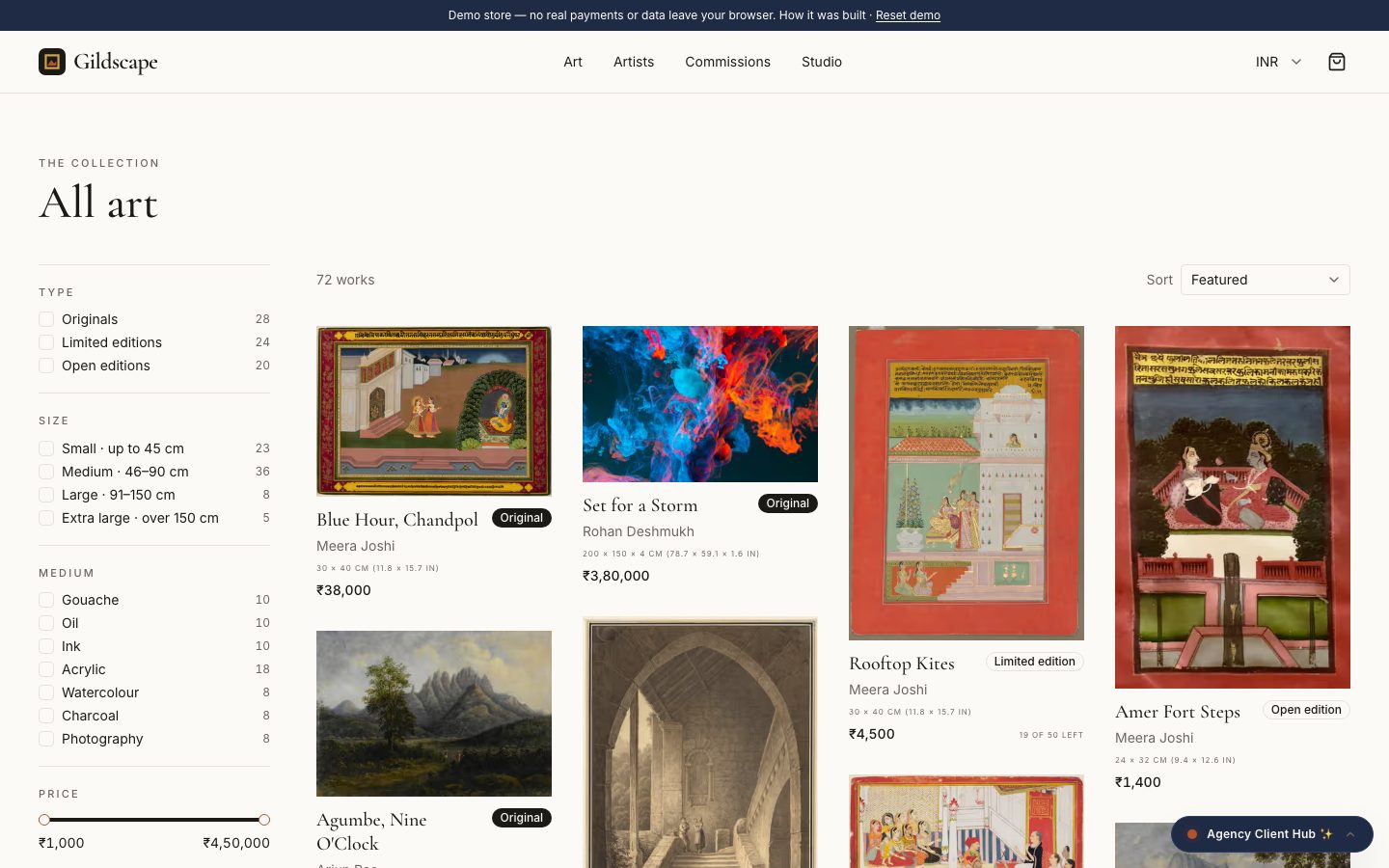
Our live Gildscape concept is an artist storefront, not a bookstore, but it is a useful look at how a curated catalogue can be presented online once you are ready to sell beyond the counter.
Paying for it
More on starting a bookstore
- Start hereThe full playbook →Models, licences, startup costs and the steps to your first customer.
- Go deeperGetting customers →School lists, book clubs, events and buy-backs: how a bookstore wins readers against online discounts.
- Go deeperFinding suppliers →Publishers, distributors and wholesale markets: discounts, credit, returns and how to vet them.
Questions people ask
How many books do I need to open a bookstore?
About 1,500–2,500 titles in a 300–400 sq ft store, roughly ₹3–6 lakh at cost as an estimate. It is better to hold two or three copies of 600 proven titles than one copy of 2,000, because depth in sections where you know the readers is what repeat customers notice.
Do I need a scanner to run a bookstore?
Yes, because the ISBN barcode on every new book makes billing and stock tracking almost automatic. A handheld 1D scanner costs about ₹1,500–3,500. Without it you will type titles by hand, make price errors and have no real picture of what sells, which hurts most during the school rush.
Should I buy second-hand books to save on stock?
Used books are the cheapest stock because you buy them from customers, but they need a rate card, grading and a record of sellers. They also have no ISBN price to scan. Treat them as a profitable side shelf that draws footfall, not as the whole store.
Is it safe to buy cheap copies of popular books from street sellers?
No. Cheap copies of bestsellers and exam guides are often pirated, and selling them is an offence under copyright law. Buy new books only on invoice from publishers or authorised distributors, and keep the invoices. This is general information, not legal advice; confirm locally.
How much should I spend on the school-list stock?
Spend only against written or pre-paid commitments. A school's list can mean tens of thousands of rupees at cost in a fortnight, as an estimate, and unsold copies stall your cash if editions change. Ask each distributor whether school stock can be returned or billed in stages before committing.