A dairy farm needs two kinds of software, and they are different jobs. One keeps the herd: tag numbers, heat and service dates, pregnancy checks, vaccinations, yield and feed. The other keeps the customers: who buys what, deliveries, payments. Start with a sheet for the herd, and add customer software only when you sell direct.
The dairy farm playbook suggests a notebook or spreadsheet for herd records. This page shows what to record, what an off-the-shelf herd app or collection-centre system can do and when something custom is worth paying for. It leaves delivery-route and wallet detail to the milk delivery software page.
The herd register: the sheet that earns its keep
Each animal gets a row, identified by its ear tag. A second sheet logs events. The aim is to answer four questions without guessing: who is due to calve, who is due for vaccination, who is losing yield and who is costing more to feed than she returns.
| Record | Fields to capture | The question it answers |
|---|---|---|
| Animal master | Tag number, breed, birth or purchase date, dam and sire if known, purchase price, photo | Which animals are yours, and what did each cost |
| Breeding log | Heat date, service date, semen or bull ID, technician, pregnancy check date and result | Who is pregnant, who needs a repeat check, expected calving date |
| Calving and dry-off | Calving date, calf sex and tag, dry-off date, days in milk | When to reduce feed and when a lactation ends |
| Health log | Date, symptom, temperature, treatment, vet, withdrawal date for milk | When an animal's milk can go back into the tank |
| Daily milk | Animal, morning and evening litres, optional fat and SNF | Who is yielding what, and which animal is dropping |
| Feed and cost | Green, dry and concentrate by group, price per kg, vet and labour | Cost per litre by month |
Use Google Sheets or Excel with drop-downs for event types and conditional colours for animals due within seven days. A Google Calendar reminder for each expected calving, vaccination and pregnancy check costs nothing and works on every phone. Write in the shed on paper and enter once a day, because a sheet no one updates is worse than a notebook.
Heat detection and the cost of a missed cycle
A cow that is not served on time can lose weeks of milk and push her next calving back. The records above help you predict the next heat from the last, but nothing replaces someone watching the animals twice a day. Software supports the watching; it does not replace it.
| Approach | Estimated cost | Fits |
|---|---|---|
| Paper chart plus phone reminder for the expected heat window | Free | 5–25 animals with an attentive owner |
| Tail paint or heat-mount detectors | ₹50–300 per animal per cycle | Low-tech visual aid for a small herd |
| Activity or rumination sensors on a collar or leg band, with a phone dashboard | Roughly ₹5,000–15,000 or more per animal plus a subscription, vendor-dependent | Larger commercial herds where each missed cycle is costly; check local after-sales support |
Sensor sales claims on yield gains are the vendor's, not independent results. Ask for a trial on a few animals and for contact details of an Indian farm already using it.
Off-the-shelf options: herd apps, collection software and the weighing-scale link
Three categories of ready-made software are relevant. Pricing and features change often, so shortlist, trial and compare rather than relying on this list.
- Herd management apps. Mobile apps that log animals, breeding, health and milk, some with reminders and vet connect features. Check that the app works offline in the shed and supports regional languages.
- Dairy collection-centre software. Used by cooperative societies and private collection centres. It reads fat and SNF from a milk analyser, weight from an electronic scale, calculates the rate and prints a slip. If you also collect milk from neighbours, this is the category to look at.
- Subscription and delivery apps. For direct sales: customer list, daily orders, pauses, delivery lists and billing. Some are built for milk delivery specifically; some are generic grocery tools.
- Accounting. A standard accounting tool such as a GST billing product for invoices if you sell processed products. Confirm GST on your products with a CA.
Whatever you pick, check four things: can you export your data to a sheet, does it work with a low-end phone and patchy signal, who answers when something breaks, and what does it cost per year as the herd grows. Our GST billing software guide covers the accounting side.
When the customer side outgrows a sheet
A farm selling to 20 households can run on a sheet and WhatsApp. At a few hundred homes the pain is not the farm; it is the daily changes: pauses, extra litres, top-ups, missed deliveries and who has paid.
| Size of direct list | What usually works | What starts to break |
|---|---|---|
| Under 50 homes | A sheet with one row per customer, a WhatsApp group or broadcast, UPI payment links | Nothing yet; keep it simple |
| 50–300 homes | A delivery-focused app or a sheet plus form for pauses, with a monthly bill and UPI collection | Cutoff times for next-day orders; reconciling payments |
| 300+ homes or several delivery agents | A subscription app with customer self-service, a wallet or autopay, and a driver run-sheet | Manual billing; the owner cannot forecast how many litres tomorrow needs |
Our subscription app guide and UPI payments guide explain wallets, mandates and the pitfalls of recurring payments.
When custom software pays, and what it would cover
Custom software pays when your process differs from what the packaged tools assume and the volume is high enough that manual work costs more than the build. For a dairy, that usually means one of three cases.
- You sell direct to several hundred homes and also process products. A custom build can connect tomorrow's subscription orders to a procurement forecast, so you know how many litres to keep for homes versus the collection centre.
- You run a farm cluster or buy from neighbouring farms. Collection from many farmers, each with a different fat and rate, wants a system that ties yield to payment.
- You want herd, milk and customer data in one place. Linking each animal's yield to what you sold and what you earned per litre is hard in separate apps.
A custom build is rarely worth it before you have the manual process working. Our app development cost guide and MVP guide explain how to scope a first version and what it should cost, and the agritech app page lists what such farm products can include.
Our concept build, and where The Saral fits
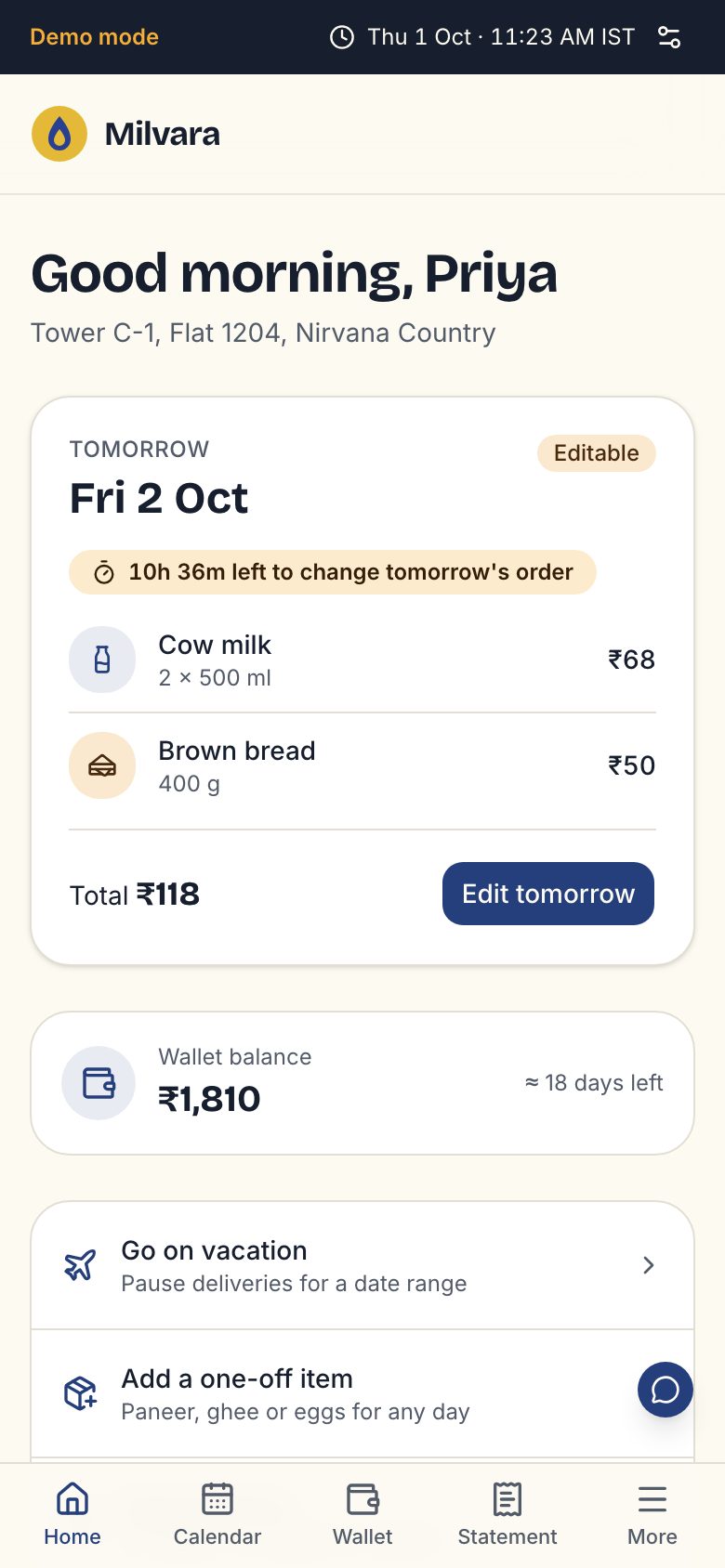
Milvara is a concept build we made to show how a farm dairy could run direct subscriptions: customers edit tomorrow's order until a 10 pm cutoff, pause for holidays and top up a wallet; the owner sees households, litres and a procurement forecast; the delivery agent follows a run-sheet sorted by tower and flat. It covers the customer and delivery side only.
It does not track animals, breeding, health or feed. For that you still need a herd register, whether a sheet or a herd app. If you want a subscription layer built for your farm, or a link between herd yield and customer demand, The Saral builds custom apps and sites; our subscription delivery app page explains what we would scope first.
More on starting a dairy farm
- Start hereThe full playbook →Models, licences, startup costs and the steps to your first customer.
- Go deeperWhat to buy →Animals, shed, milking and fodder kit costed, with what to skip until the herd earns.
- Go deeperGetting customers →Collection centre, direct homes, ghee and paneer, shops and caterers: where a farm's milk earns most.
- Go deeperFinding suppliers →Animals, fodder, feed, semen and vets: where to find them, how to vet them, and the red flags.
Questions people ask
Do I need software to run a small dairy farm?
Not at first. A notebook or spreadsheet for animal records, daily milk and feed is enough for 5 to 10 animals. Software becomes useful when you track breeding dates across many animals, run collection from several farmers or sell direct to many homes where daily changes pile up.
What should I record for every dairy animal?
Record the tag number, breed, purchase or birth date, daily milk, heat and service dates, pregnancy check, calving, vaccinations and every treatment with the date milk can be sold again. With these, you can see who is due, who is falling in yield and what each animal costs to feed.
Are herd management apps worth paying for?
Possibly, if you have 25 or more animals or several people entering data. Try the free or trial version on a few animals first, check it works offline in your shed and in your language, and confirm that you can export your data. Do not pay for sensor hardware until simple records are working.
What is collection-centre software?
It is software that connects a milk analyser and an electronic weighing scale to a computer or phone, calculates the price from fat and SNF, and prints a receipt for each farmer. Cooperative societies and private collection points use it. A single-farm dairy selling direct does not usually need it.
When should a dairy farm commission a custom app?
Usually when you sell to several hundred homes, buy from other farmers, or want herd data tied to sales, and packaged tools cannot be bent to fit. Before that, sheets and off-the-shelf apps are cheaper. Scope a small first version around the one workflow that costs you most time.