A laundry needs software that follows a garment, not just a bill. Start with a numbered tag per order, a spreadsheet, WhatsApp Business and a UPI QR. Move to laundry POS software with barcode tags once you handle more than roughly 80 to 100 orders a week or lose track of items.
Custom software only pays when your model is unusual: several outlets feeding a central plant, many delivery routes, subscriptions with weight credits, or business linen contracts with counted exchanges. We have not verified current pricing for any vendor named or implied here, so compare plans and trial them yourself.
What a laundry actually needs to track
Billing software built for a shop assumes a customer buys something and leaves. A laundry takes custody of the customer's property for days. The software has to answer who owns every item at every minute.
- Order intake: customer, pickup address, items, count, weight, special instructions (do not bleach, button missing, stain on cuff), photos.
- Garment identity: one tag or barcode per piece or per bag, linked to the order, so any item can be traced to a customer.
- Stage tracking: picked up, counted, sorted, washing, drying, pressing, quality check, packed, out for delivery, delivered.
- Pricing rules: per kg, per piece, per item, express surcharge, minimum order, delivery fee, and plan credits that run out.
- Routes and slots: pickup windows, rider assignment and an order of stops.
- Customer communication: pickup confirmation, count photo, ready and out-for-delivery messages, payment link.
- Billing and accounts: GST-capable invoices if registered, credit accounts for hostels and salons, UPI reconciliation.
Customers' personal data, addresses and photos are covered by India's data-protection rules once they apply to you. Our DPDP Act checklist explains what to ask any vendor.
The cheapest thing that works at the start
For the first few weeks, up to a few dozen orders, paper and a free tool are enough. Do not buy software before your routine is stable.
| Need | Tool | Cost note |
|---|---|---|
| Booking and updates | WhatsApp Business app with a catalogue, quick replies and labels for order stage | Free to use; see our WhatsApp guide for the API limits |
| Order register | A shared Google Sheet with one row per order: tag number, customer, count, weight, due date, stage, paid | Free; add a drop-down for stage and conditional colours for overdue orders |
| Tags | Pre-numbered tags or a cheap label printer; the number is also the sheet's row | Small hardware cost; see the buying list |
| Payments | UPI QR with a soundbox or payment links | Provider fees and plans vary; check with your bank or payment provider |
| Invoices | A GST-capable billing app; see the GST billing software guide | Pricing varies; compare entry plans, which are often modest |
| Routes | Google Maps with a saved list of stops per rider per day | Free; fine for under 20 pickups a day |
The sheet's weakness is two people editing the same row and no link between a physical tag and a customer. When that starts to cause mistakes, move up.
Signals that it is time for laundry-specific software
- You lost or swapped a garment in the last month, or more than once a quarter.
- You send more than about 20 WhatsApp status updates a day by hand.
- You have two or more riders and routes overlap or pickups are missed.
- You have a monthly credit customer who disputes counts or dates.
- You take items at more than one counter or plant, so the sheet is not the single truth.
- Customers keep asking where their order is.
Laundry and dry-cleaning POS software (several Indian vendors sell it, usually by monthly subscription) typically covers barcode tags, stage scanning, per-kg and per-item price lists, WhatsApp or SMS notifications, a customer app or link and basic reports. Features and plans differ, so list your must-haves first and trial two or three.
How to evaluate an off-the-shelf laundry system
| Check | What to ask or test | Why it matters |
|---|---|---|
| Tag printing | Can it print a barcode per piece or bag on the printer you have or plan to buy? | A slow or locked-in printer wastes hours daily |
| Scan at each stage | Does a phone or scanner scan items at sorting, wash, press and pack? | Stage scans are what catch a missing piece before delivery |
| Mixed pricing | Can one order mix per-kg wash and per-item dry cleaning, with express and minimum rules? | Real orders are rarely one type |
| Plan credits | Does it support prepaid weight or piece plans and show a balance? | Subscriptions are where repeat revenue sits |
| Routes | Can it give a rider an ordered list of pickups and deliveries with slots? | Saves petrol and missed slots |
| Notifications | Which channels, how is each message billed, can you edit the text? | WhatsApp messages sent through approved APIs may carry per-message costs |
| GST | Does it print GST-compliant invoices and support credit customers with monthly bills? | Business clients ask for it |
| Data export | Can you export customers and orders as CSV on request? | Avoids lock-in |
| Offline mode | Does counter billing work when the internet is down? | Power cuts and weak Wi-Fi are routine in plants |
Pair the laundry system with your accounts software, for example Tally, Zoho Books or a billing app such as Vyapar, rather than expecting one tool to do everything.
When custom software is worth building
Custom is not a status symbol. It pays when an off-the-shelf tool forces you into workarounds that cost more than a build would.
| Situation | What custom would cover | Why off-the-shelf may fall short |
|---|---|---|
| Many outlets feeding a central plant | Item handover scans between outlet, van and plant, with a live count per bag | Most tools assume one site |
| App-first customer experience | Customer app with slot booking, order tracking, wallet and plan top-up | Branded apps are rare in cheap plans |
| Hostel, hotel and hospital contracts | Counted exchange of linen sets, par levels per room and a monthly reconciliation | Standard POS thinks in orders, not par stock |
| Route-heavy operations | Rider app with proof of pickup, live location and route optimisation by slot | Optimisation is basic or extra-cost in packaged tools |
| Premium care with a quality story | Per-garment photos, condition notes, stain mapping and a customer approval step | Off-the-shelf photo handling is often minimal |
See our guides on app development cost in India and subscription apps before you budget. If you are not sure whether you need an app at all, app vs website explains a cheaper first step.
Where our concept build and The Saral fit
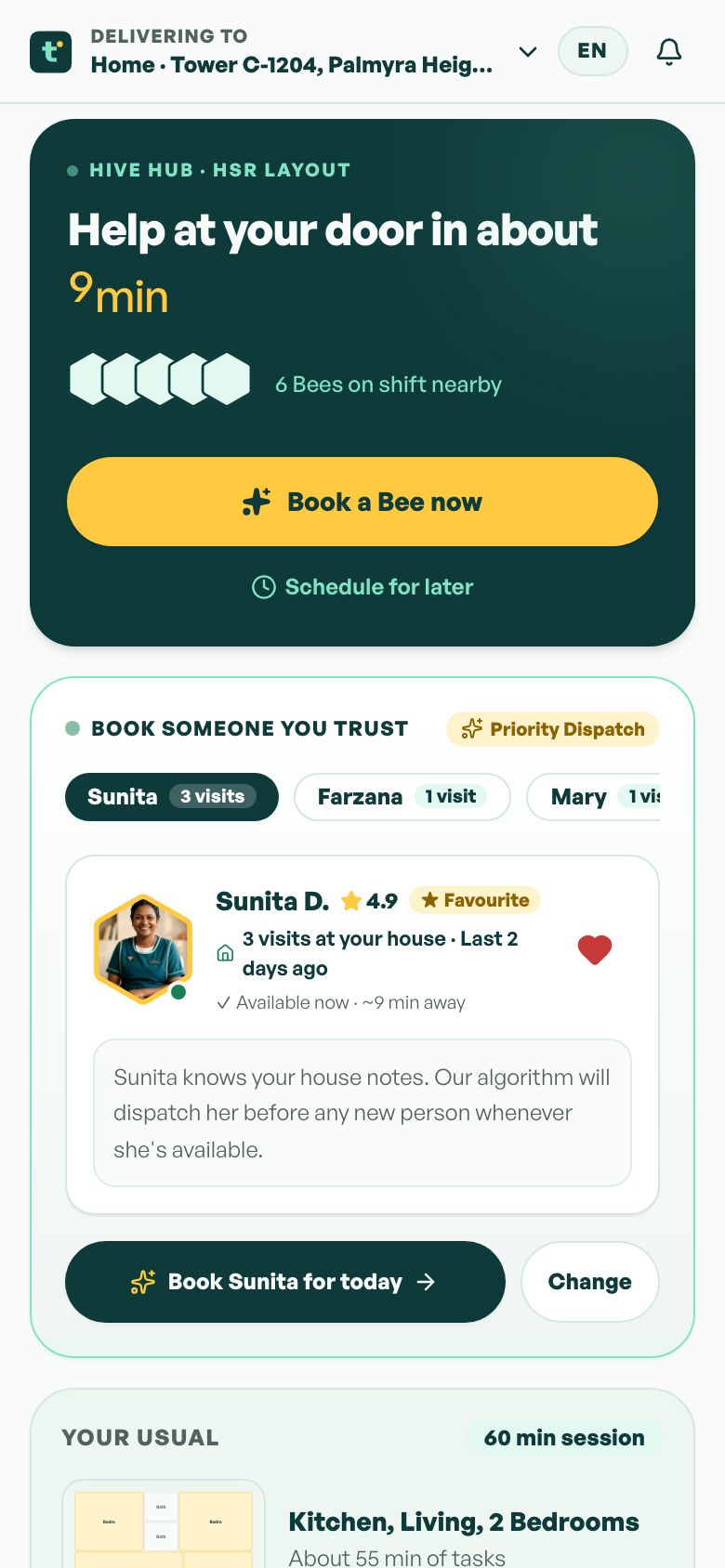
Our TidyBee concept build is a demo of an on-demand home-service product: a customer booking flow, a worker side and an operations dashboard. It is not laundry software out of the box. It does not do garment barcodes, stage scanning, per-kg pricing, solvent or machine records or GST invoicing, and it is not a live product we run for laundries.
If your plan needs those, The Saral can scope a custom build around the parts that are unique to you and leave standard accounting on standard tools. Start with the home services app and subscription delivery app pages to see the shape, and use the checklist above to decide whether you are ready.
More on starting a laundry business
- Start hereThe full playbook →Models, licences, startup costs and the steps to your first customer.
- Go deeperWhat to buy →Washers, dryers, steam and press, tags and chemicals, costed, with rent-vs-buy and what to skip.
- Go deeperWho to hire →Pressers, washers, spotter, riders and a supervisor, with pay ranges and a vetting task.
- Go deeperGetting customers →Hostels, societies and local businesses, launch pricing, WhatsApp bookings and retention.
Questions people ask
What is the best software for a small laundry in India?
At the start, a numbered tag, a shared spreadsheet, WhatsApp Business and a UPI QR are enough. Once you handle around 80 to 100 orders a week or lose items, a laundry POS with barcode tags and stage scanning is the next step. Trial two or three, since features and pricing differ and we have not verified vendor plans.
Do I need barcode tags for a laundry?
Not on day one, but they help once you pass a hundred or so pieces a day. A barcode links every garment to an order, lets you scan it at sorting, washing, pressing and packing, and catches a missing piece before delivery. Numbered paper tags and a clear tally sheet work for smaller volumes.
Can I run a laundry on WhatsApp alone?
Yes, for a while. WhatsApp Business handles bookings, count photos and ready messages, and a sheet keeps the register. It strains when you have several riders, credit customers or subscriptions, because nothing links a tag to a customer or sends status updates automatically. That is the time to move to dedicated software.
Should a laundry build its own app?
Usually not at the start. Packaged laundry software and WhatsApp cover most needs. A custom app makes sense for several outlets and a central plant, an app-first brand, business linen contracts with counted exchanges, or route-heavy delivery. Build only the unique part and keep accounting on standard tools, then review the cost against what a subscription would cost over three years.
Does my laundry software need to issue GST invoices?
If you are registered for GST, your invoices need to meet the rules, and business customers will ask for them. Whether you must register and at what rate depends on turnover and the services you sell, and we have not verified the current rates. Confirm with a CA and pick software that supports GST invoices and credit accounts.