An optical store needs software that does five things: records each customer's prescription, tracks every job from order to pick-up, bills with the right GST on each line, keeps frame stock by model and colour, and reminds people when their next test is due. A spreadsheet and WhatsApp can cover this for the first months; optical-specific billing software is the usual next step.
Custom software pays only when you have several stores, a strong online and home-test channel, or a process no packaged product handles. Do not build until the packaged tools have clearly stopped fitting.
What an optical store actually has to record
Optical data is more structured than ordinary retail, and that is why a generic billing app only goes part of the way. These are the records that cause trouble when they live on paper.
| Record | What it contains | Why it fails on paper |
|---|---|---|
| Customer and family | Name, phone, age, family members, consent to message | Families share a phone number and get mixed up |
| Prescription | Sphere, cylinder, axis and add for right and left eye, PD, segment height, date, and who tested | Handwritten axis and sign errors cause remakes |
| Job card | Frame, lens type and index, coatings, measurements, promised date, advance paid, status | No way to see which jobs are late |
| Lab order | Which lab, which lens, dispatch date, expected date, received date, any remake | Delays are discovered by the customer, not by you |
| Frame stock | Brand, model, colour, size (for example 52-18-140), cost, price, supplier, date received | Slow stock is invisible until it is old |
| Billing | Frame and lenses as separate lines, HSN and GST rate per line, advance and balance | Corrective glasses and sunglasses carry different rates |
| Recall | Next test due date per person | Without it the yearly repeat sale does not happen |
Prescriptions and contact details are personal data, and prescription data is health-related. Keep access limited, take consent for reminders and see our DPDP Act checklist. This is general guidance, not legal advice.
The first months: sheets, WhatsApp and a paper job card
- A paper or printed job card with a number on every job, filled out at order time and clipped to the lab bag. Cheap and hard to beat for a store doing a few jobs a day.
- A shared spreadsheet with one tab for customers and prescriptions, one for open jobs and one for frame stock. Add a column for promised date and a column for recall date and filter on them each morning.
- WhatsApp Business for the catalogue, quick replies, ready-for-pickup messages and appointment confirmations. Only message people who agreed to hear from you; see WhatsApp for business apps.
- A basic GST billing app or Tally-type package for invoices, returns and stock totals. Our GST billing software guide covers what to look for.
- A Google Calendar or booking link for eye-test slots, so you do not double-book the optometrist.
This works for a single store with one or two staff. It breaks when jobs go missing between the lab and the counter, when two people edit the same prescription row or when you cannot tell which frames are moving. Those are the signs to step up.
Optical-specific store software: what to look for
India has several packaged billing and management products made for optical shops, as well as general retail billing software with optical modules. I have not compared or verified their features or pricing, so shortlist two or three and ask for a trial on your own data. These are the questions that matter.
- Prescription fields: does it capture right and left eye sphere, cylinder, axis, add, PD and segment height, and print them cleanly on the job card and the invoice?
- Job status: can you mark each job as ordered, sent to lab, received, fitted and ready, and message the customer at the right step?
- Frame inventory: barcode labels per piece or per model-colour, size fields and stock ageing.
- GST: separate rates for corrective eyewear and sunglasses, HSN printing and a clean return report. Confirm current rates with your CA, since the tax treatment of some items has been debated and the rules have been amended.
- Recall: a due list by month with a WhatsApp or SMS message.
- Multi-store: shared customer and prescription records across branches and a way to transfer stock.
- Data export: you must be able to export all your records. If you cannot, you are locked in.
- Support in your language and city, and a way to restore data if a computer fails.
Expect a per-user or per-store subscription, or a one-time licence with a yearly support fee; I have not verified current prices, so ask for a written quote including data migration and training.
Selling online and booking tests: a website, not yet an app
Customers search for an optical store, then look for opening hours, the test and a way to book. A simple website with your services, a frame gallery and a booking button does that. Many stores add a catalogue on WhatsApp, which handles the first online enquiries without a shop-building project.
- Booking: a slot-based test booking page that updates the optometrist's calendar.
- Catalogue: photos of frames with price, size and colour; reserve for in-store try-on.
- Online ordering: buying glasses online means capturing a prescription, choosing lenses and checking the prescription before the lab starts. Online sales that skip this generate remakes.
- Try-on tools: virtual try-on and 3D frames help browsing but depend on good images and measurements.
- Payments: UPI collect and payment links for advances; see UPI payments in your app for how this works.
Our ecommerce website guide and website development cost guide explain the build choices and budgets before you commission anything.
When custom software starts to pay
| Situation | Packaged tools usually handle it? | Custom might cover |
|---|---|---|
| One store, two to four staff | Yes: sheets, a billing app or optical software | Nothing yet |
| Three to five stores, shared stock and customers | Mostly, with an optical multi-store product | Branded customer app, central dashboard |
| Home eye tests plus store plus online | Rarely in one product | Routing for visiting optometrists, one customer record across channels |
| Online glasses ordering with a lens selection flow | Partly | A lens-selection flow tied to prescriptions and lab orders |
| A franchise or partner network | Rarely | Partner onboarding, stock, billing and reporting |
Custom is worth it when the process is your advantage and packaged tools force awkward workarounds, or when you expect to reuse the system across many locations. It is not worth it to avoid a subscription fee, or to get a better-looking billing screen. A good test: write down the three steps in your workflow that the current tools get wrong, and the cost of each in remakes, late jobs or lost recalls. If you cannot name them, you do not need custom software yet.
A concept build for the omnichannel version, and The Saral
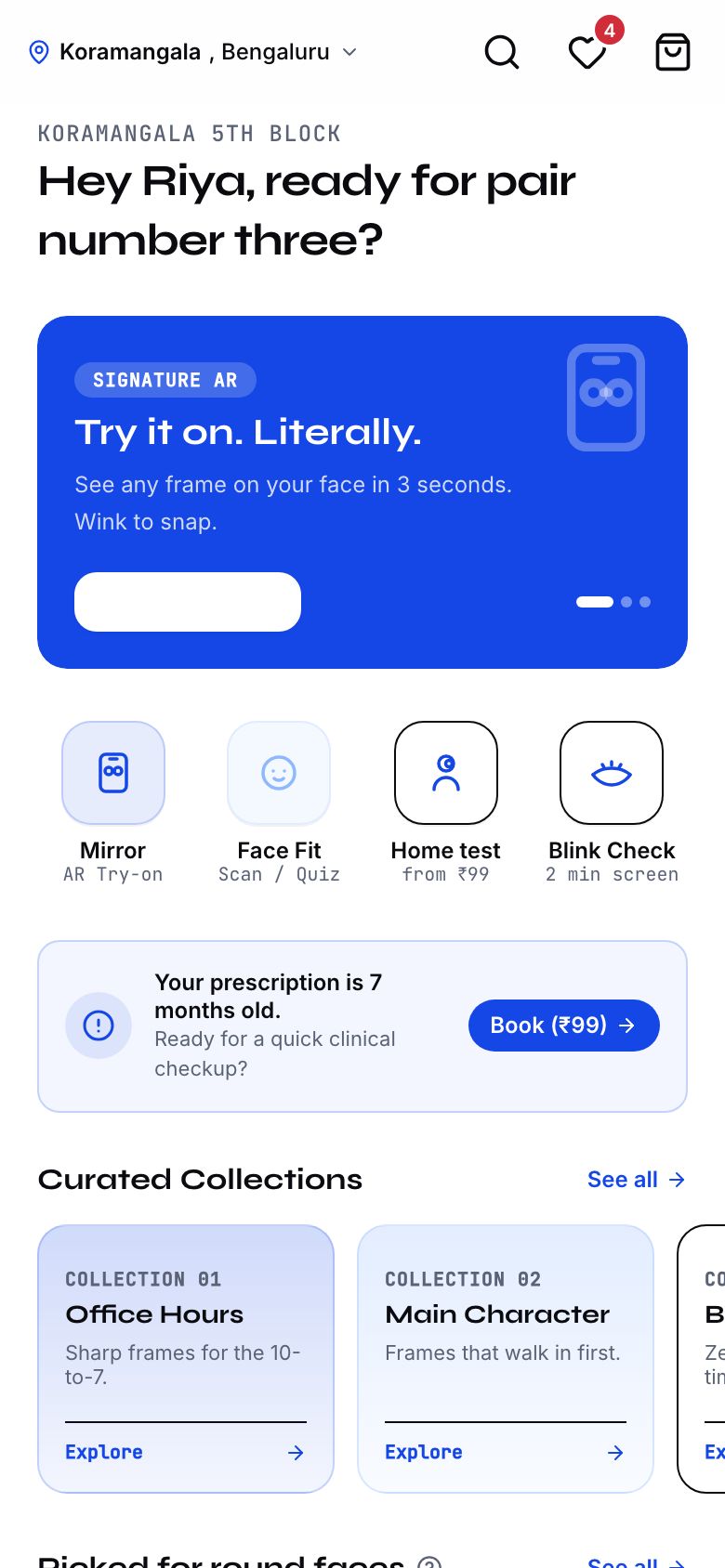
Our concept build Specsy is a demonstration of the omnichannel end of this page: a customer app with 3D frames and a lens-selection flow, a home eye-test booking and routing app for visiting optometrists, a store desk showing the queue from walk-in to ready, and a website. It is a concept, not a product you can buy or an optical store you can sign up with. It does not replace GST invoicing, prescription compliance or lab integration; those would be built to your own requirements and your own lab and tax set-up.
The Saral is the studio behind it. If you want an estimate for something like a store desk, a booking flow or an online lens-selection experience, brief us with how your store works today. Our billing app work, ecommerce website work and business inbox and CRM work show the types of systems involved. For the shop itself, start with the optical store playbook.
More on starting a optical store
- Start hereThe full playbook →Models, licences, startup costs and the steps to your first customer.
- Go deeperWhat to buy →Testing kit, dispensing bench, frame and lens stock, costed, with what to outsource or skip.
- Go deeperGetting customers →Eye camps, referrals, local search, launch pricing and yearly recall, in a workable order.
- Go deeperFinding suppliers →Frame wholesalers, lens labs and distributors: where to find, vet and agree terms.
Questions people ask
What software does an optical store need?
At minimum, a billing system with GST, a record of each customer's prescription, a way to track every job from order to pick-up, and frame stock by model and colour. A reminder system for yearly tests helps repeat sales. Sheets and WhatsApp can cover this for the first months; optical-specific software is the usual next step.
Is general billing software enough for an optical shop?
It can be for a very small store, but it usually lacks prescription fields, lab job tracking and recall reminders. If you use general billing software, keep prescriptions and open jobs in a structured sheet. Move to optical-specific software when jobs go missing or when you want automatic reminders.
How should an optical store handle GST in its software?
Set corrective glasses and sunglasses up as separate item types, print HSN codes as your CA advises, and show frame and lenses as separate lines. Rates changed in September 2025, and sources differ on how frames sold alone are treated, so confirm current rates with your CA and the GST portal before configuring anything.
Do I need an app for my optical store?
Most single stores do not. A website with test booking, a WhatsApp catalogue and good local search handle most customer needs. An app starts to make sense with several stores, home eye tests or online glasses ordering, where a shared customer record and lens-selection flow justify the build cost.
How do I keep prescription data safe?
Limit access to staff who need it, keep backups, avoid sharing prescriptions on personal phones or open groups, and get consent before sending reminders. Prescription data is personal and health-related. Check the data protection rules that apply and ask for advice if you hold large volumes. This is general information, not legal advice.