Start with a spreadsheet that records cans held per customer, a WhatsApp number for orders and a UPI QR for payment. That handles the first hundred customers. Move to a billing tool when offices need GST invoices, and to a route and ordering tool once several drivers run in parallel. Custom software pays only when your volume and routes outgrow what those tools can model.
The thing that makes this business different from other delivery is the can: every delivery is an exchange, and what you must track is the balance of cans and deposits per customer, not just orders. This page shows how to track that on each tier of tooling and what a custom build would add.
What you must record, whatever tool you use
Before choosing software, write down the six things you cannot lose track of. A tool is good if it records them without effort and bad if the driver has to type five fields at a doorstep.
| Record | Why it matters | Fields |
|---|---|---|
| Customer and address | Floor, lift, gate rules and landmark decide delivery time | Name, phone, building, floor, lift yes/no, gate pass notes |
| Cans held and deposit | The core of your asset control | Cans out, cans returned, deposit received, deposit refunded |
| Delivery log | Settles disputes | Date, time, loader, cans delivered, cans collected |
| Rate and plan | Different customers pay differently | Per-can rate, floor charge, monthly plan, skip dates |
| Dues and invoices | Offices pay late; homes forget | Invoice number, GST details, due date, paid date, UPI reference |
| Batch code from the plant | Lets you trace a complaint | Plant name, batch code on the can, delivery date |
Under 100 customers: a sheet and a phone
Use a Google Sheet or a pocket register with one row per customer and a ledger tab with one row per delivery. Add a formula that shows cans held (delivered minus returned) and a conditional colour on any customer who holds more than the cans you gave a deposit for. A second tab lists tomorrow's route sorted by building.
- Orders: one WhatsApp Business number with saved replies and labels such as 'new', 'confirmed' and 'out for delivery'. A catalogue with your can rate and plan prices saves repeated typing.
- Payments: a UPI QR sticker on the vehicle and a payment link for offices. Ask the loader to confirm the UPI reference in the ledger.
- Route: a printout sorted by building, plus Google Maps for the order of stops. Group by lane, not by name.
- Backup: download the sheet weekly. One lost phone should not erase your can balances.
This costs almost nothing and is enough until you have two loaders or more than a handful of disputes a week. The GST billing software guide explains when to add proper invoicing.
100–400 customers: billing, reminders and a route list that updates itself
At this size your pain points are invoicing offices, chasing dues and keeping two loaders from visiting the same lane. Buy tools off the shelf, one for each job, before thinking about a build.
| Job | Tool category | Approximate cost (estimate) | What to check |
|---|---|---|---|
| GST invoices and ledger | Billing or accounting app for small business | ₹0–6,000 a year | Recurring invoices, party-wise ledger, GST reports, UPI payment links |
| Customer messages and ordering | WhatsApp Business API provider or a WhatsApp catalogue app | ₹0–2,500 a month | Broadcast limits, opt-in rules and template approval for reminders |
| Route list | Route planner for delivery, or a sheet with a map link per stop | ₹0–1,500 per vehicle a month | Stop order, a driver view, a way to mark a stop done |
| Can ledger | Inventory app with serial tracking, or a custom sheet | ₹0–3,000 a month | Whether it can track a returnable item per customer, not just stock |
| Collections | UPI collection with a reconcile report | Free to a small per-transaction fee | Daily settlement, failed payment handling |
A common trap is buying inventory software that tracks stock and not returnables. Most of these tools count a can as sold when it leaves and forget it exists. If the tool cannot show 'customer X holds 3 cans', keep the can ledger in a sheet and use the tool only for invoices.
The pause, skip and top-up logic that flat customers expect
Flats want their water like a subscription: a set number of cans a week, a pause when they travel, an extra can when guests come. The rule set is small but tricky, and it is where sheets and generic order tools start to creak.
- Weekly schedule: which days, how many cans and any floor charge.
- Pause and skip: a customer should be able to skip a week without calling you, with a cutoff the night before.
- Top-up: one extra can on a day outside the plan, priced and logged.
- Deposit handling: collected once, shown on every statement, refunded when cans return.
- Statement: monthly total, cans delivered, cans held and deposit on file.
- Route build: tomorrow's list generated from schedules, skips and top-ups, not typed by you at 10 p.m.
If you run on a sheet, build this with a weekly schedule column and a skip column that you update from WhatsApp messages. It works up to a few hundred customers; beyond that, the evening task of reading messages and rebuilding the next day's route is the signal to automate.
When a custom subscription app is worth building
Custom software pays when three things are true together: you run more than three vehicles or a few hundred scheduled customers, the cost of missed or wrong deliveries and lost cans exceeds a developer's invoice, and the off-the-shelf tools cannot model returnable cans per customer. Before then, a custom app is a way to spend ₹3–10 lakh on something a sheet already does.
| What a custom build covers | What you still do outside it |
|---|---|
| Customer app or WhatsApp flow with weekly plan, pause, skip and top-up | Choosing a plant and checking its licences |
| Per-customer can and deposit balance, with statements | Counting cans in the godown each week |
| Route manifest for each driver, built overnight from schedules | Hiring and paying the loaders |
| Dues, UPI collection and reminders | Your GST filing and accounting |
| Batch code capture for complaint tracing | The plant's own lab testing |
Our guides on subscription apps, UPI payments in apps and hyperlocal delivery apps go into the moving parts, and GST billing software covers the invoicing side.
The Saral concept build, honestly described
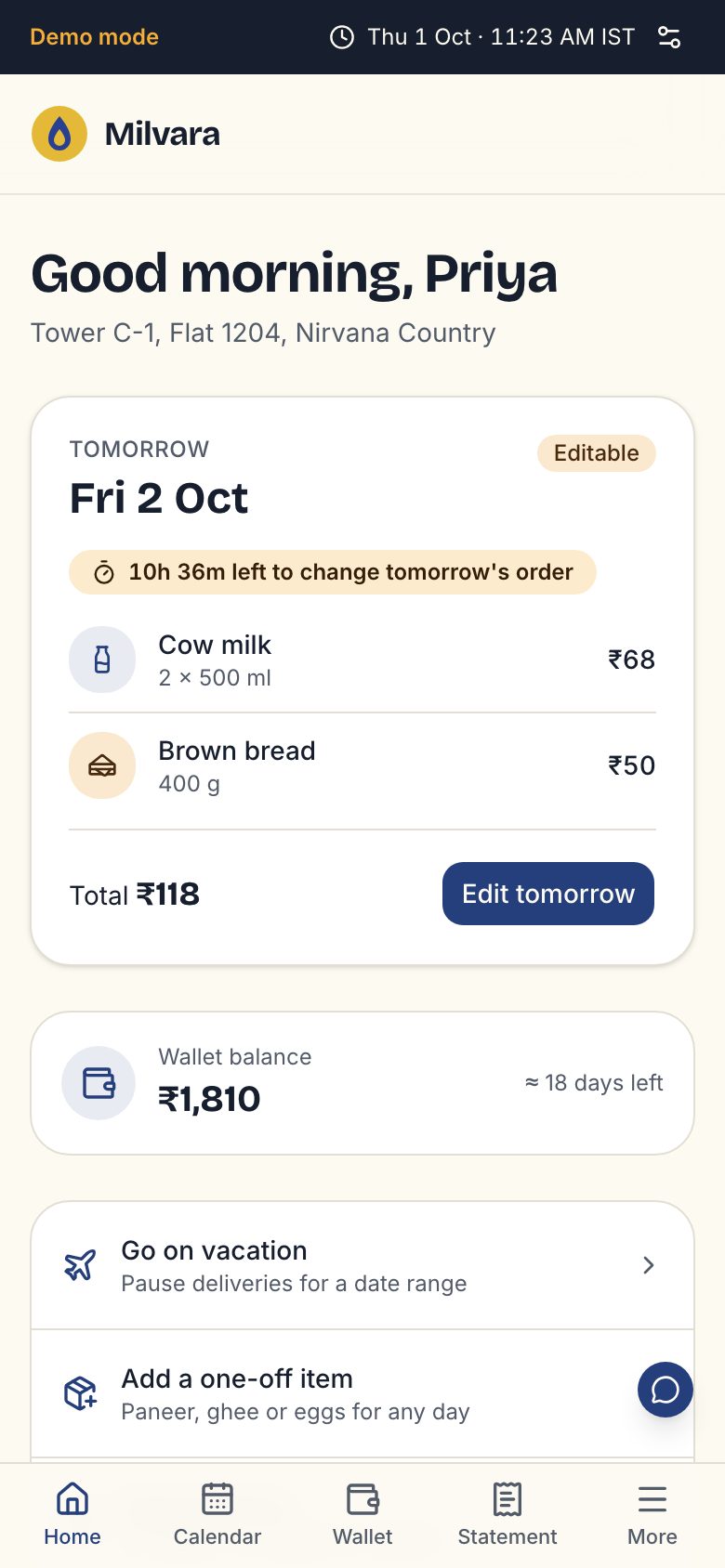
The Saral is a small studio that builds custom software. As a reference for the subscription logic, we built a concept called Milvara at milvara.thesaral.com. It was designed for a daily milk subscription: a customer calendar with pause and skip, top-ups, and a vendor view of tomorrow's deliveries. Those mechanics map onto water cans.
What it is not: a live service, a can-and-deposit ledger, a route optimiser, a GST invoicing system or a payment gateway integration. A water can version would need the can balance and deposit tracking added, and its payments and tax set-up would be decided with you. If you reach the scale in the section above, you can send us a brief, and the subscription delivery app page describes how such builds work.
More on starting a water can delivery business
- Start hereThe full playbook →Models, licences, startup costs and the steps to your first customer.
- Go deeperWhat to buy →Cans, vehicle, racks, dispensers and a TDS meter, costed, with what to hold off on.
- Go deeperGetting customers →First ten customers, can pricing and deposits, and keeping flats and offices from switching.
- Go deeperFinding suppliers →How to find, check and contract a packaged water plant, and when bottling yourself makes sense.
Questions people ask
What software do I need to start a water can delivery business?
Almost none at the start: a spreadsheet of cans held per customer, a WhatsApp Business number for orders and a UPI QR for payment. Add a billing app when offices need GST invoices and a route list once you have two vehicles. Spending on a custom app before a hundred paying customers usually wastes money.
How do I track cans and deposits per customer?
Keep a ledger with one row per delivery showing cans delivered and collected, then a formula that gives cans held per customer and compare it with the deposit received. Most stock-keeping apps track items sold, not returnables, so check that a tool can show 'customer holds three cans' before paying for it.
Do I need GST billing software?
Once you bill offices and shops that want tax invoices, yes. A small-business billing app with party-wise ledgers, recurring invoices and GST reports costs little compared with a missed invoice. Whether you must register for GST depends on your turnover and state, so confirm with a CA. This is not tax advice.
When is a custom subscription app worth it for water cans?
It is worth it when you run more than three vehicles or a few hundred scheduled customers, can losses and missed drops cost more than the build, and off-the-shelf tools cannot track cans per customer. Before that, a sheet plus WhatsApp does the job. Ask for a fixed quote against a written feature list.
Can a milk delivery app be used for water cans?
The subscription mechanics carry over: weekly plans, pause, skip, top-up and a driver manifest. What differs is the returnable can, with its deposit and balance per customer, and the per-floor carrying charge. Any app you use must track those two, or you will keep a second ledger on the side.