Start with WhatsApp Business for orders, a GST billing app for invoices and a shared sheet for stock and rider loops. Move to a hosted storefront with delivery slots once typed orders cause errors, and consider custom software only when coordinating several shops, pickers and riders by hand has become your biggest cost. Most operators are in the first two tiers for a year or more.
Tool names below are categories with a few examples to shortlist, not endorsements. We have not verified current pricing or features for any named product; check each before you commit.
The jobs software has to do in grocery
Grocery has more moving parts per order than most small businesses, and each one can fail on its own.
| Job | What goes wrong by hand | Tool category |
|---|---|---|
| Order intake | Messages missed, quantities misread, edits lost in a long WhatsApp thread | WhatsApp Business catalogue, order form, storefront |
| Catalogue and prices | Mandi price changes daily; prices differ between the chat and the bill | Spreadsheet or storefront with daily price edit |
| Stock and out-of-stocks | Accepting an order for an item that finished two hours ago | Inventory sheet, POS stock module, partner-shop stock toggle |
| Delivery slots and areas | Too many orders in one slot; orders from outside your radius | Slot capacity and pin-code or radius rules |
| Picking and packing | Missed items, wrong brand, expired pack | Pick list, barcode scan, substitution flow |
| Rider loops and routing | Riders zigzag between stops; customers phone to ask where the order is | Route planner, live location link, rider app |
| Cash, UPI and refunds | Cash on delivery goes unreconciled; refunds lost in chat | UPI QR, payment links, rider cash log |
| GST billing and returns | Bills handwritten, tax split guessed, returns late | GST billing app, export for your CA |
| Wastage and margin | No idea which items lose money | Stock sheet with wastage column |
Under 50 orders a day: WhatsApp, a billing app and sheets
At this size, speed of setup matters more than features. You can run the whole business on tools that cost a few hundred rupees a month.
- WhatsApp Business app: product catalogue with prices and photos, quick replies for “order received”, “out for delivery” and “item unavailable, substitute?”, labels for new, packed and delivered. Read WhatsApp for business apps for the platform's current business limits.
- A GST billing app on the phone: Vyapar, Zoho Invoice or a similar tool can issue GST-compliant bills, track customer dues and print to a Bluetooth printer. See our GST billing software guide. Confirm your GST position with a CA.
- A shared Google Sheet: one tab for tomorrow's orders, one for stock with a wastage column, one for rider loops and cash collected each evening.
- UPI QR and payment links: from your bank or a payment gateway; use a dynamic QR per order if your bank offers it so reconciliation is automatic.
- Google Maps and shared live location: plan each rider's loop by dropping the stops into Maps and sending the route; share live location with the customer on request.
- Google Business Profile: free; add your service area, hours and a WhatsApp link; see local SEO for India.
Failure signs: you re-type orders into the bill, you answer “is it out of stock?” by walking to the shelf, or two people edit the order sheet at once and overwrite each other. When that happens daily, move up.
50 to 300 orders a day: a storefront with slots, and a real POS
Now orders arrive faster than you can read them, and customers expect to see what is in stock and choose a slot.
| Need | Cheapest thing that works | Limits |
|---|---|---|
| Online ordering with delivery slots | A hosted storefront (Shopify, WooCommerce with a delivery-slot plugin, or an Indian grocery storefront builder). Shortlist and compare current plans | Slot rules, pin-code checks and daily price edits depend on plugins; weights and loose items are awkward |
| Grocery-specific catalogue | Per-kg and per-piece pricing, pack sizes and substitution notes in the product data | Many generic stores treat a 1 kg and 500 g option as separate products and break stock counts |
| POS and stock | A retail POS with barcode scanning and batch or expiry tracking; examples include Vyapar, Marg or Zoho Inventory; compare current pricing | Some POS tools do not support online-order stock sync without extra work |
| Picking and packing | Printed or on-phone pick lists, scan to confirm each item | Hard to enforce 'ask before substituting' without a custom flow |
| Rider routing | Route planner or delivery management tool that batches stops; many ship with a driver app | Fixed per-driver pricing adds up quickly for part-time riders |
| Customer messages | WhatsApp Business API through a provider for order confirmations and status updates | Pricing and approval rules are set by the provider and platform; verify before you rely on it |
| ONDC seller app | An ONDC-compliant seller app to receive network orders | Fees, onboarding and the customer relationship are set by the network; verify current terms |
- Decide your source of truth for stock. One system holds the quantity; the others read from it. Two stock numbers always drift.
- Test checkout from a customer's phone on a weak network. Slot picker, pin-code check and UPI redirect fail first on a 4G signal in a basement.
- Export the day's orders to your accountant in a format your CA accepts for GST returns.
- Plan for support: whoever builds your storefront should also tell you how to edit prices and slots without them.
When custom software starts to pay
Custom software is not an upgrade from the tools above; it solves problems they cannot. Think of it when two or three of these are true for months, not days.
| Signal | Why off-the-shelf tools struggle | What custom would cover |
|---|---|---|
| You list items from several shops, each with its own stock | Generic stores assume one warehouse | Multi-shop cart split into per-shop pick lists and one rider loop |
| Pickers must confirm or substitute items live | Pick lists on paper or chat have no consent step | A picker screen with item-by-item confirm, substitute-with-approval and out-of-stock flags |
| Riders cover multi-stop loops across shops | Route tools plan deliveries, not shop pick-ups plus drops | Pick-up and drop sequencing, proof of delivery and cash collected per stop |
| Slots and radius need real capacity rules | Plugins cap orders per slot, not per rider or shop | Capacity by rider-hours, radius and shop closing time |
| Riders and customers prefer Kannada, Hindi, Tamil or Telugu | Most tools are English-first | Regional-language rider and customer screens; see regional language apps |
| You are paying more in rider idle time and missed items than in software | Data is split across five tools | One ops console with live orders, late alerts and wastage reports |
- Costs vary a lot. See how much an app costs in India and app maintenance cost before you plan a budget; maintenance continues after launch.
- Build the smallest version first. One ordering flow, one picker screen and one rider app; see our MVP guide.
- Web before native. A progressive web app avoids Play Store review delays; see native vs cross-platform vs PWA.
- Payments and data: UPI behaviour is covered in UPI payments in your app, and personal data duties in the DPDP checklist.
- Do not build what you can rent. Accounting, GST filing and WhatsApp messaging are better rented than built.
Our concept build, and The Saral
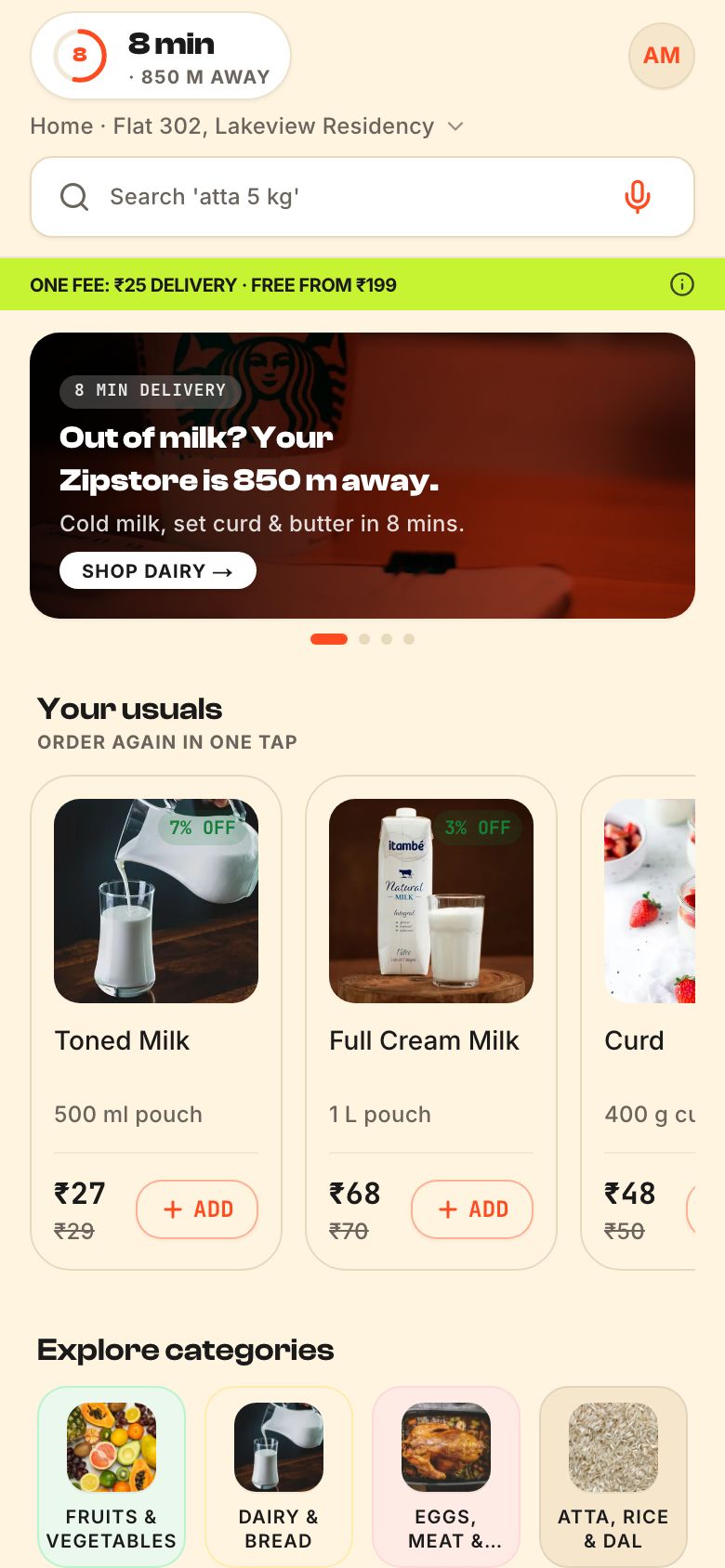
For context, our concept build Zippit is a demo of the multi-shop model: a shared cart across neighbourhood shops, a shop-counter picker screen, a rider app in Kannada and a live ops console. It is a concept, not a live service, and it does not include accounting, GST filing, real payment settlement or live partner-shop integrations. You can see it running at zippit.thesaral.com.
The Saral builds custom apps like this for businesses that have outgrown spreadsheets and storefront plugins. If you are earlier than that, you do not need us yet; use the tools above, and read our grocery delivery app page and hyperlocal delivery guide when you want to scope something custom. For the wider business picture, see the grocery delivery playbook.
More on starting a grocery delivery business
- Start hereThe full playbook →Models, licences, startup costs and the steps to your first customer.
- Go deeperWhat to buy →Crates, cold storage, scales and bags: what to buy on day one, what to rent, what to skip.
- Go deeperWho to hire →Riders, pickers and a store lead: pay, shifts, where to find them and how to test them.
- Go deeperGetting customers →Societies, WhatsApp and reorders: how to win your first 10 households and keep them weekly.
- Go deeperFinding suppliers →Mandis, dairy, wholesalers and distributors: where to buy, how to vet, and terms to ask for.
Questions people ask
What software do I need to start a grocery delivery business?
At the start, a WhatsApp Business catalogue for orders, a GST billing app for invoices, a shared sheet for stock and rider loops, and a UPI QR for payments are enough. Add a hosted storefront with delivery slots once typed orders cause errors. Custom software only makes sense when coordinating shops, pickers and riders manually becomes your biggest cost.
Can I use Shopify or WooCommerce for grocery delivery?
Yes, for a single store or dark store with a modest catalogue. You will need plugins for delivery slots, pin-code checks and per-kg pricing, and stock counts can break if one product has several pack sizes. They struggle with multi-shop carts and live substitution, so test with real orders before committing to one.
How do I handle GST billing for grocery orders?
Use a billing app that issues GST invoices, applies the right rate for each item and exports data your CA can use for returns. Many staples are exempt or taxed at different rates, so item mapping matters. Confirm rates and your registration position with a CA; we have not verified current rate schedules and this is not tax advice.
When is a custom grocery delivery app worth building?
When two or three problems persist for months: stock spread across several shops, no consent step for substitutions, multi-stop rider loops, slot capacity limits that plugins cannot enforce, or heavy regional-language needs. If your biggest cost is idle riders and missed items rather than software fees, a custom build may pay. Start with a minimal version, not a full platform.
Do I need a rider app or can riders use WhatsApp?
WhatsApp and Google Maps work for one or two riders on a few loops a day. A rider app starts to pay when you need proof of delivery, cash tracking per stop, batched multi-stop routing or a simple screen in the rider's own language. Until orders are complex, a shared route link and an evening cash tally do the job.