The short answer
A food delivery app is not one app. It is at least three — one for the customer, one for the kitchen and one for the rider — plus an ops dashboard that watches all of them. Most budgets go wrong because they plan for the first and forget the other three.
This guide walks through each side, the features Indian customers expect, the rules that touch food and GST, and a realistic plan for a first version. We use two of our own concept builds, FullPlate and Bitevia, as worked examples you can open and click through.
Decide your model before you design a screen
Three very different businesses all get called “a food delivery app”. Pick yours first, because it decides how many apps you need.
| Model | Who cooks | Who delivers | Apps you need |
|---|---|---|---|
| Single restaurant or chain | You | Your riders or a third-party fleet | Customer app or website, kitchen screen, simple rider app |
| Cloud kitchen with several brands | You, from one kitchen | Your riders | Customer app, kitchen display per station, rider app, ops dashboard |
| Marketplace for many restaurants | Partner restaurants | Your rider fleet | Customer app, restaurant partner app, rider app, ops and onboarding dashboard |
If you run one restaurant, you may not need a marketplace at all. A fast ordering website with QR table ordering often does more for less — see our restaurant online ordering guide. If you want to list many restaurants in a city, you are building a three-sided marketplace, and the guide below is for you.
The customer app: what Indian users expect
Customers compare you with the apps already on their phone. These are the features that decide whether they order a second time:
- Location that just works. Detect the area, then let people fix the pin. Indian addresses need a landmark field, a floor or flat number and a gate note.
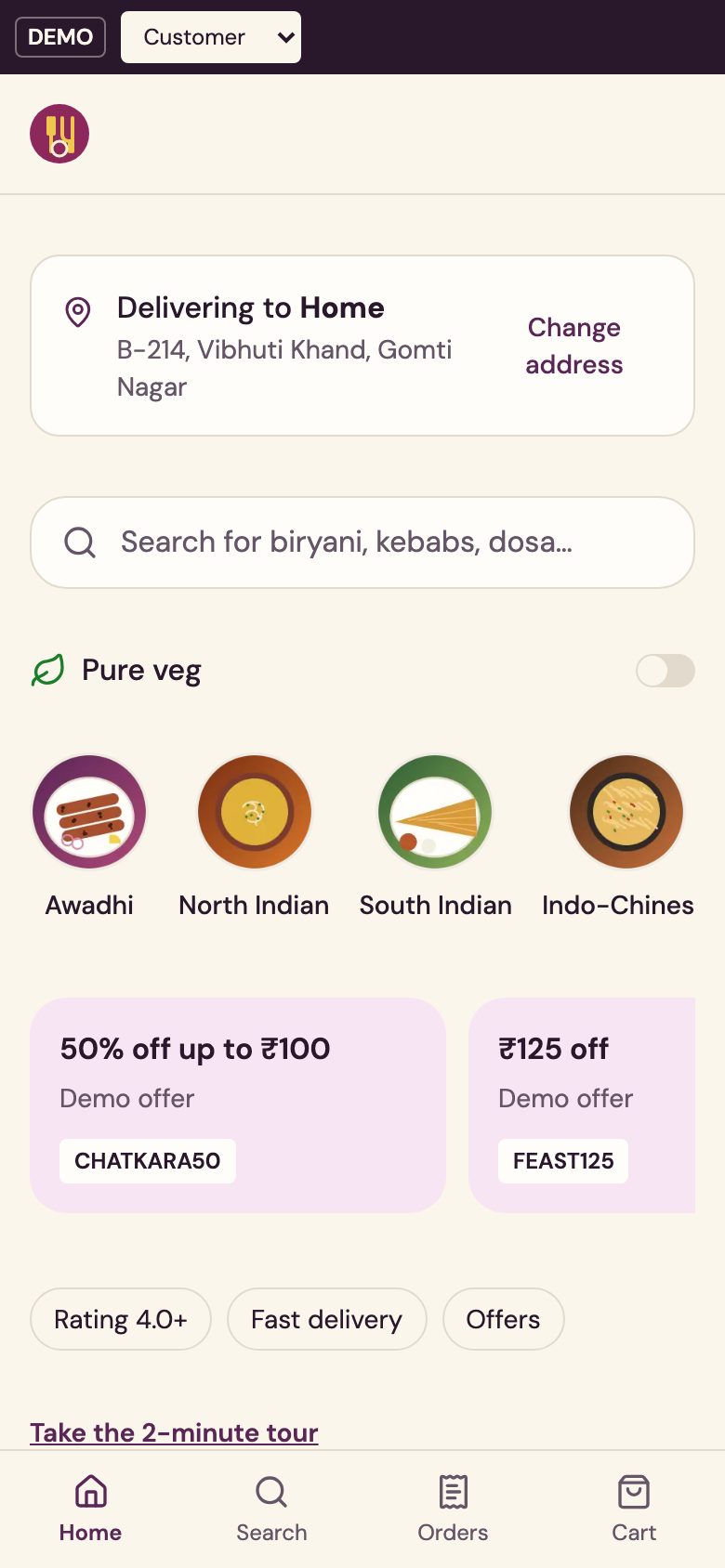
- Veg, egg and Jain filters. A pure-veg mode that hides non-veg dishes entirely, not just a filter chip. Bitevia makes this a shield on the home screen.
- Half and full portions, spice levels and add-ons. Item customisation is where Indian menus get complex. Plan the data model early.
- A clear bill. Item total, packaging, delivery fee, platform fee, taxes and discounts, each on its own line. FullPlate's Open Bill shows where every rupee goes.
- UPI first at checkout. Most people expect to pay by UPI in one tap, with cards, wallets and cash on delivery as fallbacks. Our UPI payments guide covers the flows.
- Live tracking with honest ETAs. A moving rider on a map, a status line in plain words, and a call or chat button that masks phone numbers.
- Reorder in two taps. Repeat orders are the business. Put last orders and favourites on the home screen.
- Ratings that separate food from delivery. A late rider should not sink a good kitchen's rating.
The restaurant partner app
Kitchens are loud, busy and short of hands. The partner app usually runs on a tablet near the pass, and it has one job: never miss an order.
- A loud, repeating ring for new orders, with an accept timer. Bitevia uses a 60-second ring.
- One tap to set prep time, and a way to extend it when the kitchen is slammed.
- A KOT (kitchen order ticket) print to the existing thermal printer.
- Menu toggles to mark dishes out of stock instantly, and to pause the whole store.
- Daily sales, payouts and settlement reports a restaurant owner can check at night.
- Onboarding: menu upload, photos, FSSAI licence details, GST number, bank account and timings.
Open the FullPlate kitchen tablet to see an order board that moves from New to Preparing to Picked up.
The rider app and the ops dashboard
Riders use budget Android phones, on mobile data, often in the sun, with gloves on. Design for that: big buttons, high contrast, few steps and a regional language option.
- On-duty and off-duty toggle, with the zone they are working in.
- New order alerts with pickup distance, drop distance and the expected payout before they accept.
- Pickup confirmation at the restaurant and delivery confirmation at the door (OTP or photo).
- Navigation that hands off to the phone's maps app, and an SOS button.
- Earnings for today and the week, incentives and payout history.
The ops dashboard is where your team runs the city: live orders by state, delayed orders flagged in red, riders online by zone, restaurant availability, refunds and customer support. It is the part most quotes leave out and the part your operations team will open every morning. Our services page explains why we build it alongside the customer app rather than after.
Rules and taxes that touch a food app
A few rules shape the product itself. Plan for them in the first version rather than patching them in later.
- FSSAI details. Food businesses selling through an app are expected to show their FSSAI licence or registration details. Collect them during restaurant onboarding and show them on the restaurant page.
- GST on restaurant orders. For restaurant services supplied through an e-commerce operator, the operator collects and pays the GST on those orders. That changes how your invoices and settlement reports work. Your CA should sign off the invoice format.
- Data protection. You hold names, addresses and phone numbers of customers and riders. The DPDP Act sets duties around consent, security and deletion — see our DPDP checklist.
- Rider safety and insurance. Decide early how riders are onboarded, verified and covered.
Tax and food-safety rules change and depend on your structure. Treat this section as a checklist to discuss with your CA and lawyer, not as advice.
ONDC: build your own app, join the network, or both
ONDC (Open Network for Digital Commerce) lets restaurants list once through a seller app and appear on many buyer apps. For a new food business it is worth understanding, because it changes what you need to build.
- Restaurants can reach customers through the network without building a marketplace of their own.
- A new delivery brand can still build its own customer app for loyalty and repeat orders, and connect to the network for reach.
- Logistics players can offer delivery to orders that come through the network.
Integrating with the network is a separate piece of work with its own certification steps. If it matters to your plan, tell us in the brief so it is scoped from day one.
A realistic timeline for version one
For a city-level marketplace with all four sides, a focused first version usually takes 8 to 12 weeks of design and build, after a short discovery. This is how we lay it out on our process page:
- Week 1: category deep-dive — your city, your cuisines, your unit economics, the moments customers love and hate.
- Weeks 2–3: brand system — name, logo, colour and type, coded as tokens.
- Weeks 3–10: customer app, restaurant app, rider app and ops dashboard, built together on one order model so they never drift.
- Weeks 10–12: testing with real kitchens and riders, store submission and a synced demo for investors.
What moves the timeline most: how many cities and zones you launch with, whether you need ONDC on day one, live payouts to riders and restaurants, and how many languages the rider app speaks.
Want to see the result before you commit? Open FullPlate's synced demo, where customer, kitchen and rider share one live order, or read the food delivery app solution page. When you're ready, send a brief and you'll get a fixed quote within 48 hours.
Questions people ask
How many apps does a food delivery business need?
A marketplace usually needs four: a customer app, a restaurant partner app, a rider app and an ops dashboard. A single restaurant can often manage with an ordering website, a kitchen screen and a simple rider app. The more restaurants and riders you coordinate, the more each side needs its own tools, because kitchens and riders work very differently from customers.
How long does it take to build a food delivery app in India?
A focused first version of all four sides typically takes 8 to 12 weeks after a week of discovery. A single-restaurant ordering app is faster. The biggest variables are the number of cities and languages at launch, rider and restaurant payouts, ONDC integration, and how much of your operations the dashboard needs to automate from day one.
Should a new food delivery startup join ONDC?
It depends on your plan. ONDC gives restaurants reach without each one building its own app, and a new brand can connect to it for discovery. Many founders still build their own customer app for loyalty and repeat orders. If ONDC matters to you, scope the integration from the start because it has its own technical and certification steps.
Can a food delivery app work in Hindi or other regional languages?
Yes, and the rider app benefits most. Riders often prefer their own language, so a Hindi, Kannada or Tamil rider app with large buttons and voice prompts reduces errors. Customer apps can offer a language switch too. Plan the language choice early, because text length and fonts change layouts. Our regional language guide covers the details.


