The short answer
Delivery apps bring restaurants new customers, but they also take a large share of every order and keep the customer’s details. A growing number of Indian restaurants, cafés and bakeries now run a second channel they own: their own ordering website, QR ordering at the table, and direct reservations.
You do not have to leave the apps. The goal is to move your regulars — the people who already know you — onto a channel where you keep the margin and the relationship. This guide covers what to build, what it costs to run, and where restaurants usually go wrong.
Three channels you can own
| Channel | What the diner does | What you gain |
|---|---|---|
| Own website with ordering | Orders takeaway or delivery directly, pays by UPI or card | Full margin minus payment fees, the customer’s number, repeat-order data |
| QR table ordering | Scans the table code, orders rounds, splits the bill, pays | Faster table turns, fewer order mistakes, staff free for hospitality |
| Direct reservations | Books a table on your site, gets a reminder | Fewer no-shows, a guest list you can invite back |
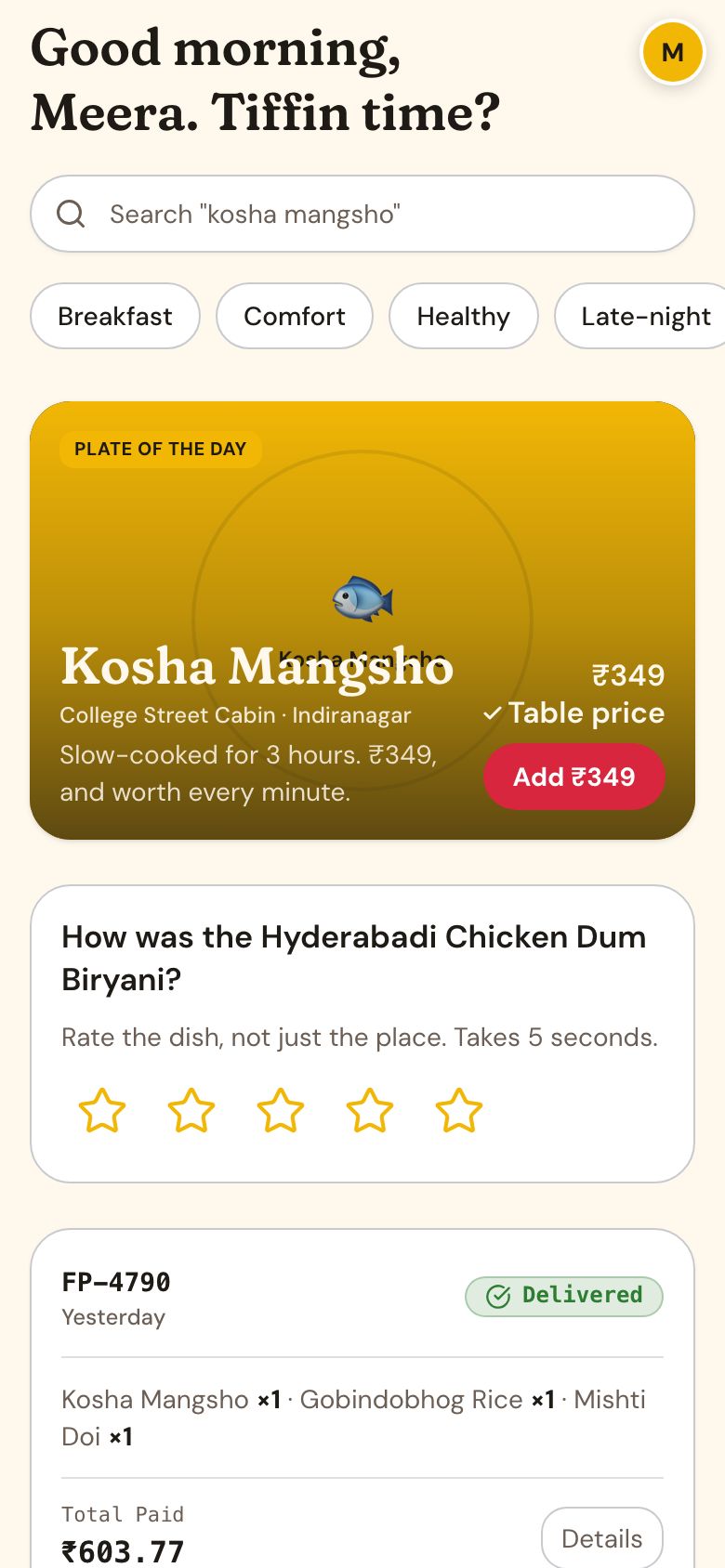
Tabletap, one of our concept builds, puts all three into one kit for an independent restaurant: a marketing site with reservations, a QR ordering web app, and a kitchen display. Crumbloom, a concept bakery, shows the pre-order side — a custom cake builder and a live bake schedule so people order before they arrive.
Your own ordering website
Diners will only order direct if it is as easy as the apps. That means:
- A fast menu on mobile data. Photos compressed, categories pinned at the top, search for a dish by name.
- Clear prices including taxes and packing. No surprises at checkout.
- UPI first. Most Indian diners pay by UPI; cards and wallets as the fallback. See UPI payments in your app.
- Login by phone number and OTP. No passwords, no long forms.
- Reorder in one tap. Regulars order the same thing; save it for them.
- Honest delivery radius and times. If you deliver only within 4 km, say so before the cart, not after.
Delivery itself is the hard part. Options include your own riders, a third-party delivery partner booked per order, or takeaway only. Many restaurants start with takeaway and pre-orders on the website, then add delivery once volume justifies it.
Give direct customers a reason to switch — a small discount, a free side, loyalty points — and say it on the packaging that goes out through the apps. That is usually how regulars discover the website.
QR table ordering that diners like
QR menus got a bad name from blurry PDFs. A proper QR ordering app is different: the diner scans, sees a fast menu with photos, orders, and the order lands in the kitchen with the table number attached.
- No app download. It must open in the phone browser instantly.
- Order in rounds. Drinks first, starters later, dessert at the end — all on one running bill.
- Call a server. A button for water, the bill or help. QR ordering should free staff, not replace warmth.
- Split the bill. By item or equally, each person paying their share by UPI.
- Works for the whole table. Several phones can add to the same table order.
- A printed menu still exists. Some diners prefer it; never force the QR.
In Tabletap, the bill-splitting screen is the signature moment: each friend ticks what they ate and pays their part. It is a small thing that makes the restaurant feel modern.
The kitchen side: where orders actually get cooked
Online orders fail in the kitchen, not on the website. If website orders come in on a separate tablet that nobody watches, they get missed.
- One kitchen display for every channel. Dine-in QR, website, phone orders and app orders in one queue, each tagged by source.
- Tickets by station. The tandoor sees tandoor items; the bar sees drinks.
- Timers. Each ticket shows how long it has been waiting.
- Item-out switch. When paneer runs out, mark it unavailable everywhere in one tap.
- Printer fallback. Keep a KOT printer for the day the screen fails.
If you already use a billing or POS system, ask how orders can flow into it — or whether the new system can replace it. Running two systems side by side is where reconciliation errors creep in. For GST billing tools, see billing app.
What it costs to run, not just to build
Owning your channel moves costs around rather than removing them. Plan for these running costs:
| Cost | Typical shape | Notes |
|---|---|---|
| Payment gateway | A small percentage per transaction | UPI is often cheaper than cards; check your gateway’s current rates |
| Hosting and maintenance | Monthly | Menus, prices and photos change constantly; someone has to update them |
| Delivery | Per order, if you deliver | Own riders or a per-order delivery partner |
| Messaging | Per message | Order updates on WhatsApp or SMS — see WhatsApp for business apps |
| Marketing to regulars | Ongoing | Packaging inserts, table cards, offers for direct orders |
For build costs, see how much a website costs in India. We quote every project as a fixed price after a brief — tell us about your restaurant.
Bakeries, cafés and pre-orders
Not every food business needs delivery. Bakeries, cake studios, sweet shops and cafés often gain more from pre-orders: the customer decides in advance, pays upfront, and collects at a set time. The kitchen plans its day, and nothing goes to waste.
- A custom order builder — size, flavour, eggless or not, message on the cake, pickup date — with the price updating as choices change.
- Lead times enforced by the system. A three-tier cake cannot be ordered for this evening; the calendar simply does not offer it.
- A daily production list generated from the orders, grouped by item, so the bakers know exactly what to make.
- A live “fresh out of the oven” schedule, so regulars know when the bread or puffs are hot.
- Festival pre-orders — Diwali hampers, Christmas plum cakes, Eid sweets — opened weeks ahead with limited quantities.
Crumbloom, our concept bakery, is built around these: a tier-and-flavour cake builder, a live bake timetable and a pastry box builder. The same approach works for a mithai shop or a café that sells coffee beans and pastries.
Allergen and eggless information must be accurate on the website, not just at the counter. If you are not sure an item is egg-free or nut-free, say so plainly.
Mistakes restaurants make
- Launching a website with no reason for regulars to use it instead of the app.
- Menu prices on the website that differ from the restaurant without explanation.
- Turning on delivery before the kitchen can handle the extra orders at peak.
- QR ordering with no way to call a person — diners feel abandoned.
- Forgetting Google: your menu, hours and order link should be on your Google Business Profile. See local SEO for Indian businesses.
- Collecting phone numbers and then spamming them. Ask permission and message sparingly.
A sensible order to build in
- A fast website with the menu, photos, hours, location and reservations.
- Takeaway and pre-order with UPI payment and a kitchen ticket.
- QR table ordering with bill splitting, if you run dine-in.
- Delivery, once takeaway volume shows demand.
- Loyalty and reorder features for regulars.
Each step pays for the next. See restaurant websites for what we build at each stage, or food delivery apps if you are planning a multi-restaurant platform rather than your own outlet.
Questions people ask
Can a restaurant take online orders without delivery apps?
Yes. A restaurant can take orders on its own website or web app, collect payment by UPI or card through a payment gateway, and either deliver with its own riders, book a delivery partner per order, or offer takeaway only. Most restaurants keep the apps for discovery and move regulars to the direct channel.
Do diners need to download an app for QR ordering?
They should not. A good QR ordering system opens in the phone’s browser the moment the code is scanned, shows the menu, and takes the order and payment there. Asking diners to install an app at the table loses most of them, especially on slow connections.
How do I get customers to order from my website instead of apps?
Give them a clear reason and tell them where you will be seen. Offer a direct-order benefit such as a discount, free item or loyalty points, add a card or sticker to every delivery bag, show the link on your Google Business Profile, and make reordering faster on your site than anywhere else.
Will QR ordering replace my waiters?
It should not. QR ordering removes order-taking and bill-waiting, the parts diners find slow, so your staff can spend time on service, recommendations and turning tables. Keep a call-server button and a printed menu for guests who prefer them.


