The short answer
A tiffin service sells home-style meals on a schedule, usually lunch and dinner for students, working professionals and older people living alone. Start from a home kitchen with FSSAI registration, a weekly rotating menu and a fixed delivery route, and sell monthly plans paid in advance.
As a ballpark, a home-kitchen tiffin service can start for roughly ₹30,000–1.5 lakh. A commercial kitchen serving a few hundred meals a day often needs ₹6–15 lakh. The business is about reliability: the same taste and the same time, every day.
Is a tiffin service right for you?
Every Indian city has people who want ghar ka khana but cannot cook it: students in PGs and hostels, young professionals who moved for work, and older parents whose children live elsewhere. They want simple, healthy food at a predictable price, not restaurant meals.
A tiffin service suits someone who cooks good everyday food at volume and is disciplined about timing. The hard parts: cooking twice a day, every day; keeping the menu interesting on a tight budget; delivery delays; customers who pause and restart without notice; and collecting payment on time.
Business models to choose from
| Model | How it works | Suits |
|---|---|---|
| Home kitchen, daily tiffins | Cook at home, deliver lunch and dinner to a fixed route | First-time owners testing demand |
| Commercial kitchen with subscriptions | A rented kitchen serving hundreds of meals on monthly plans | Owners with steady demand and staff |
| Office and corporate meals | Bulk lunches for small offices, delivered at a fixed time | Business districts and industrial areas |
| Diet and health tiffins | Calorie-counted, diabetic-friendly or high-protein plans | Health-focused customers; higher prices |
| Community or regional food | Food from one region — Gujarati, Bengali, South Indian — for people far from home | Cities with large migrant communities |
Licences and registrations
| Registration | Why you need it | Where you get it |
|---|---|---|
| FSSAI registration or licence | Required for anyone selling food, including from home | Food Safety and Standards Authority of India, online |
| GST registration | Needed once you cross the turnover limit | GST portal |
| Shop & Establishment registration | When you run a commercial kitchen or hire staff | State labour department or municipal body |
| Trade or health licence | For a commercial kitchen, and in some cities for home businesses | Municipal corporation |
| Fire NOC | For larger commercial kitchens, depending on size and building | State or city fire department |
| Udyam registration | Optional; records you as a micro enterprise for loans and schemes | Udyam portal |
Rules and thresholds vary by state and change. Confirm what applies to your kitchen with a CA or the local authority. This is not legal advice.
What it costs to start
| Item | Small start | Larger setup |
|---|---|---|
| Kitchen equipment: burners, large vessels, rice cooker | ₹10,000–40,000 | ₹2–5 lakh |
| Tiffin boxes or sealed containers | ₹10,000–30,000 | ₹50,000–1.5 lakh |
| Commercial kitchen rent deposit | — | ₹1–3 lakh |
| FSSAI registration and paperwork | Small | ₹20,000–60,000 with CA help |
| Delivery: a two-wheeler or delivery staff | ₹0–80,000 | ₹1–3 lakh |
| First month's groceries | ₹10,000–30,000 | ₹1–2 lakh |
| Staff for the first two months | — | ₹1–3 lakh |
| Rough total | ₹30,000–1.5 lakh | ₹6–15 lakh |
Price monthly plans so that a customer who skips a few days does not wipe out your margin. Many services count meals rather than days, and set a cut-off time for changes to the next day's order.
These are ballpark estimates to sanity-check a plan, not quotes.
Step by step: from idea to first customer
- Pick your customer: students, office workers or older people. Their budgets and timings differ.
- Write a weekly rotating menu that is simple, balanced and costed per meal.
- Apply for FSSAI registration before taking paid orders.
- Choose containers that keep food warm and do not leak.
- Map a delivery route you can finish within a tight window, and cap customers to what that route can serve.
- Set plans and rules: daily, weekly and monthly plans, advance payment, and a cut-off time for skips.
- Offer a paid trial week to the first customers and ask for feedback each day.
- Collect payments by UPI with reminders before renewal.
- Keep a list of every customer's preferences — less oil, no onion, Jain — and check it every day.
- Add a second route only when the first one runs on time every day.
Running it day to day
The rhythm is fixed: groceries the evening before, cooking from early morning, packing by count, lunch delivery in a tight window, then the same again for dinner. The evening is also when skips, pauses and new orders for tomorrow must be locked, so the kitchen knows exactly how many meals to make.
- Counts: a wrong count means wasted food or a customer without lunch. Lock tomorrow's numbers at a fixed time each night.
- Containers: if you use steel tiffins, collect empties on the next delivery and track who has how many.
- Delivery: one late day is forgiven; three lose the customer.
- Payments: renewals due on different dates are hard to chase; move everyone to one billing cycle if you can.
Keep the menu fresh without raising cost. A weekly rotation with one special day — a festive sweet on Sundays, a regional dish on Wednesdays — gives customers something to look forward to while you buy the same staples in bulk. Ask for feedback once a month, and drop the dishes people quietly leave uneaten.
Getting your first customers
Tiffin services grow through word of mouth within PGs, hostels, offices and housing societies. One happy customer in a PG often brings the whole floor. A Google Business Profile helps people searching for tiffin services nearby find you; our local SEO guide explains how.
- PG owners and hostel wardens: offer a group plan.
- Offices: a fixed lunch plan for a small team is an easy first deal.
- WhatsApp: share the week's menu each Sunday with customers who opted in.
- Trial meals: a low-priced first meal removes the risk for new customers.
The tech you need
With 20 customers, a WhatsApp group, a spreadsheet and UPI work. Past 50, the daily count, skips, pauses, renewals and returned containers become the hard part, and mistakes cost meals. That is when a subscription app helps: customers manage their own calendar, pay in advance or through UPI AutoPay, and the kitchen gets one accurate count each night. Read about UPI AutoPay and payments.
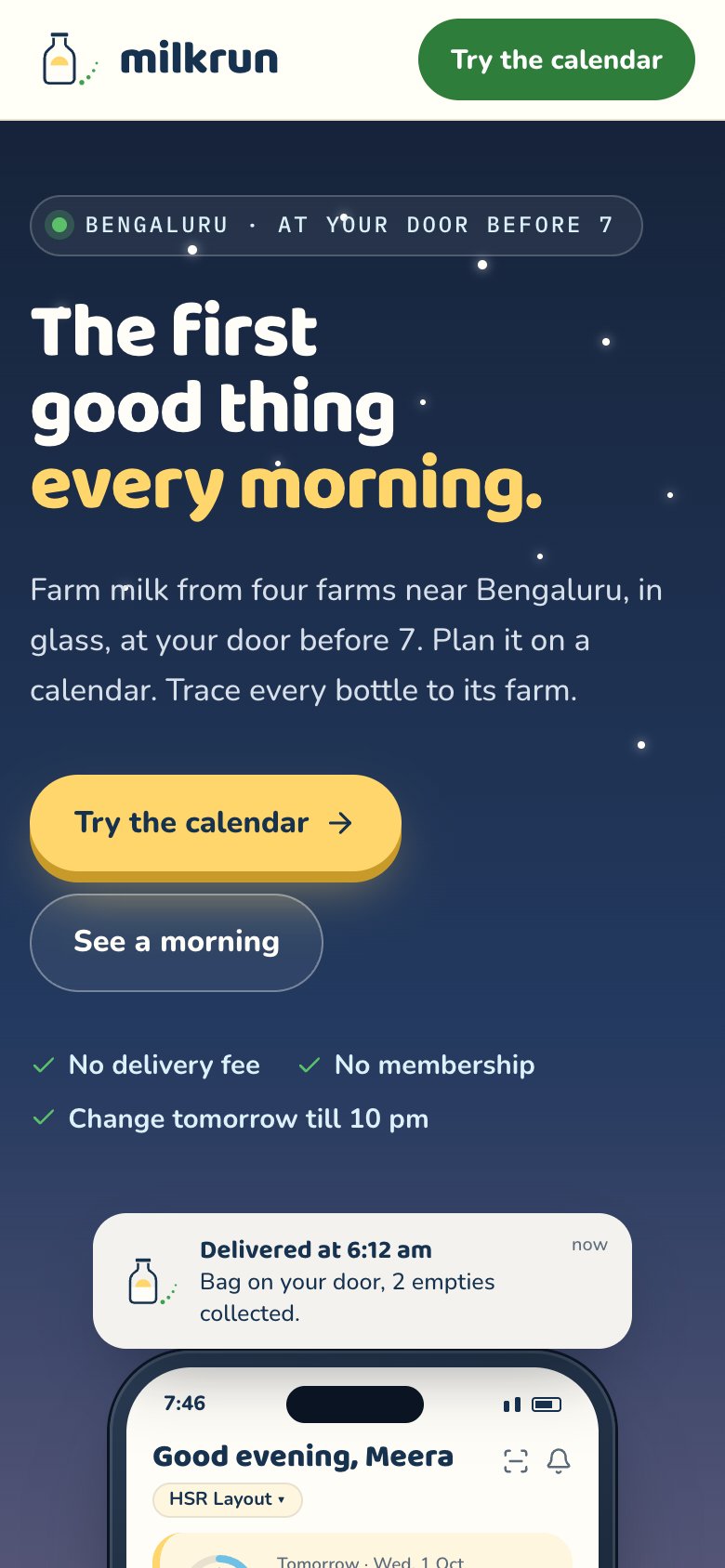
Our concept build Milkrun solves the same problem for daily milk: a monthly subscription calendar, a 10 pm cut-off countdown for tomorrow's order, a bottle wallet, and a route sheet for delivery staff. The same pattern fits tiffins. See what a subscription delivery app involves, or how to start a milk delivery business for a close cousin of this model.
See the app a tiffin service runs on
We designed and built this concept end to end, every side of it, so you can open it and try it before you plan your own. Our milk & subscription delivery app page covers the features, timeline and what moves the cost.
Questions people ask
Do I need a licence to start a tiffin service from home?
Yes. Selling food from home still needs FSSAI registration, and a licence as you grow. GST registration applies once you cross the turnover limit, and some cities ask for a trade licence. Confirm the exact requirements for your area with a CA or the local food safety office.
How much can I earn from a tiffin service?
It depends on how many meals you serve, your price per meal and your food cost. Earnings grow with steady monthly customers on one efficient route. Cost each meal carefully, including containers and delivery, and price plans so skipped days do not erase your margin.
How do I handle customers who skip meals?
Set a clear cut-off time, usually the night before, for skipping or pausing the next day's meal. Count meals rather than days on monthly plans, so skipped meals carry over. A simple subscription app lets customers manage this themselves and gives you an accurate count.
What is the right price for a tiffin?
Look at what local services charge, then cost your own meals: groceries, gas, containers, delivery and your time. Students expect lower prices than office workers, and diet plans can charge more. Keep a simple and a premium option rather than many plans.
When does a tiffin service need an app?
Usually somewhere past 50 regular customers, when counts, skips and renewals become hard to manage on WhatsApp. An app lets customers pause, skip and pay by themselves, and gives your kitchen one reliable number each night.


