The short answer
A home services business sends skilled people — electricians, plumbers, AC technicians, carpenters, painters — to fix things in people's homes. Customers do not mainly buy the repair. They buy the confidence that someone will arrive when promised, charge a fair price and stand behind the work.
Start with one or two trades you understand, a small team of trained and verified technicians, a clear price list and a warranty on every job. Grow by adding trades and areas only when your first ones run smoothly and customers come back.
Is a home services business right for you?
Every home needs repairs, and most families struggle to find a reliable technician quickly. Apartment growth, more appliances and busier lives keep demand steady, with peaks before summer for AC servicing and before festivals for painting and deep repairs.
You will do well if you either know a trade yourself or can judge good work, and if you can keep technicians busy and motivated. It is an operations business: routes, parts, scheduling and follow-ups decide your margin.
- The hard parts: unpredictable job lengths, parts that are not in stock, price arguments at the door and technicians who take customers private.
- What helps: fixed prices for common jobs, inspection fees that count towards the repair, and a written warranty.
- What to avoid: offering ten trades at launch. Quality slips when you cannot check the work.
Business models to choose from
| Model | How it works | Suits |
|---|---|---|
| Single-trade specialist | One skill — say AC servicing or plumbing — done very well, with your own technicians. | A founder who knows the trade |
| Multi-trade service company | A team covering several trades, booked through one number or app. | Founders with ops experience and some capital |
| Annual maintenance contracts | Homes, societies or offices pay a yearly fee for scheduled visits and priority repairs. | Steady recurring income; works well with societies and small offices |
| Marketplace of independent pros | You connect customers with freelance technicians and take a commission. | Founders with technology and marketing strengths |
A marketplace grows fastest but controls quality least. Most small businesses start as a specialist or service company and add contracts once they have repeat customers.
Licences and registrations
| Registration | Why you need it | Where you get it |
|---|---|---|
| Business structure | Sets liability and tax treatment. | A CA; LLPs and companies register with the Ministry of Corporate Affairs |
| GST registration | Needed once turnover crosses the threshold; lets you issue GST invoices to societies and offices. | The GST portal |
| Udyam registration | MSME recognition for loans and schemes. | The Udyam registration portal (free) |
| Shop & Establishment / trade licence | Covers your office, workshop or store under state and municipal rules. | Municipal body or state labour department |
| Electrical licence or certification | Electrical work is regulated; many states require licensed electricians or contractors for certain work. | State electrical licensing board or inspectorate |
| Police verification of technicians | Customers and societies expect it before letting anyone into homes. | Local police station or state police portal |
| EPF and ESI | Once your employee count crosses legal thresholds. | EPFO and ESIC portals |
Requirements differ by state and by trade, and they change. Check with a CA and your local authority before you start. This is general information, not legal advice.
What it costs to start
| Item | Small start | Larger setup |
|---|---|---|
| Registrations and CA | ₹10,000–25,000 | ₹40,000–1 lakh |
| Tool kits per technician | ₹10,000–40,000 | ₹40,000–1 lakh for specialist kits |
| Spare parts stock | ₹30,000–1 lakh | ₹3–10 lakh |
| Two-wheelers or fuel allowances | Technicians' own bikes with allowance | Company vehicles or EV fleet |
| Uniforms, ID and safety gear | ₹3,000–6,000 per technician | ₹5,000–10,000 per technician |
| Marketing | ₹30,000–75,000 | ₹3–8 lakh |
| Working capital | ₹1–3 lakh | ₹10–30 lakh |
These are planning estimates, not quotes. Tool and parts costs depend heavily on the trades you choose.
Step by step: from idea to first customer
- Choose your first one or two trades and the areas you will cover.
- Write a price list for the twenty most common jobs, with an inspection fee for the rest.
- Register the business, open a current account and set up UPI and card collection.
- Recruit technicians with proven experience; test them on real tasks before hiring.
- Verify every technician and give them uniforms, ID cards and a standard kit.
- Write a service standard: arrival window, shoe covers, clean-up, photo before and after.
- Set a warranty period for each type of job and explain it on every invoice.
- Line up parts suppliers who give you credit and fast delivery.
- Set up a Google Business Profile, a WhatsApp Business number and a simple website.
- Offer a launch deal to one or two housing societies or small offices.
- Call every customer after the job, fix complaints the same week, and ask happy ones for reviews.
Running it day to day
Mornings are for dispatch: matching jobs to technicians by skill and distance, confirming parts and sending customers an arrival window. Evenings are for closing jobs, collecting payments and planning tomorrow.
- Training. Run short monthly sessions on new appliances, safety and how to talk to customers.
- Fair pay. A fixed base plus per-job incentives keeps technicians motivated without rushing work.
- Safety. Insulated tools, ladders, gloves and a rule that no one works on live wiring without the right gear.
- Quality. Before and after photos on every job settle most disputes and show customers what they paid for. Our HomeCraft concept build uses a before/after slider for exactly this.
- Ratings. Ask for a rating after every job and review low ones within a day.
Watch your repeat rate closely. A customer who calls you again for a different job is worth more than any advertisement.
Parts deserve their own discipline. Keep a small van stock of the parts you use most — capacitors, gas for AC top-ups, washers, switches, hinges — and log what each technician takes out. Margins quietly disappear when parts go missing or are billed at the wrong price. A weekly count, matched against the jobs closed that week, keeps everyone honest.
Plan for peaks. AC servicing before summer and painting before festivals can double your bookings for a few weeks. Line up extra trained technicians or partner firms in advance, and stop taking bookings you cannot serve well. A missed slot in peak season costs you a customer for years.
Getting your first customers
Repairs are urgent, so people search “electrician near me” or “AC service near me” and call the first credible result. A complete Google Business Profile with photos and real reviews matters more than anything else. Our local SEO guide explains the steps.
- Seasonal pushes. Promote AC servicing before summer and painting and waterproofing before the monsoon and festivals.
- Societies and offices. Annual maintenance contracts bring predictable work and referrals.
- Builders and property managers. New handovers need snag fixing, fittings and appliances installed.
- WhatsApp reminders. A service reminder six months after an AC service brings customers back.
The tech you need
Early on, a booking number on WhatsApp, a job sheet and UPI are enough. As you grow, you need to see every technician's day, assign jobs by skill and distance, track parts and keep warranty records.
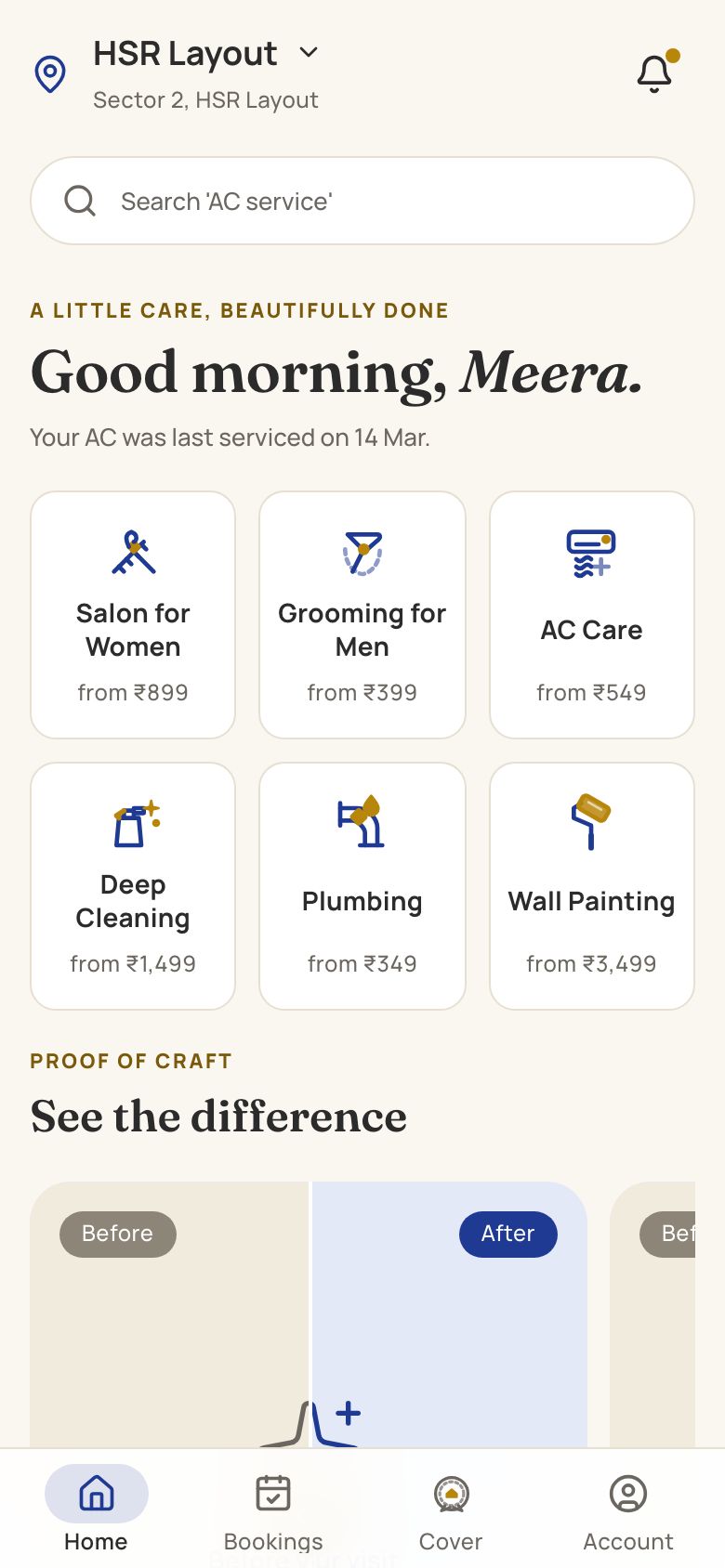
A home services app usually has a customer app for booking and tracking, a technician app for jobs, earnings and photos, and a dispatch dashboard. Our HomeCraft concept build shows all three, with certified-pro profiles and a warranty card after every job.
If you also sell parts or run AMCs, a billing app with GST invoices helps. Read how app costs work in India and our guide to home services apps before you brief anyone.
See the app a home services business runs on
We designed and built this concept end to end, every side of it, so you can open it and try it before you plan your own. Our home services app page covers the features, timeline and what moves the cost.
Questions people ask
Which home service business is most profitable in India?
It depends on your skills and area, but AC servicing, appliance repair, waterproofing and annual maintenance contracts often have good margins because they combine skilled labour, parts and repeat visits. Choose the trade you can deliver well; a profitable trade done badly loses customers quickly.
Do I need a licence to start an electrician or plumbing business?
Electrical work is regulated in India, and many states require licensed electricians or contractors for certain work. Plumbing licensing varies by city. You will also need standard business registrations such as GST once you cross the threshold. Check your state's rules with a CA and the local authority.
How should I price home repair jobs?
Publish fixed prices for common jobs, charge a small inspection fee for diagnosis and adjust it against the repair, and quote parts separately at clear prices. Customers distrust surprise bills at the door, so agree the total before work starts, and put it on a GST invoice if you are registered.
How do I stop technicians taking customers directly?
Make staying with you worth more: steady jobs, fair incentives, training, insurance and fast payouts. Give customers reasons to book through you, such as a warranty, tracked visits and easy rebooking. Clear agreements help, but loyalty comes mostly from how you treat your team.
When should a home services business build an app?
When phone calls and spreadsheets start causing missed jobs, double bookings or lost warranty records — usually around ten to fifteen technicians. Before that, a website with booking, a WhatsApp number and a simple job sheet will do. Note what goes wrong each week; that list becomes the brief for your app.


