The short answer
Start small and local. Pick one neighbourhood, partner with shops that already hold stock, take orders on WhatsApp and a simple website, and deliver yourself or with one or two riders. Prove that people reorder every week before you rent a dark store or build a full app.
Grocery delivery is a thin-margin, high-frequency business. You win on reliability, freshness and a radius you can actually cover — not on speed promises you can’t keep. This playbook walks through the models, licences, costs, launch steps and the tech you need at each stage.
Is a grocery delivery business right for you?
Indian households buy groceries several times a week: milk and bread daily, vegetables every few days, staples monthly. That rhythm is what makes delivery attractive. A customer who trusts you can order from you dozens of times a year.
The people who do well usually know their area street by street. They already run a kirana or a vegetable business, or they have worked in retail or logistics. They are comfortable with early mornings, thin margins and lots of small problems: a missing item, a late rider, a customer who wants a substitution.
The hard parts are real. Margins on staples are small, so delivery costs eat profit quickly. Fresh produce spoils. Customers compare your prices with what they see elsewhere. And a promise like “in 15 minutes” is expensive to keep. Many small operators do better promising a slot — “before 8 am” or “within the hour” — and keeping it every time.
Business models to choose from
There is no single grocery delivery business. The model you choose decides how much money you need and how much stock risk you carry.
| Model | How it works | Suits |
|---|---|---|
| Shop-led delivery | You deliver from one existing kirana or supermarket, often your own | Shop owners adding delivery with little new investment |
| Multi-shop aggregator | Customers order from several local shops in one cart; one runner picks up and delivers | Founders who know many shopkeepers and want no stock risk |
| Dark store | A small warehouse that only serves online orders within a fixed radius | Teams with capital who can drive volume quickly |
| Scheduled slots | Orders close the night before and deliveries go out in morning or evening slots | Dense housing societies and lean teams |
| Fresh-only | Vegetables, fruit, meat or dairy, often sourced directly from mandis or farms | People with sourcing relationships and quality control |
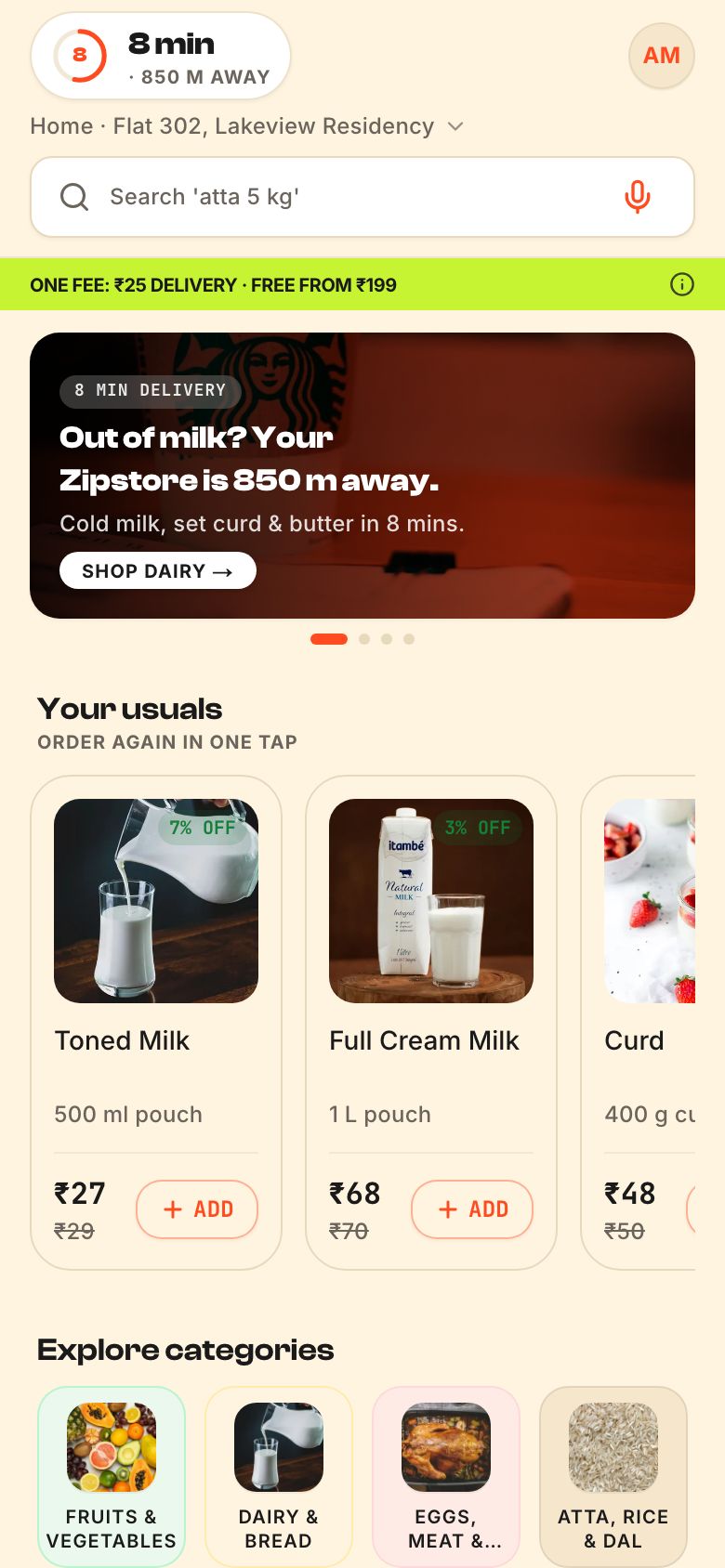
Our concept build Zippit uses the multi-shop model: the neighbourhood’s own shops within a short radius, one cart and one runner doing a multi-stop loop. It avoids rent on a dark store, but depends on shopkeepers keeping stock data honest.
Licences and registrations
| Registration | Why you need it | Where you get it |
|---|---|---|
| FSSAI registration or licence | You sell and store food, including packaged food, even if you only deliver it | FSSAI’s online portal (FoSCoS); level depends on your size |
| GST registration | Needed once you cross the threshold, and often earlier if you sell through online platforms or want input tax credit | GST portal, usually through your CA |
| Shop & Establishment registration | Covers your store or dark store and the people you employ | Your state’s labour department, usually online |
| Trade licence | Permission to run a trade from the premises | Your municipal corporation or local body |
| Legal metrology (weights and measures) | Scales must be verified and stamped; repacking loose goods brings labelling rules | State legal metrology department |
| Udyam registration | Recognises you as an MSME for schemes and some loans | Udyam portal, free and online |
Rules and thresholds vary by state and change over time. Confirm what applies to your premises and products with a CA or the local authority before you launch. This is general guidance, not legal advice.
What it costs to start
Costs depend heavily on the model. A shop-led or multi-shop start needs very little; a dark store needs serious capital before the first order.
| Item | Small start (shop-led, one area) | Larger setup (dark store) |
|---|---|---|
| Premises deposit and fit-out | ₹0 – ₹50,000 | ₹5 lakh – ₹15 lakh |
| Opening stock | ₹0 (partner shops) – ₹1 lakh | ₹8 lakh – ₹20 lakh |
| Cold storage (fridge, freezer) | ₹20,000 – ₹60,000 | ₹2 lakh – ₹6 lakh |
| Delivery vehicles | ₹0 (riders own bikes) – ₹1.5 lakh | ₹4 lakh – ₹10 lakh (EV fleet) |
| Phones, scanner, printer | ₹15,000 – ₹40,000 | ₹1 lakh – ₹3 lakh |
| Website, ordering and billing | ₹10,000 – ₹1 lakh | Custom apps; see our cost guide |
| Working capital (3 months) | ₹1 lakh – ₹2 lakh | ₹10 lakh – ₹25 lakh |
These are rough estimates to help you plan, not quotes. Rent, salaries and stock levels vary widely by city. For custom app costs, read how much it costs to build an app in India.
Step by step: from idea to first customer
- Pick one area. Choose a radius you can cover in 20–30 minutes on a bike, ideally with dense housing societies.
- Choose your model. Shop-led if you own a shop, multi-shop if you know shopkeepers, scheduled slots if you want to stay lean.
- Line up supply. Agree terms with two or three shops or wholesalers, including how they tell you an item is out of stock.
- Get registered. FSSAI, Shop & Establishment and GST as applicable, with a CA’s help.
- Build a short catalogue. Start with the 150–300 items people actually reorder: milk, bread, eggs, atta, rice, dal, oil, vegetables, cleaning basics.
- Set your promise and fees. A delivery slot you can keep, a minimum order, and a delivery fee that is clear before checkout.
- Set up ordering. A WhatsApp catalogue and a simple order page are enough to begin. Accept UPI and cash on delivery.
- Hire and brief riders. Teach them the area, packing rules for eggs and chilled items, and how to handle a missing item.
- Soft-launch in one society. Offer a launch week to residents, deliver every order personally and write down every complaint.
- Fix and expand. Once reorders are steady, add the next society or the next set of shops.
Running it day to day
The daily rhythm starts early. Milk, bread and vegetables move before 8 am, then a quieter late morning, then an evening peak when people get home. Plan rider shifts around those two peaks rather than spreading staff evenly.
Stock accuracy is everything. The fastest way to lose a customer is to accept an order and then call to say half of it isn’t available. If you work with partner shops, agree a daily stock check and a simple way to mark items unavailable. If you run a dark store, count fast movers every day.
Wastage needs a rule. Decide what happens to vegetables that don’t sell by day two: a discount shelf, a staff meal, or returning them to the supplier. Track wastage weekly; it quietly decides whether you make money.
Substitutions need consent. If one brand of atta is out, ask before swapping. Customers forgive a missing item far more easily than a surprise one.
Keep cash and UPI collections reconciled every evening, especially with cash on delivery. A short daily tally — orders, collections, refunds, wastage — catches problems while they are still small.
Getting your first customers
Grocery is local, so your marketing should be too.
- Google Business Profile. Set it up with your real address and service area so people searching “grocery delivery near me” can find you. Our local SEO guide explains how.
- Housing societies and RWAs. Ask to put up a notice, sponsor a small event, or offer a society-only morning slot. One trusted society can carry a new business.
- WhatsApp. A broadcast of daily fresh arrivals and a one-tap reorder link works better than discounts. Read WhatsApp for business apps before you scale it.
- Referrals. Give a small credit to both the referrer and the new customer after the first order is delivered.
- Your own packaging. A clean, branded bag and a printed bill make you look like a real business on day one.
Larger online platforms and networks such as ONDC can bring extra orders, but they add commission or fees and you don’t own the customer relationship. Treat them as a channel, not your foundation.
The tech you need
Match your tools to your stage. Don’t build a full app before you know people reorder.
| Stage | What to use |
|---|---|
| First 100 customers | WhatsApp catalogue, a simple order page, UPI QR, a billing app or spreadsheet |
| Steady daily orders | Your own ordering website with slots, stock and delivery areas; a rider checklist |
| Several areas or a dark store | Customer app, rider app, picker screen and an ops dashboard working together |
When you are ready for your own platform, our grocery delivery app page covers every side you will need. Our concept build Zippit shows a multi-shop cart, a rider app in Kannada, a shop-counter picker screen and a live ops console working together. For the operational side of delivery, read our hyperlocal delivery guide.
See the app a grocery delivery business runs on
We designed and built this concept end to end, every side of it, so you can open it and try it before you plan your own. Our grocery delivery app page covers the features, timeline and what moves the cost.
Questions people ask
How much money do I need to start a grocery delivery business?
You can start a shop-led or multi-shop delivery business in one neighbourhood for roughly ₹2–5 lakh, mainly working capital, phones and basic ordering tools. A dark store with its own stock, cold storage and a rider fleet usually needs ₹30 lakh or more. These are rough estimates; rent and stock levels change the number.
Do I need an FSSAI licence to deliver groceries?
Usually yes. If you sell, store or deliver food, including packaged food, FSSAI registration or a licence is generally required, and the level depends on your scale. Even if partner shops hold their own licences, check with a CA or FSSAI consultant whether your delivery business needs its own.
Is grocery delivery profitable in India?
It can be, but margins are thin. Profit comes from repeat orders, a dense delivery area, low wastage and a sensible minimum order or fee. Businesses that chase speed or discounts before they have dense, loyal customers often lose money on every order.
Do I need an app to start?
No. Many grocery delivery businesses start with WhatsApp, a simple ordering website and UPI. Build your own app once you have steady daily orders and know exactly which features your customers use. Our app vs website guide helps you decide when.
How do I compete with large delivery platforms?
Don’t compete on speed or discounts. Compete on what large platforms find hard: knowing your customers by name, local and fresh products, reliable slots, easy substitutions and personal service. A neighbourhood that trusts you will reorder even when prices are similar.


