The short answer
Start with a small herd — often 5 to 10 animals — of a breed suited to your climate, on land with water, fodder and a vet within reach. Learn feeding, milking and animal health well before you grow, and decide early whether you will sell to a dairy cooperative or directly to households.
Dairy farming is steady but demanding. Animals need care twice a day, every day. Profit depends on milk yield, feed cost and how much of your milk you can sell at a better price directly. This playbook covers the models, permissions, costs and daily rhythm.
Is a dairy farm right for you?
India has a deep dairy culture and a strong cooperative network that buys milk from farmers in many states. At the same time, more city families now want farm-fresh milk from a source they can visit, which opens a premium direct-to-home market for small farms near towns.
People who succeed have farm experience or work closely with someone who does. They are hands-on, patient with animals, and willing to learn about feed, breeding and disease. It is not a business you can run from a distance in the first years.
The hard parts: feed prices move, animals fall ill, yields drop in summer, and a sick herd can cost months of income. Selling only to a collection centre often gives modest prices. Selling direct gives better prices but turns you into a delivery business too.
Business models to choose from
| Model | How it works | Suits |
|---|---|---|
| Supply to a cooperative or dairy | Sell milk twice a day to a local collection centre | Farmers who want simple, steady sales |
| Direct to households | Chill, pack and deliver your own milk on subscription | Farms near a town with nearby demand |
| Value-added products | Make paneer, curd, ghee or butter from part of the milk | Farms with surplus and processing skills |
| Premium single-breed milk | Milk from one breed, often marketed as A2, sold at a premium | Farms with indigenous breeds and branding ability |
| Mixed | Supply a dairy for base volume, sell direct for margin | Growing farms reducing risk |
Selling direct pairs naturally with our playbook on starting a milk delivery business.
Licences and registrations
| Registration | Why you need it | Where you get it |
|---|---|---|
| FSSAI registration or licence | Required when you sell milk or dairy products directly to consumers or shops | FSSAI’s FoSCoS portal |
| Local body permission | Many cities restrict keeping cattle within limits; rural panchayats have their own rules | Municipal body or gram panchayat |
| Pollution control consent | Larger farms may need consent for waste and wastewater handling | State Pollution Control Board |
| Animal health and identification | Vaccination programmes and animal tagging where your state applies them | State animal husbandry department and local veterinary hospital |
| GST registration | May apply to value-added products such as ghee or packaged items; fresh milk is treated differently | GST portal, through a CA |
| Udyam registration | MSME recognition, useful for loans and schemes | Udyam portal |
Banks lend to dairy farms, and central and state governments run schemes that support animal purchase and infrastructure. Your local animal husbandry office and bank branch can tell you what currently applies.
Rules on cattle in urban areas, pollution consent thresholds and scheme eligibility vary by state and change. Confirm with the local authority, the animal husbandry department and a CA. This is general guidance, not legal advice.
What it costs to start
| Item | Small start (5–10 animals) | Larger setup (30–50 animals) |
|---|---|---|
| Animals | ₹4 lakh – ₹10 lakh | ₹25 lakh – ₹60 lakh |
| Shed, flooring, water, drainage | ₹2 lakh – ₹6 lakh | ₹12 lakh – ₹30 lakh |
| Milking machine, cans, chaff cutter | ₹50,000 – ₹2 lakh | ₹3 lakh – ₹8 lakh |
| Chiller (if selling direct) | ₹50,000 – ₹1.5 lakh | ₹3 lakh – ₹8 lakh |
| Feed and fodder (3 months) | ₹1 lakh – ₹2.5 lakh | ₹6 lakh – ₹15 lakh |
| Vet, vaccination, insurance | ₹20,000 – ₹60,000 | ₹1.5 lakh – ₹4 lakh |
| Labour (3 months) | ₹30,000 – ₹1 lakh | ₹3 lakh – ₹6 lakh |
These are planning estimates, not quotes. Buy animals only after a vet checks them, and budget for a few months of feed before milk income steadies.
Step by step: from idea to first customer
- Learn first. Spend time on a working dairy farm and attend training run by your state’s animal husbandry or agricultural institutions.
- Secure land and water. Enough space for shed, fodder and waste handling, with reliable water and road access.
- Plan fodder. Grow green fodder if you can, and line up suppliers for dry fodder and concentrate feed.
- Check permissions. Local body rules, pollution consent if your size needs it, and FSSAI if you will sell direct.
- Build the shed. Ventilation, sloped floors for drainage, clean water points and a separate area for calves and sick animals.
- Buy animals carefully. From trusted sources, with a vet check and records of yield and health.
- Insure the animals and register with the local veterinary hospital.
- Decide where milk goes. A collection centre for steady volume, or a short list of households for direct sales.
- Start testing milk for fat and SNF so you know what you are selling.
- Sell your first litres and keep daily records of yield, feed and income per animal.
Running it day to day
A dairy day runs around two milkings, usually early morning and evening, with feeding, cleaning and health checks in between. Consistency matters to the animals: the same times, the same routine.
Feed is your biggest running cost. Balance green fodder, dry fodder and concentrate for each animal’s yield. Growing your own fodder protects you from price swings.
Records pay for themselves. Track yield per animal, feed, breeding dates, vaccinations and treatments. Low-yield animals cost the same to feed as high-yield ones.
Hygiene protects the milk. Clean udders, clean equipment and fast chilling keep bacterial counts low, especially if you sell direct.
Cash flow is uneven. Cooperatives pay on cycles; direct customers pay monthly or in advance; feed and labour are paid continuously. Keep a cushion.
Getting your first customers
- Farm visits. Invite nearby families to see the animals and the milking. Transparency is your strongest marketing.
- Trial bottles for a few days in nearby housing societies, with permission from the RWA.
- Google Business Profile for the farm, with real photos and accurate location. Our local SEO guide explains how.
- WhatsApp for daily availability, holiday schedules and new products like ghee or paneer.
- Local shops and cafés as steady buyers of milk, curd or paneer.
The tech you need
On the farm, simple herd records — a notebook or a spreadsheet — are enough to start. The real tech need appears when you sell direct: tracking subscriptions, pauses, deliveries and payments across many households.
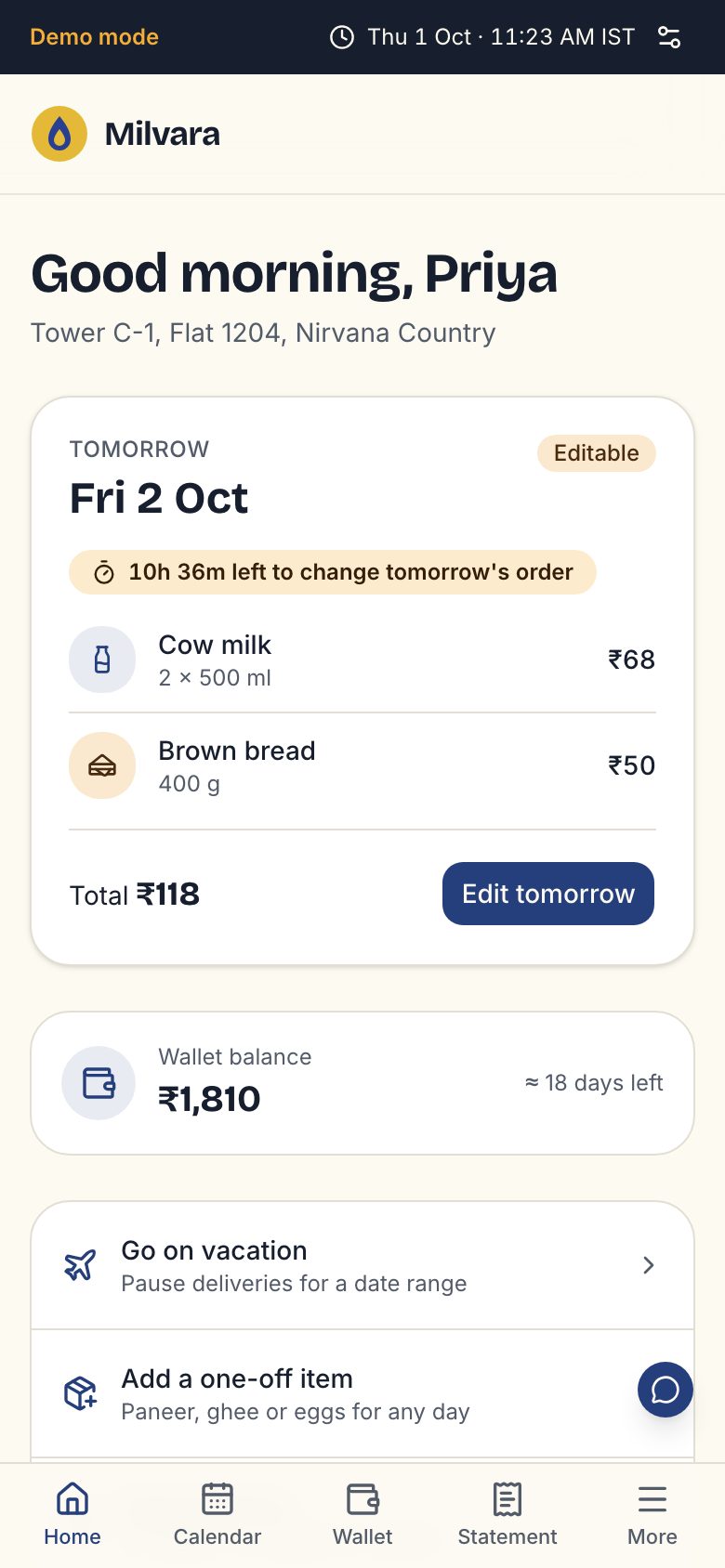
Our concept build Milvara shows how a farm dairy can run subscriptions: customers edit tomorrow’s order until a 10 pm cutoff, pause for holidays and top up a wallet, while the owner sees households, litres and a procurement forecast, and the delivery agent follows a run-sheet sorted by tower and flat. Our subscription delivery app page explains what you need at each stage.
If you also want a simple site that tells your farm’s story and takes enquiries, see our business website page, and read website, app or both? before deciding.
See the app a dairy farm runs on
We designed and built this concept end to end, every side of it, so you can open it and try it before you plan your own. Our milk & subscription delivery app page covers the features, timeline and what moves the cost.
Questions people ask
How many cows do I need to start a dairy farm?
Many first-time farmers start with 5 to 10 animals. That is enough to learn feeding, breeding and health management without huge risk, and to test whether you can sell the milk at a good price. Grow only once your yields, costs and sales are steady.
How much investment does a small dairy farm need?
A 5–10 animal farm typically needs roughly ₹8–22 lakh excluding land, covering animals, shed, equipment, feed and vet costs for the first months. A 30–50 animal farm can need ₹50 lakh to over ₹1.2 crore. Animal prices vary widely by breed and region, so treat these as estimates.
Is selling milk directly more profitable than supplying a dairy?
Usually the price per litre is higher when you sell directly, but you take on chilling, packing, delivery, collections and customer service. Supplying a cooperative is simpler and steadier. Many farms do both: base volume to the dairy, the rest direct to households.
Do I need a licence to sell milk from my farm?
If you sell milk or dairy products directly to consumers or shops, FSSAI registration or a licence is generally required. Local body rules on keeping cattle and pollution consent for larger farms may also apply. Confirm with the local authority and an FSSAI consultant.
Which breed is best for a dairy farm in India?
There is no single answer. The right breed depends on your climate, fodder, budget and market. Crossbreeds often give higher yields; indigenous breeds are hardier and may command a premium. Ask your local veterinary office and experienced farmers in your region before buying.


