The short answer
Start with one subject, one level and one batch you can teach brilliantly — school maths for classes 9 and 10, say, or a single entrance exam — in a rented room close to where your students already study. Register the business, follow your state's coaching rules, run free demo classes, and grow only when the first batch is full and parents are recommending you.
Coaching is a trust business. Parents pay for results they can see in test scores and for a teacher they believe in. Small, well-run batches with honest progress reports beat big promises. The tech can start with WhatsApp and a spreadsheet and grow into a proper app once you have several batches to manage.
Is a coaching institute right for you?
Indian families spend seriously on tuition, from board exams to engineering, medical and government-job entrance tests. Demand is steady in every city and town, and it peaks around school terms and exam calendars. That steadiness is the attraction.
The people who do well are usually strong teachers first and business owners second. They know one syllabus inside out, they can explain the same concept five ways, and they enjoy the routine of tests, corrections and doubt sessions. If you love teaching but dislike chasing fees and handling parents, plan to hire someone for the front desk early.
The hard parts are predictable:
- Teacher dependence. If students come for one teacher and that teacher leaves, the batch can leave too. Build a teaching method and material that belong to the institute.
- Seasonality. Admissions cluster in a few months. Cash comes in lumps, while rent and salaries go out every month.
- Competition on promises. Rivals advertise toppers and guarantees. You compete on smaller batches, regular tests and transparent progress, not louder claims.
- Regulation. Coaching centres now face registration and student-welfare rules in many states. Plan for them from day one.
Business models to choose from
Most institutes are one of these, or a mix as they grow.
| Model | How it works | Suits |
|---|---|---|
| Neighbourhood tuition centre | Small batches for school subjects, after school hours, one or two rooms | A teacher starting alone with a local reputation |
| Entrance-exam coaching | Long courses with a fixed syllabus, test series and doubt sessions | Subject experts who can hire and train other teachers |
| Hybrid (classroom + online) | Live classes in the room, streamed or recorded for students elsewhere | Institutes in smaller towns or with a known teacher brand |
| Online-only batches | Live classes on video with an app for notes, tests and doubts | Teachers with a following and students spread across cities |
| Skill and language courses | Short courses: spoken English, coding, accounting software, competitive typing | Trainers who want shorter cycles and adult learners |
Whatever you choose, start narrow. A centre that is known for “class 10 maths that finally makes sense” fills faster than one that offers everything to everyone.
Licences and registrations
Coaching has become more regulated. Central guidelines on the registration and regulation of coaching centres were issued in 2024, and many states have their own rules or are adopting them. They broadly expect registration with the state, a minimum age for enrolled students, safe premises, qualified tutors, clear fee and refund terms, and no misleading claims about ranks or marks. Read the current guidelines and your state's rules before you sign a lease.
| Registration | Why you need it | Where you get it |
|---|---|---|
| Business structure (proprietorship, LLP or company) | Separates the institute from you and makes bank accounts and contracts simpler | A CA; LLPs and companies through the Ministry of Corporate Affairs portal |
| Coaching centre registration | Required under state rules in many states, often with conditions on premises, staff and fees | The state education department or the authority your state names |
| Shop & Establishment registration | Covers working hours, holidays and records for your staff | Your state labour department or municipal body |
| Trade licence | Permission to run a commercial activity at that address, where your city requires it | The municipal corporation or local body |
| Fire safety NOC | Classrooms hold many people at once; fire and building safety is a common condition | The local fire department, depending on building size and use |
| GST registration | Coaching fees are generally taxable services once you cross the registration threshold or opt in | The GST portal, usually through your CA |
| Udyam registration | Recognises you as an MSME, useful for some loans and schemes | The Udyam portal, free and online |
Rules for coaching centres vary by state and have been changing. Confirm what applies to you with your state education department or local authority, a CA or a lawyer. This is general guidance, not legal advice.
What it costs to start
A neighbourhood centre can start lean. An entrance-exam institute with several rooms, printed material and full-time faculty needs much more working capital.
| Item | Small start | Larger setup |
|---|---|---|
| Rent deposit and first months' rent | ₹50,000–1.5 lakh | ₹3–10 lakh |
| Furniture, boards, fans, lighting | ₹40,000–1 lakh | ₹2–6 lakh |
| Projector or smart board, laptop, sound | ₹30,000–80,000 | ₹2–5 lakh |
| Study material and test papers | ₹20,000–60,000 | ₹1–4 lakh |
| Registrations, CA and safety fittings | ₹20,000–60,000 | ₹1–3 lakh |
| Website, app or software | ₹10,000–50,000 | ₹3–15 lakh |
| Marketing for the first admission season | ₹25,000–75,000 | ₹2–8 lakh |
| Salaries until fees cover them (3 months) | ₹50,000–1.5 lakh | ₹5–15 lakh |
These are estimates to help you plan, not quotes. Rent and salaries vary hugely by city and locality. Get real quotes before you commit.
Step by step: from idea to first customer
- Pick one level, one subject group and one exam or board. Write down who exactly the student is.
- Visit the schools and colleges nearby. Note their timings, so your batches fit around them.
- Read your state's coaching rules and choose premises that meet them: safe exits, ventilation and enough space per student.
- Register the business, open a current account and set up fee receipts.
- Prepare the first term's material: lesson plans, worksheets and a test every one or two weeks.
- Fix batch sizes, timings, fees and a written refund policy. Keep it simple and fair.
- Set up your Google Business Profile with real photos of the classroom, and a one-page website with the timetable.
- Run free demo classes for a week. Invite parents to sit in on one.
- Open admissions with a clear deadline and a small early-batch benefit, not a discount war.
- Start the batch, hold the first test in week two, and share results with parents.
- After the first month, ask happy parents for reviews and referrals.
Running it day to day
Once classes start, the institute runs on routines. Write them down early so they survive a busy exam season.
- Teachers. Hire for clarity, not only qualifications. Watch a demo lecture before you hire. Share a common lesson plan so a substitute can step in.
- Attendance and tests. Mark attendance every class and test on a fixed day. Students and parents trust what is regular.
- Doubt solving. Set a time and a channel for doubts. Unanswered doubts are the quiet reason students drop out.
- Parent updates. A short monthly report — attendance, test scores, one comment — does more for retention than any advert.
- Fees and cash flow. Offer instalments with fixed dates, send polite reminders before each one, and accept UPI. Keep two to three months of costs in reserve for the slow months between admission seasons.
- Student welfare. Keep reasonable hours, give breaks, and watch for stress. Many rules now expect it, and parents notice.
Getting your first customers
Most students arrive through other students and parents. Your job in the first year is to make that word of mouth easy to find and easy to act on.
- Google Business Profile. Parents search “maths tuition near me”. Add your exact subjects, timings and photos. Our local SEO guide explains how to do it honestly.
- Demo classes. A free class beats any pamphlet. Make the demo a real lesson, not a sales talk.
- WhatsApp. A broadcast list for parents who opted in: timetable changes, test dates and results. Keep it useful and infrequent.
- School partnerships. Some schools welcome remedial or olympiad sessions. Approach them with a clear, modest offer.
- Results you can show. Share anonymised improvements, such as average test scores rising over a term, rather than one topper's photo.
The tech you need
Match the tech to your size. Buying a full platform before you have two batches is money better spent on teachers.
- First batch: WhatsApp groups, a spreadsheet for attendance and fees, UPI for payment and a simple website with timings and a contact form.
- Three to ten batches: a student app or portal for notes, recorded lectures, tests and fee reminders, plus a dashboard for attendance and results.
- Hybrid or online: live classes built for low bandwidth, timestamped doubts, test series with analysis and a teacher app.
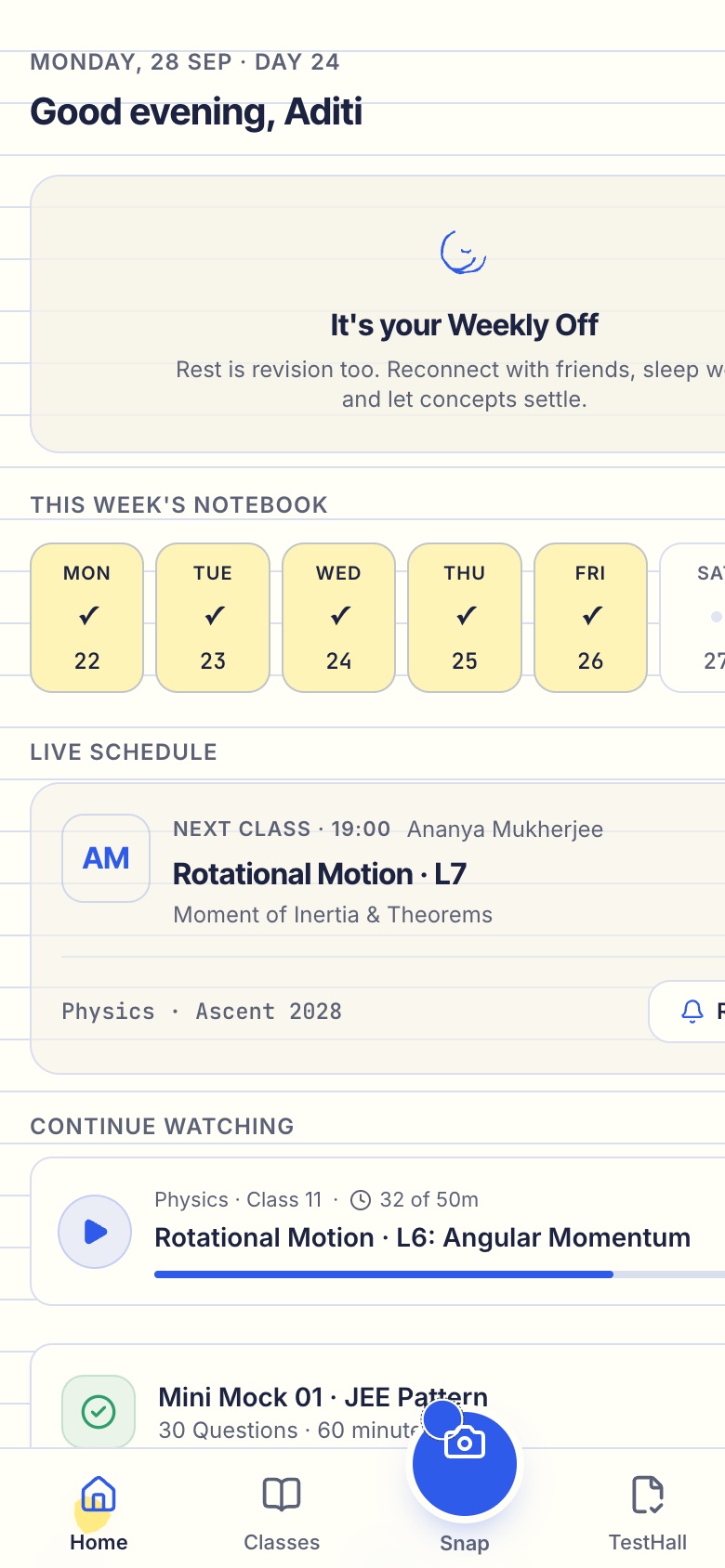
Our RankUp concept build shows what the later stage can look like: live classes that hold up on weak connections, doubts pinned to the moment in the lecture, formula flashcards and a test series. See what goes into an edtech app, and if you also run a school, the school app guide covers the parent side. Not sure whether you need an app yet? Read website, app or both.
When you are ready, send us a brief. You get a fixed quote within 48 hours.
See the app a coaching institute runs on
We designed and built this concept end to end, every side of it, so you can open it and try it before you plan your own. Our edtech app page covers the features, timeline and what moves the cost.
Questions people ask
Do I need to register my coaching centre?
In many states, yes. Central guidelines issued in 2024 asked states to register and regulate coaching centres, and several states have their own rules. Expect conditions on premises, safety, staff qualifications, fees and the minimum age of students. Check your state education department's current rules before you open, and register the business itself with your CA.
How much does it cost to start a coaching institute?
A small centre with one or two rooms and the founder teaching can start with roughly ₹2–6 lakh in a tier 2 city, including deposits, furniture, material and a few months of running costs. A multi-room entrance-exam institute with full-time faculty needs far more. These are ballparks; rent and salaries in your area decide the real number.
How do I get students for a new coaching centre?
Run free demo classes, set up a complete Google Business Profile, and talk to parents directly. Hold a test in the first fortnight and share the results, because visible progress is what parents talk about. Ask happy families for reviews and referrals after the first month. Avoid promising ranks or marks; it erodes trust and many rules now forbid it.
Should my coaching institute have its own app?
Not on day one. WhatsApp, a spreadsheet and a simple website are enough for your first batch. An app starts paying off when you have several batches, recorded lectures, regular tests and fee instalments to manage, or when you teach students outside your city. At that point a student app and a teacher dashboard save hours every week.
Can I run coaching classes from home?
Small home tuition is common, but once you run regular batches with many students, local rules on commercial use of residential property, safety and coaching registration may apply. Check with your local body and your housing society. Many tutors start at home and move to a rented room once the second or third batch fills.


