The short answer
A food delivery business connects hungry customers, restaurants and riders. In practice that means one of three things: a local delivery platform for your town's restaurants, a delivery fleet that restaurants hire, or your own food brand that delivers. Each needs riders, tight timing and software that keeps all three sides in step.
Big platforms dominate the metros, so the openings are usually local: smaller towns with poor coverage, specific communities, or restaurants tired of high commissions. As a ballpark, a single-town operation can start for roughly ₹8–20 lakh; building a full multi-city platform costs far more.
Is a food delivery business right for you?
Ordering food on a phone is now normal in Indian cities, and expectations are high: live tracking, quick delivery and cash or UPI on delivery. National platforms cover the large cities thoroughly, but many tier-2 and tier-3 towns, campuses, industrial townships and gated communities are served poorly. Local restaurants there often want an alternative with lower fees.
This business suits people who are comfortable with operations: hiring and managing riders, handling late orders and complaints, and selling to restaurant owners. The hard parts are rider supply at peak times, thin margins per order, refunds and disputes, and the cost of acquiring customers in the early months.
Business models to choose from
| Model | How it works | Suits |
|---|---|---|
| Local delivery platform | Customers order from many restaurants on your app; you deliver and take a commission | Towns and areas with weak coverage from national platforms |
| Delivery fleet for restaurants | Restaurants take orders themselves; you supply riders per order or per month | Operators good at managing riders |
| Single brand with own delivery | Your own kitchen and brand delivering directly | Food entrepreneurs; see starting a cloud kitchen |
| Community or campus delivery | Delivery for one campus, township or set of societies | Dense, closed areas with fixed delivery points |
| ONDC participant | Restaurants list through the open network; you run a seller or logistics service | Teams who want reach without building every side alone |
Most new operators start with one town or one cluster of neighbourhoods. Density matters more than size: a rider who can carry two orders in the same street is how the numbers work.
Licences and registrations
| Registration | Why you need it | Where you get it |
|---|---|---|
| Company or LLP registration | Platforms usually need a company to contract with restaurants and payment providers | Ministry of Corporate Affairs, often through a CA |
| GST registration | Required; food delivery platforms also have specific GST rules for e-commerce operators | GST portal, with a CA's help |
| FSSAI licence | Platforms dealing in food are treated as food businesses too | Food Safety and Standards Authority of India |
| Shop & Establishment registration | Covers your office and staff under state law | State labour department or municipal body |
| Payment gateway onboarding | Collecting online payments needs a regulated payment provider | A licensed payment aggregator or bank |
| Rider insurance | Protects riders on the road; increasingly expected by law and by riders | Insurers offering accident and health cover |
Some states have started making rules for gig and platform workers, covering registration and welfare contributions. Ask your CA whether any apply where you operate. If you store customer data, India's data protection law applies too; see our DPDP Act checklist.
Rules for platforms, GST and gig workers vary and are changing. Confirm what applies to your model with a CA and a lawyer. This is not legal advice.
What it costs to start
| Item | Small start | Larger setup |
|---|---|---|
| Customer, restaurant and rider apps plus dashboard | ₹4–10 lakh (simpler first version) | ₹25–60 lakh (full custom platform) |
| Company setup, licences and legal | ₹50,000–1.5 lakh | ₹2–5 lakh |
| Rider onboarding, bags and insurance | ₹1–3 lakh | ₹5–15 lakh |
| Office and support desk | ₹50,000–1.5 lakh | ₹3–8 lakh |
| Restaurant onboarding and photos | ₹50,000–1 lakh | ₹2–5 lakh |
| Launch offers and marketing | ₹1–3 lakh | ₹10 lakh+ |
| Rough total | ₹8–20 lakh | ₹50 lakh+ |
Tech is the line that varies most. Our guide to app development costs explains why a three-sided product costs more than a single app.
These are ballpark estimates to sanity-check a plan, not quotes.
Step by step: from idea to first customer
- Choose your area: one town or a tight cluster where coverage is weak and restaurants are willing to try you.
- Talk to 30 restaurant owners about what they pay today and what they would switch for.
- Decide the model: platform, fleet or own brand, and how you will earn on each order.
- Register the company, and get GST and FSSAI in place with your CA.
- Sign your first 20–30 restaurants with clear commission, payout and menu terms.
- Recruit and train riders, with bags, insurance and clear pay per order.
- Launch with a simple tech stack that covers customers, restaurants and riders, even if version one is basic.
- Test with friends and staff for a week to iron out timings.
- Open to the public in one area, with a launch offer and a support number that is answered.
- Track three numbers daily: delivery time, cancellations and repeat orders.
Running it day to day
The day has two big peaks. Before each, you need enough riders logged in and restaurants open and accepting orders. During the peak, someone must watch the live board for stuck orders: a kitchen that has not accepted, a rider who has not moved, a customer who cannot be reached.
- Riders: fair pay per order, incentives for peak hours, and quick weekly payouts keep them loyal.
- Restaurants: clear weekly payout statements with every deduction shown build trust.
- Support: answer complaints fast and refund fairly; one bad experience travels quickly in a small town.
- Cash: reconcile cash on delivery from riders every night.
Getting your first customers
Restaurants are your first customers, and they bring the eaters. Ask each one to promote your app with table stickers, bill inserts and their own WhatsApp lists, in exchange for lower commission in the early months.
- Local search: a Google Business Profile and a website that ranks for food delivery in your town. See our local SEO guide.
- Societies and campuses: partner with residents' associations and hostels for launch offers.
- Referrals: give both sides a discount when a customer invites a friend.
- Local language: an app in the language people use daily lowers the barrier; see regional language apps.
The tech you need
A food delivery business needs at least four pieces of software: a customer app, a restaurant screen to accept orders and set prep time, a rider app with navigation and earnings, and an ops dashboard to watch it all live. They have to share one order in real time. Payments, refunds and payouts sit underneath; read adding UPI payments.
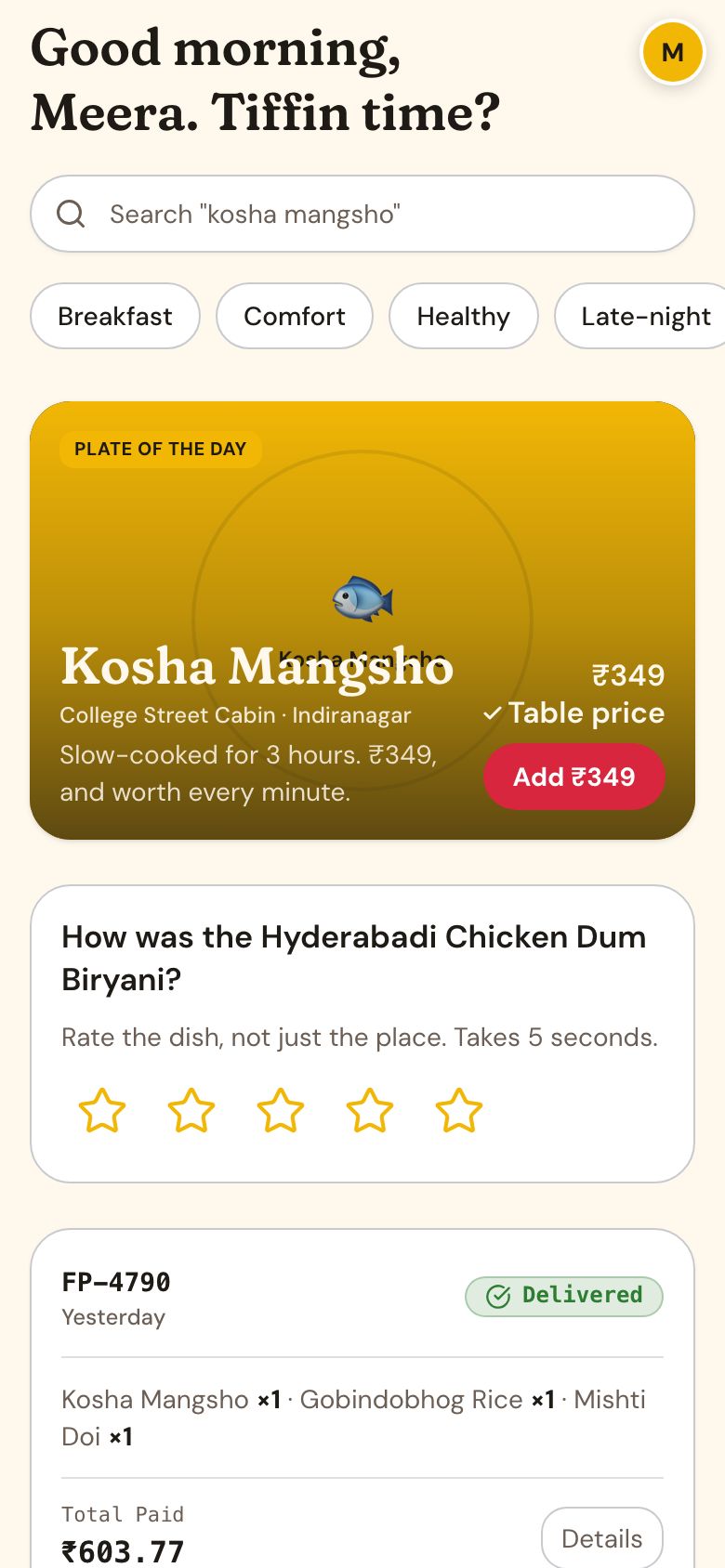
Our concept build FullPlate shows every side working on one live order: a customer app with an Open Bill that shows exactly where each rupee goes, a kitchen tablet that moves orders from New to Picked up, and a rider app with zones, drops and earnings. See what a food delivery app involves and our food delivery app guide, or send us a brief for a fixed quote.
See the app a food delivery business runs on
We designed and built this concept end to end, every side of it, so you can open it and try it before you plan your own. Our food delivery app page covers the features, timeline and what moves the cost.
Questions people ask
How much does it cost to start a food delivery business in India?
As a ballpark, a single-town operation with a simpler first version of the apps can start for about ₹8–20 lakh. A multi-city operation on a fully custom platform needs ₹50 lakh or more. Tech, rider setup and launch marketing are the largest costs.
Can a small food delivery app compete with big platforms?
Usually not head-on in the metros. Small operators do well where big platforms are weak: smaller towns, campuses, townships and particular communities, or by offering restaurants lower commission and faster payouts. Local density and service quality are the advantage.
What licences does a food delivery platform need?
Typically company registration, GST registration with the rules that apply to e-commerce operators, an FSSAI licence for dealing in food, and Shop & Establishment registration. You also need a regulated payment provider and rider insurance. Some states have new rules for gig workers. Confirm the full list with a CA.
How do food delivery businesses make money?
Mainly through commission on each order from restaurants, delivery fees from customers, and sometimes ads or featured listings for restaurants. Margins per order are small, so profit comes from density: many orders per rider per hour in a compact area.
How long does it take to build a food delivery app?
A first version with customer, restaurant and rider apps plus an ops dashboard typically takes 10–12 weeks with a team that has built one before. A simpler pilot can be faster. We give a fixed quote within 48 hours of a brief.


