The short answer
Give people a reason to visit that an online listing cannot: a curated shelf, an owner who can recommend, author events, school book lists handled without fuss, or a second-hand section with real finds. Pick one strong focus, such as children's books, regional-language titles, exam preparation or used books, and buy only from publishers and authorised distributors, never pirated copies.
As a ballpark, a 300–400 sq ft bookstore in a tier-2 city can open for roughly ₹6–14 lakh. A metro store with a reading corner, a small café and an events space often needs ₹28–60 lakh. This guide covers the models, registrations and copyright, the money, the yearly rhythm and how bookstores find readers.
Is a bookstore right for you?
India has readers in every language and age group, from children discovering picture books to students buying exam guides and retirees hunting for history. Parents buy books for children even when they read little themselves, and schools generate predictable demand every year. A store that knows its readers can build a loyal community.
It suits readers who enjoy recommending, can remember who liked which author, and are patient with stock that moves slowly. You will also need retail discipline: buying, returns, invoices and shelf space are what keep the lights on, not love of books alone.
The hard parts are thin margins, heavy online discounting, slow-moving titles, rent that does not care how good your shelves look, and distributor terms that vary widely. School season can be chaotic. The stores that last usually add events, school supply, second-hand books or a café to steady their income.
Business models to choose from
| Model | How it works | Suits |
|---|---|---|
| General trade bookstore | Fiction, non-fiction and children's books, with staff picks and special orders | Reading neighbourhoods and areas near colleges |
| School and academic | Textbooks, school set lists, guides and some stationery | Locations near schools; very seasonal |
| Exam preparation | Guides, previous papers and reference books for competitive exams | Coaching hubs and student areas |
| Second-hand and rare books | Buy used books from readers and estates, then sort, price and resell | Low capital; patient sorters with a good eye |
| Bookstore with café or events | Readings, book clubs and children's story time alongside sales | Metros and university towns |
| Regional-language bookstore | Fiction, poetry and children's books in the local language | Cities with strong local reading cultures |
If exam books are your focus, your customers are the same students that a coaching institute serves, so tie-ups can work well. For used books, the second-hand goods playbook covers buying, grading and pricing pre-owned stock.
Licences and registrations
| Registration | Why you need it | Where you get it |
|---|---|---|
| Shop & Establishment registration | Covers hours, holidays and staff at your store | State labour department or municipal body |
| Trade licence | Permission to run a shop at that address | Municipal corporation |
| GST registration | Needed above the turnover limit or for online sales across states; printed books, stationery and other items are treated differently, so ask a CA how to set up billing | GST portal |
| Legal Metrology declarations | Packaged stationery and gift items must carry the mandatory declarations | State Legal Metrology department |
| FSSAI registration | Only if you add a café or sell packaged snacks | FSSAI, online |
| Copyright compliance | Not a registration, but selling pirated or photocopied books is an offence under copyright law | Buy on invoice from publishers and authorised distributors |
Pirated copies of popular novels and exam guides circulate widely and are cheap. Stocking them risks a raid, seized stock and your reputation with publishers. Keep invoices for every new book, and for second-hand stock keep a simple record of who you bought from.
Requirements vary between states and change over time. Confirm them for your address with a CA and the local authority. This is not legal advice.
What it costs to start
| Item | Small start | Larger setup |
|---|---|---|
| Rent deposit and advance | ₹60,000–2 lakh | ₹4–10 lakh |
| Shelving, seating, lighting and signage | ₹1.5–3 lakh | ₹6–12 lakh |
| Opening stock | ₹3–6 lakh | ₹10–20 lakh |
| Café corner and events space | Not included | ₹3–6 lakh |
| Licences and CA fees | ₹15,000–40,000 | ₹50,000–1 lakh |
| Billing with ISBN lookup and a scanner | ₹30,000–80,000 | ₹1–2 lakh |
| Staff for the first two months | ₹50,000–1.2 lakh | ₹3–5 lakh |
| Website and launch events | ₹25,000–80,000 | ₹1–3 lakh |
| Rough total | ₹6–14 lakh | ₹28–60 lakh |
Ask every distributor about discount, credit period and whether unsold copies can be returned, because these terms decide your cash flow more than the cover price. Start with fewer copies of more titles, reorder fast sellers weekly, and return or discount titles that have not moved in a few months.
Treat these as ballpark figures for a first plan; they are not quotes. Stock depth and rent account for most of the gap between the two columns.
Step by step: from idea to first customer
- Choose your focus and the readers you are building for, then list the first fifty titles you would want on the shelf.
- Meet distributors and publishers' representatives, compare discounts, credit and returns, and open accounts with two or three.
- Find a site near schools, colleges, coaching centres or a reading neighbourhood, with space for browsing.
- Register the business and apply for GST, Shop & Establishment and a trade licence.
- Fit the store for browsing: good light, low shelves for children, face-out displays and a place to sit.
- Set up billing with ISBN lookup, stock tracking, GST invoices and UPI.
- Approach local schools about supplying their book lists, with clear delivery dates and pricing.
- Start a second-hand shelf if it suits your model, with a simple buy-back rate card.
- Create a Google Business Profile listing your focus, hours and special-order service.
- Open with an event: a local author reading, a children's story hour or a book swap.
Running it day to day
Mornings are for receiving cartons, matching invoices against ISBNs and shelving. Afternoons bring students and parents, evenings and weekends bring browsers and events. The weeks before the school year are the busiest of all, with set lists to pack, parents queueing and distributors running short.
- Special orders: take a name, number and advance, order the title, and message the customer the day it arrives.
- Weeding: review shelves monthly and return, discount or move titles that have not sold.
- Second-hand buying: fixed buying days, a written rate card and a quick check for damage and pirated copies.
- Events calendar: one regular event a week, such as story time or a book club, does more than an occasional big launch.
- School season: pack set lists in advance by class, and confirm quantities with schools in writing.
Getting your first customers
Readers come back to people, not shelves. Staff recommendations written on cards, a regular book club and a WhatsApp list for new arrivals turn browsers into regulars. If you serve readers in a local language, our guide to regional-language apps explains how to reach them online as well.
- Schools: supply book lists and run book fairs on campus, which introduce whole families to your store.
- Book clubs: host one, or offer space and a discount to existing clubs.
- Authors and publishers: local launches and readings bring readers and press.
- Students: exam guides, previous papers and a buy-back scheme for used textbooks.
- Google Business Profile and Instagram: post new arrivals, staff picks and event dates every week.
The tech you need
On day one you need billing with ISBN lookup and stock tracking, GST invoices, a UPI QR and a Google Business Profile. Later, a website with a searchable catalogue, special orders and pre-orders, wishlists, gift notes, event sign-ups and school list ordering lets you serve readers who never visit, and keeps parents from buying elsewhere in school season. A billing app with stock alerts helps here too.
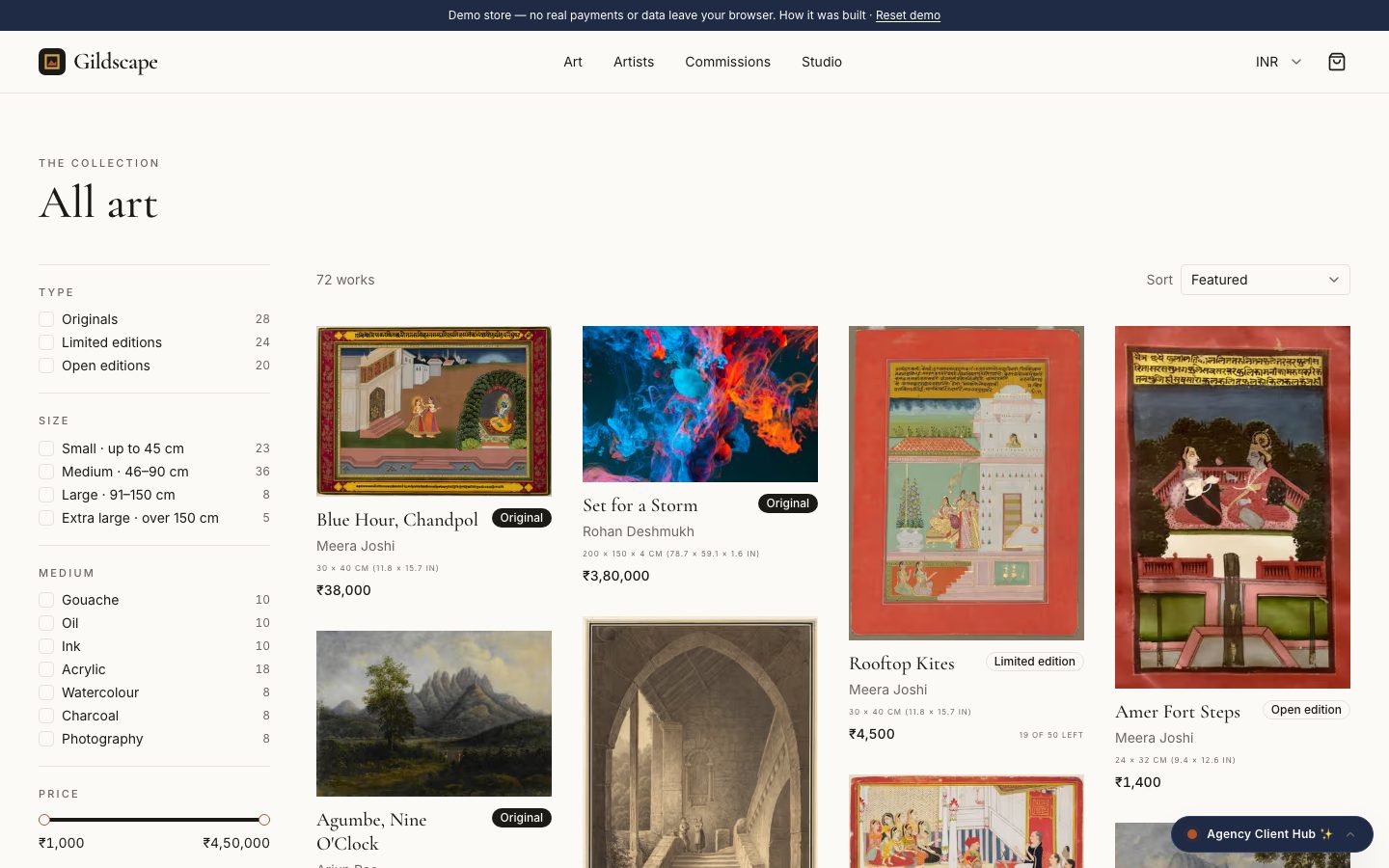
Our concept build Gildscape is an art marketplace, not a bookstore, but its curated catalogue, wishlists, gift notes and commission-style ordering map closely onto staff picks, special orders and pre-orders. See what an ecommerce website for a bookstore needs, read how we work on our process page, or send us a brief for a fixed quote.
See the app a bookstore runs on
We designed and built this concept end to end, every side of it, so you can open it and try it before you plan your own. Our ecommerce website page covers the features, timeline and what moves the cost.
Questions people ask
How much does it cost to start a bookstore in India?
A 300–400 sq ft bookstore in a tier-2 city usually costs about ₹6–14 lakh to start, and a metro store with a café and events space often needs ₹28–60 lakh. Opening stock and rent are the largest items. Distributor credit and return terms make a big difference to how much cash you actually need.
What licences do I need to open a bookstore?
Usually Shop & Establishment registration, a trade licence and GST registration. Printed books, stationery and other items can be treated differently under GST, so ask a CA to set up billing correctly. Add FSSAI if you run a café, and follow Legal Metrology rules for packaged stationery. Always buy books on invoice to stay clear of copyright issues.
Can I sell second-hand books in India?
Yes, selling genuine used books is legal and can be a good, low-capital business. Buy from readers, libraries and estates, check condition, price by demand, and keep a record of where stock came from. Do not buy or sell photocopied or pirated books, which is an offence under copyright law even if they are sold as used.
How do small bookstores make money?
Mostly from a mix of streams rather than new books alone. Common ones are school book lists, exam guides, second-hand books, stationery, gifts, events, a small café and special orders for regulars. Good distributor terms, quick reordering and steady weeding of slow titles protect margins. Community and events keep readers coming back.
How do I supply school book lists?
Approach schools a few months before the academic year with clear pricing, delivery dates and a plan for set lists by class. Order early from distributors, pack sets in advance and confirm quantities in writing. Offer online or WhatsApp ordering with pickup slots to avoid long queues, and handle exchanges for wrong editions quickly.


