The short answer
A cloud kitchen is a delivery-only kitchen with no dining room. You save on rent and interiors, but you live and die by delivery: your menu has to travel well, your kitchen has to accept orders within seconds, and you need a way to reach customers that is not only a commission-heavy platform.
As a ballpark, a single-brand kitchen in a tier-2 city can start for roughly ₹5–12 lakh. A multi-brand metro kitchen often needs ₹20–40 lakh. Choose the location by delivery radius, not by footfall.
Is a cloud kitchen right for you?
Delivery is now a normal way for Indian households and office workers to eat, and a cloud kitchen lets you serve that demand without paying for a high-street shopfront. It is a good fit if you have a menu that people order again and again — biryani, rolls, thalis, bowls, desserts — and you are comfortable running a business you mostly see through order numbers.
People who succeed here are operators. They track prep times, packaging cost and ratings every day, and they treat the delivery platform as a channel, not a partner. The hard parts are commissions, discount wars, cancelled orders and food that arrives soggy or cold. Without a dining room, you also lose walk-in customers who might have tried you by chance.
Business models to choose from
| Model | How it works | Suits |
|---|---|---|
| Single brand | One kitchen, one menu, one brand name | First-time owners with one strong cuisine |
| Multi-brand | One kitchen runs two to five brands with shared ingredients | Experienced operators who want more listings from one kitchen |
| Restaurant with a delivery kitchen | An existing restaurant opens a delivery-only outlet in another area | Restaurants whose delivery orders outgrow their area |
| Shared kitchen space | You rent a station inside a larger commercial kitchen | Testing a brand with less money up front |
| Own-delivery kitchen | You take orders on your own app or site and run your own riders | Dense neighbourhoods with steady repeat orders |
Multi-brand only works when the menus share ingredients and equipment. A biryani brand and a rolls brand can share onions, meat and a tandoor; a sushi brand and a South Indian tiffin brand mostly cannot.
Licences and registrations
| Registration | Why you need it | Where you get it |
|---|---|---|
| FSSAI licence | Required for every food business; each brand needs to be covered for the kitchen address | Food Safety and Standards Authority of India, online |
| GST registration | Delivery platforms generally expect GST details before listing you | GST portal |
| Shop & Establishment registration | Covers working hours and staff under your state's law | State labour department or municipal body |
| Health or trade licence | Permission to run a commercial kitchen at that address | Municipal corporation |
| Fire NOC | Needed for many commercial kitchens with gas and burners | State or city fire department |
| Pollution control consent | For kitchens of a certain size or fuel use, where your state asks for it | State Pollution Control Board |
| Trademark application | Protects each brand name you list under | Trade marks registry, ideally through an attorney |
Check that the building allows commercial cooking. Many residential buildings and some commercial ones do not, and a landlord's word is not the same as an approval.
Rules, tiers and thresholds vary by state and city, and they change. Confirm the exact list for your kitchen with a CA or the local authority. This is not legal advice.
What it costs to start
| Item | Small start | Larger setup |
|---|---|---|
| Rent deposit and advance | ₹50,000–2 lakh | ₹3–8 lakh |
| Kitchen equipment, exhaust and gas line | ₹2.5–5 lakh | ₹8–15 lakh |
| Licences, CA and trademark fees | ₹25,000–75,000 | ₹1–2 lakh |
| Packaging stock and branding | ₹30,000–75,000 | ₹1.5–3 lakh |
| Opening raw material | ₹30,000–75,000 | ₹1–2 lakh |
| Staff salaries for the first two months | ₹1–2.5 lakh | ₹4–8 lakh |
| Platform onboarding, photos and launch ads | ₹30,000–1 lakh | ₹2–5 lakh |
| Rough total | ₹5–12 lakh | ₹20–40 lakh |
These are ballpark estimates to sanity-check a plan, not quotes. Budget separately for the discounts and ads platforms expect in the first months.
Step by step: from idea to first customer
- Pick a menu that travels: test every dish in its box after a 30-minute ride, not on a plate.
- Map demand by radius. Look at the neighbourhoods within delivery distance and the cuisines already crowded there.
- Find a kitchen space with gas, drainage, exhaust and permission for commercial cooking.
- Register the business and each brand, then apply for GST and FSSAI for the kitchen address.
- Cost every dish including packaging, platform commission and discounts, and set prices from there.
- Choose packaging that is sealed, sturdy and branded. Leaks and soggy food lose customers faster than taste.
- Hire a small team — a head cook, helpers and a packer — and write a prep list for each shift.
- List on delivery platforms with good photos and a short, focused menu.
- Set up your own ordering link on WhatsApp or a simple site for repeat customers.
- Run a soft launch with friends and nearby offices and fix timings before you push ads.
- Watch three numbers daily: acceptance time, ratings and the share of orders that are repeat.
Running it day to day
A cloud kitchen has two peaks, lunch and dinner, and a long tail of late-night orders in many cities. Prep has to be done before each peak so that a dish leaves the kitchen in minutes. The order tablet must be watched constantly: an order not accepted quickly is often lost.
- Prep lists: batch sauces, gravies and marinades so each order is assembly, not cooking from scratch.
- Packing station: a checklist per order — items, cutlery, sauces, seal — cuts the complaints that hurt your rating.
- Ratings: read every review, reply to the bad ones and fix the cause the same week.
- Payouts: platforms settle on a cycle and deduct commissions and ad spend. Reconcile every payout against your orders.
- Wastage: track what you throw away each night and trim the menu items that cause it.
Getting your first customers
Delivery platforms will bring most of your first orders. Use their listings well, but plan from the start to move repeat customers to your own channel. A sticker in every box with a QR to your own ordering link and a small loyalty benefit is the simplest way.
- Google Business Profile: even without a dining room, list your kitchen as a delivery business so people searching nearby can find you. See our local SEO guide.
- Offices and PGs nearby: offer a fixed lunch menu delivered at a set time.
- WhatsApp: share the daily special with customers who opted in.
- ONDC: listing through an ONDC-connected seller app is another way to be found, with different fee terms.
The tech you need
At the start: billing that handles GST and KOTs, the delivery platforms' partner apps, a UPI QR and a WhatsApp Business number. As orders grow, a single order screen that brings every channel into one queue saves missed orders and wrong deliveries.
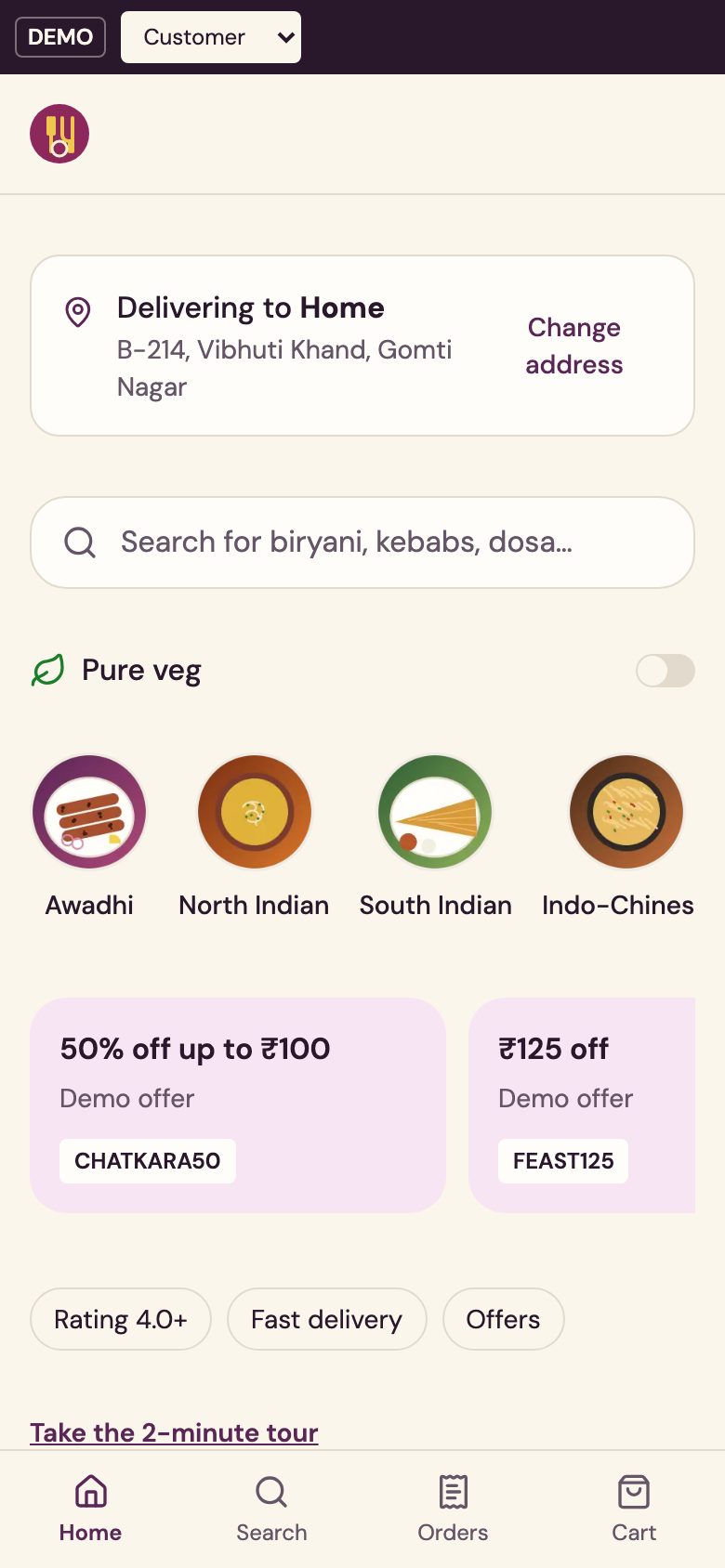
When repeat orders are a big share, your own ordering app with your own riders becomes worth it. Our concept build Bitevia shows the three apps this takes: a customer app, a kitchen screen that rings and counts down 60 seconds to accept an order, and a rider app. It even includes a payout statement comparing platform fees with own-app economics. Read what a food delivery app involves, the food delivery app guide, and how app costs work.
See the app a cloud kitchen runs on
We designed and built this concept end to end, every side of it, so you can open it and try it before you plan your own. Our food delivery app page covers the features, timeline and what moves the cost.
Questions people ask
How much does it cost to start a cloud kitchen in India?
As a ballpark, a single-brand kitchen in a tier-2 city needs about ₹5–12 lakh, and a multi-brand metro kitchen about ₹20–40 lakh. Equipment, rent deposit and the first months of salaries take most of it. Keep money aside for platform discounts and ads in the first months.
Can I run a cloud kitchen from home?
Small home-based food businesses can get FSSAI registration, and many start that way. Delivery platforms and local rules may still ask for a commercial kitchen as you grow, and your housing society may object. A home start is fine for testing; plan a proper kitchen once orders are steady.
Is a cloud kitchen better than a restaurant?
It needs less money and less space, and you can test brands quickly. But you depend on delivery platforms for discovery, pay commissions on most orders, and miss walk-in customers. It suits operators who are strong on menu, packaging and speed rather than ambience.
How many brands should one cloud kitchen run?
Start with one and make it work. Add a second brand only when it reuses most of your ingredients and equipment and your team can handle the extra orders at peak time. Running too many brands too early usually hurts ratings on all of them.
Do I need my own app for a cloud kitchen?
Not on day one. Start with platforms plus a WhatsApp or website ordering link for regulars. An own app with your own riders makes sense once repeat customers are a large share of orders and you deliver in a dense area, because that is when saving commission pays for the build.


