The short answer
Start with the classes and subjects you can teach yourself, say maths and science on one board, and run small evening batches near the schools your students attend. Register the business and GST, check whether your state's coaching-centre rules apply to you (they can limit the ages you enrol), make the room fire-safe, and publish a clear refund policy before you take a single fee.
As a ballpark, a two-classroom centre in a tier-2 city can open for about ₹3.5–10 lakh, and a metro centre with four to six rooms, smart boards and a front desk often needs ₹20–50 lakh. This guide covers the models, registrations, costs, a launch plan, daily running and the tech that tracks attendance, tests and fees.
Is a tuition centre right for you?
School tuition is part of daily life for a great many Indian families, from primary maths to board-exam revision. Unlike entrance coaching, which sells one high-stakes result, a tuition centre sells steady help through the school year: homework support, regular tests and a teacher who notices when a child starts falling behind.
It suits teachers who like working with school students and their parents, and who are comfortable being judged every term on report cards. If you already teach privately at home, a centre is the natural next step once your living room is full.
- School calendars. Demand peaks before unit tests and board exams and drops in vacations, so income arrives unevenly.
- Parent expectations. Parents want marks to rise quickly and will move a child mid-year if they do not.
- Mixed boards and levels. Students from different schools and boards in one batch slow everyone down. Group them carefully.
- Regulation. The 2024 central guidelines for coaching centres, and the state rules built on them, can reach tuition too. Know where you stand before you grow.
Business models to choose from
| Model | How it works | Suits |
|---|---|---|
| Home tuition batch | A teacher takes small groups at home or in a rented room after school | Teachers testing demand before they rent |
| Neighbourhood tuition centre | Two to six classrooms, several teachers, subject-wise batches by class and board | Founders ready to manage teachers and a front desk |
| Board-exam revision centre | Intensive batches for the final school years, with mock papers and doubt sessions | Experienced subject teachers in the exam months |
| Foundation and skill classes | Abacus, handwriting, spoken English or Olympiad preparation alongside school subjects | Centres that want to fill afternoon hours with younger children |
| Hybrid tuition | Classroom batches plus online doubt sessions, recorded lessons and tests in an app | Centres with students spread across a town |
Pick one model and one catchment before adding more. If you plan to prepare students for entrance exams rather than school subjects, read how to start a coaching institute as well, because the economics and the regulatory attention are different.
Licences and registrations
| Registration | Why you need it | Where you get it |
|---|---|---|
| Shop & Establishment registration | Registers the premises and covers staff hours, leave and records | State labour department or municipal body |
| Trade licence | City permission to run classes from a commercial address | Municipal corporation |
| GST registration | Needed above the turnover limit; private tuition is generally a taxable service, so ask your CA early | GST portal |
| Coaching centre registration | Where your state has adopted the central guidelines or passed its own law, centres must register and follow rules on student age, class hours, tutor qualifications and student welfare | State education department or the authority your state names |
| Fire safety clearance | Classrooms full of children need exits, extinguishers and safe wiring; many cities ask for a fire NOC | State or city fire department |
| Building use permission | Some cities object to classes in residential buildings, so check the zoning before you sign | Municipal corporation or development authority |
| Published fee and refund policy | The guidelines expect transparent fees and a fair refund when a student leaves partway through a course | Your own document, shown on the website and fee receipt |
| Police verification of staff | Reassures parents and is increasingly expected for anyone teaching minors | Local police or the state police citizen portal |
The Ministry of Education sent its guidelines on registering and regulating coaching centres to states as a model, and each state is adopting them in its own way and at its own pace. Some details, such as the minimum age for students and whether small centres are covered at all, matter a great deal for a school tuition centre. Read your state's current notification rather than a summary.
Coaching rules are new and still settling, and they vary between states. Check with a CA, a lawyer or your state education department before you enrol students. This is not legal advice.
What it costs to start
| Item | Small start | Larger setup |
|---|---|---|
| Rent deposit and advance | ₹50,000–1.5 lakh | ₹3–8 lakh |
| Benches, whiteboards, lighting, fans or AC | ₹1–2.5 lakh | ₹5–12 lakh |
| Fire safety equipment and electrical work | ₹25,000–75,000 | ₹1–3 lakh |
| Projector or smart board, printer | ₹40,000–1 lakh | ₹2–5 lakh |
| Registrations and CA fees | ₹15,000–50,000 | ₹50,000–1.5 lakh |
| Teacher salaries for the first two months | ₹60,000–1.5 lakh | ₹4–10 lakh |
| Study material and test printing | ₹20,000–60,000 | ₹1–3 lakh |
| App or website for attendance, tests and fees | ₹15,000–75,000 | ₹1.5–5 lakh |
| Demo classes, flyers and local ads | ₹20,000–60,000 | ₹1–3 lakh |
| Rough total | ₹3.5–10 lakh | ₹20–50 lakh |
Teacher pay is the line that grows fastest. Many centres pay subject teachers a share of the fees from their batches, which keeps fixed costs low while seats fill. Keep enough cash to cover rent and salaries through the summer holidays, when new admissions slow down.
These ranges are a planning aid, not quotes. They shift with the city, the building and how many teachers you hire.
Step by step: from idea to first customer
- Choose your segment: which classes, which boards and which subjects, matched to the teachers you have.
- Map nearby schools and the routes students take home, and look for a space along that route.
- Check the rules your state applies to coaching and tuition, especially on student age and registration, before you commit.
- Register the business, open a current account, and apply for Shop & Establishment, the trade licence and GST.
- Make the space safe: fire extinguishers, clear exits, good lighting, ventilation and clean toilets.
- Hire teachers with subject strength and patience, agree pay terms in writing and complete police verification.
- Write your fee and refund policy and print it on the admission form, so there are no arguments later.
- Build a test calendar that mirrors school exams: weekly quizzes, monthly tests and a progress report each term.
- Set up attendance, fee and parent updates on WhatsApp or an app, with UPI payment links.
- Run free demo classes for two weeks before the school term starts.
- Hold the first parent meeting after the first monthly test, with each child's marks and a plan.
Running it day to day
Tuition centres are quiet in the morning and full from mid-afternoon, once schools let out. Mornings go on preparing worksheets, checking test papers, answering parent calls and following up fees. Evenings are batch after batch, with doubt-clearing squeezed in between, and weekends often carry test sessions and extra classes before exams.
- Batch size: keep batches small enough that each teacher can check every notebook. Split by board and school when the syllabus differs.
- Tests and reports: a short test every week and a written report every month give parents something concrete and catch weak spots early.
- Parent communication: one scheduled update a week works better than ad-hoc calls. Share marks, attendance and what is coming next.
- Fees: collect monthly or quarterly with automatic reminders, and follow the refund policy you published, with no exceptions for the loudest parent.
- Student welfare: watch for stress around exams, keep class hours reasonable and make sure a struggling child gets attention, not just more homework.
Getting your first customers
Tuition is a word-of-mouth business. Most new students come because a classmate's marks went up. Help that along: ask happy parents for a Google review after results, and make your timetable easy to forward. A listing with correct hours, subjects and photos of real classrooms helps parents who search on their phones; our piece on getting found in local search shows how.
- Free demo week before each term, open to classmates of existing students.
- Near school gates: hand out a one-page timetable and fee sheet at dispersal time, with the school's permission where needed.
- Housing societies: a free revision session in the clubhouse before exams brings parents in.
- Results season: share honest progress stories with parental consent, not inflated rank claims, which the coaching rules discourage.
- WhatsApp: a broadcast list for parents of prospective students, used before each new batch rather than daily.
The tech you need
Day one needs very little: a register or spreadsheet for attendance, UPI for fees, printed worksheets and a WhatsApp group per batch. When you pass a hundred students or a few teachers, those groups turn chaotic, and parents start asking for marks and attendance you cannot quickly find.
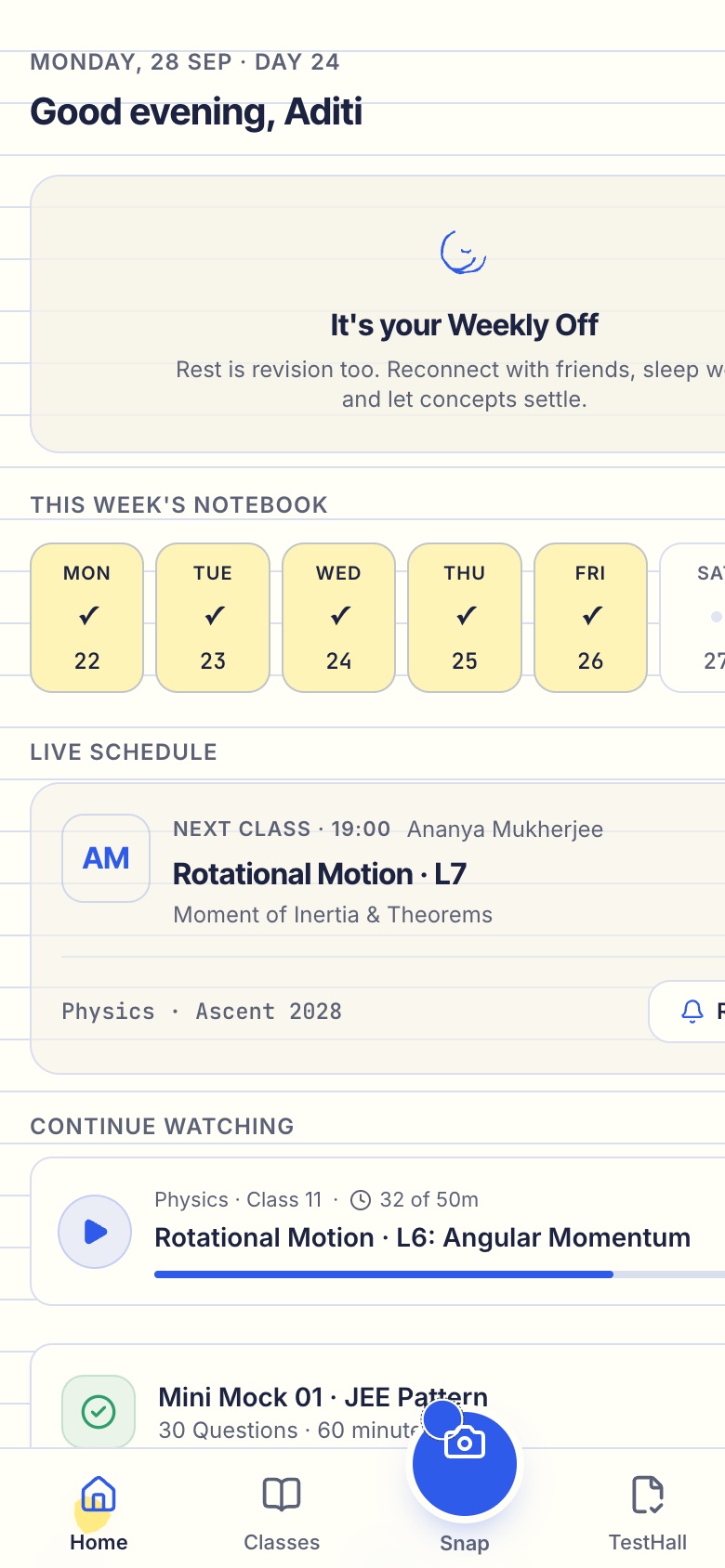
Then a tuition app pays for itself. Parents see attendance, test marks and fee dues; students get notes, recorded lessons and online tests; teachers post homework and mark registers in a minute. Our concept build RankUp shows this at a larger scale for JEE, NEET and board students, with live classes and offline centres in one system, and the same pieces scale down to a two-room centre. Read about planning a learning app, see what an edtech app includes, and when you are ready, send us a brief for a fixed quote within 48 hours.
See the app a tuition centre runs on
We designed and built this concept end to end, every side of it, so you can open it and try it before you plan your own. Our edtech app page covers the features, timeline and what moves the cost.
Questions people ask
How much does it cost to start a tuition centre in India?
A two-classroom tuition centre in a tier-2 city can open for roughly ₹3.5–10 lakh, and a larger metro centre with four to six rooms and smart boards often needs ₹20–50 lakh. Rent, furniture, fire safety and teacher pay are the main costs. Many teachers start smaller still, with a home batch, before they rent.
Do tuition centres need registration in India?
Increasingly, yes. Beyond Shop & Establishment, a trade licence and GST, many states are adopting the Ministry of Education's 2024 guidelines for coaching centres, which call for registration and rules on student age, safety and refunds. How they apply to small school-tuition centres varies by state, so read your state's notification or ask a CA.
Can I run a tuition centre from home?
Many tuition businesses begin at home with one or two small batches. Check your housing society's rules and local zoning, keep batches small, and register for GST if your income requires it. Once you add teachers or several batches, a separate rented space is safer, easier to make fire-safe and more convincing for parents.
How should I set tuition fees?
Set fees by looking at what nearby centres charge for the same classes and board, then price for the batch size and attention you offer. Monthly fees suit younger classes; course fees suit board-exam batches. Publish a clear refund policy for students who leave midway, since the coaching guidelines expect transparent fees.
What tech does a tuition centre need?
Start with UPI payments, a spreadsheet for attendance and marks, and WhatsApp for updates. As you grow, a tuition app that shows parents attendance, test results and fee dues saves hours every week and reduces disputes. Add online tests and recorded lessons when students start asking to revise from home.


