The short answer
A maid service in India is a trust business before it is a cleaning business. Families let your workers into their homes, so verification, reliable attendance and a quick replacement when someone is ill matter more than a glossy brand. Most agencies start small in one or two neighbourhoods, with ten to twenty verified workers and a phone number that always answers.
You can start with little capital: a GST and Udyam registration, police verification for every worker, a simple booking system and enough cash to pay workers on time while customers settle their bills. The hard part is keeping good workers, which comes down to fair pay, respect and steady hours.
Is a maid service right for you?
Demand for house help is steady in every Indian city, and it is growing in apartment communities where both partners work. Families who once relied on word of mouth now want someone accountable: a person they can call when a helper does not turn up, and a business that has checked who is entering their home.
The people who do well here are organised, calm on the phone and good with people on both sides. You will spend as much time with your workers as with your customers. If you enjoy solving the 7 am problem — a helper is sick and a family has guests at noon — this business suits you.
- The hard parts: worker churn, last-minute absences, disputes over breakages or missing items, and customers who want the lowest price and the highest trust.
- What helps: a small, well-paid, well-treated team in a tight area, so travel is short and replacements are quick.
- What to avoid: spreading across a whole city before you can cover one neighbourhood properly.
Business models to choose from
| Model | How it works | Suits |
|---|---|---|
| Placement agency | You find, verify and place a full-time or live-in helper; the family pays a one-time fee and pays the helper directly. | Founders with low capital and a strong local network |
| Managed monthly service | Workers are on your rolls; families pay you a monthly fee for fixed daily visits, and you handle leave and replacements. | Agencies that want recurring revenue and control over quality |
| On-demand by the hour | Customers book short sessions — dishes, a deep clean, help before guests — through an app or WhatsApp. | Dense apartment areas where helpers can do several visits a day |
| Society tie-up | You become the approved help provider for a gated society, with a desk or a fixed roster. | Areas with large residential complexes and active RWAs |
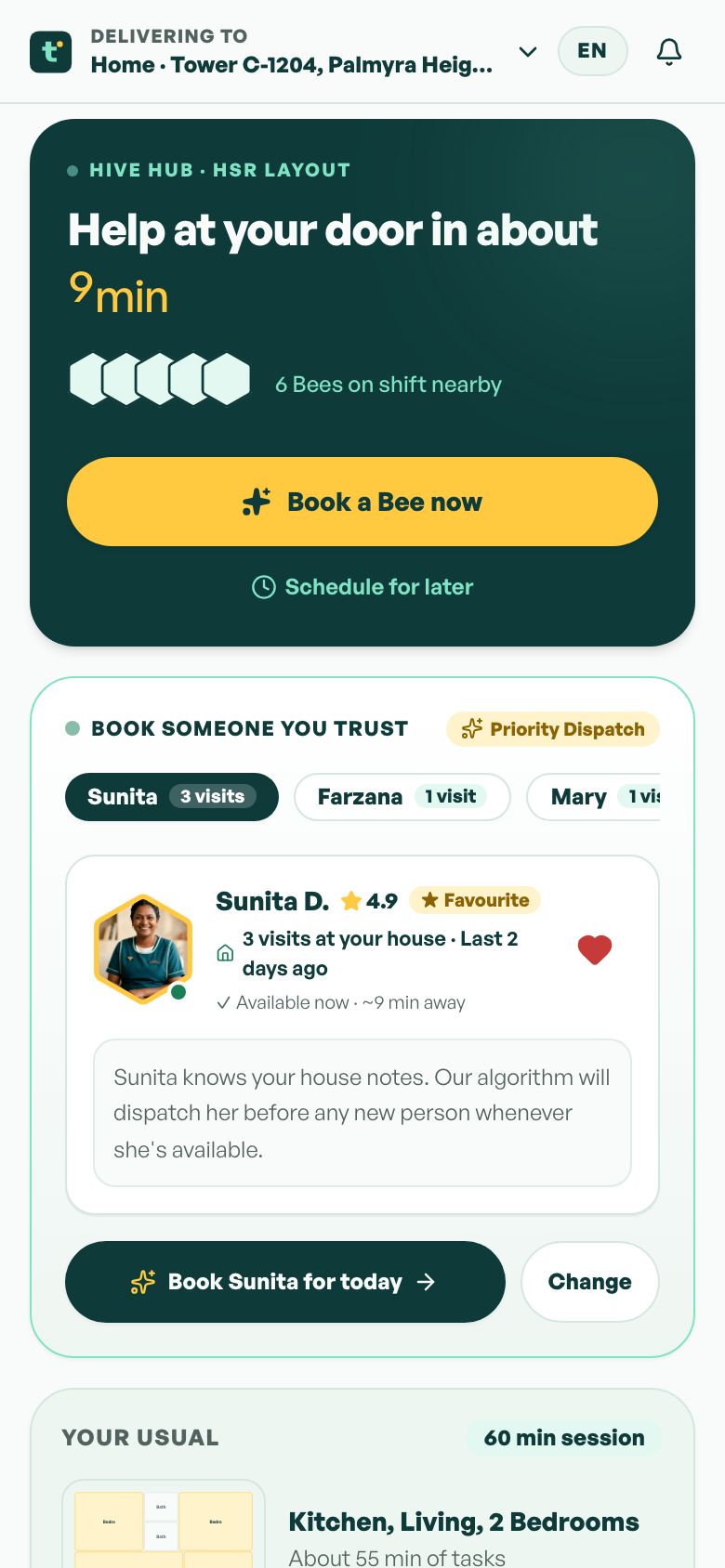
Many agencies mix two models: monthly service for steady income, and hourly bookings to fill gaps in workers' days. Our TidyBee concept build explores the on-demand model, with sessions billed by the half-hour.
Licences and registrations
| Registration | Why you need it | Where you get it |
|---|---|---|
| Business structure | A proprietorship, partnership, LLP or private limited company decides liability and taxes. | A CA; LLPs and companies register with the Ministry of Corporate Affairs |
| GST registration | Required once turnover crosses the threshold, and often asked for by societies and corporate clients. | The GST portal |
| Udyam registration | Recognises you as an MSME; useful for loans and some schemes. | The Udyam registration portal (free) |
| Shop & Establishment registration | Covers your office or premises under your state's shops law. | Municipal body or state labour department |
| Placement agency registration | Some states regulate agencies that place domestic workers. | State labour department — check your state's rules |
| Police verification of workers | Families and societies expect it; some cities require it for domestic workers. | Local police station or the state police citizen portal |
| EPF and ESI | Apply once your number of employees crosses the legal thresholds. | EPFO and ESIC portals |
Rules and thresholds vary by state and change over time. Confirm what applies to you with a CA or your local authority. This is general information, not legal advice.
What it costs to start
| Item | Small start | Larger setup |
|---|---|---|
| Registrations, CA and agreements | ₹10,000–25,000 | ₹40,000–1 lakh |
| Office or desk | Work from home or a shared desk | ₹20,000–60,000 a month plus deposit |
| Uniforms, ID cards and cleaning kits | ₹2,000–4,000 per worker | ₹3,000–6,000 per worker |
| Worker accident or health cover | A few thousand rupees per worker a year | Group policy for the whole team |
| Marketing and society events | ₹20,000–50,000 | ₹2–5 lakh |
| Booking and scheduling tools | WhatsApp and a spreadsheet | A booking app and dispatch dashboard |
| Working capital for wages | ₹1–3 lakh | ₹10–25 lakh |
These are rough estimates to help you plan, not quotes. Rents, wages and insurance differ widely between cities.
Step by step: from idea to first customer
- Pick two or three neighbourhoods or societies close to where your workers live.
- Decide your model — monthly, hourly or placement — and write a simple price card.
- Register the business, open a current account and set up UPI collection.
- Recruit your first ten workers through referrals, local NGOs and self-help groups.
- Complete police verification and keep copies of ID and address proof for each worker.
- Train everyone on your cleaning standards, safety, punctuality and how to raise problems.
- Agree pay, weekly offs and leave in writing, and pay on a fixed day every week or month.
- Write a short customer agreement covering hours, tasks, leave cover and complaints.
- Set up a Google Business Profile and a WhatsApp Business number.
- Approach RWAs and society managers with a trial offer and a stall on a weekend.
- Start with a handful of homes, check in after the first week, and fix problems fast.
Running it day to day
Your day starts early. Workers confirm attendance, you spot gaps, and you send replacements before customers notice. A simple roster that shows who is where, and who is free, is the most valuable tool you will have.
- Fair pay and dignity. Pay on time, every time. Tips should go to the worker in full. Address workers by name and give them a way to report bad treatment.
- Safety. Share an emergency number, insure your team and never send a worker to a home you have concerns about.
- Quality. Do surprise check-ins in the first month with each new family, and ask customers for a rating after visits.
- Disputes. Have a written process for complaints about breakages or missing items. Listen to both sides before acting.
- Cash flow. Collect monthly fees in advance where you can, so wages never depend on late payers.
Workers stay where they feel respected. Good agencies give training badges, steady hours close to home and a clear path to better-paid work, such as deep cleaning or cooking.
Getting your first customers
Most families search on Google Maps for “maid service near me” or ask in their society WhatsApp group. Be visible in both places. Our local SEO guide covers how to set up and grow a Google Business Profile honestly.
- Society tie-ups. Offer the RWA a verified-worker list and a single point of contact. One approved society can fill your roster.
- Referrals. Give existing customers a discount for each family they refer who stays a month.
- WhatsApp. Share a simple price card and answer quickly. Our WhatsApp guide explains broadcast lists and templates.
- Platforms. Listing on home-services marketplaces can bring early volume, but watch the commission and who owns the customer.
The tech you need
At the start, WhatsApp, a shared spreadsheet and UPI are enough. Once you have more than twenty workers or several societies, missed visits and double bookings start costing you customers. That is when a booking app and a dispatch view pay for themselves.
A typical home services app has three sides: a customer app to book and rate, a worker app with schedules and earnings in their own language, and a dashboard to see who is where. Our TidyBee concept build shows all three, including a big-button worker app in Hindi and a coverage map for the ops team.
If you are not ready for an app, start with a business website and online booking. When you are ready to plan an app, read how much an app costs in India, then send us a brief.
See the app a maid service runs on
We designed and built this concept end to end, every side of it, so you can open it and try it before you plan your own. Our home services app page covers the features, timeline and what moves the cost.
Questions people ask
How much money do I need to start a maid service in India?
A small agency can start with roughly ₹2–5 lakh: registrations, uniforms, kits, some marketing and enough working capital to pay workers on time. The biggest cost is wages before customers pay, so collect monthly fees in advance where you can. These are rough estimates and vary by city.
Is police verification compulsory for maids?
Many cities and housing societies require or strongly expect police verification of domestic workers, and most families will not hire without it. Even where it is not compulsory, verify every worker through your local police station or state police portal, and keep copies of their ID and address proof.
How do maid agencies make money?
Placement agencies charge families a one-time fee for finding a helper. Managed services charge a monthly fee and pay workers a salary, keeping the margin. On-demand services charge by the hour or session. Many agencies combine models so workers have full days and the business has steady income.
How do I stop workers leaving?
Pay fairly and on time, keep travel short, offer steady hours, treat workers with respect and back them in unfair disputes. Training and a path to better-paid work, such as deep cleaning or cooking, also help. Workers talk to each other, so a good reputation among them brings new recruits.
Do I need an app to run a maid service?
Not at first. WhatsApp, a spreadsheet and UPI work for your first few homes. An app makes sense once missed visits, replacements and payments become hard to track, usually beyond twenty or thirty workers. Start simple and build the app when you know exactly what slows you down.


