The short answer
A marketplace is not one app with two logins. It is three products: one for buyers, one for sellers or service pros, and one for the team that keeps both honest. The listing and search screens are the easy part. Trust, payouts and moderation decide whether people come back.
This guide walks through each side, the trust features Indian users expect, how money should move, and how to launch in one locality before you try a whole city. We use our concept builds — Vendly, Gildscape, Secondgear and HomeCraft — as worked examples.
The three products inside every marketplace
Before you write a feature list, name the people. Every marketplace has at least three, and each needs its own screens.
| Side | What they need | Example from our builds |
|---|---|---|
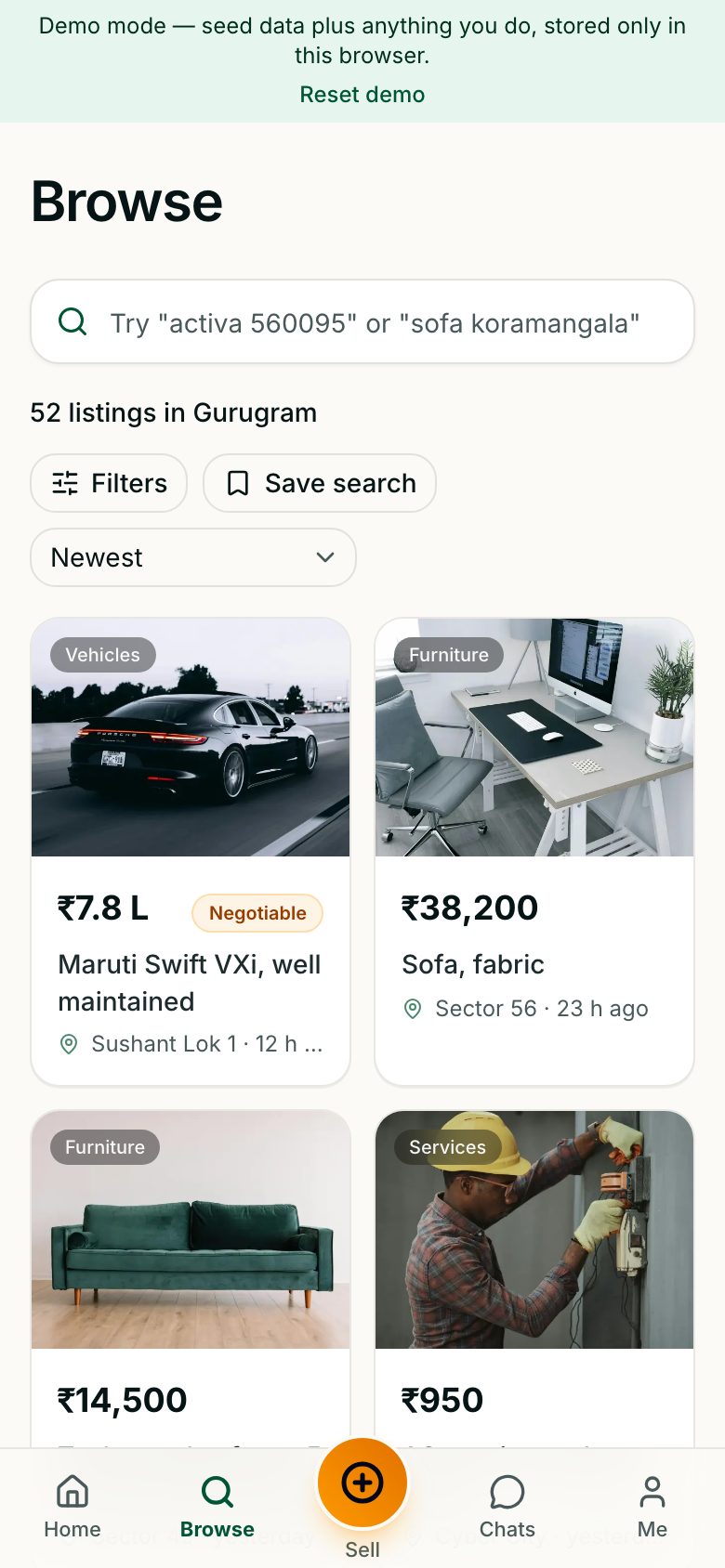
| Buyers | Search, filters, honest listings, a safe way to talk and pay | Vendly's browse by city, locality, PIN code and category |
| Sellers or pros | Fast listing, enquiries in one place, payouts they can trust | Gildscape's artist studio with works and commission requests |
| Your team | A queue of reports, tools to remove, restrict and refund | Vendly's moderation queue with dismiss, remove and restrict actions |
If a quote prices only the buyer app, it is not the price of a marketplace. Our marketplace app page lists every side we build, and the app cost guide explains why the partner and ops sides often take as much effort as the customer side.
Pick your marketplace model first
The model decides how much you build. Three common shapes:
- Classifieds. Buyers and sellers meet, talk and settle the deal themselves. You never touch the money. Lightest to build, hardest to keep clean. Vendly is this shape.
- Managed marketplace. The buyer pays you, you pay the seller after delivery, and you handle disputes. Heavier, but you can promise quality. Gildscape's commissions and cart work this way.
- Inspected or full-stack. You check the goods or train the pros yourself. Secondgear inspects every car before it lists; HomeCraft trains and kits its pros. Most trust, most operations.
Start with the lightest model your category allows. You can move from classifieds to managed later; moving the other way is painful.
Trust and safety: the features that matter in India
In India, buyers on a new marketplace are rightly cautious. Scam messages, fake advance-payment requests and reused photos are common. Trust features are not extras; they are the product.
- Verified phone numbers. OTP login for everyone, and a clear badge once a seller is verified.
- Protected contact details. Vendly's Show number button opens a safety dialog and an OTP step before revealing a seller's number, with a daily limit on reveals. That alone slows down scrapers and spammers.
- In-app chat with warnings. When a message asks for an advance, a courier fee or a UPI collect request, show a calm warning above the composer.
- Report and block on every listing and chat. Reports should land in a queue someone actually reads.
- Duplicate and spam checks. Flag a burst of new ads from one account, or a photo already used on another listing.
- Safe meetup advice. For local deals, a short, friendly note about meeting in public places goes a long way.
Vendly's Trust page walks through six abuse cases with live try-it panels. Building them early is cheaper than cleaning up a reputation later.
How the money should move
If you take payment, payouts become the hardest part of the build. Customers pay by UPI or card; sellers want their share on a predictable day; you need your commission, GST and refunds to reconcile.
- Use a payment gateway that supports split payments or marketplace settlements, so you are not manually transferring money every evening.
- Hold the seller's share until the order is delivered or the service is done, then release it on a fixed cycle.
- Show sellers a statement: order, amount, your commission, GST, payout date. Every rupee explained.
- Decide your refund rules before launch and write them into the app, not only the terms page.
- Collect seller KYC and bank details at onboarding, not at the first payout.
Our UPI payments guide explains intents, QR, refunds and reconciliation in plain terms.
Holding and splitting customer money can bring regulatory requirements. Work with a regulated payment partner and check the setup with your CA and a lawyer before launch.
Moderation is a daily job, so design the tools
Somebody on your team will spend part of every day in the moderation console. Make it fast for them.
- One queue for user reports and auto-flags, sorted by risk.
- One-tap actions: dismiss, remove listing, restrict user, ban, with a required reason.
- A history per user, so repeat offenders are obvious.
- Category rules you can change without a new app release, such as banned words or price ranges that look wrong.
This is the same ops-dashboard thinking we apply across our builds. See how we approach it on the services page.
Solve the chicken-and-egg problem locally
Buyers won't come without listings, and sellers won't list without buyers. The practical answer is to go narrow.
- Launch in one locality, one category or one community first: one housing society cluster in Pune, one art scene in Jaipur.
- Supply first. Onboard the first sellers yourself, by phone and in person if needed. Help them write good listings.
- Make listing fast. Vendly's post form shows a running timer and suggests a price from comparable listings, so posting feels like seconds, not a chore.
- Seed honestly. Your own team can list genuine items, but never fake buyers, reviews or activity.
Our guide to first users after launch covers referrals, WhatsApp sharing and local search in more detail.
What to build in version one
A sensible first version, in the order we would build it:
- OTP login and basic profiles for both sides.
- Listing creation with photos, price and locality.
- Search and filters that match how people in your category actually look.
- Chat with safety warnings, plus report and block.
- A moderation queue for your team.
- Payments and payouts only if your model needs them on day one.
Ratings, promoted listings, subscriptions for sellers and seller analytics can wait until you have enough activity to make them meaningful. Our MVP guide helps you draw that line.
Questions people ask
How long does it take to build a marketplace app?
A first version with buyer and seller sides, chat, moderation and an admin console usually takes 8–12 weeks with a focused team. Adding managed payments and payouts, inspections or live tracking pushes it to the upper end. A two-week concept sprint can give you a clickable prototype to test with real sellers before you commit to the full build.
Should a marketplace take payments or let users pay each other?
Let users pay each other if your category is low value and local, like classifieds. Take payments when you need to promise quality, hold money until delivery, or earn a commission reliably. Taking payments adds payouts, refunds and reconciliation, so it adds build time and needs a regulated payment partner.
How do marketplaces stop scams?
Through layers, not one feature: verified phone numbers, protected contact details, in-app chat that warns about advance-payment requests, duplicate-photo and spam checks, easy reporting and a moderation team with good tools. None of these is perfect alone. Together they make scamming slow and visible, which is usually enough to push bad actors elsewhere.
Do I need a separate app for sellers?
Not always. Many marketplaces start with one app where a user can switch to selling, plus a web dashboard for busy sellers. A separate seller or pro app makes sense when the seller's job is very different, such as a service pro accepting jobs on the move. Decide based on what sellers do every day.
How much does a marketplace app cost in India?
It depends on the model, the number of sides and whether you handle payments, maps and moderation. Our app cost guide gives ballpark ranges and the drivers behind them. For your own idea, send a brief and we give a fixed quote within 48 hours, with scope and timeline in writing.


